For swimming clubs in South Africa
Swimming club management software, from learn-to-swim through state qualifiers.
ClubHelix runs your swim club — learn-to-swim programs, squad memberships, time trials, club nights, meets and the parent comms that hold a season together — without four separate systems behind the scenes.
Year-round · weekly squad nights · Updated 7 Oct 2026

Why committees of swim clubs come to us
The same problems show up in every committee meeting. ClubHelix is built to retire each one for good.
- Squad fees paid via bank transfer with no easy way to reconcile.
- Carnival nominations done via Google Form that doesn't link to payment.
- Time-trial results stuck on a printout pinned to the noticeboard.
- Wet-weather pool closures going out via three different group chats.
- Parent volunteer rosters for carnival days managed via SMS.
- Lane hire for lap swimmers and masters written in the tuck shop diary, with the money in a tin.
What ClubHelix does for swim clubs
The platform mapped onto the moments your season actually runs on.
Squad memberships
Self-serve sign-up with squad levels (development, intermediate, performance, masters) — Stripe Connect for the term fee, automatic reminders before each new term, and a clean list per squad.
Learn-to-swim and squad programs
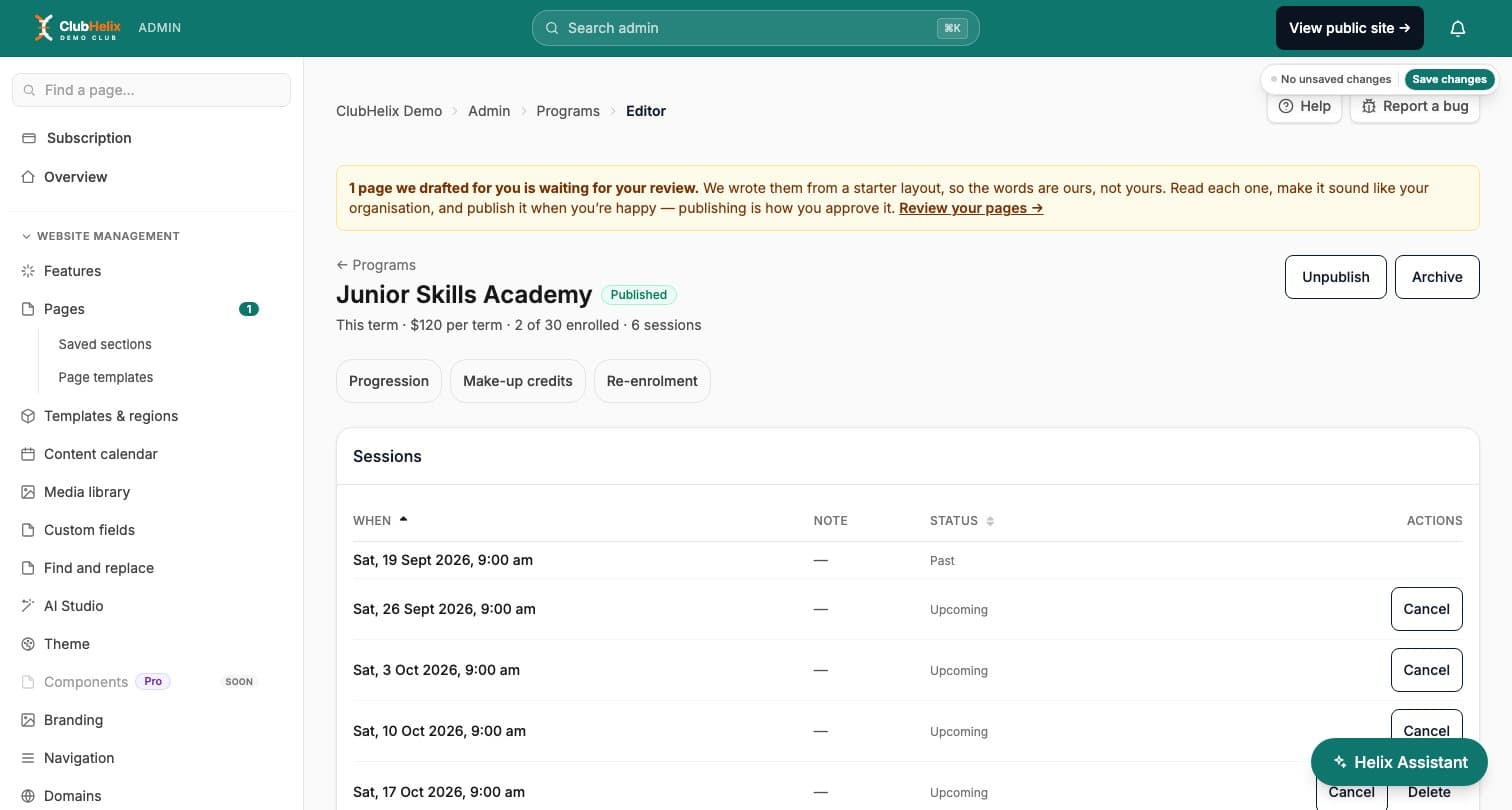
Run learn-to-swim intakes and holiday clinics as term programs with capacity, automatic waitlists and per-session attendance — families enrol and pay online, and coaches get a live class list each week.
Club nights and time trials
Recurring events for weekly club nights and time-trial sessions. Per-member ICS feed so parents see their child's session in their phone calendar.
Lane bookings and lap swimming
Where the club controls pool time, facility booking sells it by the place: the pool is a shared resource with a capacity in lanes, lap swimmers book a lane for an hour at the member or casual rate, the grid shows how many lanes are left, and a squad block holds every lane for training. Payment is by card at booking or at the tuck shop, marked paid in the admin, with a CSV for the treasurer.
Meet and carnival nominations
Paid nomination forms for club, district and state meets, with conditional logic so a 9-year-old swimmer only sees age-appropriate events. Capacity caps per event, with the nomination list visible to coaches in real time.
Pool closure broadcasts
Broadcast pool-closure and session-cancellation notifications to a single squad or the whole club. Send from your own swimming@yourclub.com.au on Pro and Enterprise.
Volunteer rosters and carnival days
Publish timekeeper, marshal and tuck shop rosters with capacity on each slot — parents claim their own shifts, completion is tracked across the season, and reminders go out before each meet.
Club shop and presentation
Club shop for caps, club tee-shirts, hoodies and warm-ups — variants for size and stock tracking. Native ticketing for presentation night.
The club census
Squad numbers by age group, learn-to-swim enrolments, and meet entry income — the shape both the association return and the local council pool-agreement review want. Program enrolment and attendance reporting cover the squads.
What is swimming club management software?
Swimming club management software brings the whole swim club — squad fees, learn-to-swim intakes, club nights, meet nominations and the parent messages in between — into one system, instead of a bank statement, a form tool, three group chats and a noticeboard. In ClubHelix that means squad sign-up with online payment, learn-to-swim programs with capacities and waitlists, recurring club nights with per-member calendar feeds, paid meet nomination forms and broadcasts that reach exactly the squad affected by tonight's lane closure — one login, one record per swimmer.
The tell that a swim club has outgrown its tools is reconciliation. Squad fees arrive by bank transfer with no reference, carnival nominations sit in a form that never met the payment, and the treasurer spends Sunday matching deposits to surnames. Swim-specific software takes payment in the same step as the sign-up or the nomination, so the list and the money always agree.
Squads, learn-to-swim and club night
Squad membership is self-serve: development, intermediate, performance and masters levels each carry their own term fee paid at sign-up through Stripe, automatic reminders go out before each new term, and every squad has a clean list — juniors and masters happily on the same club site. Learn-to-swim intakes and holiday clinics run as term programs with capacity, automatic waitlists and per-session attendance, so the coach opens a live class list each week rather than a clipboard.
Club nights and time trials publish as recurring events with a per-member calendar feed, so a parent's phone shows their child's session and nothing else. Results stay with your timing gear — ClubHelix publishes them afterwards as news and runs everything around the racing. When the pool closes, one broadcast reaches a single squad or the whole club — and on Standard plans and above it sends from your own swimming@ club address, not a generic one.
Lane booking for lap swimmers, masters and squads
Some swim clubs hire pool time from a council and never think about lanes. Others lease the pool, or own it, and lane time is the club's second-biggest asset after the squad. For those clubs, facility booking sells lane time by the place. Set the pool up as a shared resource with a capacity in lanes — six, say — and each booking takes one or more of them: a lap swimmer books a lane for an hour, a masters group books two, the grid shows "2 of 6 left" until it reads "Full", and a seventh booking is refused rather than squeezed in. If you'd rather sell places in a lane than whole lanes, run each lane as its own resource with a capacity in swimmers — several resources, not named lanes inside one.
Pricing is per lane (or per swimmer), per hour: a member rate for financial members, a casual rate for visitors, both in your own currency, with the arithmetic on the booking page before anyone pays. A comments box the club labels — "Anything we should know?" — is where a swimmer says "fins and a pull buoy, slow lane please", and it stays private to the club.
Squad training holds its lanes with an admin block: every lane for the 5am session, or four of six so two stay open for lap swimmers alongside. A closure takes the whole pool off the grid for the carnival or the annual shutdown, with a reason swimmers can see.
Payment is by card at booking or at the tuck shop. Set the pool to pay at the venue, write the instructions ("pay at the tuck shop before you swim", "scan the QR code at reception"), and the booking confirms straight away with what's owed. The Bookings admin shows an Owed at the venue total, Mark paid records each payment as cash, card or transfer with a receipt, and Download CSV gives the treasurer the filtered list to reconcile against the tuck shop till at month end. Venue-settled bookings need no payment provider connected, and money the club records itself carries no platform commission. The guide to sharing a facility between bookings walks through the lane setup.
Meet nominations and carnival-day rosters
Nominations for club, district and state meets run as paid forms with conditional logic — a nine-year-old sees only age-appropriate events — plus capacity caps per event and a nomination list coaches can watch fill in real time. Hosting an open carnival? A public paid form gives visiting swimmers a way in and hands you a clean, paid entry list.
The carnival itself runs on volunteer rosters: timekeeper, marshal and tuck shop slots with capacity on each, claimed by parents themselves, with reminders before every meet and completion tracked across the season. Nobody manages a roster by SMS again.
A swim club website that answers the questions
The public site runs on the same platform as the memberships, so squad pages, the training timetable and "how do I join?" are never out of date. Build it with the page editor, publish meet wrap-ups as news, and sell caps, club tees and hoodies — size variants, stock tracking — through the club shop, with ticketing built in for presentation night. Start from the template gallery or poke around the live demo to see what families will see.
Free swimming club management software to start
Every ClubHelix club starts on the free plan — your swim club website and core admin at no cost, with no time limit. When the club wants paid features such as online squad payments, paid plans carry a 14-day free trial, bill on a 28-day cycle and can be cancelled any time; current tiers are on the pricing page. Fees and nominations settle straight into the club's own Stripe account — ClubHelix never holds your funds — and the platform fee is never surcharged to your families.
Switching before the next season starts
Most swim clubs arrive with a membership spreadsheet, a folder of bank statements and a nomination form that lives somewhere else. Import the member list, set up squads and the first term's programs, and run one term in parallel if the committee wants a safety net. A state swimming body can sit a tier above its clubs later, with shared branding and cross-club reporting, so start where you are. Clubs run ClubHelix in Australia, New Zealand, the UK, the US, Canada, Ireland and South Africa. If you get stuck, talk to us — or read the full guide to running a swimming club.
Features in your plan
Every plan starts free and includes the whole platform below — browse all features or compare plans.
Programs & enrolment
Term programs, clinics and come-and-try days — term or casual enrolment, capacity with waitlists, session attendance, skill levels, make-up credits and trial classes.
Self-registration
Club membership software that handles the joining for you: online registration and season sign-ups on your own branded site, with email verification and optional admin approval.
Events
A club events calendar with one-off and recurring events — and ticket sales built in, so you never send members off to an external ticketing site.
News
A club news page for announcements, match reports and committee updates — the club notice board, published from the same editor as your pages.
Broadcasts
Send a message to everyone, a role, or a custom segment of members.
Club shop
Run a club shop or team store: take uniform, kit and spirit wear orders online with variants, carts and order management — with GST handled properly on every sale.
Mobile app
A club app of your own — install-to-home-screen with your branding, push notifications and digital membership cards, no app store required.
Reports & analytics
Club reporting software with 341 built-in reports live today — membership, money, compliance and match day — with CSV and PDF exports, saved views and packs that email themselves.
Frequently asked questions
The questions swim club committees ask before signing up.
- No — results are published as news posts or match reports after the fact. Real-time timing capture sits with your timing system; ClubHelix is for the rest of the club.
- Yes. Each squad and program is a separate registration form variant under the same club tenant, with its own coordinator role and broadcast list.
- If you host an open carnival, set up a paid public form with the events listed — external swimmers nominate via the form, pay via Stripe, and you get a clean entry list.
- Yes — the state body is one tier above clubs, with cascading branding, a cross-club directory and centralised reporting on members and events.
- Yes. Every ClubHelix club starts on the free plan — put your swim club website and core admin online at no cost, and upgrade only when you need paid features. Paid plans carry a 14-day free trial and bill on a 28-day cycle you can cancel any time.
- ClubHelix starts free, and paid tiers add capacity and features as the club grows — billed every 28 days, no yearly lock-in; current tiers are on the pricing page. Online payments carry a small published platform fee that is never surcharged to your families.
- Yes, where the club controls the pool time. Set the pool up as a shared resource with a capacity in lanes and lap swimmers book a lane per hour until the grid reads Full; an admin block holds every lane for squad training. Swimmers pay by card at booking or at the tuck shop, where the club marks the booking paid, and Download CSV gives the treasurer the list.
Does ClubHelix do real-time time-trial results capture?
Can we manage masters and juniors on the same site?
How do we handle carnival nominations from another club?
Can a state swimming body sit above its clubs?
Is there free swimming club management software?
How much does swim club software cost?
Can we sell lane time to lap swimmers?
More clubs like yours
ClubHelix isn't a single-sport tool — browse other sports we support out of the box.


Bring your swim club online in under 30 minutes.
Start on the free plan, then take a 14-day free trial of paid features when you're ready — nothing to pay today, cancel any time before the trial ends.