Programs & enrolment
From come-and-try to term three.
Term programs, clinics and come-and-try days — term or casual enrolment, capacity with waitlists, session attendance, skill levels, make-up credits and trial classes.
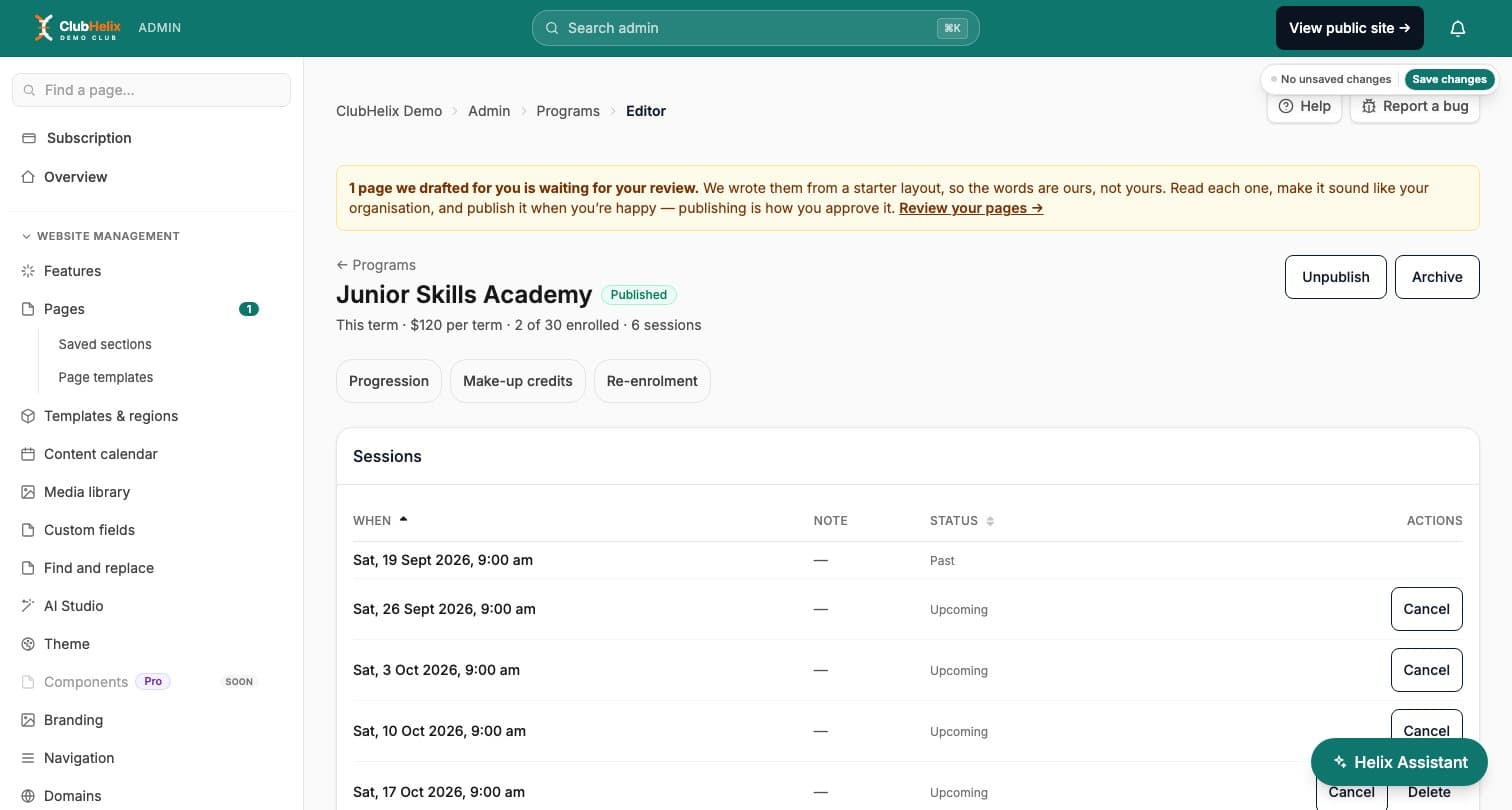
Sports program registration with proper structure: junior clinics, come-and-try days and coached programs, each with its term dates, sessions and capacity — and families enrolling online. Everything a class provider runs a term enrolment on sits here too: skill levels, make-up credits, trial classes and next term’s invitation list.
Structure
A real term, not a shared spreadsheet
Run junior clinics, come-and-try days and coached programs with proper structure: each program carries its term dates, sessions and capacity, plus its venue, price and enrolment window. Save it and the weekly sessions are generated across the term — real, individual sessions you can drag around a public holiday or cancel one week of, with enrolled families notified of the change.
Programs start as drafts and publish to a /programs page on your site, each with its own shareable link.
Enrolment
Junior program sign-up, handled by the parents
Families enrol online — for the whole term or session by session where you’ve set a casual drop-in price. Guardians enrol the kids on their own account, and every roster entry shows the participant’s name, not just the account holder’s — a parent enrolling two children appears twice, once per child. Paid enrolments go through card checkout; free ones confirm instantly.
Capacity
Full means waitlist, not turned away
When a program fills, the waitlist takes over automatically, so demand is captured instead of turned away. Offers go out strictly first come, first served, each holding the spot for 48 hours before passing to the next in line — nobody has to babysit the queue, and the club sees exactly how much demand term two really has.
Set a staff-to-participant ratio and it works as a second capacity gate: roster the coaches who run a session, say how many children each may take, and the next place is refused at the moment somebody tries to buy it rather than found in an audit afterwards. A coach rostered on a session is a capacity of one and cannot be in two rooms at once, so the ratio is counted against people actually on the roster. Two things to know before you rely on it: a session with nobody rostered reports no limit rather than a limit of zero, so roster the staff before you lean on the number — and the ratio is enforced at enrolment, not yet reported on, so for a season-long view of who is carrying the load, run the Coach load report.
Attendance
Someone is keeping a record — provably
Attendance is marked per session — present, late or absent — giving coaches a record of who came and parents confidence that someone is keeping one. Because the register is per session, patterns across the term are easy to spot, and casual drop-ins appear on their session’s register alongside the term participants.
Progression
Levels that two coaches mark the same way
A skill progression scheme is why a family enrols again: it gives the child a visible reason to come back, and it gives you a defensible answer when a parent asks why their child has not moved up. Write out your own ladder of levels and the skills under each — swim levels, gymnastics levels, belts, badges, whatever your sport already calls them — then mark them off against each child on the program’s own progression sheet.
The award is marked from the attendance register, on the same row the coach already has in front of them at the pool or the mat, so it happens on the day rather than from memory on Sunday night. And a level belongs to the enrolment rather than to the child: the same swimmer can be at level five in squad and level two in a stroke-correction class without either mark contradicting the other. The current level is always derived from the awards themselves, so there is no second record to drift out of step with the history, and carrying a level into next term is a deliberate act rather than an accident. Families see the level on the program page instead of asking at the desk.
One honest note: writing skills that two different coaches mark identically is the hard part, and it is a writing problem rather than a software one. We give you the ladder and the sheet; the wording that makes “can float unaided” mean the same thing to both of them is yours.
Make-ups
The Sunday-night “can we make it up?” text, answered once
“We were sick — can we make it up?” is the most common message a class provider gets, and most answer it inconsistently, which is how a policy becomes an argument. In ClubHelix a family reports the missed class from your own website and earns a missed class credit they book into another class time themselves — so the rule you chose is the rule that runs, and the front desk is out of the loop by design.
The guards are what make a class credit policy hold. A credit is issued once — two “my child is away” messages for the same week produce one credit, not two. It expires on the cycle you set, and an expired one is refused. It cannot be spent twice, even by two people pressing the button at the same moment. And it does not survive a refund of the enrolment that earned it, so a credit can never outlive the money that paid for it.
Decide the rule before you switch it on: how much notice counts as notice, how many make-ups a term can absorb, and what happens when you cancel the class rather than the family. An unexpiring credit quietly becomes a liability on your books.
The front door
A trial class that takes no account and no phone call
A trial class is the cheapest front door a coaching business has, and it only works if it costs the family nothing to walk through. Offer a free or paid trial of a program, and somebody who has never dealt with you can take a place with a name and an email — no account required.
The limit is built in rather than policed: each child may take a given program’s trial once, ever, and a cancelled or refunded trial still counts — so a trial cannot quietly turn into a weekly price cut for a family that keeps rebooking it.
Next term
Term four is one click from term three
Duplicate to new term takes a finished program, asks for the new dates, and hands back a fresh draft with the same settings and newly generated sessions — roster and attendance empty, prices ready to tweak. Holiday clinic in January, same drill.
That carries the term across. The re-enrolment campaign carries the families. Re-enrolment is where the revenue is and the part most providers do last, so ClubHelix builds next term’s invitation list from last term’s confirmed enrolments — one per child, with anyone who cancelled or was refunded left out — and then tracks every family on it separately. A run interrupted halfway is resumed rather than restarted, and nobody is invited twice.


See it with your club's name on it
Spin up a fully-branded site in under 30 minutes, free — no technical skills needed.