
What this guide answers
- We are a not-for-profit club, not a private gym. Does that change the answer?
It changes it considerably. A private gym is a business with customers, and a class-management product built for that business is often the right fit.
- Can families see their child's level?
In ClubHelix, yes. The level is shown on the program page for the family, and coaches mark skills off against each child.
- How should we handle make-up classes?
Write the policy down first: how many make-ups per term, how much notice, and whether a credit expires.
- Do we need competition features?
Usually not for running the club. Gymnastics meets are usually run and scored by the governing body or the host club, so most clubs only need to enter gymnasts and publish results.
- What about holiday programs and open gym?
Treat each as its own program with its own cap and price. A holiday program is a short term, and open gym works well as a punch card or a pass rather than a term fee.
A gymnastics club looks like a sports club from the outside and runs like a school on the inside. There is rarely a fixture list. There are terms, classes by age and level, waitlists that never quite clear, a coach-to-gymnast ratio that is a safety limit rather than a preference, and a steady stream of families asking which class their child should move up to next.
That shape is why so many gymnastics committees end up with a booking tool for classes, a spreadsheet for levels, a folder of paper waivers and a bank account full of transfers with the wrong reference. Most club management software is built around seasons and teams, which is the wrong way round for a club whose week is forty capped classes.
This guide covers what a gymnastics club genuinely needs, how the realistic kinds of software differ, and what to test before moving a term's enrolments. We are ClubHelix, an all-in-one club platform, so we sell into this market. We will name our own gaps rather than pretend to be neutral. Observations are current as at October 2026.
What a gymnastics club actually needs covered
- Term enrolment with hard caps. A recreational class capped at eight because of the ratio cannot quietly accept a ninth. The cap has to hold at checkout, not be checked by a volunteer afterwards.
- Waitlists that move on their own. When a place opens mid-term, the next family on the list should be offered it without anyone working through a spreadsheet.
- Levels and skills per child. Families want to know where their child is and what comes next, and coaches need a record that survives a change of coach.
- Make-up classes and trial classes. Missed classes are the most common source of friction in a class-based club. A clear credit system turns a complaint into a booking.
- Re-enrolment at the end of every term. The busiest week of the year is the one where current families need first offer on next term's places before the public sees them.
- Waivers and medical notes. Gymnastics carries real injury risk. A current, versioned waiver against each gymnast is the minimum.
- Coach accreditation with expiry dates. Coaching qualifications, first aid and child-safety checks all lapse, and a lapsed check is the risk that stops a session.
- Family billing. Most clubs have siblings enrolled, and a family discount someone has to remember to apply by hand is a discount that is applied unevenly.
How the options actually differ
Class-management products are built exactly for the term-and-class shape, and that makes them the closest fit for many gymnastics clubs. They handle enrolment, class rolls, tuition billing and the rest of running a class business. The one we can cite with a checked source is Jackrabbit Class, which publishes its pricing by student count: from US$49 a month for up to 100 students to US$245 a month for more than 3,000, with a branded app on its Plus option from US$93 a month plus a US$169 setup fee (checked on its own pricing page in July 2026). For a privately owned gym run as a business, this category is often the right answer outright.
Gym-booking and fitness apps are strong on timetables, casual bookings and recurring payments. They suit drop-in classes and adult open gym sessions well. The trade-off is that they think in memberships and bookings rather than terms, levels and families, so a club ends up tracking progression and siblings somewhere else.
A general class-scheduling tool — the kind used for tutoring, music lessons or community classes — will take bookings and payments for very little money. It usually stops there: no waivers against the gymnast, no coach accreditation, no levels, and no public website that families recognise as the club.
Spreadsheets and bank transfers are where most volunteer-run clubs start, and they work until the club passes about a hundred gymnasts or loses the one person who understands the sheet. The cost does not show up as a fee. It shows up as unpaid term fees, double-booked classes and a waitlist kept in someone's inbox.
Where ClubHelix fits is the not-for-profit club with a committee, members and a public website, rather than the privately owned gym. The details are in the next section.
Where ClubHelix fits
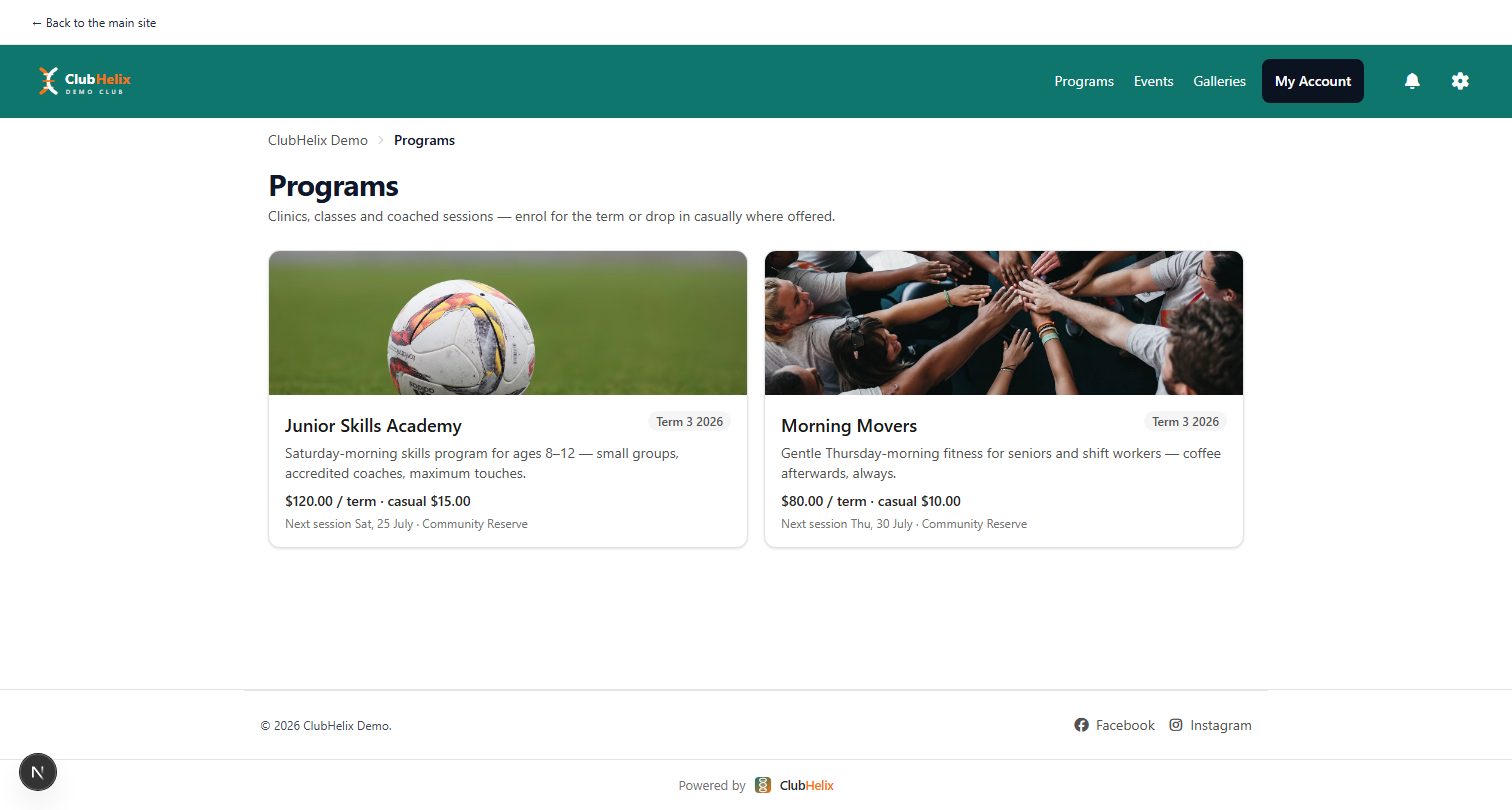
ClubHelix runs the class timetable as programs and term enrolment: classes with capacity, waitlists and session attendance, sold as a term fee, a punch card of set sessions or an unlimited pass for a period. You write out your own ladder of levels and the skills under each, mark them off against each child, and families see the level on the program page. A level belongs to the enrolment, so the same child can be at different levels in two programs.
Families report a missed class from your website and earn a credit they book into another class time, and you can offer a free or paid trial class to people who have not enrolled yet, one per child. At the end of term, re-enrolment invitations are built from last term's confirmed enrolments, with anyone who cancelled or was refunded left out. Family and sibling pricing is worked out at checkout from the household on the form, with no code to type.
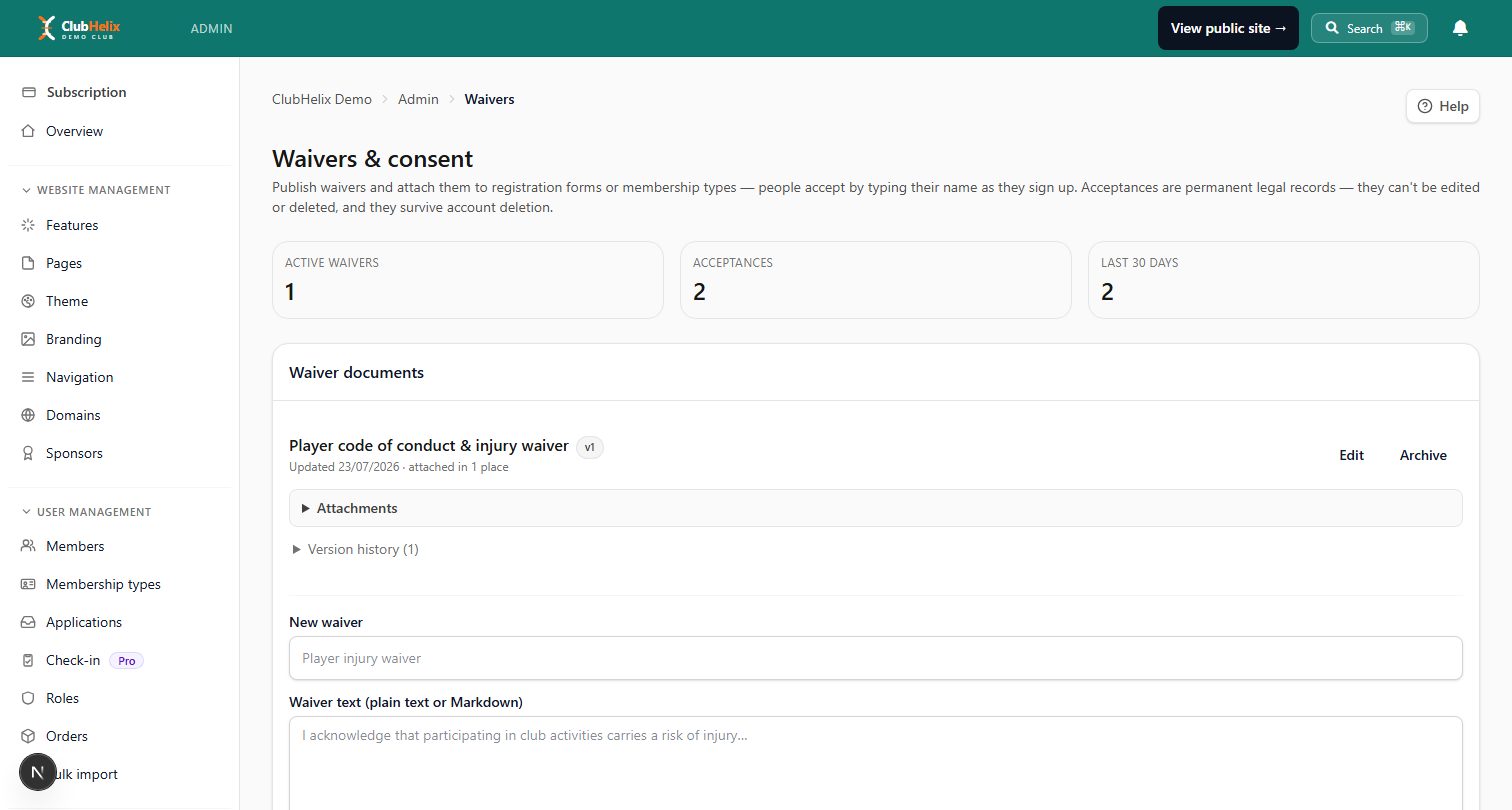
Digital waivers are versioned, with typed-name acceptances kept permanently. Accreditations track child-safety checks, first aid and coaching credentials with expiry reminders. Attendance is taken per session, with QR and kiosk check-in, and test sessions let you publish an assessment day with a deadline and online entry, check what each gymnast has already passed, and build the running order when entries close. All of it sits on the same record as your public website, memberships and online payments. The gymnastics club management software page shows the setup from a committee's side.
Our honest gaps. There is no app-store app: ClubHelix installs to the home screen with lock-screen notifications, which most families find enough, but a club that wants its own listing in the app stores will not get one. Our competitions module does not score judged events, so meet results go out as news posts rather than live scoreboards. Integrations with accounting and mailing tools are not available yet. And if you are a privately owned gym that thinks of gymnasts as customers rather than members, a class-management product built for that business may suit you better.
The questions that separate the products
| Question to ask | Why it matters for gymnastics |
|---|---|
| Does the class cap hold at checkout, with an automatic waitlist? | The ratio is a safety limit, and a ninth gymnast in a class of eight is risk. |
| Can a coach record levels and skills against each child? | Progression is the conversation every family wants to have. |
| Can families claim a make-up class themselves? | Missed-class emails are the biggest admin drain in a class-based club. |
| Do current families get first offer on next term's places? | Losing a long-standing gymnast to a stranger on a waitlist loses the family. |
| Is family and sibling pricing automatic? | A discount someone has to remember is one that gets missed. |
| Are waivers versioned and stored against the gymnast? | After an injury, "which waiver did they sign" needs an exact answer. |
| Can a volunteer coach take a roll without seeing the club's money? | Coaches need the class list, not the treasurer's view. |
What it costs, realistically
Model enrolments per term, not members. A club with 300 gymnasts across four terms processes well over a thousand enrolments a year, plus make-up bookings, trial classes and holiday programs. The ease of taking a term fee online, and what the payment provider charges for each one, will matter more than the headline subscription.
Pricing models in this category differ. Some class-management products price by student count, as above. Gym-booking apps tend to price per location. General scheduling tools are cheap and limited. Spreadsheets are free and expensive in volunteer hours.
ClubHelix has a free plan to start on, and current tiers are on the pricing page. Payments go through the club's own payment account, so the money lands with the club rather than with us.
Moving a gymnastics club without disrupting a term
The moves that go wrong are the ones attempted in the week a new term opens. The order that works:
- Load gymnasts, families and the class timetable first, with nothing switched on for families. This is the step that shows how messy the current records are, and it is better to find that out privately.
- Run next term's re-enrolment on the new system. Current families get first offer, so the people who already trust the club are the first to use it.
- Move waivers and medical notes next. The safety gain is immediate and it touches no money.
- Open public enrolment and the waitlist once re-enrolment closes.
- Bring levels and skills across last, class by class, as coaches assess. Nobody needs a full history on day one.
Budget a term, not a weekend, and keep the old system readable until a full term has run on the new one.
Frequently asked questions
We are a not-for-profit club, not a private gym. Does that change the answer?
It changes it considerably. A private gym is a business with customers, and a class-management product built for that business is often the right fit. A not-for-profit club has members, a committee, a constitution and a public website, and is usually better served by a club platform that also handles the class timetable.
Can families see their child's level?
In ClubHelix, yes. The level is shown on the program page for the family, and coaches mark skills off against each child. Ask the same question of any product you are considering, because progression is the thing families ask about most.
How should we handle make-up classes?
Write the policy down first: how many make-ups per term, how much notice, and whether a credit expires. Then pick software that lets families claim the credit themselves. Our guide to make-up classes and credits covers the policy side.
Do we need competition features?
Usually not for running the club. Gymnastics meets are usually run and scored by the governing body or the host club, so most clubs only need to enter gymnasts and publish results. If your club hosts a meet, check whether the product can score judged events; ours cannot.
What about holiday programs and open gym?
Treat each as its own program with its own cap and price. A holiday program is a short term, and open gym works well as a punch card or a pass rather than a term fee.
For the wider job of running the club, from coach ratios to equipment planning, see the complete guide to running a gymnastics club. When you are ready to try it with your own classes, you can set up your club and load a term before you open enrolments.

