For the person who affiliates and supports campus societies
Two hundred societies, one place to see them.
Affiliation applications, the society directory, grant applications and acquittals, event risk paperwork and the annual committee turnover — for every affiliated society, without a shared drive and a spreadsheet that is already out of date.

What makes the clubs and societies officer job hard
None of this is the interesting part of running a club. All of it is why the role is hard to fill.
- Affiliation applications arriving as PDFs attached to emails, each in a different format.
- A society directory on the association website that is wrong within a fortnight of the club fair.
- No reliable member count per society, so funding is allocated on whoever argues loudest.
- Grant acquittals that arrive months late because the committee that spent the money graduated.
- Chasing every society individually for a risk assessment before an event weekend.
- Nobody knowing which society still has the keys, the float or the equipment.
How ClubHelix handles it
The platform mapped onto the moments the clubs and societies officer job actually runs on.
Affiliation and re-affiliation
Affiliation runs as a form with conditional questions and file uploads — constitution, committee list, bank details, insurance declaration — so every application arrives in the same shape and can be approved, queried or rejected from one queue instead of an inbox.
The society directory
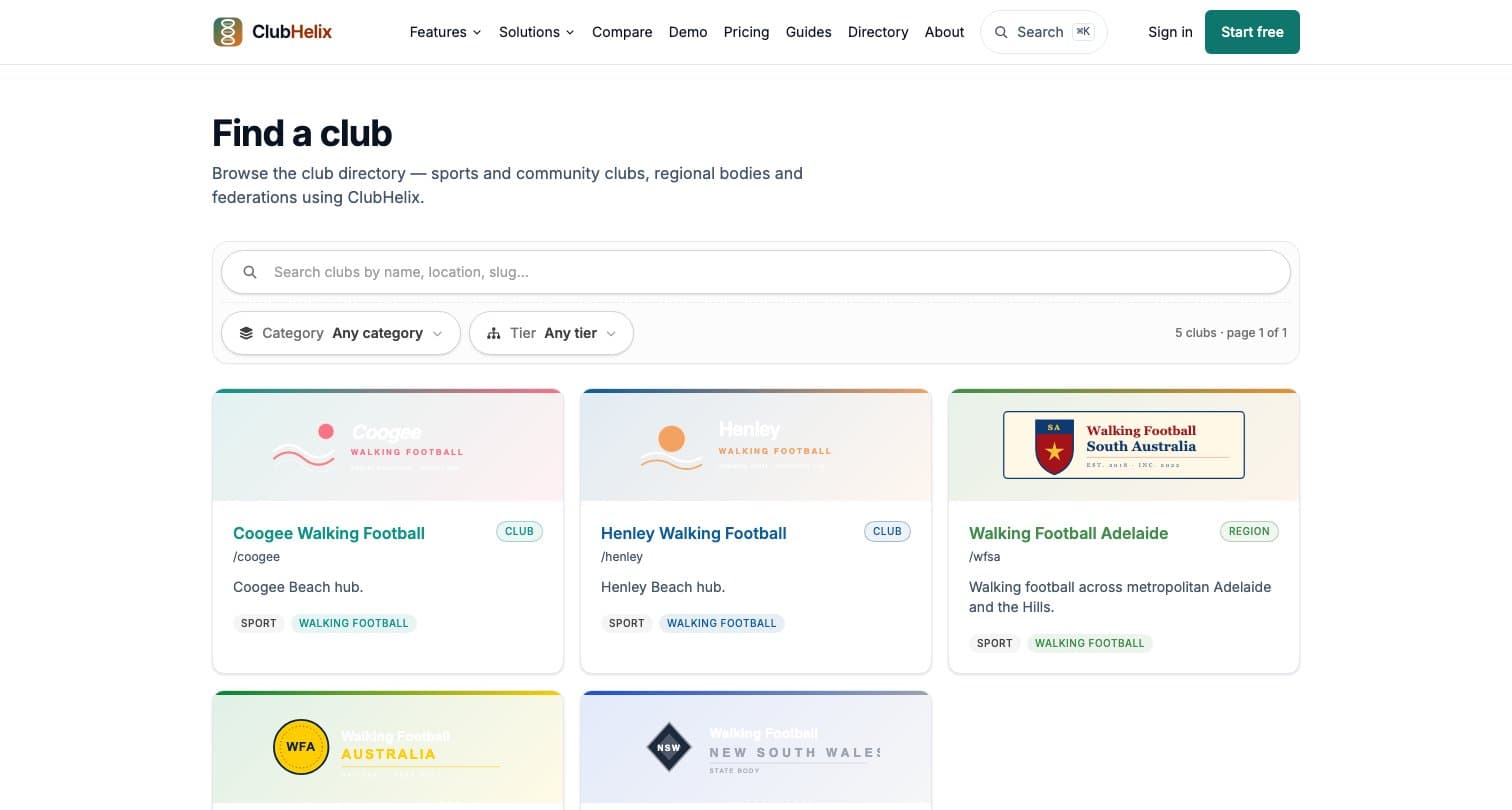
Affiliated societies appear in a directory that is generated from live records rather than hand-maintained, so a society that changes its contact email or its meeting time updates its own listing and yours at the same moment.
Funding rounds
Grant applications as forms with a closing date, then acquittals as a second form that asks for the numbers the society already has — member count, event attendance, what was spent. The evidence is attached to the record, not promised in a reply.
Safety and event paperwork
Risk assessments, waivers and incident reports collected against the society and the event they belong to, with expiry visible before the weekend rather than after it. Accreditation records hold first-aid and safeguarding checks for the people who need them.
The annual committee turnover
Every society changes committee within the same few weeks. Positions carry the access, so a society appointing next year’s treasurer removes last year’s at the same time — and your contact list for two hundred societies updates itself.
Sitting above the societies
The association is the parent tenant: your news, events and venues publish onto every affiliated society’s site, standard committee positions can be shared down for societies to appoint to, and you get roll-up reporting across them. You do not get to run a society’s admin or touch its money — cross-tenant access needs an explicit role, which is what keeps societies willing to join.
Communicating with committees
Broadcasts to every affiliated committee — the funding deadline, the venue closure, the compliance reminder — sent from the association address with delivery and open reporting, instead of a mail-merge from a spreadsheet.
The reports you will live in
A handful of the hundreds in the catalogue — the ones a clubs and societies officer opens most. Each states how it was calculated, so the number can be argued with.
- Membership snapshot
- How many paid-up members each affiliated society has, at a date you choose — the number funding allocations and affiliation renewals should be based on.
- Event attendance
- What each society actually ran and how many people came, which is the evidence a grant acquittal asks for and the honest measure of an active society.
- Compliance and accreditation expiry
- Which societies have current insurance declarations, safeguarding checks and first-aid cover, and which lapse before the next event weekend.
- Income summary
- What a society collected in membership fees, tickets and donations over a period — visible to the society itself, and reportable in aggregate across the association.
- Renewal and retention
- How many members each society kept from last year, so a society in quiet decline is visible while there is still time to help.
See the whole reporting feature →
Frequently asked questions
- No, and mandating it rarely works. The usual pattern is that the association runs its own site and offers affiliated societies their own, with the ones that want a real website and online payments taking it up first. Societies that stay on a spreadsheet still appear in your directory.
- Not by default, and that is deliberate. A parent tenant publishes shared content down and sees roll-up reporting; operating a society’s admin requires an explicit role granted at that society. It is the boundary that makes societies comfortable being under you.
- Each society is its own tenant on its own plan, so a small society can sit on the free tier while a large one pays for what it uses. An association that wants to fund its societies centrally should talk to us about how that is set up.
- Nothing breaks. Records, sites and history stay with the society; only the people holding positions change. Outgoing committee members lose access when their appointment ends, and the audit log records the change.
- It is, if it lands in the handover window rather than mid-semester. The pattern that works is the outgoing committee exporting the member list and writing down where the domain and the social accounts actually live — that second one is what societies lose — and the incoming committee building the site from a template in their first fortnight, while everyone is still keen. A society with no website to move has the easier job of the two and can be live in an afternoon.
Do we have to make every society use it?
Can we see inside a society’s admin?
How does billing work for a hundred affiliated societies?
What happens at the end of the academic year?
Societies hand over every year. Is a migration realistic for a volunteer committee?
Other committee roles
A club runs on more than one volunteer. Here is what the platform does for the rest of the committee.


Stop rebuilding the same spreadsheet.
14-day free trial of paid features — nothing to pay today, cancel any time before the trial ends.