
What this guide answers
- How many members does a student society actually need?
Fewer than you think to be viable, and more than you think to be safe.
- Our entire committee graduates in the same year — what do we do?
Start recruiting your successors in the first month of the year, not at the AGM.
- Do we need background checks to run events involving under-18s?
Often yes, and the requirement sits with the check scheme your jurisdiction runs rather than with your society's own judgement.
- How much should a student society charge for membership?
Anchor on what your members spend without thinking — a coffee and a half is the usual sweet spot for a year's membership — and then check the maths against your program.
- Is it worth reviving a society that has gone dormant?
Usually yes, and it is far less work than founding one from nothing.
A student society is usually six people in a group chat, a list of 340 names collected at a trestle table in the first week of term, and a bank balance only one person can actually see. Twelve months from now, four of those six will have graduated, gone on placement or quietly stopped replying — and the society will either hand itself cleanly to the next committee or start again from scratch with all the enthusiasm and none of the knowledge.
That is the whole problem in one sentence. Societies rarely die because the idea was bad or the events were dull. They die because a committee that only exists for twelve months keeps everything in its own heads, its own personal inboxes and its own personal accounts — and then leaves.
This guide walks the entire year: getting affiliated and staying affiliated, building a committee that can survive losing half its people, keeping a member list that outlives you, handling money without a treasurer carrying cash, running a term of events people actually attend, and doing the handover that decides whether your society still exists in five years. It assumes you have no budget for administration and no time to spend on it, because that is true of nearly every society we have ever met.
The society year runs on a twelve-month clock
Almost nothing about a society's calendar is your choice. The academic year sets when people are available, your student association sets when affiliation and grant paperwork is due, and exam periods delete four to six weeks from the middle and the end. The committees that cope are the ones that write the fixed dates down once and work backwards from them.
| When | What has to happen | What usually goes wrong |
|---|---|---|
| 6–8 weeks before teaching starts | Affiliation renewal, budget submitted, recurring room bookings requested, fair stall booked | Everyone is away and the deadline passes unnoticed |
| The week of the club fair | The stall, the pitch, the sign-up flow | A paper list nobody ever types up |
| Weeks 1–4 of term | First social, first paid memberships, welcome message, committee recruitment | Follow-up lands 11 days later, after people have forgotten |
| Weeks 5–12 | The regular program, the flagship event, grant acquittals | Committee burnout around week eight |
| Between terms | Reset, second recruitment push, plan the next term | Nothing happens at all and momentum dies |
| Second half of the year | Program continues, big event, sponsor obligations delivered | Exam period swallows the final month |
| Late in the year | AGM and committee elections, annual report, financial statements | Nominations opened far too late |
| Immediately after the AGM | Handover, bank signatory changes, access transfer | The outgoing president "will send it through" |
Two of those rows carry more weight than the rest. The affiliation deadline is the one that can end your society without anybody deciding to end it — miss it and you lose insurance cover, room booking rights and grant eligibility in a single stroke, and getting them back is a term's work. The four weeks after the club fair produce most of your paid members for the entire year; a society that takes three weeks to send its first message converts a fraction of the people who signed up.
Put both in a shared calendar the committee can all see, not one person's phone. Add the grant rounds, the room-booking release date and the AGM notice period while you are there. If your society keeps its calendar on its own website, next year's committee inherits the dates automatically instead of rediscovering them.
Affiliate first — everything downstream depends on it
Affiliation is what turns a group chat into a society. It is also the least glamorous thing a committee does, which is exactly why it gets left to the week it is due.
What affiliation typically buys you is remarkably consistent across campuses: public liability cover for approved activities, the right to book campus rooms at student rates (or at all), eligibility for the funding your student association hands out, a stall at the start-of-year club fair, a listing in the official club directory that new students actually browse, and in many cases a bank account or an account held on your behalf. What it asks for is also consistent: a constitution, a committee list with contact details, a minimum number of currently enrolled student members, agreement to a code of conduct, and — increasingly — evidence that the committee has done whatever training the association requires.
You affiliate with your student guild, association or union, usually through its clubs and societies (C&S) office. Expect to supply a constitution based on the guild's model rules, a committee list, a minimum number of currently enrolled student members (often somewhere between 15 and 25) and agreement to the guild's code of conduct. In return you get cover for approved activities, room bookings at club rates, eligibility for grants funded from the student services and amenities fee, a stall at O-Week, Market Day or Clubs Day, and a listing in the guild's club directory. Renewal usually falls due right at the start of the academic year, with forms closing weeks before the fair — which is to say, while your committee is still on summer break. This is general information; the C&S office's own handbook is the authority for your campus.
The practical advice is the same everywhere: keep a single folder — not a personal drive — containing your current constitution, your affiliation confirmation, your committee list, your insurance note and last year's report. Rebuild that folder now if it does not exist. Our affiliation guide covers the paperwork in detail, and if your society already lapsed, the dormant society revival guide is the faster route back.
Build a committee that can lose half its people
Most societies write a committee structure that assumes everybody stays. Write one that assumes attrition instead, because attrition is the base case: people go on exchange, take a placement year, get a graduate job offer in October, or simply run out of capacity in week nine.
| Role | Realistic load in term | The thing only they can do |
|---|---|---|
| President | 3–5 hours a week | Represent the society, chair meetings, own the relationship with the association |
| Secretary | 2–3 hours a week | Minutes, notices, the records folder, affiliation paperwork |
| Treasurer | 2–4 hours, with spikes | The account, the budget, grant acquittals, the reconciliation |
| Events officer | 3–6 hours a week | Bookings, run sheets, the door on the night |
| Communications officer | 2–3 hours a week | The weekly message, the website, the social accounts |
| Welfare and inclusion officer | 1–2 hours a week | Accessible events, the referral list, the quiet check-ins |
| First-year representative | 1–2 hours a week | Tell you what first-years actually want, and recruit next year's committee |
Three rules make that structure survivable. Two people deep on anything critical: the treasurer is never the only person who can see the account, and the president is never the only person with the affiliation login. Fixed meeting rhythm: a 45-minute committee meeting every fortnight, same day, same time, with an agenda circulated the day before and minutes that take one person ten minutes to write. Written role descriptions: a page per role, describing the actual work, so that asking someone to stand is not asking them to sign a blank cheque.
Split the president role if it is eating one person alive — a president plus a vice-president who owns internal operations is far more sustainable than a hero. The detailed breakdown lives in our committee roles guide, and if you are writing role descriptions from scratch, the position descriptions template will save you an evening.
Access should follow the role, not the person. Give the treasurer the finance permissions, the communications officer the messaging permissions, and the events officer the events permissions — then remove them when the role changes hands. A system with roles and per-position permissions does this properly; a shared password in a pinned chat message does not, and it is how societies end up with a graduated member who can still email 400 people.
Your member list is the society
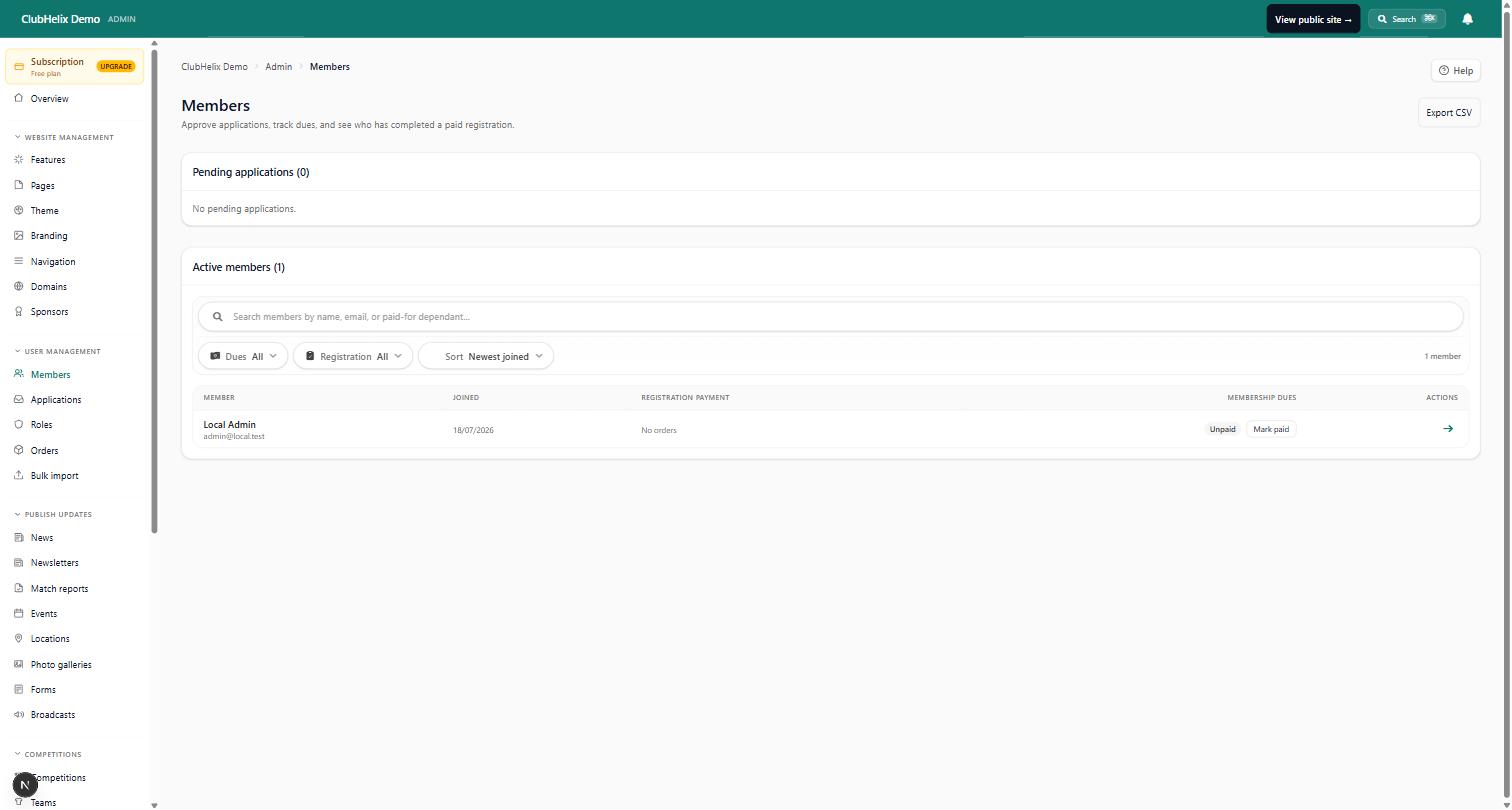
Ask a struggling committee for its membership number and you will usually get three different answers: the sign-up sheet count, the chat server count and the number who have actually paid. Only one of those is a member list.
The failure mode is depressingly standard. You collect 340 names at the fair. Around 210 are legible. Someone types up 150 over two weeks. The welcome message goes out on day 11, by which point five other societies have already run their first social. Sixty people pay. The other 280 were real, interested humans, and they are gone.
Fix the capture, not the follow-up. A sign-up link and a printed QR code on the stall, going to a form on your own site, means the record exists the moment someone joins — correctly spelled, timestamped, and available to whoever sends the welcome message that evening. If your membership is paid, take payment in the same flow rather than chasing 120 people for $10 each afterwards.
What to record, and no more:
- Name and preferred name. The name they want called out at events, not just the one on the enrolment record.
- A university email and a personal email. Student addresses are deactivated after graduation, which is how alumni lists evaporate.
- Year, course or faculty, if your society is academic or runs mentoring.
- Membership type and paid status, with the date it expires.
- Consent flags for photography and for non-essential email, captured at sign-up.
- Access and dietary needs, collected per event rather than stored permanently.
- Emergency contact, only if you run trips, sport or anything physical.
What not to record: full dates of birth you have no use for, health information you have no plan for, and free-text "notes" containing anyone's opinion of a member. Every field you collect is a field the next committee inherits and must protect.
Your society sits under privacy obligations that flow from both the Privacy Act and your state's information privacy legislation, and — usually more immediately — from the privacy policies of your university and your guild, which your affiliation agreement binds you to. In practice that means collecting only what you use, telling people at sign-up what you will use it for, never sending a group email with 300 addresses visible in the To field, deleting what you no longer need, and naming one committee member as accountable for the list. Photographs need their own consent: a tick box at sign-up plus a visible sign at the event is the standard approach. This is general information rather than legal advice — your guild's privacy contact can confirm what applies to you.
The reason to keep all of this in one system rather than a spreadsheet in someone's drive is not tidiness — it is survival. A spreadsheet leaves with its owner. A self-serve member register with paid registration stays with the society, and the incoming treasurer can see who is paid up on their first day. The deeper treatment is in our member records and privacy guide.
Money: fees, funding and the float
Student society money comes from three places, in roughly this order of reliability: membership fees, event income, and external money (grants, sponsorship and fundraising). A healthy society has all three and depends on none of them.
Membership fees should be small enough that nobody thinks twice and large enough to be worth collecting. Most societies land somewhere around the price of a coffee and a half for a year. The maths matters more than the number: 340 sign-ups converting at 35% to a $10 membership is $1,190 — enough to fund a term of low-cost socials, not enough to fund a ball. If you charge nothing, you will have a huge list and no way of knowing who is real. If you charge $40, you will have 40 members. Life membership, priced at three or four times the annual fee, is worth offering to final-year students who want to stay connected. Our membership fees guide works through the pricing properly.
Every event should have break-even maths written down before it is announced. Fixed costs (room hire, deposit, minimum spend) divided by ticket price gives the number of tickets you must sell before you are risking the society's money. If that number is above 60% of the room's capacity, the event is a gamble, not a plan. Sell early-bird tickets in waves rather than panic-discounting in the final week.
The float and the reserve are the two numbers nobody teaches committees. The float is the cash you need before any income arrives — the fair stall costs, the printing, the deposit on the first social. The reserve is what you deliberately leave for the next committee so they can do the same. Somewhere between $300 and $600 covers both for a mid-sized society; write the reserve into your budget as a line item so it does not get spent in week ten on pizza.
External money mostly comes from your guild's grant rounds, funded from the student services and amenities fee, and these usually run once or twice a year against a submitted budget. Faculties and schools often hold small discretionary funds for societies attached to their disciplines, equity and diversity offices fund inclusive events, and local councils run community grants that a campus society is sometimes eligible for. Panels look for specifics: how many students benefit, what it costs per head, and whether you acquitted last year's grant on time. GST is very unlikely to apply at student society turnover — you would need to be registered, and typical society income is nowhere near the threshold — but if you ever run a large ball or festival, ask the guild's finance staff before you set ticket prices. General information only, not tax advice.
Then there is the question of what your society legally is, which matters the moment it starts holding real money or signing contracts.
Most societies are unincorporated clubs operating under the guild's legal umbrella, and many hold their money in a sub-account managed by the guild's finance office rather than a bank account of their own. That is usually the right answer: it keeps the committee out of personal liability and removes the annual signatory scramble. A society that holds substantial funds, employs anyone or signs venue contracts in its own name should look at incorporating as an association under its state's legislation, which gives the committee limited liability and a legal identity that survives the year. If you do run your own account, insist on two signatories, at least one an office bearer, and change them within a week of the AGM — the bank will want the minutes and the constitution. General information, not legal advice.
Whatever shape you are, keep a simple budget the whole committee can see. Our budget template is built for a term-by-term cash view rather than an accountant's format, and the funding and grants guide covers what selection panels actually reward. If you want money that is not a grant, start with the sponsorship guide and the fundraising ideas ranked by return per volunteer hour.
A term of events people actually turn up to
A term's program has three layers, and societies that only run one of them struggle.
The anchor is the small, repeatable thing that happens whether or not anyone organises it — a weekly meet-up in the same room at the same time, a fortnightly practice, a Thursday study session. It costs almost nothing, it needs no promotion after week three, and it is where friendships form. Societies without an anchor are just a series of one-off events with a fresh audience each time.
The flagship is the one event per term worth telling people about: the ball, the tournament, the careers night, the production. It carries the financial risk, the risk assessment and most of the committee's stress. Give it a named owner and a run sheet, not a group chat.
The free entry point is the low-commitment thing a nervous first-year can attend without buying anything or committing to anything. If every event of yours costs money, your effective membership is the people who can afford you.
Two numbers to plan against. Free RSVPs convert at roughly 55–70% to actual attendance; paid tickets convert above 90%. That is why a $2 or $5 ticket on a "free" event is not about the money — it is about knowing whether to cater for 40 or 80. And the first four weeks of term generate the relationships that carry the rest of the year, so front-load your program even though that is exactly when the committee is busiest.
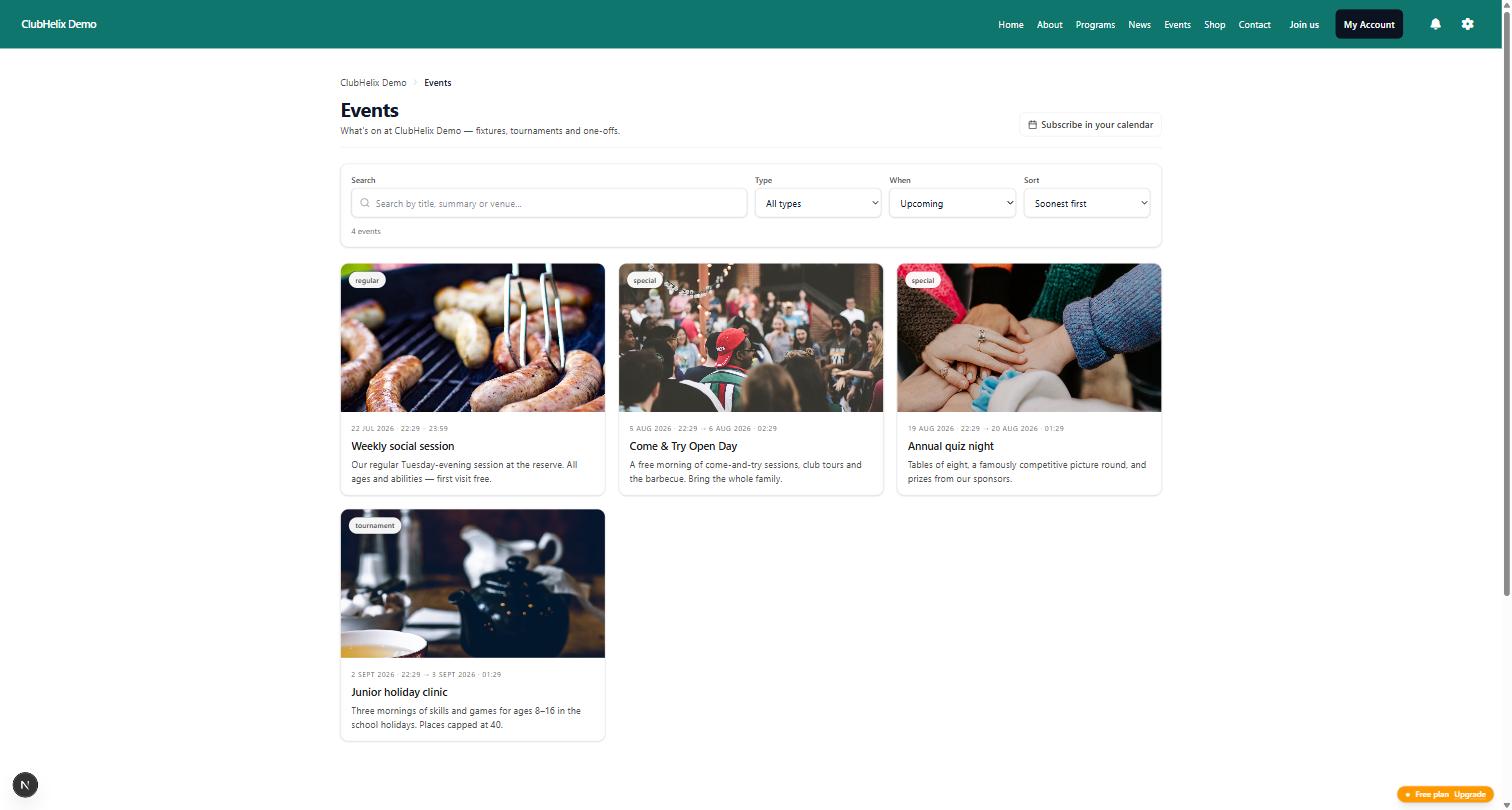
Run every event off one page that has the date, the venue, the price, the access information and the sign-up in the same place. Sending people from a chat message to a form to an external ticketing site to a payment link loses a third of them at every step. A society site with events, RSVPs and ticketing built in removes those steps entirely, and the attendance data it produces is exactly the evidence your next grant application needs.
For the mechanics, work through the end-to-end event guide, keep the risk assessment proportionate, and read the room bookings guide before you assume a space is yours. If the flagship is a ball, the ticketing guide covers pricing against a venue minimum. Stuck for ideas? Start with the social event ideas list.
Keeping the people you already recruited
Recruitment gets all the attention; retention decides your numbers. A society that recruits 200 and keeps 40 is doing more work for a worse outcome than one that recruits 90 and keeps 70.
Communication rhythm does most of the work. One message a week during term, sent at the same time (Sunday evening or Monday morning both work), covering what is on this week, what is coming, and one thing worth celebrating. The chat handles the day-to-day chatter; the weekly message reaches the 60% of members who muted the chat in week two. Anything permanent — the constitution, the calendar, the sign-up, the committee contacts — lives on the website so nobody has to scroll a chat history to find it.
A society list that opens at 35–50% is doing well. If yours opens at 12%, the usual culprits are sending from a personal address, sending irregularly, and a subject line describing the society rather than the reader's decision. Our email and newsletters guide covers the rhythm, and why club emails go to spam covers the technical half. Sending through a proper broadcast system gives you unsubscribe handling and a send log, which is also what proves your AGM notice actually went out.
The other half of retention is whether people feel the society is for them. Alcohol-free options at socials, events that do not all happen at 9pm, a stated access contact, and a welfare officer who knows where to refer someone rather than trying to counsel them — these are small, cheap decisions that change who stays. The welfare and inclusion guide is worth an hour of committee time, and a short member survey in week six will tell you more than a year of guessing.
The handover that decides whether the society survives
This is the section to bookmark. Everything above is undone by a bad handover, and a good handover takes one afternoon.
Hold it within two weeks of the AGM, with both committees in the room, and work through this list item by item. Tick each one in front of the incoming committee — an item is not handed over until the new holder has personally logged in, opened the folder or spoken to the contact.
- The constitution, plus any amendments passed this year and the date they were passed.
- The affiliation record: confirmation, renewal date, the association contact's name, and the login for the association's club portal.
- The bank or account access: signatories changed at the bank (book the appointment the day after the AGM — it always takes longer than anyone expects), the current balance, and any pending transactions.
- The financial position: this year's income and expenditure, the reserve you are leaving, and every debt or unpaid invoice, including the embarrassing ones.
- Grant obligations: what was awarded, what was spent, what still has to be acquitted, and by when.
- The member list, transferred inside the society's own system rather than exported to a personal spreadsheet.
- The website and domain, with ownership moved to a society role account, not a personal one.
- Email and social accounts, with recovery addresses pointed at a role address (president@yoursociety…) so no future committee is locked out by a graduate's dead inbox.
- Supplier and venue contacts: who to ring, what you paid, what went wrong last time.
- The equipment inventory and, crucially, where it physically is — plus the cupboard key.
- The calendar of fixed dates: affiliation renewal, grant rounds, the fair, the AGM notice deadline.
- Minutes and AGM records, including this year's annual report.
- The honest debrief: which events worked, which lost money, which sponsor did not pay, which room is unbookable in exam term.
- Access, not passwords. Create accounts for the new committee, remove the old ones, and never hand over a shared login.

That last point is the one societies get wrong most often. A shared password means you cannot remove one person without disrupting everyone, you cannot see who did what, and a graduate retains access to 400 members' contact details indefinitely. Per-person accounts with role-based permissions and an audit trail solve it in five minutes at the handover meeting.
The full version, with a printable agenda for the meeting itself, is in our society handover checklist; the general committee handover checklist covers the same ground for non-student clubs. Get the elections right first with the AGM and elections guide.
Frequently asked questions
How many members does a student society actually need?
Fewer than you think to be viable, and more than you think to be safe. A society with 25 to 40 engaged members can run a strong weekly program, fill a small room and staff a committee; below about 15 you will struggle to meet most affiliation minimums or fill positions at the AGM. The number that matters is not sign-ups but the count of people who attended something in the last six weeks — track that instead, because 300 names and 12 regulars is a society with one bad term left in it.
Our entire committee graduates in the same year — what do we do?
Start recruiting your successors in the first month of the year, not at the AGM. Create a first-year representative position and a couple of general committee roles specifically as apprenticeships, invite those people to committee meetings from week three, and hand them a real, small responsibility each — the week-six social, the newsletter, the fair roster. By the time nominations open you want two or three people who already know how the society runs. Where the calendar allows, elect the incoming committee before the outgoing one leaves, so there is a genuine overlap rather than a cliff.
Do we need background checks to run events involving under-18s?
Often yes, and the requirement sits with the check scheme your jurisdiction runs rather than with your society's own judgement. This matters more than committees expect: outreach in schools, open days aimed at prospective students, junior coaching and any residential activity can all pull you into scope. Check before you commit to the activity, because these take weeks to process. This is general information — confirm with your student association or a professional.
That means a working with children check issued by your state or territory, held individually by every committee member and volunteer in a child-related role, plus whatever child-safe standards your guild and university layer on top. The check belongs to the person, not the society, so it travels with them and has to be verified against your society's record of who holds one and when it expires — a graduating volunteer takes their clearance with them and the next person starts from zero. Application is usually online with an identity check in person, and processing times vary from days to many weeks depending on the state, so treat it as a term's lead time rather than a fortnight's. Most schemes are free or heavily discounted for volunteers; the guild will tell you whether it reimburses the fee. If someone declines to apply, the answer is simply that they do not take that role — it is not a negotiation, and your guild's child-safe policy will say the same.
How much should a student society charge for membership?
Anchor on what your members spend without thinking — a coffee and a half is the usual sweet spot for a year's membership — and then check the maths against your program. If your society's costs are genuinely low, a small fee still earns its keep because it tells you who is real. If your society needs equipment, rooms or kit, a higher fee is defensible as long as you offer a concession rate and never make cost the reason someone cannot join. There is a full pricing walkthrough in our membership fees guide.
Is it worth reviving a society that has gone dormant?
Usually yes, and it is far less work than founding one from nothing. A dormant society often still has a constitution, a name people recognise, an entry in the association's records and — surprisingly often — money sitting in an account. The recovery order matters: find the old records and the account first, then re-affiliate, then rebuild the committee, then relaunch at the club fair. Our dormant society guide walks through it, and the starting a university club guide covers the parts that are genuinely from scratch.
Where ClubHelix fits
Most of what makes a society fragile is administrative: the list in someone's drive, the login nobody else has, the payments collected by hand, the events spread across four tools. ClubHelix puts the society's website, member register, paid sign-ups, events and ticketing, email broadcasts and role-based access in one place that belongs to the society rather than to whoever set it up — so the handover is a permissions change, not an archaeology project. A students' association can even sit above its affiliated societies in the same structure, with each society running its own site and records.
If you are starting from a directory listing on your association's site, our student society website guide shows what a proper home page looks like, and you can see the ready-made site templates before you commit to anything. Plans are tiered by how many active members you have, so a society checks its own number against the pricing page rather than guessing.
ClubHelix gives your society one home for member sign-ups and payments, events and ticketing, email to the whole list and committee access that changes with the roles. Start free before your next club fair.


