
What this guide answers
- How many people do you need to start a university club?
It depends on your student association's rules, but a founding list of 10 to 25 named members and a committee of at least three — president, secretary, treasurer — is the common shape.
- Do you need a constitution before you can be affiliated?
Almost always, yes — and on many campuses you must adopt the association's model constitution rather than one you wrote yourself, so ask before you spend an evening drafting.
- When is the best time of year to start a society?
Work backwards from your campus's start-of-year club fair, because that one afternoon supplies most of a new society's members.
- Can you run events before affiliation comes through?
Informally, yes — a group of friends can meet for coffee. Formally, no: without affiliation you generally have no insurance cover, no right to book campus space at student rates, and no ability to advertise through…
- What happens to the society when the founders graduate?
That is the question every society answers badly, and the fix is structural rather than sentimental.
It usually starts the same way. Three or four of you work out that the thing you all want — a badminton ladder, a debating circuit, a Sunday film night, a support network for students on your course — either does not exist on your campus or quietly stopped existing when the last committee graduated. Somebody says "we should just start one". That is the easy part.
The hard part is that a society is a small organisation with real obligations: a founding list of members, a constitution, an application to your student association, somewhere safe to keep money that is not a founding member's own account, and a first semester busy enough that people come back. None of it is difficult. All of it is time-sensitive, because almost every campus runs its affiliation approvals and its recruitment on a calendar you do not control.
Everything below is general information — your student association's rules, and the law where you are, always win, so check the specifics with the office that processes affiliations.
Start with a search, then a founding group
Check nobody has already done it
Before you write a word of a constitution, spend twenty minutes finding out whether your society already exists. Search your student association's club directory, ask in the office that handles affiliations, and search the campus newspaper archive for the name. Two things commonly turn up: an active society doing 80% of what you planned, and a dormant one that ran for six years and folded when its committee finished.
Both are good news. Most associations will not affiliate two societies with near-identical objects, so discovering the active one now saves you a rejected application. And reviving a dormant society is genuinely faster than founding one — the name is already recognised, the constitution exists, and any money left in its account usually belongs to whoever can re-establish it properly. Our guide on restarting a dormant student society covers the recovery order. Either way, a fifteen-minute conversation with the person who processes affiliations beats a day of reading policy: they will tell you the current threshold, the application window, and which fields everyone gets wrong.
Then find the people
Most student associations want two things before they will consider a new society: a founding list of members — commonly somewhere between 10 and 25 named students — and a committee of at least three, usually president, secretary and treasurer.
Collect more names than the threshold — if the requirement is 15, get 25, because six will have signed out of politeness and two will have mistyped their email address. Collect them digitally rather than on a clipboard you retype at midnight: an online form gives you names, student email addresses and course in a list you can filter, and it becomes the founding membership record your association may ask to see.
The failure mode to avoid is a founding committee of five friends from the same course in the same year. They graduate in the same month and the society dies with them. Deliberately recruit at least two committee members who are more than a year from finishing, and give the newest person a real job rather than a decorative one — roles handed out as thank-yous produce a committee where the president does everything. The breakdown of what each committee role actually involves is the fastest way to hand out the work rather than the titles.
Write the two documents that unlock everything else
Almost every affiliation application rests on two documents: a short statement of what the society is for, and a constitution.
The statement of purpose (your "objects" or "aims") is three or four sentences and does more work than its length suggests: it is what the approvals panel compares against every existing society, so write it narrowly enough to be distinct and broadly enough to survive three committees. "To provide social, competitive and volunteering opportunities for students interested in board games" is a workable object. "To have fun" is not.
The constitution is the rulebook, and reviewers check for the same clauses every time:
- Membership — who can join, what it costs, what non-student or associate membership looks like, and how someone can be removed.
- Committee — the positions, what each is responsible for, and how vacancies are filled mid-year.
- Elections and the AGM — when it is held, how much notice members get, quorum, and how ballots are run.
- Money — who can authorise spending, how many signatories are required, and who reports to the members.
- Dissolution — where the assets go if the society folds. This is the clause new committees skip and the clause reviewers check first, because the answer must never be "split between the members".
You can adapt one in an afternoon. Start from our student society constitution template, which explains what each clause is for, or the general guide to writing a club constitution for the reasoning behind the structure. Adopt it formally at a founding meeting and take minutes recording who was present and that the constitution was adopted — that minute is often the evidence your association wants that the society exists at all.
While you are here, settle the name: short, searchable, free of the current year, and understandable to somebody who has never heard of you (naming ideas and traps if you are stuck).
Get affiliated — and know what affiliation buys
Affiliation is what turns a group chat into a society. In broad terms it gives you public liability cover for your events, the right to book rooms on campus at student rates, a listing in the official club directory, eligibility for funding, and a stall at the start-of-year club fair. Without it you are a few people who like the same thing, and the university has no reason to give you a room.
The mechanics vary by campus, but the shape is consistent: an application form, your constitution, your founding member list, your committee's contact details, and sometimes a short pitch to a panel or a vote by an existing committee. Applications open and close in a window — miss it and you will usually wait months for the next one.
Affiliation runs through your student guild or association, usually via a clubs and societies (C&S) office with its own affiliation policy. Expect an application form, your constitution, a founding member list and a committee contact sheet, assessed against whether an existing club already covers your objects. Many guilds run a probationary first year: you are affiliated but not yet eligible for the full grant pool, which is funded from the student services and amenities fee.
Affiliation is what gets you insured for on-campus activities under the guild's cover, room bookings at club rates, a listing in the C&S directory and — the one that matters most in your first year — a table at O-Week or Market Day. Those stall allocations are typically issued weeks before the event and only to affiliated clubs, so an application lodged in the first week of semester is already too late for that year's biggest recruitment day.
Affiliation is annual. Most guilds require you to re-affiliate each year with an updated committee list, your AGM minutes and a financial report, and clubs that miss the renewal window lose their room-booking rights and their grant eligibility until they reapply. Diarise the renewal date the day you are approved, and put it in the handover notes. This is general information — your guild's own affiliation policy is the authority, and the C&S office will walk you through it if you ask early.
Once you are through, keep affiliation. It is renewed annually, and the renewal is where most societies fail — see how to affiliate a society and keep affiliation for the full renewal cycle.
Money, before you have any
Every founding committee makes the same mistake: someone pays for the first thing on their own card and everyone agrees to sort it out later. Six weeks on, nobody knows who is owed what and the treasurer's role has become an argument.
Fix it with four rules on day one. Never run society money through a personal account — not for a week, not for the first event. Require two people to approve any spend, whichever mechanism your account supports. Keep every receipt in one shared folder, named by date and event. And decide before your first event who is allowed to commit the society to a cost — the answer should be one or two named people, written into the constitution.
Then take cash out of the equation. A treasurer standing at a stall with an envelope of notes is the most common source of a society's first financial hole, and it makes reconciling membership impossible: you end up with 90 sign-ups, 61 payments and no way to match them. Taking payment online at the moment somebody joins makes the payment, the member record and the receipt one action. Our guides on setting and collecting society membership fees and the society budget template cover pricing and cash flow.
What follows is general information about how societies typically hold money and what legal shape they take. Your association's finance rules override all of it, and anything with a tax or legal consequence is worth a question to a professional.
Most new clubs do not need their own legal identity. You start as an unincorporated club operating under the guild's umbrella, which is exactly what the affiliation covers. Some guilds hold club funds in an internal account and pay your invoices for you; others expect you to open a community or association account with a bank, which usually needs your constitution, your founding meeting minutes and identification for two or three signatories. Ask the C&S office which model applies before you book a bank appointment.
Incorporation — becoming an incorporated association under your state's legislation — is a step for a club holding real money, employing someone or signing a lease, not for a society in its first year. It brings annual reporting duties that a student committee will resent.
For a first-year budget, plan on a float of $300–$600 to get through the club fair and the first two events: printing, a table cloth, name badges and the first social's deposit. Membership at $5–$15 a year is normal for a society and $20–$40 for a club with equipment or a venue cost. Your grant application to the guild — funded from the student services and amenities fee — will usually want that budget attached, so write it before you need it. GST registration is far above anything a first-year society turns over, so most never register; check with the guild if you are unsure.
Give the society an address of its own
Your entry in the student association's directory is a line of text with an email address on it. It is not a home. The moment you have a name and an approved constitution, give the society somewhere of its own that a stranger can find, a member can pay through, and the next committee can inherit.
Two founding decisions save the next three committees enormous pain. Create a society email address and register everything to it — never a founder's personal account, or your society's entire digital life graduates with them. And give at least two committee members full access from day one, so a lost phone is an inconvenience rather than the end of the society.
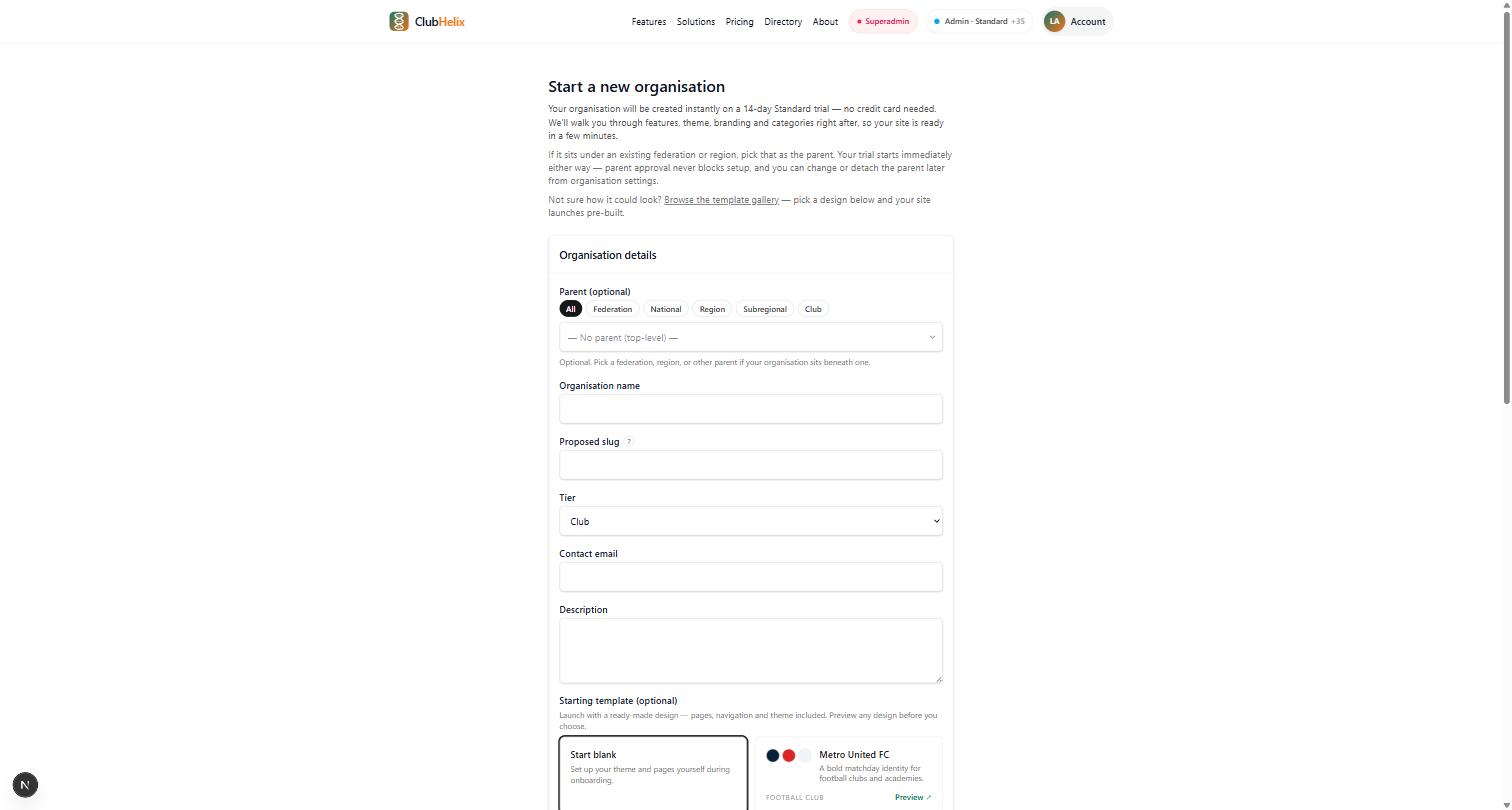
You need six pages, and you can build them in an evening: a home page that says what the society is and when it next meets; a what-we-do page; an events page with real dates; a join page that takes a payment; a committee page with roles and contact addresses; and a contact page. Anything else is optional. The test of the site is not how it looks but whether next year's publicity officer can update it without help — a page editor you drag sections around in passes that test; a beautiful site nobody can edit is a dead site within a year.
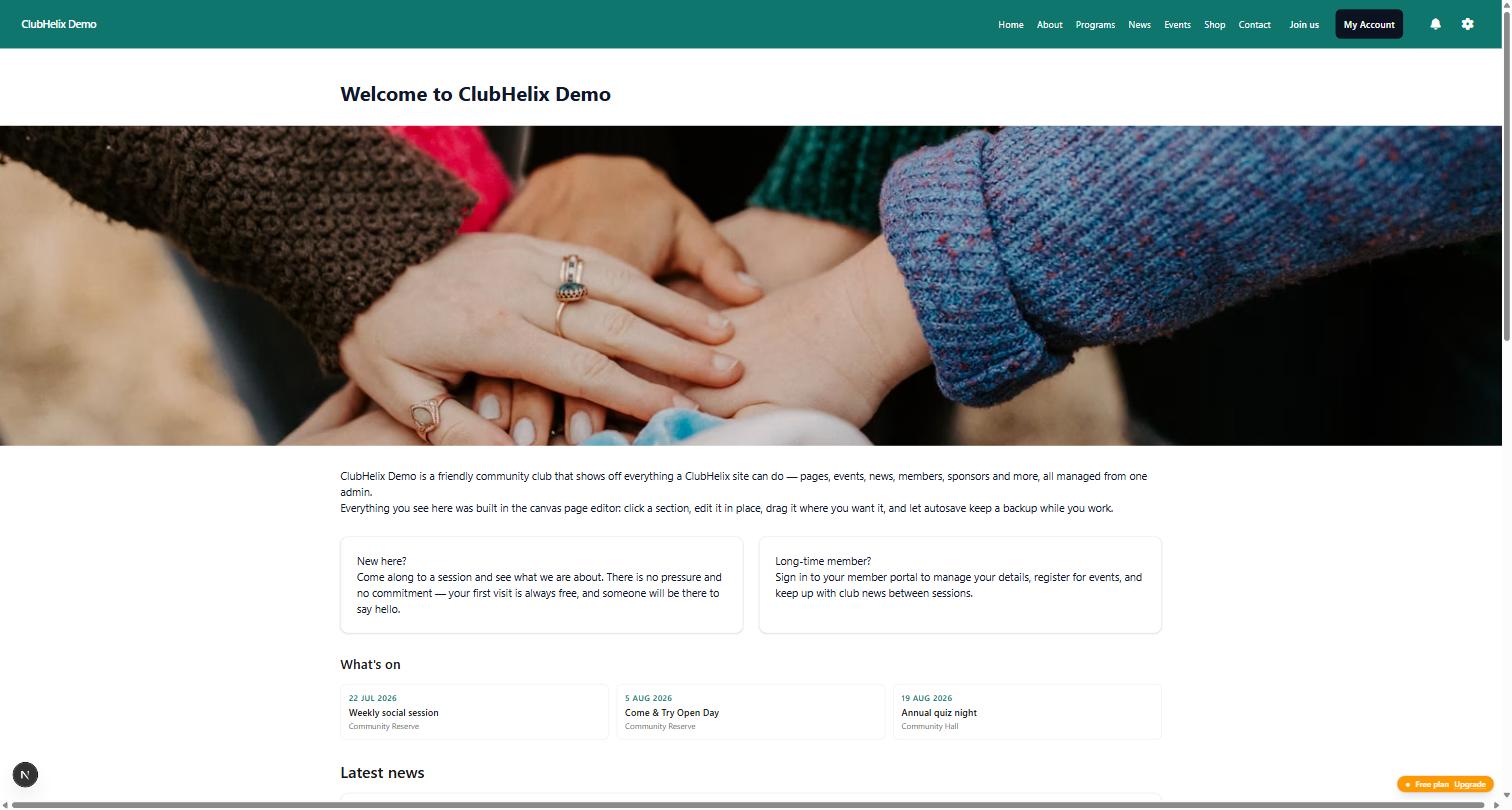
The join page is the part that pays for itself. Self-serve registration turns a sign-up into a member record and a payment in one step, so your membership list is the same object as your payment list — no reconciliation, no spreadsheet, no "did Priya pay?". Add the two or three custom fields you genuinely need (course, year of study, dietary requirements for the first social) and resist asking for more; every extra field costs you sign-ups. One-offs — an expression of interest, a committee nomination, a trip application — go in an online form rather than another tool with another login.
For the full build, see how to build a student society website.
The obligations that arrive with your first event
The day you announce an event, you pick up responsibilities you did not have as a group chat. Most campuses require a risk assessment before releasing a room, a named organiser present on the day, and separate approval for anything involving alcohol, external speakers, physical activity, food or minors attending an open event. Build a twenty-minute version of the risk assessment once and reuse it — a worked society risk assessment shows the shape.
You also become responsible for personal data. A membership list with names, student email addresses, phone numbers, emergency contacts and dietary or access needs is exactly the kind of record that must not live in a shared drive with public link access, or in an exported file on four laptops. Collect only what you use, keep it in one system with per-role access rather than a file that copies itself, and delete what you no longer need. Our guide to society member records and privacy covers the retention side.
The rules below differ by jurisdiction. This is general information, not legal advice — confirm the specifics with your student association or a professional.
Two obligations catch new committees. If your society will run anything involving under-18s — a school outreach program, a come-and-try day open to the public, a mentoring scheme — the volunteers involved will generally need a working with children check. These are issued by each state and territory under different names and rules, they take weeks, and they are not transferable between states, so start early and never let an unchecked volunteer supervise minors while you wait.
The second is privacy. Your society's member list is personal information, and while a small club may sit below the Privacy Act's turnover threshold, your university and your guild almost certainly do not — and their obligations flow to you through the affiliation agreement, along with state information privacy legislation at public universities. In practice: tell people what you will use their details for when they join, use bcc or a proper mailing system so you never expose the list, do not share it with sponsors, and hand it over between committees as an access change rather than an emailed file. Your guild's privacy policy and the university's are the documents to read.
The first twelve weeks
Founding a society is a race against one date: the start-of-year club fair. Everything before it is preparation, and everything after it is conversion. Work backwards.
| When | What you do | Why it matters |
|---|---|---|
| 12 weeks before the fair | Search the directory, meet the affiliations office, agree the idea and the name | Rules out a duplicate application before you have invested anything |
| 10 weeks before | Collect the founding member list; name a committee of at least three | The threshold is the gate on the whole application |
| 8 weeks before | Adopt the constitution at a founding meeting; take minutes | The minute is the evidence the society exists |
| 6 weeks before | Lodge the affiliation application with everything attached | Panels meet on a schedule; late applications wait for the next one |
| 4 weeks before | Sort out how money is held; create the society email address | You cannot take a payment or sign for a room without this |
| 3 weeks before | Publish the website, open the join page, date your first four events | People sign up for a calendar, not an idea |
| 1 week before | Book the stall, print a QR code to your join page, brief who is on the table when | Paper lists are the number-one source of lost members |
| Fair day | Capture sign-ups digitally; announce a first event less than ten days away | Interest decays fast — a distant first event converts almost nobody |
| Within 48 hours | Send the welcome email: who you are, what is on, how to join properly | This single email decides most of your conversion |
| Weeks 1–4 | Run three events; hold your first committee meeting; note who did not come back | Momentum is built in the first month or not at all |
| Weeks 5–8 | Fix what broke; ask ten members what they want; submit your first funding application | Grant rounds close early and reward evidence of activity |
| Weeks 9–12 | Start recruiting next year's committee informally; write the handover as you go | The founders' knowledge is the society's only real asset |
Five ways a first-year society dies
- The distant first event. You sign up 90 people at the fair and hold your first event five weeks later; almost none of them come. Schedule it inside ten days, before anyone's timetable hardens.
- The paper list. Names on a clipboard become 40 typed addresses, six of them wrong, entered three weeks late. Sign people up digitally at the table — a QR code to your join page, and one person whose only job is helping people through it (the full stall setup).
- The single account. Everything registered to one founder's personal email, one card, one login. Two people with full access from the start turns a catastrophe into an inconvenience.
- The all-in-one-year committee. Five friends, one graduating cohort, no succession — and a society that survives its first year only to die in its second, because nobody wrote down how any of it worked. Recruit downwards from day one and keep a running handover document from week one; the full guide to running a society covers the annual cycle it feeds.
Frequently asked questions
How many people do you need to start a university club?
It depends on your student association's rules, but a founding list of 10 to 25 named members and a committee of at least three — president, secretary, treasurer — is the common shape. Collect noticeably more names than the minimum, because a proportion signed to be polite and a few will mistype their email address. The mix matters more than the number: a founding committee drawn from one course and one year graduates together and takes the society with it.
Do you need a constitution before you can be affiliated?
Almost always, yes — and on many campuses you must adopt the association's model constitution rather than one you wrote yourself, so ask before you spend an evening drafting. Reviewers check the same clauses every time: objects, membership, committee positions, elections and quorum, how money is authorised, and where the assets go if the society folds. Adopt it at a founding meeting and keep the minutes, because that record is often the evidence your association wants that the society legally exists.
When is the best time of year to start a society?
Work backwards from your campus's start-of-year club fair, because that one afternoon supplies most of a new society's members. Applications for new clubs generally close weeks before it, so the founding work belongs in the break beforehand, not in the first week of teaching.
Teaching typically starts in late February or early March, with O-Week or Market Day in the fortnight before or the first week of semester. Most guilds open new-club affiliation applications from around November and close them well before O-Week, so the summer break is when you should be collecting your founding list and adopting your constitution. If you miss it, many guilds run a second, smaller intake around the start of semester two in July — smaller stalls, fewer first-years, but a genuine second chance rather than a lost year.
Can you run events before affiliation comes through?
Informally, yes — a group of friends can meet for coffee. Formally, no: without affiliation you generally have no insurance cover, no right to book campus space at student rates, and no ability to advertise through official channels, and running a public event without cover is the kind of thing that ends a society before it starts. Use the waiting period for unadvertised, low-risk gatherings that build your founding list, and hold the launch event until your approval is confirmed.
What happens to the society when the founders graduate?
That is the question every society answers badly, and the fix is structural rather than sentimental. Recruit at least two committee members each year who are more than twelve months from finishing, register every account to a society email address, keep the member list and the money in a system the committee holds jointly, and write the handover as you go rather than the week you leave. A society whose records, website and membership live somewhere the next committee can simply be given access to survives its founders; one that lives in a graduate's inbox does not.
Where ClubHelix fits
A new society's real problem is that its members, money, events and website all start out in different places, and every handover loses one of them. ClubHelix puts them together: a public site you build in an evening with a page editor anyone on the committee can use, a join page where signing up and paying are one step, events with RSVPs, email to your members, and forms for nominations, trips and expressions of interest. Access is per person and per role, so a handover is an access change rather than a shared password. A student association that affiliates dozens of societies can sit one tier above them all, each society running its own site and membership while the association sees the whole picture. Start with the pricing options — the free tier is for building the site and trying it out, with taking payments online and being found in search on the paid plans.
ClubHelix gives a brand-new society a home of its own from day one — a website, a member list, online sign-ups and payments, all in one system the next committee can inherit. Start free before your club fair.


