
What this guide answers
- What is a volunteer position description?
A half-page summary of a club role: its purpose, key tasks, honest time commitment, who the volunteer reports to, and when the role ends.
- How detailed should club volunteer role descriptions be?
Half a page maximum. Four to seven dot points of tasks, an honest hours estimate and a defined term are what matter — a role that needs a full page to describe is usually two roles that should be split.
- Do volunteers need a working with children check?
Roles with regular contact with junior members typically require one, but the rules differ by state and territory — check your state government's working with children scheme, and see our guide to working with children…
- How do we get people to actually take these roles?
Make specific, personal asks with the PD in hand, keep the time commitment honest, guarantee an end date, and split anything too big into smaller roles.
"Can you help out a bit this season?" is the worst recruiting question in club sport — because the honest answer is "it depends what you mean, and I suspect you mean everything, forever." People say no to vague, unbounded asks. They say yes to specific ones: two hours a fortnight, this task, this season, this person to call when stuck.
That's the whole case for volunteer position descriptions. A position description (PD) is a half-page that says what the role is, what it involves, how much time it takes and when it ends. Clubs that write them recruit more easily, share the load more fairly and burn out fewer good people. This guide gives you a structure that works for any club role, plus example descriptions you can copy and adapt today.
What goes in a volunteer position description
Keep each PD to half a page. If a role needs more than that to describe, it's probably two roles. The structure:
| Section | What to write |
|---|---|
| Role title | Plain and specific — "Under-12s team manager", not "helper" |
| Purpose | One sentence on why the role exists |
| Key tasks | 4–7 dot points of what the person actually does |
| Time commitment | Honest hours per week and any fixed dates — the make-or-break section |
| Reports to | The one person they go to with questions |
| Term | When the role starts and, crucially, when it ends |
| Requirements | Any checks or accreditation needed (e.g. a working with children check for junior roles) |
| Support and training | What the club provides — handover notes, budget, a predecessor's phone number |
Two of these do the heavy lifting. Time commitment is where trust is won or lost: understate it and the volunteer feels tricked by June; state it honestly and the people who say yes actually stay. Term is what makes saying yes safe — "until the presentation night, then we ask again" beats a life sentence, and it gives both sides a graceful exit.
For committee roles specifically — president, secretary, treasurer — see our companion guide to club committee roles and responsibilities. The templates below cover the non-committee roles most clubs need filled every season.
Template: team manager
Purpose: Be the organisational link between the coach, the players and their families for one team, so the coach can focus on coaching.
Key tasks:
- Share training and match details with players/parents each week and chase RSVPs
- Coordinate the team's share of club duties (canteen shifts, ground setup) on the roster
- Manage the team kit bag, match balls and playing strip; return all gear at season's end
- Collect match paperwork (team sheets, scores) and pass results to the club
- Welcome new families and pass questions to the right committee member
Time commitment: 1–2 hours per week during the season, plus match-day presence. Reports to: Junior coordinator (junior teams) or club secretary. Term: One season, ending after the final match and gear return. Requirements: Working with children check for junior teams (check your state's rules). Support: Handover notes from last season's manager; club communication tools; the coordinator's phone number.
Template: food outlet coordinator
Purpose: Keep the club's food outlet stocked, staffed and profitable — it's most clubs' best fundraiser after registrations.
Call the role what your club calls it — canteen coordinator at most clubs here.
Key tasks:
- Plan the menu and order stock ahead of each home game
- Build the canteen shift roster and confirm volunteers each week
- Manage the float, count takings with a second person and hand over to the treasurer
- Keep the canteen clean and compliant with food-safety basics
- Track what sells and adjust orders — waste is lost fundraising
Time commitment: 2–3 hours per home match day, plus about an hour of ordering midweek. Reports to: Treasurer. Term: One season. The role does NOT mean working every shift — the coordinator rosters others. Requirements: None, though basic food-handling knowledge helps (see our guide to food safety for club canteens). Support: Supplier list and price sheet, float procedure, last season's sales notes.
Template: social media volunteer
Purpose: Keep the club visible online — results, photos, celebrations and key dates — so members feel connected and new families can find us.
Key tasks:
- Post 2–3 times a week during the season: results, upcoming games, volunteer thanks, milestones
- Share club announcements (registration opening, events, wet-weather calls) promptly when asked
- Gather photos from team managers, with consent rules followed for juniors
- Reply to simple public questions; pass anything tricky to the secretary
- Keep login details stored with the club, not in a personal account
Time commitment: 1–2 hours per week, mostly from a phone. Reports to: Secretary or communications officer. Term: One season, reviewed at the AGM. Requirements: Familiarity with the platforms the club uses; commitment to the club's photo-consent policy. Support: Content ideas list, club logo and colours, scheduled-post access to club accounts.
Template: registration day helper
Purpose: Make the club's registration day welcoming and quick, so new families sign up on the spot instead of "doing it later".
Key tasks:
- Greet arrivals, answer basic questions about fees, age groups and training times
- Help families complete online registration on the day, on their own phones
- Hand out welcome packs and point people to uniforms and the canteen
- Capture details of anyone who wants a follow-up call
Time commitment: One morning, once or twice a year. Reports to: Registrar. Term: The event itself — this is a perfect first ask for a new volunteer.
Using position descriptions to recruit
A PD changes the recruiting conversation. Instead of a plea from the president at presentation night, you can put real roles in front of people: publish the open positions on your club website, include one PD in each newsletter, and make direct asks — "we think you'd be a great canteen coordinator, here's exactly what it involves" — which succeed far more often than general appeals. Our guide on how to recruit club volunteers covers the ask itself in detail.

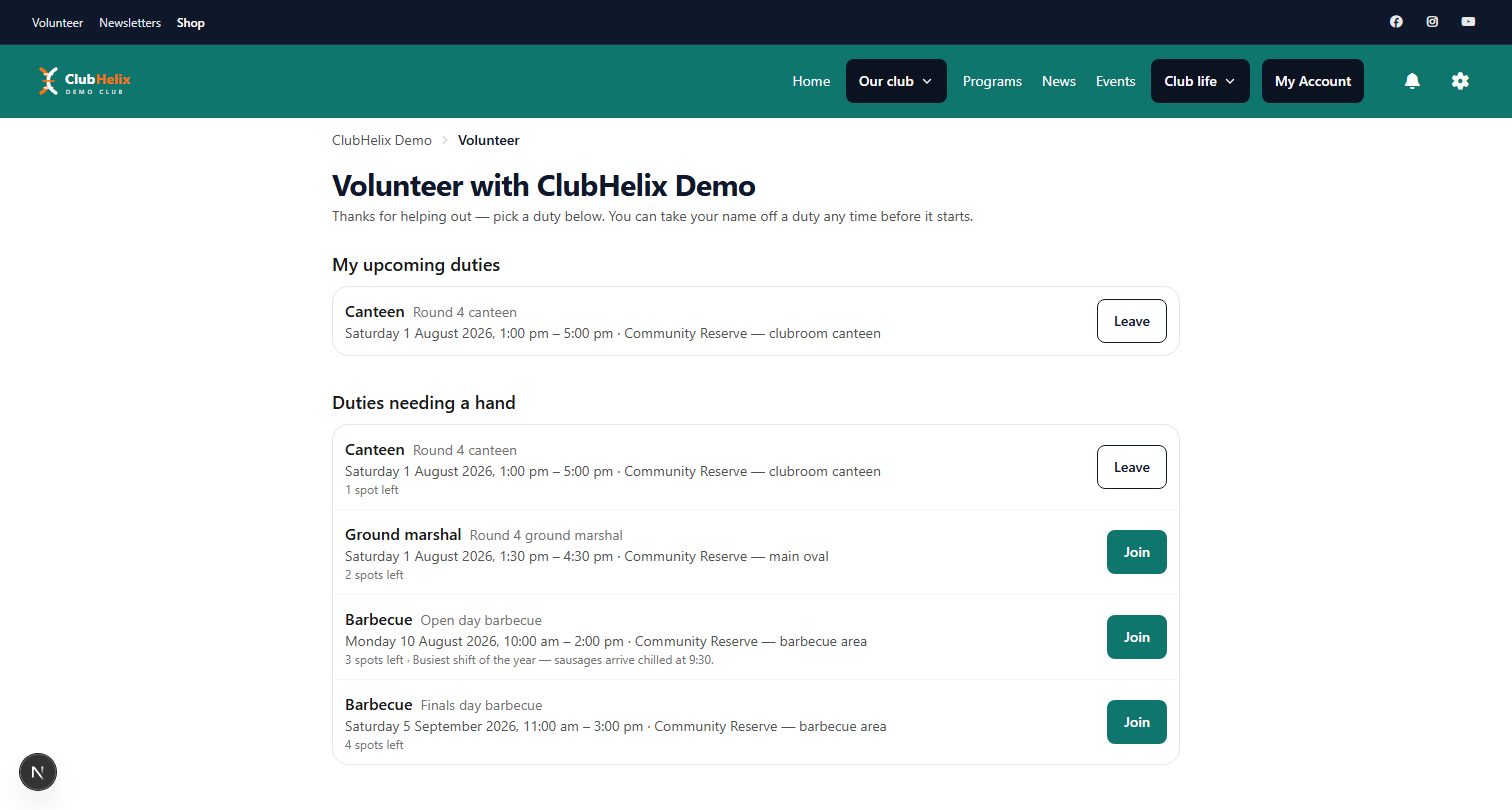
Once roles are filled, the PD becomes the fairness tool: everyone can see who does what, which makes it much easier to spot when one person is quietly doing four roles — the classic burnout pattern. Pair the descriptions with a volunteer roster so recurring duties (canteen, ground setup, scoring) are spread across many hands rather than defaulting to the same three families.
ClubHelix makes both halves practical: volunteer rostering lets you publish duty rosters that members sign up to and get reminders for, and roles and permissions means each position holder gets access to exactly the club admin they need — the canteen coordinator sees the roster, the social media volunteer doesn't see member records.
Keep them honest, keep them current
Three habits stop your PDs going stale:
- Review at handover. When a role changes hands, ask the outgoing volunteer what the PD got wrong — especially the hours — and fix it before recruiting the replacement.
- Date them. A "reviewed October 2026" line tells next year's committee whether to trust it.
- Store them centrally. PDs belong in the club's shared document storage with the constitution and policies, not in someone's personal files.
And close the loop: people who know what they signed up for, do it well, and get thanked properly come back next season. Our volunteer appreciation ideas guide has low-cost ways to do that well.
If your club is still coordinating volunteers through group-chat chaos, ClubHelix gives you rosters, reminders, member records and a club website in one place — free tier available — so every role in this guide gets easier to fill and easier to do.
Frequently asked questions
What is a volunteer position description?
A half-page summary of a club role: its purpose, key tasks, honest time commitment, who the volunteer reports to, and when the role ends. It replaces the vague "can you help out?" with a specific, bounded ask people can confidently say yes to.
How detailed should club volunteer role descriptions be?
Half a page maximum. Four to seven dot points of tasks, an honest hours estimate and a defined term are what matter — a role that needs a full page to describe is usually two roles that should be split.
Do volunteers need a working with children check?
Roles with regular contact with junior members typically require one, but the rules differ by state and territory — check your state government's working with children scheme, and see our guide to working with children check requirements for clubs. This is general information, not legal advice.
How do we get people to actually take these roles?
Make specific, personal asks with the PD in hand, keep the time commitment honest, guarantee an end date, and split anything too big into smaller roles. Direct asks with a clear scope outperform general appeals many times over.


