
What this guide answers
- Does a volunteer-run club canteen need to register with the council?
Very often yes — clubs selling food generally count as food businesses and most councils require at least a notification, though many jurisdictions apply lighter-touch arrangements for low-risk community and…
- Do canteen volunteers need food safety training?
Everyone handling food needs basic skills and knowledge appropriate to what they do — that's a general requirement of the food standards — and some operations need a person with formal food safety supervisor–style…
- What are the temperature rules for a sausage sizzle?
Keep raw sausages cold (5°C or below, in a fridge or well-iced esky) until they hit the grill, cook them right through with juices running clear, and serve promptly or hold them above 60°C.
- What equipment does a compliant club canteen actually need?
Less than you'd fear, for a typical low-to-medium-risk canteen: a fridge that reliably holds 5°C or below (with a fridge thermometer so you can prove it), a probe thermometer for cooking and hot-holding checks…
- How should we handle allergen questions at the canteen?
Keep an ingredient list or the original packaging for everything unwrapped that you sell, train volunteers to check rather than guess, and never talk a customer past their allergy ("there's probably none in it" is a…
The canteen is the beating heart of a community club — and often its best fundraiser, quietly clearing more per season than any raffle. It's also the one club activity where an ordinary volunteer mistake can put someone in hospital. Undercooked sausages, a chicken roll left in the sun, an allergen nobody thought to mention: food safety incidents are rare precisely because the basics work, and they only work when every volunteer on the roster knows them.
The good news is that canteen food safety is not complicated. The rules scale sensibly for community and charity food activities, the core practices fit on a laminated A4, and a decent roster system solves the real problem — which is consistency across the dozens of different volunteers who'll work the window this season. This guide covers how the rules reach your club, links every state authority, and gives you the volunteer basics and routines.
General information only. This guide is general information for community clubs, not legal or financial advice. Requirements differ by state and change over time — always confirm with the official sources linked below.
How the rules apply to a volunteer canteen
Food regulation in Australia runs on a shared national code with state-based enforcement. Food Standards Australia New Zealand (FSANZ) develops the Food Standards Code — including the food safety standards that cover handling, skills and premises — and each state and territory enforces it through its own food authority and, usually, your local council, which is the body a club deals with day to day.
The concepts your committee needs:
- Clubs selling food are generally "food businesses" under the law, even as not-for-profits staffed by volunteers. That typically means notifying or registering with your council, meeting handling standards, and being inspectable.
- But community and charity activities get proportionate treatment. Most jurisdictions apply lighter requirements to low-risk community food activities (the classic sausage sizzle or cake stall) and scale up for higher-risk operations — hot food held for service, meals, anything involving raw chicken or seafood. Where your canteen sits on that spectrum determines what applies; your council will tell you.
- Risk follows the food, not the size of the operation. A tiny canteen serving hot chicken rolls carries more food-safety risk than a large stall selling wrapped lollies and canned drinks. Classify what you actually sell.
- Someone may need training or oversight duties. Food handler skills and knowledge requirements apply broadly, and several jurisdictions have food safety supervisor–style requirements for certain food businesses. Free or cheap online training exists — many authorities run or endorse basic food handler courses. Ask your council what applies to your canteen and put at least a couple of regulars through training regardless: it's the cheapest risk reduction available.
State-by-state food authorities
Your council is the front door for registration/notification questions; these are the state authorities whose guidance (much of it written specifically for community groups and fundraising events) you should bookmark:
| State / territory | Authority | Start here |
|---|---|---|
| NSW | NSW Food Authority | foodauthority.nsw.gov.au |
| VIC | Dept of Health — Food Safety | health.vic.gov.au — food safety |
| QLD | Queensland Health — Food Safety | qld.gov.au — food safety |
| WA | WA Dept of Health — Food Safety | health.wa.gov.au — food safety |
| SA | SA Health — Food Safety | sahealth.sa.gov.au — food safety |
| TAS | Tasmanian Dept of Health — Food Safety | health.tas.gov.au — food safety |
| ACT | ACT Health — Food Safety Regulation | health.act.gov.au — food safety |
| NT | NT Health — Environmental Health | nt.gov.au — food safety |
One phone call to your council's environmental health team — "we run a sports club canteen, here's what we sell, what applies to us?" — settles your obligations in fifteen minutes and gets you a contact who wants your canteen to succeed. Do it before the season, minute the answer, and file it with your club documents.
The volunteer basics: what goes on the laminated sheet
Everything below is standard food-handling practice drawn from the authorities above. Print it, laminate it, stick it above the bench.
Hands and health. Wash hands properly (soap, 20 seconds, dry with paper towel) before starting, after handling raw meat, after money-handling stints, after breaks. Don't work the canteen while sick with vomiting or diarrhoea — or for 48 hours after symptoms end. Cover cuts with a bright waterproof dressing and gloves.
Keep hot food hot and cold food cold. The danger zone is 5°C to 60°C — bacteria multiply fast in it. Keep cold food at 5°C or below, hot food at 60°C or above, and minimise any time in between. If potentially hazardous food (meat, dairy, cooked rice, filled rolls) has sat in the zone, the widely used community-event rule of thumb is: under two hours, refrigerate or use it; two to four hours, use it immediately; over four hours, bin it. A $15 probe thermometer is the canteen's single best purchase — cook sausages and chicken through (juices run clear, no pink; poultry to 75°C in the centre) and check, don't guess.
Separate raw from ready-to-eat. Different tongs, boards and plates for raw meat versus cooked food and salads — the sausage sizzle's classic failure is one pair of tongs doing both jobs. Store raw meat below and away from everything else in the fridge or esky.
Money and food don't share hands. Split roles each shift: one person on the till, others on food. If numbers make that impossible, wash or sanitise between.
Allergens are a service job, not just a kitchen job. Know what's in what you sell — keep ingredient packaging or a simple list for anything unwrapped — and never guess when a customer asks. "I'll check" is the only acceptable answer you're unsure of. Nut, egg, dairy and gluten questions are routine at a junior sport canteen; treat every one seriously.
Clean as you go. Food-contact surfaces cleaned and sanitised, chemicals stored away from food, bins lidded and emptied, and a proper close-down wipe/stock/empty routine at the end of each shift.

Consistency is a roster problem
Here's the structural truth about canteen food safety: your standards are only as good as the least-briefed volunteer on the busiest day. A club canteen might see forty different volunteers in a season, most doing two or three shifts. The fix isn't more rules — it's making sure every shift has the right mix of people and every new volunteer gets the same induction.
That's a rostering problem, and it's exactly what ClubHelix's volunteer rostering is built for: publish the season's canteen shifts, let members sign up (or be assigned) from their phones, require at least one trained regular or supervisor on every shift, and send automatic reminders so Saturday doesn't start with an empty window. Because the roster lives with your member records, you always know who actually worked — useful for recognising your regulars, and for knowing who was on shift if a question ever arises.
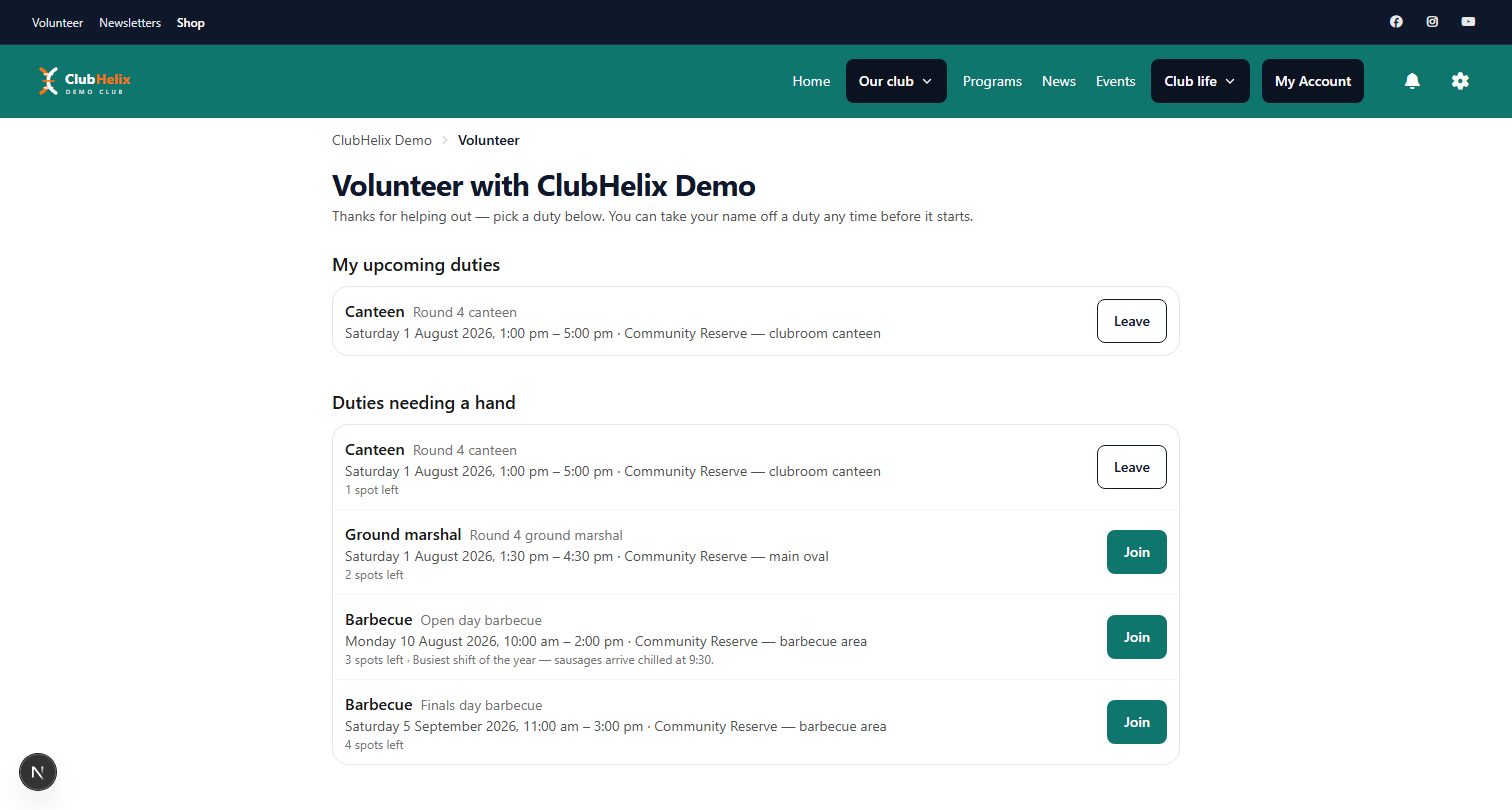
Round out the system with three artefacts that survive volunteer turnover: the laminated basics sheet above the bench; a one-page open/close checklist (fridge temp checked and recorded, thermometer present, sanitiser made up, raw/cooked tongs separated — then the reverse at close); and a ten-minute induction for first-timers, delivered by the shift supervisor from the sheet. If something does go wrong — a customer reports illness, a fridge fails overnight — treat it like any club incident: record it promptly and factually (our incident report template works for canteen incidents too), bin any suspect stock, and loop it into your risk register review. Food incidents are also where your insurer and council want early, honest records — see our guides on club insurance.
Frequently asked questions
Does a volunteer-run club canteen need to register with the council?
Very often yes — clubs selling food generally count as food businesses and most councils require at least a notification, though many jurisdictions apply lighter-touch arrangements for low-risk community and fundraising food activities. The requirements depend on what you sell and how often, so call your council's environmental health team with a plain description of your canteen and get the answer in writing. It's usually free or cheap, and it comes with helpful guidance.
Do canteen volunteers need food safety training?
Everyone handling food needs basic skills and knowledge appropriate to what they do — that's a general requirement of the food standards — and some operations need a person with formal food safety supervisor–style credentials, depending on jurisdiction and risk level. For a typical club canteen, the practical approach is: put two or three regulars through a recognised (often free) online food handler course, have one of them on every roster, and induct every casual volunteer from your laminated basics sheet.
What are the temperature rules for a sausage sizzle?
Keep raw sausages cold (5°C or below, in a fridge or well-iced esky) until they hit the grill, cook them right through with juices running clear, and serve promptly or hold them above 60°C. Use separate tongs for raw and cooked, and apply the community-event time rule to anything that sits out: under two hours in the danger zone, refrigerate or use; two to four hours, use immediately; beyond four, throw it away. A probe thermometer removes the guesswork for a few dollars.
What equipment does a compliant club canteen actually need?
Less than you'd fear, for a typical low-to-medium-risk canteen: a fridge that reliably holds 5°C or below (with a fridge thermometer so you can prove it), a probe thermometer for cooking and hot-holding checks, separate colour-coded tongs and boards for raw and ready-to-eat food, handwashing facilities with soap and paper towel, food-grade sanitiser for benches, sealed containers for storage, and lidded bins. For off-site sausage sizzles add well-iced eskies and a way to keep cooked food above 60°C or serve it straight off the grill. Your council's environmental health officer will tell you if your particular menu needs more — which is another reason that pre-season phone call pays for itself.
How should we handle allergen questions at the canteen?
Keep an ingredient list or the original packaging for everything unwrapped that you sell, train volunteers to check rather than guess, and never talk a customer past their allergy ("there's probably none in it" is a sentence that has no place at a canteen window). For club-made items, a simple card listing the main allergens present is both good practice and good service. When in doubt, say so honestly — parents of allergic kids deeply appreciate a straight "I can't be sure of that one".
Full shifts, briefed volunteers, no empty canteen window. ClubHelix's volunteer rostering fills the season's shifts and reminds people automatically — explore all features or see pricing.


