
What this guide answers
- What should an incident report never include?
Blame, speculation and diagnosis. "The other team's player is a thug", "it was definitely a concussion", "the coach should have cancelled training" — all of these belong to other processes (tribunals, doctors…
- Who should fill in the incident report — the injured person or an official?
Whoever saw it and holds responsibility on the day — usually the coach, team manager or first aider.
- How long should a club keep incident reports?
Longer than feels natural — personal injury claims can arise years after an incident, and claims involving minors can be brought well after they turn 18, so many clubs retain incident records for a decade or more.
- Should near-misses really get a full report?
Yes — and make it culturally normal, because near-misses are the cheapest safety data a club will ever collect.
- Do we need to report incidents to anyone outside the club?
Sometimes, and the form should prompt the question (field 16).
Something happens at training — a rolled ankle, a collapsed goalpost, a spectator altercation, a near-miss in the car park. Six weeks later, the association asks for details, or an insurance claim needs the facts, or a pattern of similar injuries starts to matter. What the club has at that point is whatever someone wrote down within a day or two of the incident. Usually, that's nothing.
An incident report form fixes this — but only if the form is good and the process is easy. A bad form intimidates volunteers into not reporting; a good one takes five minutes on a phone and captures exactly what future-you needs. This guide gives you the template, field by field, with the reasoning behind each one, then covers the part most clubs skip: access, privacy and follow-up.
General information only. This guide is general information for community clubs, not legal or financial advice. Requirements differ by state and change over time — always confirm with the official sources linked below.
Two framing notes before the template. First, some incidents carry external reporting obligations that your club form doesn't satisfy on its own — serious injuries may be notifiable to a workplace safety regulator, child safety matters route to police and your sport's safeguarding processes, and your association or insurer will have their own notification requirements and deadlines. The club form is the internal record that feeds those channels. Second, an incident report is a factual account, not a verdict — it records what happened and what was done, not whose fault it was.
Serious workplace-style incidents may be notifiable to your state WHS regulator (see Safe Work Australia's guidance on incident notification), and child safety matters route to police, child protection and your sport's safeguarding processes (see our child safe standards guide).
What counts as a reportable incident?
Set the bar low and say so on the form. Clubs should capture: any injury beyond trivial (anything needing first aid or where a participant left the session), any head knock at all, medical episodes, property damage or equipment failure, security incidents, behavioural incidents (abuse of officials, altercations, discrimination complaints), child safety concerns, and — this is the one clubs miss — near-misses, where nobody was hurt but easily could have been. Near-misses are free lessons; a register full of them is a club that sees problems coming. Your risk register is only as good as this feed.
The template, field by field
| # | Field | Type | Why it's there |
|---|---|---|---|
| 1 | Reporter name and role | Text | Who is giving this account (coach, manager, first aider, parent) |
| 2 | Date and time of incident | Date/time | Precision matters for insurance and patterns; "about 6:30pm" beats blank |
| 3 | Date and time reported | Auto | The gap between 2 and 3 is itself useful information |
| 4 | Location | Text/picklist | Ground, court number, clubroom, car park — specific enough to spot venue patterns |
| 5 | Activity at the time | Picklist | Match, training, event, canteen duty, travel — routes the report and reveals patterns |
| 6 | Type of incident | Picklist | Injury / illness / head knock / property / behaviour / security / child safety concern / near-miss |
| 7 | People involved | Text | Names and roles of those directly involved; age group if a junior |
| 8 | Witnesses | Text | Names and contact details — memories fade, get them on day one |
| 9 | What happened | Long text | Factual narrative: what was seen, in order, in plain words. No blame, no diagnosis |
| 10 | Injury details (if any) | Structured | Body part, apparent nature (cut, sprain, suspected fracture), left/right |
| 11 | First aid / action taken | Long text | What was done, by whom, when — including "none needed" |
| 12 | Outcome on the day | Picklist | Resumed activity / sat out / sent home / ambulance / hospital / police attended |
| 13 | Parent or emergency contact notified? | Yes/No + time | Non-negotiable field for any junior incident |
| 14 | Equipment or conditions a factor? | Yes/No + text | Wet surface, faulty gear, poor light — this is your risk-register gold |
| 15 | Photos | Upload | Conditions, equipment, hazards — never injured people |
| 16 | Referred to | Picklist | Committee / safety officer / MPIO / association / insurer / external authority |
| 17 | Follow-up needed | Text | The loose ends: welfare check, equipment repair, policy question |
Then a second section completed later by the club's safety officer or secretary, kept separate from the reporter's account: review date and reviewer, follow-up actions taken, external notifications made (association, insurer, regulator — with dates), and closure notes. Keeping "what the reporter saw" separate from "what the club then did" preserves the integrity of the original account.
Writing the narrative field well
Field 9 is where reports go wrong, so coach your volunteers with three rules. Facts, not conclusions: "Player landed on his left arm and said he heard a crack" — not "broke his arm" (you don't know yet) and certainly not "the tackle was reckless" (that's a judgement for another process). Sequence: what happened first, then, then. Plain words: the reader in six months may be an insurer, a tribunal or a new committee; write so they can see it. A good narrative is five to ten sentences. If a report ever becomes part of a legal or insurance matter, the sober factual account is worth everything; the speculative one is a liability.

Who can see incident reports? (Decide before, not after)
Incident reports contain health information, children's details and sometimes allegations — among the most sensitive records a club holds, and treated as a special category by privacy law almost everywhere.
Health information gets specific protection under Australian privacy law (the OAIC's health information guidance is the reference point), and even where small clubs fall outside the Privacy Act's formal scope, members reasonably expect the same care.
The rules to set:
- Submission is open, reading is restricted. Anyone can lodge a report; only named roles (safety officer, secretary, president, MPIO for behavioural/child-safety matters) can read them.
- Child safety concerns route tighter still — direct to your child safety contact and the external channels, not the general committee pile.
- No incident details in group chats. Ever. The report is the record; the chat is a leak.
- Retention: keep incident records for the long haul — injury claims can surface years later, and minors can bring claims after turning 18. When in doubt, retain; your association or insurer can advise on periods.
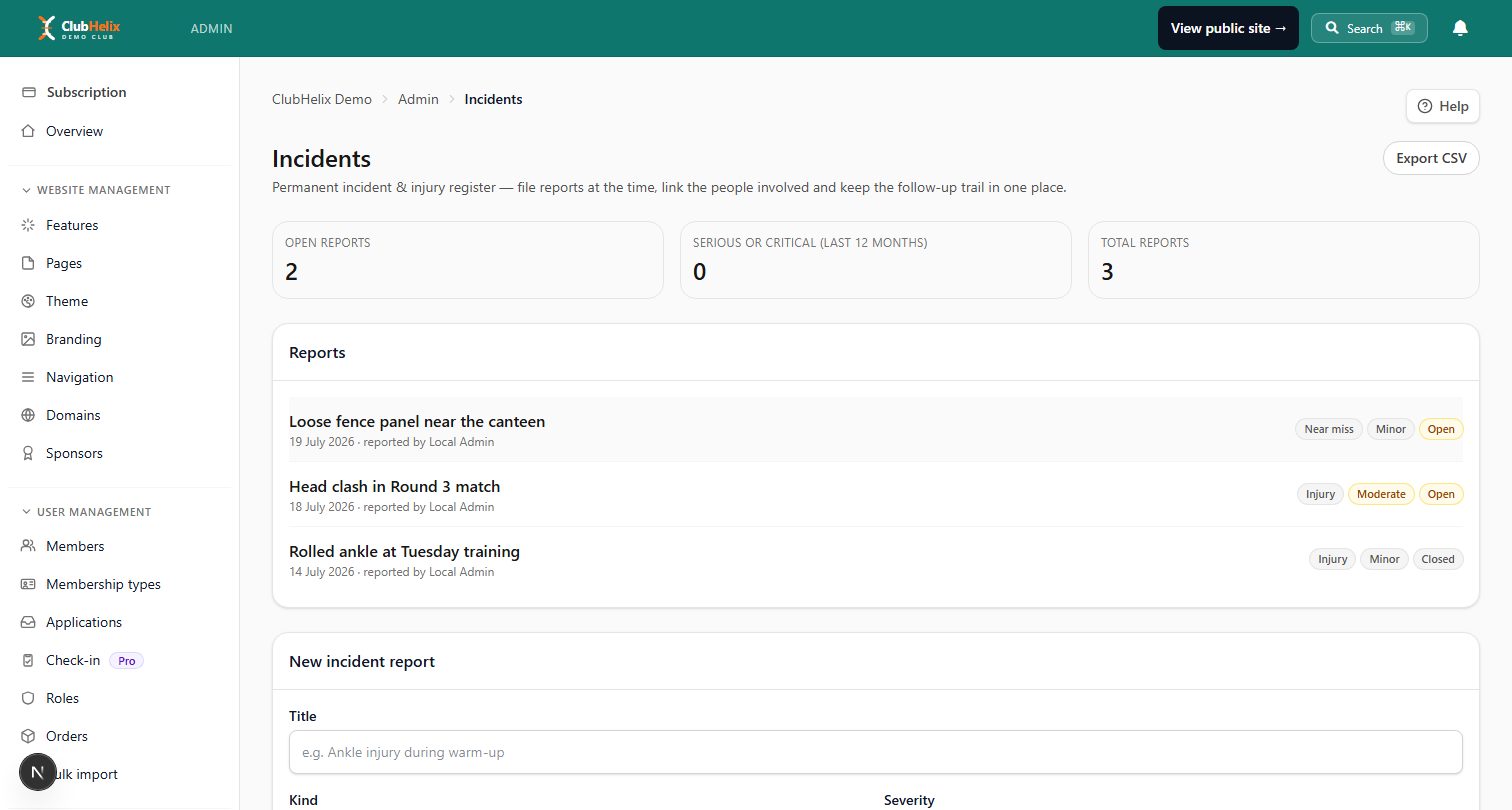
This is where paper forms and shared spreadsheets structurally fail: they can't do submission-open/reading-restricted. A purpose-built system can. ClubHelix's incident reporting feature lets any coach or manager lodge a structured report from their phone in minutes, while access stays locked to the officers who should see it — with the full history searchable when the committee, the association or the insurer needs it.
The process around the form
A form without a process is a filing cabinet. The minimum viable process has four beats. Report within 24 hours — publish the expectation to every coach and team manager at pre-season induction, and make the form reachable in two taps. Acknowledge and triage within 48 — the safety officer reads every report, checks welfare, and routes anything with external obligations immediately (insurer deadlines can be short). Fix the fixable now — a broken sprinkler head that rolled an ankle gets flagged to the ground owner the same week, and the report records that it was. Review quarterly — counts, patterns, control failures, feeding straight into the risk register review at committee, minuted.
And close the loop with reporters: a coach who lodges a report and hears nothing learns not to bother next time. A one-line "thanks — handled, here's what changed" keeps the reports coming, and the reports are the whole point.
Frequently asked questions
What should an incident report never include?
Blame, speculation and diagnosis. "The other team's player is a thug", "it was definitely a concussion", "the coach should have cancelled training" — all of these belong to other processes (tribunals, doctors, reviews), not the factual record. Stick to what was seen and done. Also avoid photographing injured people, and keep health details to what was observed and the first aid given.
Who should fill in the incident report — the injured person or an official?
Whoever saw it and holds responsibility on the day — usually the coach, team manager or first aider. The injured person's account can be added, but don't make it their job while they're hurt. What matters is that one named person owns lodging the report within 24 hours, and that witnesses are recorded on day one while contact details are easy to get.
How long should a club keep incident reports?
Longer than feels natural — personal injury claims can arise years after an incident, and claims involving minors can be brought well after they turn 18, so many clubs retain incident records for a decade or more. Storage is cheap; a missing record when a claim lands is not. Confirm expectations with your association and insurer, and keep the records access-controlled for the whole retention period.
Should near-misses really get a full report?
Yes — and make it culturally normal, because near-misses are the cheapest safety data a club will ever collect. The goalpost that toppled onto empty grass this week is the same goalpost that lands on a seven-year-old next month; the difference between those two outcomes is whether anyone wrote the first one down and fixed the anchor. Keep the bar low for near-miss reports (the same form, most fields optional, two minutes on a phone) and celebrate rather than eye-roll the volunteers who file them. A season's worth of near-misses is a map of where your next real incident is coming from, and it feeds your risk register with facts instead of guesses.
Do we need to report incidents to anyone outside the club?
Sometimes, and the form should prompt the question (field 16). Serious incidents may be notifiable to your state WHS regulator, child safety matters go to police, child protection and your sport's safeguarding channels, insurers typically require prompt notification of anything that could become a claim, and your association may require reports for tribunal or insurance purposes. The club form is the internal record that makes all of those external reports fast and accurate.
Make the report easier than the excuse. ClubHelix's incident reporting puts a structured, access-controlled form in every coach's pocket — explore all features or see pricing.


