
What this guide answers
- Are the child safe standards legally mandatory for community sports clubs?
Increasingly, yes — several states have legislated Child Safe Standards that apply to organisations providing services to children, sports clubs included, each with its own regulator and compliance expectations, while…
- Do we need to write our own member protection policy from scratch?
Almost never. Your national or state sporting body very likely publishes a member protection policy and child safeguarding policy that affiliated clubs adopt, and Play by the Rules offers free club-level templates and…
- What is an MPIO and does our club need one?
A Member Protection Information Officer is a trained first point of contact for members with concerns about child safety, discrimination, harassment or other member protection issues — they listen, explain the options…
- How do we get volunteers to actually read the policy?
Don't rely on reading — build the policy into moments volunteers already pass through.
- What should we do when someone reports a child safety concern?
Take it seriously, record it, and route it — immediately to police if a child is in danger, to your state child protection authority where reporting obligations apply, and through your sport's child safeguarding…
Every club with junior members says it takes child safety seriously. The National Principles for Child Safe Organisations exist to turn that sentence into something checkable — ten concrete expectations covering leadership, policies, recruitment, complaint handling and review, endorsed by all Australian governments and progressively embedded in state law, sport funding conditions and national sporting body requirements.
For a volunteer committee, the principles can feel abstract on first read. This guide translates them into community-club terms: what each principle actually asks of a club your size, what a member protection policy should contain, and — most importantly — the operating habits that make a club genuinely child safe rather than child safe on paper.
General information only. This guide is general information for community clubs, not legal or financial advice. Requirements differ by state and change over time — always confirm with the official sources linked below.
Where the standards come from
The National Principles for Child Safe Organisations were developed following the Royal Commission into Institutional Responses to Child Sexual Abuse and are published by the Australian Human Rights Commission. The National Office for Child Safety coordinates their implementation nationally. Each state and territory has been embedding them — some as legislated Child Safe Standards with their own regulators and slightly adapted wording, others through funding and sector requirements. In sport specifically, Sport Integrity Australia administers the National Integrity Framework that most national sporting organisations have adopted, including its Child Safeguarding Policy, and Play by the Rules publishes free club-level guidance and training.
Practical upshot for your committee: your obligations arrive through two channels at once — your state's child safe scheme (check your state government's child safety pages for the local regulator and any mandatory standards) and your sport's own policies, which bind affiliated clubs through your association. Read your national body's child safeguarding and member protection policies first; most clubs discover the framework they must follow is already written, and their job is adoption and implementation, not authorship.
Two dates your committee should know
Queensland's Child Safe Standards became binding on sporting clubs on 1 April 2026. If your club is in Queensland, the standards stopped being good practice on that date and became an obligation with a regulator behind it, phased in across the organisations the legislation covers. Read your state regulator's own page rather than a summary — including this one — because the wording and the timetable are local.
The second date is the one that explains why the club's own record-keeping matters so much right now. Australian governments agreed on 31 July 2026 to reform working with children checks nationally, so that a clearance and the monitoring behind it work consistently across borders rather than eight different ways. That reform is not operational until 2029. For the three years in between, nothing changes in practice: the schemes stay separate, a check still does not travel reliably between states, and the only continuous record of who at your club is cleared for what is the register your club keeps and the links it holds with each scheme. A committee that reads "national reform agreed" as "this is being handled" will spend three seasons with a gap it thinks is closed. The working with children check guide covers what that register has to contain and why an expiry date alone is not enough.
The ten national principles, in club terms
- Child safety is embedded in leadership, governance and culture. The committee owns this — it's an agenda item, a named Member Protection Information Officer (MPIO) or child safety contact, and decisions that visibly prioritise kids.
- Children participate in decisions affecting them and are taken seriously. Junior members have real ways to speak up — captains' groups, surveys, a known adult they can talk to — and complaints from kids are treated as seriously as complaints from adults.
- Families and communities are informed and involved. Parents know your policies, who the child safety contact is, and how selection, travel and communication with juniors work.
- Equity is upheld and diverse needs respected. The club actively includes kids with disability, from different cultures, and from tough circumstances.
- People working with children are suitable and supported. Safe recruitment: working with children checks verified before roles start, reference conversations for junior coaches, codes of conduct signed, induction done.
- Processes to respond to complaints are child-focused. A clear, known path for concerns and complaints, taken seriously, acted on quickly, with records kept.
- Staff and volunteers are equipped through education and training. Your junior coaches and managers know what grooming looks like, what the code of conduct requires, and what to do with a concern.
- Physical and online environments minimise opportunity for harm. Two-adult rules, change-room policies, and controlled digital channels — official club platforms rather than private coach–child messaging.
- Implementation is regularly reviewed and improved. An annual review of policies, incidents and near-misses, minuted at committee.
- Policies and procedures document how the organisation is child safe. Written, accessible, actually followed.
None of this requires a compliance department. It requires the committee to decide it matters, write down how the club does things, and build the handful of systems that keep it true every season.
Your member protection policy: an outline
Most clubs implement the principles through a member protection policy (often adopted from their national body's template — start there before writing your own; Play by the Rules also publishes resources and templates). Whether you adopt or adapt, a complete club policy covers:
| Section | What it contains |
|---|---|
| Purpose and scope | Who and what the policy covers — members, volunteers, parents, spectators, officials, online conduct |
| Child safety commitment | Statement of zero tolerance; the national principles the club follows |
| Codes of conduct | Separate short codes for coaches/officials, players, and parents/spectators — signed at registration |
| Recruitment and screening | Which roles need a working with children check; verification and record-keeping; induction |
| Communication rules | How adults communicate with juniors (official channels, group-not-private, parents included) |
| Photography and images | Consent at registration, publication rules, no identifying details with images |
| Complaints and reporting | Who to raise concerns with (MPIO/child safety contact), the process, escalation to police/child protection and the sport's integrity unit, protection from reprisal |
| Discipline | How breaches are handled, aligned with your association's tribunal processes |
| Review | Who reviews the policy and when |
Two adoption mistakes to avoid: adopting a 40-page policy nobody reads (better: adopt the association's policy formally, then publish a two-page club summary everyone actually reads), and adopting a policy that names people who left the club in 2023 — the policy should name roles, and a current contact list should live beside it.
From paper to practice: the systems that make it real
A policy in a drawer protects nobody. The clubs that are genuinely child safe run four everyday systems:
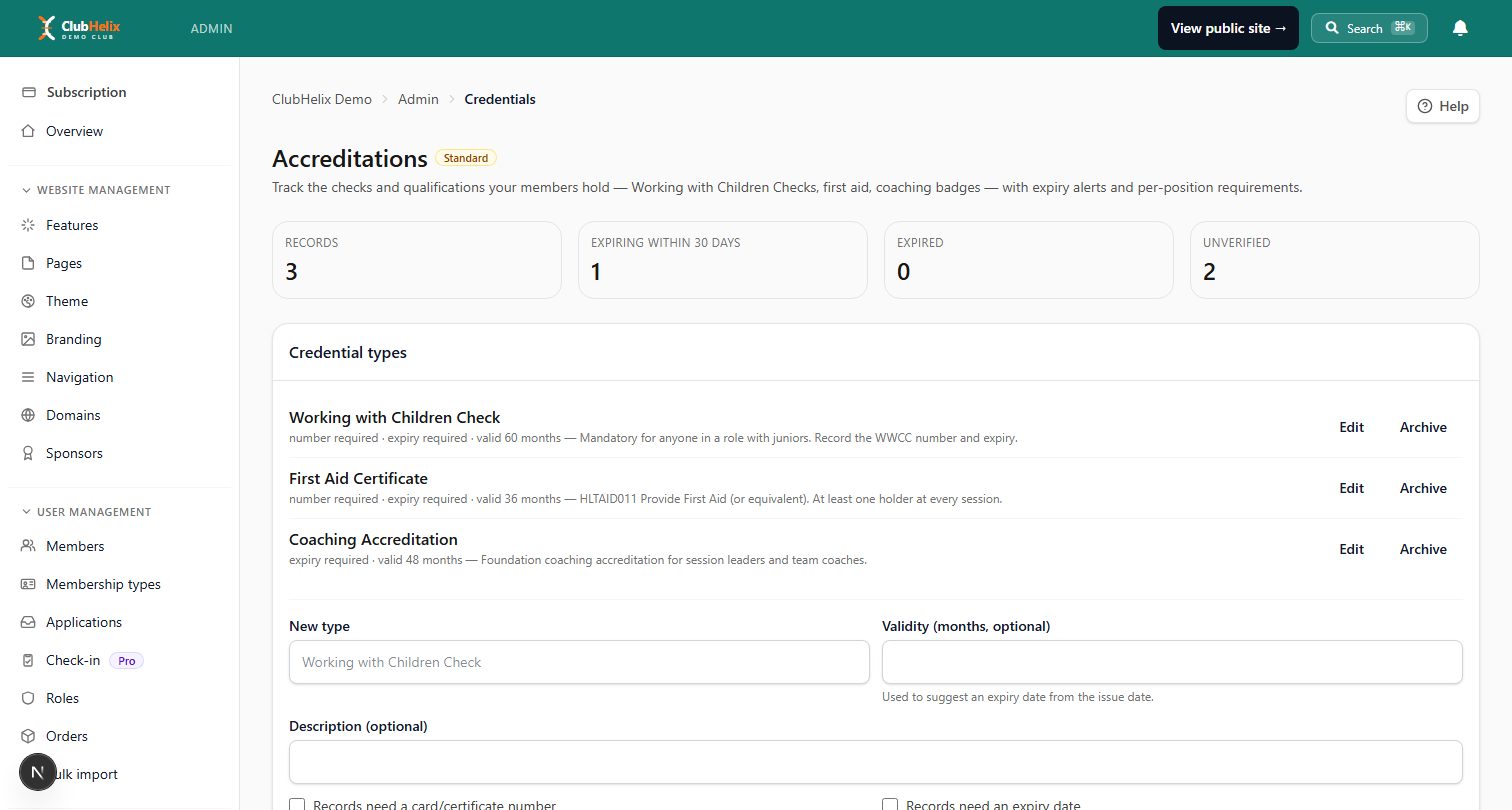
A screening register that can't drift. Every child-facing role mapped, every check verified and recorded with its expiry, renewals chased automatically. This is credential management, and it belongs in a system built for it — ClubHelix's accreditations feature keeps every member's checks and qualifications against their record with expiry tracking and reminders, so "everyone's current" is a report, not a hope.
A reporting path people actually use. Concerns die in clubs where raising them is awkward. Publish who the child safety contact is (website, newsletter, clubroom wall), accept concerns in writing through a simple form, and record every report and what was done about it. ClubHelix's incident reporting gives the club a structured, access-controlled record — see our incident report template guide for what to capture. Remember that some matters must go straight to police or child protection authorities, and sport integrity matters to your sport's national processes; your club process is the front door, not the whole house.
Consent captured at registration. Photo/video consent, codes of conduct acknowledgement, and emergency contacts all belong in the registration flow — collected once, stored against the member, reportable when you need to check. Doing this digitally at sign-up beats chasing paper forms in week three, every time.
A visible annual review. Once a year, on the committee agenda: are checks current, did complaints get handled properly, what did incidents teach us, does the policy need updating? Minute it. That single agenda item is principle 9 in action and powerful evidence of principle 1 — and it slots naturally into your broader club risk management review.

Culture: the standard behind the standards
Everything above can be true and a club can still be unsafe if its culture punishes speaking up. The behaviours that actually protect kids are small and constant: coaches who never find reasons to be alone with a junior; a committee that thanks the parent who raises an awkward concern instead of bristling; selection and discipline decisions that would survive being read aloud at the AGM; adults who intervene at the first off-colour comment, not the fifth. Committees set this tone. If your club gets the culture right, the ten principles become descriptions of how you already operate — and the paperwork becomes the easy part.
Frequently asked questions
Are the child safe standards legally mandatory for community sports clubs?
Increasingly, yes — several states have legislated Child Safe Standards that apply to organisations providing services to children, sports clubs included, each with its own regulator and compliance expectations, while other jurisdictions apply the national principles through funding and sector arrangements. On top of that, most clubs are bound through affiliation to their sport's child safeguarding policies. Check your state government's child safe scheme pages and your national sporting body's integrity policies for what specifically binds your club.
Do we need to write our own member protection policy from scratch?
Almost never. Your national or state sporting body very likely publishes a member protection policy and child safeguarding policy that affiliated clubs adopt, and Play by the Rules offers free club-level templates and training. Formally adopt the applicable policy at committee (minute it), then produce a short club-level summary with your local contacts and rules. Writing from scratch risks contradicting the policies that already bind you.
What is an MPIO and does our club need one?
A Member Protection Information Officer is a trained first point of contact for members with concerns about child safety, discrimination, harassment or other member protection issues — they listen, explain the options, and route the matter properly rather than investigate it. Many state associations expect or require clubs to have one, and free/low-cost MPIO training is widely available through state sport departments and Play by the Rules. Even where it's not mandated, having a known, trained contact is one of the highest-value child-safety moves a club can make.
How do we get volunteers to actually read the policy?
Don't rely on reading — build the policy into moments volunteers already pass through. Codes of conduct are acknowledged at registration, not distributed as PDFs; the two-page club summary is part of coach and manager induction each pre-season; the child safety contact's name is on the website, the newsletter footer and the clubroom wall; and communication rules ("group channels, parents included, never private") are stated wherever team chats are set up. A ten-minute pre-season briefing for junior coaches covers more ground than a forty-page document nobody opens. The test isn't whether people have read the policy — it's whether a random team manager can name the child safety contact and the two or three rules that apply to their role.
What should we do when someone reports a child safety concern?
Take it seriously, record it, and route it — immediately to police if a child is in danger, to your state child protection authority where reporting obligations apply, and through your sport's child safeguarding process for integrity matters. The club's own role is to listen without judgement, document what was reported and when, act on any interim safety measures (like standing someone down pending an outcome), and never investigate serious allegations itself. Keep records access-controlled and factual.
ClubHelix helps you run the systems behind the policy — credential tracking, incident records, and consent captured at registration. Explore all features or see pricing.


