
What this guide answers
- Do volunteers at a sports club need a working with children check?
In most Australian states, yes — volunteer roles involving children (coaching, managing, supervising junior teams) are covered by the schemes, and volunteer checks are typically free or low-cost.
- How long does a working with children check last?
It depends on the state — validity periods across the schemes range from two to five years.
- Does a check from one state work in another state?
Generally no — the schemes are state-based, and a person doing child-related work in a state normally needs that state's check, though there are limited cross-border arrangements for short visits in some jurisdictions.
- What happens if a volunteer's check expires mid-season?
Treat it as a hard stop, not a technicality: an expired check means the person should step out of child-facing roles until their renewal comes through, because the schemes' protections (including ongoing monitoring)…
- What if a check is revoked before it expires?
This is the gap most clubs never think about, and it is the reason verification matters more than record-keeping.
If your club has junior members, working with children checks are part of running it — as fundamental as insurance or a bank account. Coaches, team managers, age-group coordinators and plenty of other volunteers will need a valid check or registration under your state's scheme, and the club has its own obligations: knowing who needs one, verifying them, and making sure nobody's check quietly expires mid-season.
The complication is that Australia doesn't have one scheme — it has eight. Each state and territory runs its own check with its own name (Working with Children Check, Blue Card, Ochre Card, WWVP registration), its own rules about who needs one, its own volunteer arrangements, and its own validity period. This guide explains the common shape of the schemes, links every official state page, and covers the part clubs most often get wrong: tracking checks so they're renewed before they lapse.
General information only. This guide is general information for community clubs, not legal or financial advice. Requirements differ by state and change over time — always confirm with the official sources linked below.
How the schemes work (the common shape)
Every scheme is different in detail, but they share a structure worth understanding before you dive into your own state's rules:
- It's a screening of the person, not a training course. A working with children check screens an individual's criminal history and, in most schemes, keeps monitoring it while the check is valid. It says "this person is not barred from child-related work" — it does not make them a safe or competent coach on its own, which is why checks sit inside a broader child-safe framework, not instead of one.
- "Child-related work" usually includes volunteering. Most schemes explicitly cover unpaid roles. Volunteer checks are typically free or heavily discounted in most jurisdictions.
- There are exemptions — and they're narrow. Common ones include parents volunteering in activities their own child participates in, one-off helpers, and under-18 volunteers. But the exemptions differ significantly by state and are the single most misunderstood part of the system. Never assume; check your scheme's page.
- The organisation has obligations too. Clubs generally must verify checks (not just sight a card — actually validate the number with the scheme), keep records, and in several states register as an employer/organisation with the scheme. Some schemes require the club to report when a person starts or stops child-related work.
- Checks expire. Validity runs two to five years depending on the state. An expired check is no check.
Your sport's state association or national body will usually publish sport-specific guidance layered on top of the state scheme — Play by the Rules and Sport Integrity Australia are the best general starting points for how the schemes apply in sport.
State-by-state schemes and official links
| State / territory | Scheme name | Official page |
|---|---|---|
| NSW | Working with Children Check (WWCC) | Office of the Children's Guardian |
| VIC | Working with Children Check | workingwithchildren.vic.gov.au |
| QLD | Blue Card | Queensland Blue Card Services |
| WA | Working with Children Check | workingwithchildren.wa.gov.au |
| SA | Working with Children Check | SA Dept of Human Services Screening Unit |
| TAS | Registration to Work with Vulnerable People | CBOS Tasmania |
| ACT | Working with Vulnerable People (WWVP) registration | Access Canberra |
| NT | Ochre Card (Working with Children Clearance) | NT Government — Ochre Card |
When you read your scheme's page, answer these questions in writing for your club: Who at our club needs a check (coaches? managers? committee? canteen?)? What are the volunteer exemptions and do any apply? How do we, as an organisation, verify a check and do we need to register with the scheme? How long are checks valid? What must we do when someone joins or leaves a child-facing role? That one-page summary becomes part of your club's child-safety documentation and your committee handover.
Which club roles typically need a check?
The precise answer is your state's, but as a planning starting point, clubs commonly find that these roles are in scope: coaches and assistant coaches of junior teams, team managers, age-group coordinators, junior program leaders, first-aiders assigned to junior teams, and anyone who transports or supervises children overnight (camps, travel teams). Committee members are explicitly in scope in some schemes when the organisation provides services to children. Roles like occasional barbecue volunteers or grounds maintenance are often out of scope or exempt — but again, exemptions are the trap: a parent-volunteer exemption in one state may not exist in another, and it may stop applying the moment the parent's role becomes regular or formal.
The safest operational posture for a club is simple: map every volunteer role once, decide (from the official guidance) whether it needs a check, write the answer down, and apply it consistently. When a new volunteer steps up, the answer is already on the list — no on-the-spot judgement calls at training on a Tuesday night.

Verify properly — sighting a card is not verifying it
Most schemes expect organisations to validate a check, not just glance at a card: that usually means entering the person's name and check number into the scheme's online verification tool, confirming the status is current and appropriate for the role (volunteer versus paid categories matter in some states), and recording that you did so.
Record, at minimum: name, check/card number, type (volunteer/paid), expiry date, the date you verified it, and who verified it. That record is the difference between "we're confident everyone's covered" and "we think Dave had one?"
The part almost nobody explains: it is a link, not a lookup
Here is something worth knowing before you go shopping for software that promises to "check WWCCs automatically". No Australian jurisdiction offers a working-with-children verification API to an ordinary organisation. Not one. Queensland has said so in writing: Blue Card Services state they have no current plans to publish an API endpoint for blue card validation, citing their own legislation, in a response published on the Queensland open-data portal on 9 January 2025. Victoria is the only jurisdiction offering anything like bulk processing, and it is a spreadsheet rather than an interface — an organisation can submit a CSV file of up to 1,500 rows for checking. Everywhere else you are looking at a web portal, a public single-card checker, or something more manual again: in the Australian Capital Territory the mechanism for an organisation is emailing a list of its people to a government address.
So any vendor claiming live, automatic verification of a check is describing something that does not exist to sell you. What does exist is better than an API, and it is the thing most clubs never switch on.
The real control is a persistent link between your organisation and the person, held inside the regulator's own system. You do not poll it; it contacts you. Queensland states the rule as a slogan — "No Card. No Link. No Start" — and says that once a person is linked, the organisation will then be notified of any change to a card holder's status. New South Wales puts it the same way: verifying makes the link, and if your worker becomes barred in the future, they will let you know immediately. South Australia notifies all known organisations. The link is created by the act of verifying properly and registering as an employer or organisation with the scheme — which is exactly the step a club skips when someone photographs a card and texts it to the registrar.
Why an expiry date on its own is not enough
This is the failure mode the link exists to catch, and it is the one a spreadsheet cannot see. A check can be revoked, suspended or barred long before it expires. When that happens:
- The expiry date in your register is still in the future.
- No renewal reminder fires, because nothing is due.
- Your monthly glance at the register shows the coach as current.
- The only party that knows is the regulator — and it will tell you, but only if the link exists.
Put bluntly: an expiry-tracking register answers "has this lapsed?", and the regulator's link answers "is this person still cleared?". They are different questions, a club needs both answers, and only one of them can be automated by anybody other than the scheme itself.
What to do about it this month. Confirm your club is registered with your state or territory's scheme as an organisation or employer, not merely a bystander to individual cards. Verify each person through the scheme's own tool so the link is made, and record the date you did it and who did it. Record whether each person is linked to your club in the scheme, as a field in its own right — it is not the same fact as "has a valid card". Re-verify on a cadence rather than only at expiry, especially for anyone who joined before the club started doing this properly. And make sure the scheme holds a current club email address that more than one person reads, because a notification sent to a 2019 committee inbox is a notification nobody receives.
Tracking expiries: where clubs actually fail
Almost no club fails by ignoring checks entirely. They fail by drift: the spreadsheet lives with a volunteer who left, renewals aren't chased until someone notices at finals, and a coach spends a season with an expired check nobody looked at. The fix is to treat checks like any other credential with an expiry date and put them in a system that watches the dates for you.
This is exactly what ClubHelix's accreditations feature does: record each member's check with its number, type and expiry; see at a glance who's current, expiring soon or lapsed across every team; and let automatic reminders chase renewals weeks before expiry instead of after. Because it's attached to the member record, the credential follows the person across seasons and roles, and the club always has a defensible register to show its association or a grant assessor. What no register can do — ours or anyone's — is tell you a clearance has been revoked before its expiry date. That notice comes from the scheme, to a club that has done the linking described above, which is why the two belong together rather than one standing in for the other.
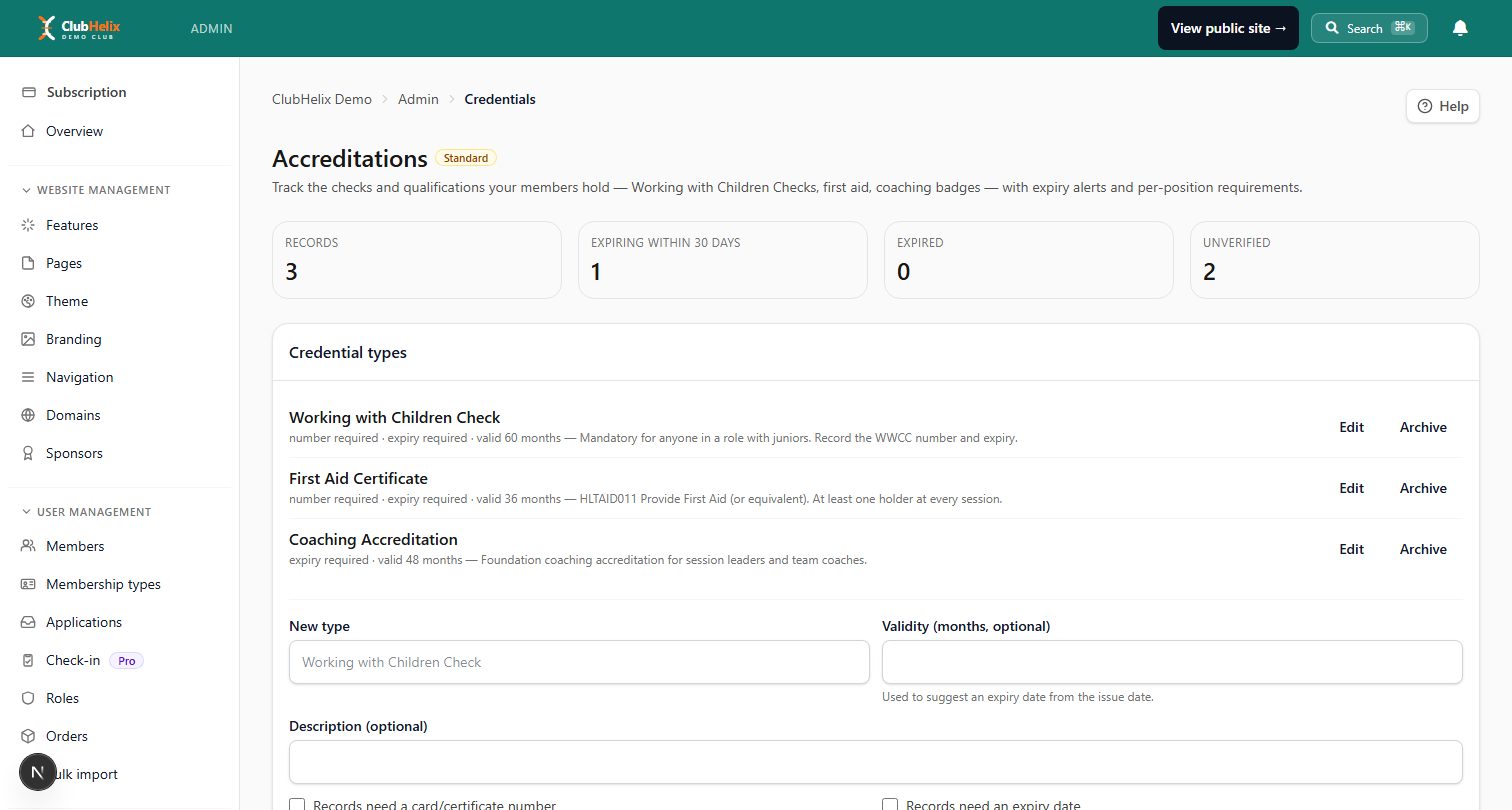
A good rhythm: review the register monthly during season (it's a two-minute glance when the data is live), start renewal reminders 60–90 days out (renewals can take weeks to process), and make "valid check verified" a gate in your volunteer onboarding — the role assignment happens after verification, not before. If you roster volunteers through your platform, connect the two: someone whose check has lapsed shouldn't be rosterable into a child-facing role, and a volunteer rostering system that knows about credentials closes that loop.
Checks are the floor, not the ceiling
A final framing your committee should hear: working with children checks are a screening baseline. They exclude people with disqualifying histories; they don't create a child-safe club by themselves. The National Principles for Child Safe Organisations — covered in our child safe standards guide — expect clubs to also have codes of conduct, safe recruitment beyond the check, complaint handling, and a culture where concerns are raised and acted on. And when something does go wrong, a proper incident reporting process is what turns a bad moment into a managed one. Checks, standards, and reporting are three legs of the same stool.
Frequently asked questions
Do volunteers at a sports club need a working with children check?
In most Australian states, yes — volunteer roles involving children (coaching, managing, supervising junior teams) are covered by the schemes, and volunteer checks are typically free or low-cost. The main nuance is exemptions, such as parents helping in their own child's activity, which vary significantly by state. Check the official page for your scheme (linked in the table above) and write down which of your club's roles need a check.
How long does a working with children check last?
It depends on the state — validity periods across the schemes range from two to five years. The practical implication for clubs is that in any given season, some of your volunteers' checks will be approaching expiry, which is why an expiry-tracked register with automatic reminders matters more than the one-off paperwork.
Does a check from one state work in another state?
Generally no — the schemes are state-based, and a person doing child-related work in a state normally needs that state's check, though there are limited cross-border arrangements for short visits in some jurisdictions. If your club travels interstate for carnivals or your volunteers live across a border, read both states' official guidance rather than assuming a check travels.
What happens if a volunteer's check expires mid-season?
Treat it as a hard stop, not a technicality: an expired check means the person should step out of child-facing roles until their renewal comes through, because the schemes' protections (including ongoing monitoring) only apply to current checks, and the club's obligations assume validity. This is exactly why renewal reminders need to start 60–90 days before expiry — renewals can take weeks to process, and a coach benched in finals week because nobody watched the date is an avoidable failure. If it happens anyway, backfill the role temporarily, record the gap and what the club did about it, and tighten the reminder window. A register that shows expiries coming is the difference between a planned handover and a scramble.
What if a check is revoked before it expires?
This is the gap most clubs never think about, and it is the reason verification matters more than record-keeping. A clearance can be suspended, cancelled or turned into a bar at any time — the expiry date in your register does not move, no reminder fires, and your own paperwork will keep reporting the person as current. Nobody outside the scheme can detect it: there is no verification API in any Australian jurisdiction, so there is nothing to poll. What catches it is the link between your organisation and that person inside the regulator's system, created when you verify properly and register your club with the scheme — Queensland's "No Card. No Link. No Start" is exactly this rule, and Queensland, New South Wales and South Australia all undertake to notify linked organisations when a status changes. If your club is not registered with its scheme, a revocation is invisible to you. Fix that before you tidy the spreadsheet.
What should the club record about each volunteer's check?
At minimum: full name, check or card number, check type (volunteer or paid), expiry date, the date the club verified it through the scheme's online tool, who verified it, and whether the person is linked to your club inside the scheme — that last field is what determines whether a revocation ever reaches you. Keep the register current and private — it contains personal information, so store it in a permission-controlled system rather than a shared spreadsheet, and apply your club privacy practices to it like any other member data.
Stop tracking checks in a spreadsheet three volunteers old. ClubHelix's accreditations feature records every check with its expiry and chases renewals automatically — explore all features or see pricing.


