
What this guide answers
- Is public liability insurance legally required for sports clubs?
There's generally no single law saying "clubs must hold public liability insurance" — but in practice it's mandatory anyway, because councils, venue owners, schools, associations and event approvals all require it as a…
- Are volunteers covered by the club's insurance?
Often, but never assume — coverage of volunteers depends on the specific policies.
- What is a certificate of currency and who asks for them?
It's a one-page insurer-issued document confirming a policy is in force — type of cover, limit, period, and the named insured.
- What should we do when an incident might become a claim?
Notify early and document everything. Most policies require prompt notification of incidents that could give rise to a claim — not just confirmed claims — and late notice is one of the classic ways otherwise-valid…
- Does affiliation with our state body mean we're fully insured?
It usually means you have significant cover — typically public liability and personal accident through a group program — but rarely complete cover.
Short answer: yes — a community club without insurance is one bad afternoon away from not existing, and in practice you usually can't operate without it anyway. Councils won't lease grounds to uninsured clubs, associations won't affiliate them, schools won't host them, and grant programs won't fund them.
The better questions are the ones this guide answers: what cover does a club like ours actually need, what does our affiliation with the state body already provide, where are the gaps committees miss, and what paperwork will everyone keep asking us for? This is general information about how club insurance works — not advice about any product, and not a substitute for reading your own policies. For decisions, talk to your association and a licensed professional; Moneysmart, the Australian Government's financial guidance site, explains insurance fundamentals, and the Australian Sports Commission's club resources cover the sport context.
General information only. This guide is general information for community clubs, not legal or financial advice. Requirements differ by state and change over time — always confirm with the official sources linked below.
The cover types, in plain English
Club insurance isn't one thing — it's a stack of distinct covers, each answering a different "what if". The ones community clubs encounter:
Public liability is the non-negotiable core. It responds when the club is legally liable for injury to someone or damage to their property — a spectator trips on a hazard the club should have fixed, a ball through a neighbour's window, a sausage sizzle mishap. Ground leases, council permits and event approvals almost universally require it, commonly at $10–$20 million. Without it, one serious claim can consume everything the club has, and its volunteers can be personally exposed depending on structure — one of the reasons incorporation matters (see business.gov.au on incorporated associations).
Personal accident / player injury cover pays defined benefits when players (and usually officials and volunteers) are injured in club activity — typically capped contributions to non-Medicare costs, and sometimes loss-of-income benefits. Crucial nuance: these are scheduled benefits, not full compensation. In Australia, private health insurance and out-of-pocket costs still matter, and members should never be told "the club's insurance will cover everything". Know what your policy actually pays and say no more than that.
Management liability / association liability protects the committee itself — office bearers making decisions in good faith — against claims arising from how the club is run: employment-style disputes, alleged mismanagement of funds, regulatory issues. Volunteer committee members are entitled to ask whether this cover exists before they accept a role; good clubs have the answer ready.
Property and contents covers clubrooms, equipment, canteen stock and mowers against fire, storm and theft — relevant once the club owns anything worth stealing or hard to replace. An asset register with photos (a one-evening job) makes both insuring and claiming dramatically easier.
Event-specific covers come up for the big one-offs: a major tournament, a fair, anything outside normal activities. Your existing policies may not automatically extend — the golden rule is ask before the event, not after the incident.
Affiliation cover: what your association already provides
Here's the piece that changes the shopping list: most clubs affiliated with a state or national sporting body are already inside a group insurance program — public liability and personal accident cover arranged across all affiliated clubs, funded through affiliation fees or per-player registration levies. It's often excellent value and the main reason affiliation fees are worth paying.
But "we're covered through the association" is the start of the enquiry, not the end. Your committee should be able to answer, in writing:
- Exactly what covers are included, at what limits and excesses — and which of the types above are not included (management liability and property commonly aren't).
- Who is covered — registered players only? Unregistered come-and-try participants? Social members? Volunteers at a working bee?
- Which activities are covered — sanctioned matches and training usually; the club's fundraising quiz night at the pub, maybe not.
- What conditions apply — many programs assume affiliation is current, registrations are up to date, and club activities follow the sport's safety policies. A club whose player registrations lag its actual participation is running a quiet gap.
Get the program summary from your association, file it with club documents, and confirm the answers whenever the program renews. Where gaps exist — property, management liability, an unusual event — that's what club-arranged top-up policies are for, through a licensed broker or insurer of the club's choosing.

Certificates of currency: the paperwork everyone wants
A certificate of currency is the one-page document proving a policy exists and is in force — insurer, policy type, limit, period of insurance, named insured. Councils want it for ground allocations, schools and venues want it before you set foot on site, event organisers want it, and grant programs routinely require it as an attachment.
Three habits make certificates painless. Know where they come from — your own insurer or broker for club-arranged policies, your association for group-program cover. Keep the current ones in the club's document store, not a volunteer's inbox, alongside the policy schedules; certificates expire annually, so diarise the renewal and the re-request together. Check the details match reality — the named insured should be the club's correct incorporated name, and if a venue requires them to be noted as an interested party, arrange it before the booking, not the morning of.
Insurance is a governance job
Cover lapses rarely happen because a club couldn't afford the premium. They happen because renewal landed in a former treasurer's personal email, or nobody was sure whether the association or the club held a particular cover, or the incident that became a claim was never documented. Insurance is fundamentally a governance function, and it runs on the same rails as the rest of good club administration:
- A named owner. The treasurer or secretary owns the insurance calendar: renewal dates, certificate requests, the annual review of what's covered.
- An annual committee item. Once a year, ten minutes: what covers do we hold, through whom, at what limits; what changed at the club (new equipment, new activities, more juniors) that the covers should reflect; minuted. Clubs that run agendas, minutes and resolutions in one system can point to that trail instantly — which is exactly what an insurer, association or grant assessor wants to see.
- Documents in club systems. Policies, schedules, certificates and the association program summary in the club's shared records, so handover is automatic when officers change.
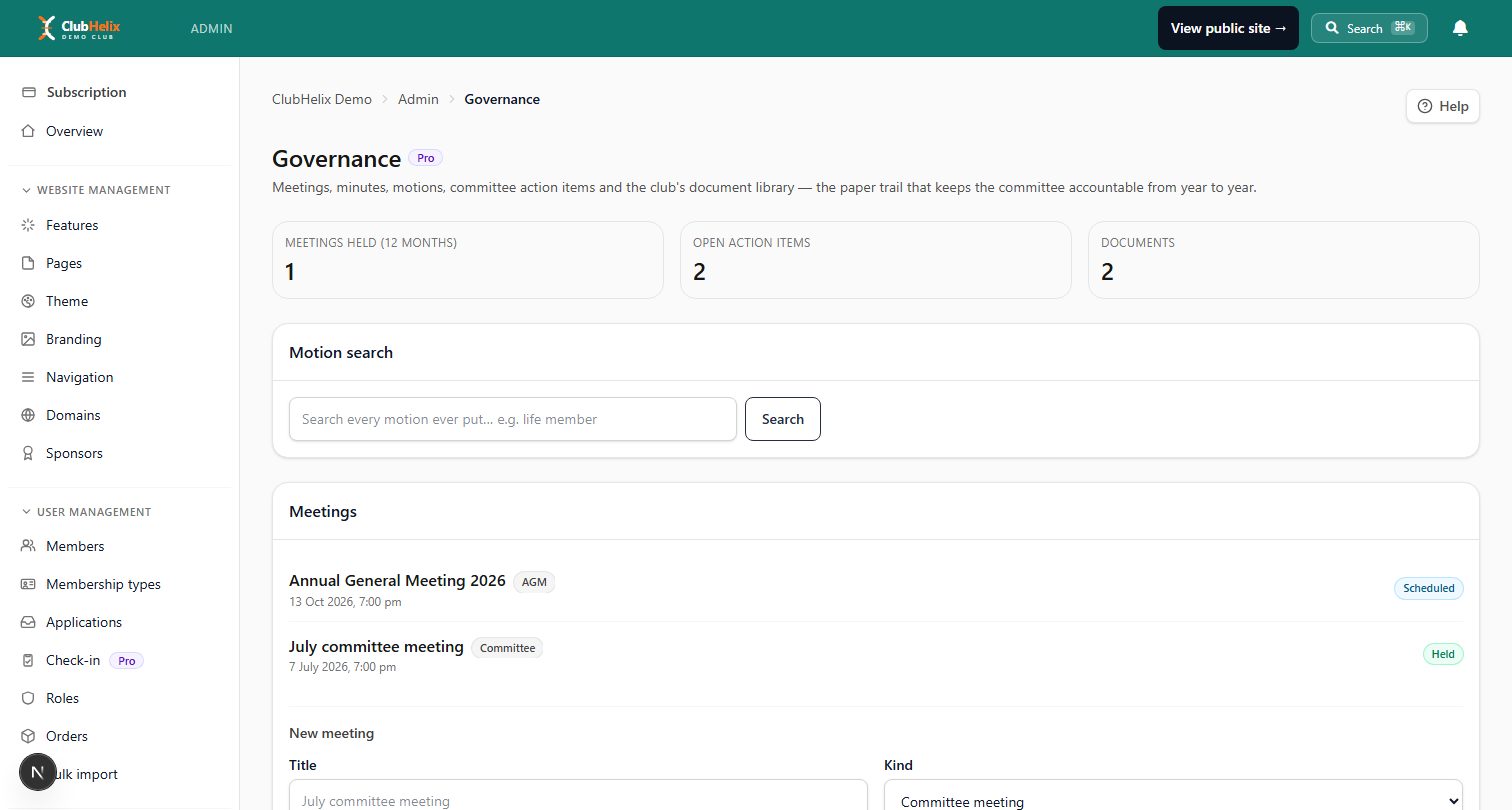
And when something happens: notify early. Policies carry notification requirements, and late notice is a classic way claims get complicated. This is where disciplined incident reporting earns its keep — a structured, dated, factual record made within 24 hours of the incident (see our incident report template) is precisely what a claim needs, and the pattern of reports across the season feeds the risk management that keeps premiums and incidents down in the first place. Insurers reward clubs that can demonstrate they take reasonable care; your risk register and incident history are that demonstration.
What insurance doesn't do
A final calibration for the committee. Insurance transfers some financial consequences; it doesn't prevent anything, and it doesn't replace obligations. It won't make an unsafe ground safe, won't satisfy your duty of care by itself, generally won't respond to deliberate wrongdoing, and won't cover the gap between what a member assumed and what the policy schedule says. The clubs in the strongest position hold sensible cover and run the boring systems — risk register, incident reports, credential tracking, minuted decisions — that make claims rare and defensible. Cover for the storms you can't prevent; systems for the ones you can.
Frequently asked questions
Is public liability insurance legally required for sports clubs?
There's generally no single law saying "clubs must hold public liability insurance" — but in practice it's mandatory anyway, because councils, venue owners, schools, associations and event approvals all require it as a condition, commonly at $10–$20 million. Operating without it also exposes the club (and potentially individuals, depending on structure) to uninsured claims. Treat it as a cost of existing, like the ground lease.
Are volunteers covered by the club's insurance?
Often, but never assume — coverage of volunteers depends on the specific policies. Group personal accident programs frequently include registered volunteers and officials in defined club activities, and public liability generally responds to the club's liability for volunteers' actions in their club roles. The gaps appear at the edges: unregistered helpers, working bees, activities outside sanctioned club business. Ask your association for the written answer and file it.
What is a certificate of currency and who asks for them?
It's a one-page insurer-issued document confirming a policy is in force — type of cover, limit, period, and the named insured. Councils (ground allocations), schools and venues (bookings), event organisers, and grant programs all routinely require one. Request current certificates each renewal from your insurer, broker or association, check the club's incorporated name is exactly right, and keep them in the club's document store where any officer can find them.
What should we do when an incident might become a claim?
Notify early and document everything. Most policies require prompt notification of incidents that could give rise to a claim — not just confirmed claims — and late notice is one of the classic ways otherwise-valid claims get complicated. So the sequence is: handle the incident itself first (welfare, first aid, making the area safe), lodge the club's internal incident report within 24 hours while memories are fresh, then notify your association's insurance contact or your insurer per the policy's instructions, even if you think nothing will come of it. Keep the incident record, witness details, photos of conditions and any correspondence together, and let the insurer drive from there — the club's job is a fast, factual record and early notice, not its own investigation.
Does affiliation with our state body mean we're fully insured?
It usually means you have significant cover — typically public liability and personal accident through a group program — but rarely complete cover. Property, contents and management liability are commonly excluded, participant and activity definitions have edges, and conditions (current affiliation, up-to-date registrations, compliance with the sport's policies) apply. Get the program summary, map it against the cover types in this guide, and arrange top-ups for the genuine gaps.
Keep the paperwork where the next committee can find it. ClubHelix's governance tools hold your minutes, resolutions and club documents in one place, with incident reporting built in — explore all features or see pricing.


