
What this guide answers
- How much grant money can a community sports club realistically get?
Small equipment and participation grants typically range from $500 to $5,000, state "active club" style programs often run $1,000 to $25,000, and facility programs can reach six or seven figures with council or club…
- Do we need to be incorporated to apply for grants?
Almost always, yes — most government programs require applicants to be an incorporated association or to apply through an incorporated auspice body such as your league or association.
- What is the most common reason club grant applications fail?
Eligibility and compliance misses, not bad projects — applying to a program the club doesn't qualify for, missing a required attachment like a certificate of currency or quotes, or failing to show the committee…
- Can we use ClubHelix reports as evidence in grant applications?
Yes — that's one of the quiet superpowers of running your club on a platform.
Every year, hundreds of millions of dollars in government funding flows to Australian community sport — new floodlights, defibrillators, female-friendly change rooms, junior participation subsidies, volunteer training. And every year, a large share of it goes to the same well-organised clubs, while everyone else finds out about the program two weeks after it closed.
The difference is rarely the quality of the club. It's that grant-winning clubs treat funding as a year-round system: they know where the money comes from, they keep their paperwork and member data in order all season, and when a round opens they can assemble an application in an evening instead of a month. This guide maps the landscape and shows you how to become one of those clubs.
General information only. This guide is general information for community clubs, not legal or financial advice. Requirements differ by state and change over time — always confirm with the official sources linked below.
The three layers of the grant landscape
Australian club funding comes from three levels of government, plus a handful of other sources. Understanding who funds what stops you wasting time applying to the wrong program.
Federal programs tend to fund participation, equipment and community outcomes rather than bricks and mortar. The starting points are the business.gov.au grants and programs finder and GrantConnect, the Australian Government's official register of grant opportunities. The Australian Sports Commission runs sport-specific programs and lists current opportunities.
State and territory programs are where most club facility and equipment money lives — the "active club" style grants that fund uniforms, equipment, minor works and volunteer training. Each state runs its own department and its own calendar of rounds.
Local councils are the most overlooked layer. Almost every council runs small community grants ($500–$5,000 is typical), and because fewer clubs apply, your odds are often best here. Search your council's website for "community grants" and get on their mailing list.
Beyond government, look at your sport's state and national bodies (many run their own club development grants), community banks and co-ops with local grant programs, and the Australian Sports Foundation, which isn't a grant program but lets clubs fundraise with tax-deductible donations — often the co-contribution piece a grant application needs.
State-by-state starting points
Program names change almost every budget cycle, so the table below links to each state's sport and recreation funding page rather than to individual programs — bookmark yours and check it quarterly.
| State / territory | Where to look | Typical club-level programs |
|---|---|---|
| NSW | NSW Office of Sport — grants | Local Sport Grant Program, facility and defibrillator grants |
| VIC | Sport and Recreation Victoria — grants | Sporting Club Grants Program, facility programs |
| QLD | Queensland Government — sport and recreation funding | Active Clubs / Gambling Community Benefit Fund |
| WA | Dept of Local Government, Sport and Cultural Industries — funding | Community sport and recreation funding programs |
| SA | Office for Recreation, Sport and Racing — grants | Active Club Program, facility grants |
| TAS | Active Tasmania — grants | Community sport grant rounds |
| ACT | ACT Government — Sport and Recreation grants | Sport and recreation grants program |
| NT | NT Government — sport and active recreation grants | Grassroots and facility grants |
Two habits make this table useful. First, subscribe to every newsletter these pages offer — rounds are short, often four to six weeks, and clubs that hear about them on day one have a real advantage. Second, note each program's cycle in your club calendar so next year's committee inherits the knowledge instead of rediscovering it.
What grant assessors actually look for
Read any state program's guidelines and the same themes repeat. Assessors are trying to answer four questions:
- Is this club real and well run? Incorporated, insured, solvent, with a functioning committee. Many programs require incorporation — see the ACNC if you're also a registered charity, and your state fair trading body for incorporated association requirements via business.gov.au.
- Who benefits, and how many? Membership numbers, junior numbers, female participation, growth trends, disability inclusion, disadvantaged access. Numbers beat adjectives every time.
- Is the project specific and costed? "Two portable goals at $1,850 each, quote attached" wins. "Equipment upgrades" loses.
- Will the money be handled properly? A named treasurer, a club bank account, and evidence you've acquitted previous grants correctly.
Notice that three of the four questions are answered by records you either kept all year or didn't. That's the real secret of grant-ready clubs: the application is mostly assembly, not authorship.

Build your evidence pack before you need it
Here's what to keep permanently ready, and where a club platform does the work for you:
Membership evidence. Almost every application asks for member numbers broken down by age, gender or program. If your member records live in a spreadsheet three treasurers old, this takes a weekend. If your registrations flow into a live member database, it's an export. ClubHelix clubs pull these straight from member reports — current financial members, juniors versus seniors, season-on-season growth — with the numbers dated and consistent between applications, which matters when the same assessor reads your application two years running.
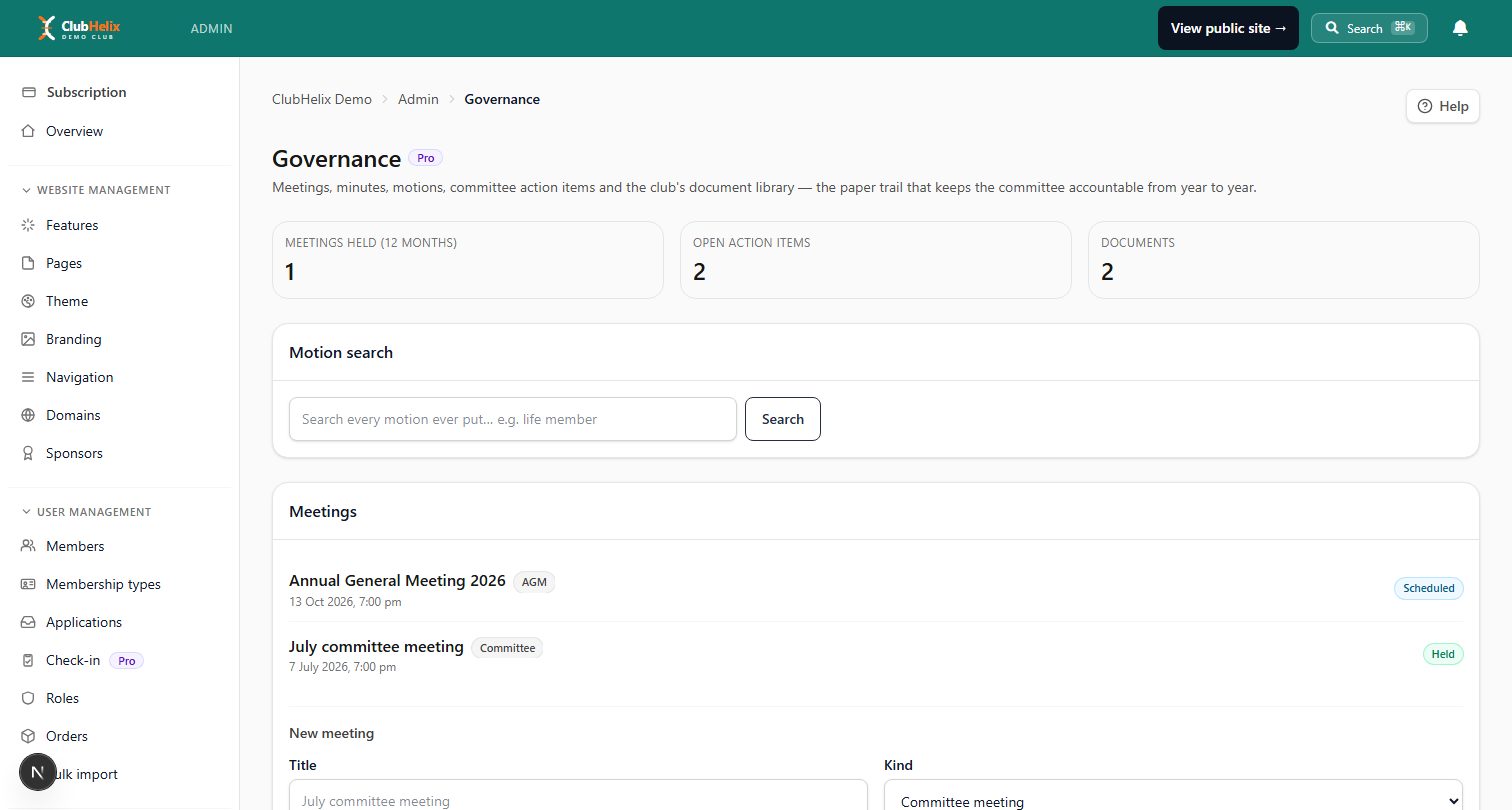
Governance evidence. AGM minutes, committee meeting minutes showing the project was endorsed, your constitution, and committee contact details. Programs increasingly ask for the minute reference where the committee approved the application. Clubs that run meetings and minutes through their platform can cite and attach these in minutes rather than hunting through someone's email.
Financial evidence. Last AGM's financial statement, current bank balance, and — for facility grants — evidence you can fund your co-contribution. If your registrations, events and shop all settle to the club account through one system, your income story is coherent and documentable.
Compliance evidence. Certificate of currency for insurance (see our guide on club insurance), incorporation certificate, child-safety and inclusion policies. Several state programs now ask clubs to attest to child-safe practices, so having your risk and safety paperwork in order pays twice.
Photos and stories. A folder of good, consented photos of real members, and two or three short participant stories. Assessors read hundreds of applications; the ones with a face and a sentence from a junior's parent are the ones they remember.
Writing the application itself
With the evidence pack ready, the writing is the easy part. A few rules that experienced grant writers in community sport swear by:
- Answer the question asked, in their language. If the guidelines say the program funds "increased participation by women and girls", your project description should say — truthfully — how it does exactly that, using those words.
- One project per application. Programs fund projects, not wish lists. "Floodlight the second pitch" is a project; "improve our facilities" is a wish.
- Get real quotes. Two written quotes for anything significant. It signals seriousness and speeds up assessment.
- Have someone outside the committee read it. If your neighbour can't tell what you're asking for and why, neither can the assessor.
- Submit early. Portals crash on deadline day every single round. There is no prize for last-minute drama.
And after the result, either way: if you win, diarise the acquittal deadline immediately — a late or sloppy acquittal quietly blacklists clubs from future rounds. If you lose, ask for feedback; most state programs will give it, and it's usually a precise map of what to fix next time.
Make it someone's job
The single biggest upgrade most clubs can make is naming a grants officer — not necessarily a committee member, and it's a genuinely good role for a member who can't commit to weekly volunteering. Their job description fits on an index card: watch the funding pages and newsletters, keep the evidence pack current, maintain a one-page list of the club's next three fundable projects (agreed with the committee), and coordinate applications when rounds open. Give them access to the club's member reports and document store — with role-based permissions you can do that without handing over the whole admin — and the club stops missing rounds.
Pair the grants pipeline with your other income streams — membership fees collected online, a well-run raffle, sponsorships and canteen revenue — and the club's finances stop depending on any single source. Grant money is wonderful, but it's seasonal weather; the clubs that thrive treat it as a bonus on top of solid recurring income, not the plan.
Frequently asked questions
How much grant money can a community sports club realistically get?
Small equipment and participation grants typically range from $500 to $5,000, state "active club" style programs often run $1,000 to $25,000, and facility programs can reach six or seven figures with council or club co-contributions. A well-organised club applying consistently across council, state and sport-body programs can realistically bring in several thousand dollars a year in small grants, with facility grants as occasional larger wins.
Do we need to be incorporated to apply for grants?
Almost always, yes — most government programs require applicants to be an incorporated association or to apply through an incorporated auspice body such as your league or association. Incorporation requirements are state-based; start at business.gov.au and your state's fair trading or consumer affairs office. If you're not incorporated yet, ask your state sporting body about auspicing in the meantime.
What is the most common reason club grant applications fail?
Eligibility and compliance misses, not bad projects — applying to a program the club doesn't qualify for, missing a required attachment like a certificate of currency or quotes, or failing to show the committee endorsed the project. The fix is boring and effective: read the guidelines twice, use the program's own checklist, and keep your evidence pack current so nothing is scrambled at the deadline.
Can we use ClubHelix reports as evidence in grant applications?
Yes — that's one of the quiet superpowers of running your club on a platform. Membership counts by age and gender, growth over seasons, event attendance, and program participation all come from the same live records you use to run the club, so the numbers are dated, consistent and defensible. Pair them with minutes from your governance records showing the committee endorsed the project, and the "is this club well run" question answers itself.
Want to be the club that assembles a grant application in an evening? ClubHelix keeps your member records and reports, meeting minutes and club finances in one place — see pricing or explore the full feature list.


