
What this guide answers
- Do we need a permit to run a small club raffle?
Often not — most states let not-for-profit clubs run small raffles without a permit, especially ones drawn at the event where tickets are sold, provided prize values stay under the state's threshold and conditions are…
- Can we sell raffle tickets online?
In many cases yes, but this is exactly where state rules diverge the most — some jurisdictions have specific conditions for online sales, and selling to buyers in other states can bring other rules into play.
- What prizes work best for a club raffle?
Donated prizes with broad appeal: grocery or fuel vouchers, local restaurant dinners, a quality esky or barbecue, signed memorabilia if your sport has it, and the evergreen meat tray for match-day draws.
- How often can a club run raffles?
As often as your state's rules and your members' patience allow — there's generally no blanket limit on small exempt raffles, though permit-based raffles are approved individually and some conditions cap how many can…
- How do we handle the money from a raffle?
Like all club money, but with extra care because it's cash-heavy and regulated: a recorded float, two people counting, everything banked into the club account promptly, and a reconciliation of tickets issued versus…
The humble raffle is still one of the best fundraisers a community club can run: low cost, low effort compared with an event, and members genuinely enjoy it. A well-run meat tray raffle can quietly fund a set of junior uniforms; a well-run major raffle can fund the new canteen.
But raffles are a form of gaming, and every Australian state and territory regulates them — who may run one, whether you need a permit, how tickets must be sold, and how the draw and results must be handled. The rules are genuinely different in each jurisdiction, and they turn on things like total prize value and whether tickets are sold to the general public. This guide walks through how the rules work in general, links you to every state regulator, and then gets practical: a step-by-step plan for running a raffle that is legal, trusted and actually profitable.
General information only. This guide is general information for community clubs, not legal or financial advice. Requirements differ by state and change over time — always confirm with the official sources linked below.
First question: do we need a permit?
There's no single national answer — raffles are regulated state by state. But the shape of the rules is similar everywhere:
- Who can run one. Raffles for fundraising are generally restricted to not-for-profit organisations — community clubs, charities, schools. A club raffle must benefit the club, not any individual.
- Small raffles are usually easy. Most jurisdictions let a not-for-profit run small raffles (think: drawn on the day, modest prize value, tickets sold at club events) without a permit, subject to conditions.
- Bigger raffles trigger permits. Cross a threshold — typically based on total prize value or gross proceeds — and you'll need a permit, licence or registration before you sell a single ticket. Thresholds vary widely between states.
- Where tickets are sold matters. Selling tickets to the general public, online, or across state borders can change which rules apply. If you plan to sell online to anyone beyond your own members, read your regulator's guidance on online and interstate sales carefully first.
The only reliable way to answer "do we need a permit?" is your own state regulator, so here they are.
State-by-state raffle regulators
| State / territory | Regulator | Start here |
|---|---|---|
| NSW | NSW Fair Trading (community gaming) | fairtrading.nsw.gov.au — community gaming |
| VIC | Victorian Gambling and Casino Control Commission | vgccc.vic.gov.au — community and charitable gaming |
| QLD | Office of Fair Trading Queensland (charitable and non-profit games) | business.qld.gov.au — charitable games |
| WA | Dept of Local Government, Sport and Cultural Industries (Gaming and Wagering Commission) | dlgsc.wa.gov.au — gaming permits |
| SA | Consumer and Business Services (lottery licences) | cbs.sa.gov.au — lotteries and raffles |
| TAS | Liquor and Gaming Tasmania | gaming.tas.gov.au — minor gaming |
| ACT | ACT Gambling and Racing Commission | gamblingandracing.act.gov.au — lotteries |
| NT | Licensing NT (community gaming) | nt.gov.au — community gaming and lotteries |
When you check your regulator's page, look for four specific things: the prize-value threshold at which a permit is required, the rules for ticket format (what must be printed on a ticket or shown to online buyers), the draw requirements (when, where, how, and who may draw), and the record-keeping and results-publication obligations after the draw. Write those four answers into your raffle plan and most compliance work is done.
Step-by-step: running the raffle
1. Get committee sign-off and name a raffle coordinator. Minute the decision: what the raffle is for, the prize budget, ticket price, sales window, and draw date. One named person owns compliance and the float.
2. Confirm the rules for your state. Using the regulator links above, confirm whether your raffle needs a permit at your prize value, and apply well before you plan to start selling if it does. Permits can take weeks.
3. Source prizes — donated if possible. A raffle's profit is ticket sales − prizes − printing, so donated prizes transform the economics. Local businesses will often donate a prize in exchange for a mention on the ticket and your socials; that's a sponsorship conversation, not a favour. Popular structures: one hero prize plus two or three minor prizes, or the classic multi-draw meat/veg tray raffle at home games.
4. Set the ticket price and target. Cheap tickets sell themselves ($2–$5 is the community-club sweet spot); expensive tickets need an expensive-looking prize. Work backwards: if the goal is $3,000 profit with a $500 prize outlay, you need roughly 1,200 tickets sold at $3.
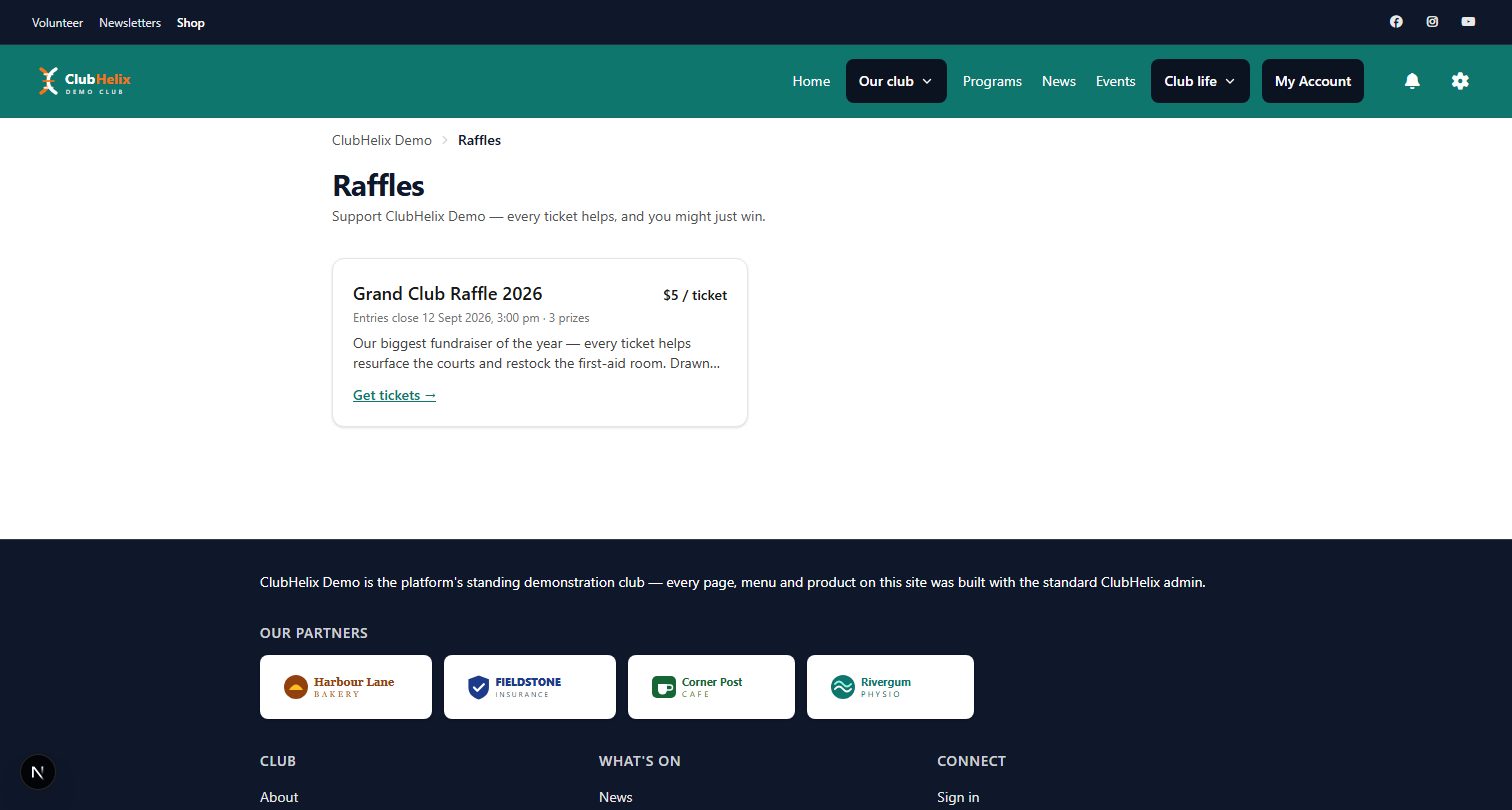
5. Sell everywhere your members already are. Match days with a float and a visible prize, club events, and online to your own membership. Digital sales change the game for clubs: members buy from the couch, you're not chasing ticket books and cash tins, and every sale is automatically recorded against a name. ClubHelix's raffles module sells numbered tickets through your club site, tracks every sale, and keeps the ledger the regulator expects — check your state's rules on online sales first, and configure the raffle to match.
6. Run a clean draw. Do exactly what your permit or your state's exempt-raffle conditions say: draw on the advertised date, by the advertised method, with every sold ticket having an equal chance. Draw in public where you can — at the club, streamed or filmed — because being seen to be fair is what keeps members buying tickets next year.
7. Notify winners and publish results. Contact winners directly, publish results the way your state requires (and the way your tickets promised), and record who won what. Unclaimed-prize handling is regulated in some states — check before you re-draw or absorb a prize.
8. Bank, reconcile and report. All proceeds into the club account, a simple reconciliation (tickets sold × price = banked + float), and a one-paragraph report to the committee: gross, costs, net, and lessons. If your state requires a return or record of the raffle, file it now while everything is fresh.

The trust rules that aren't written down
Beyond the legal requirements, a few practices protect the club's most valuable raffle asset — members' trust:
- Committee members and their families can buy tickets, but shouldn't draw. Have a junior member, a sponsor or an independent person draw the winner.
- Never hold back tickets. Every printed or issued ticket is either sold, returned or void — and voids are recorded. "The coordinator's mate won again" is a club-killing sentence even when it's innocent.
- Handle cash in pairs. Two people count the float and the takings. This protects your volunteers as much as the club.
- Mind the personal details. Names and phone numbers on ticket stubs are personal information — collect only what you need, store it safely, and don't repurpose the list for marketing without consent. Our club privacy policy guide covers the basics.
Making raffles part of the funding mix
A raffle is one stream, not the strategy. The clubs with healthy finances stack several: membership fees collected online at registration, canteen and merchandise, sponsorships, grants, and two or three well-run raffles a year timed to the club calendar — season launch, a mid-season home game, and presentation night. Because raffles are cheap to run, their net margin is often the best of any fundraiser; because they're regulated, they reward clubs that keep tidy records. Run them properly once and you have a repeatable template — same permit process, same float procedure, same draw ritual — that any future committee can pick up and run.
Frequently asked questions
Do we need a permit to run a small club raffle?
Often not — most states let not-for-profit clubs run small raffles without a permit, especially ones drawn at the event where tickets are sold, provided prize values stay under the state's threshold and conditions are met. But the thresholds and conditions differ significantly between states, so check your regulator (linked in the table above) before selling tickets rather than after.
Can we sell raffle tickets online?
In many cases yes, but this is exactly where state rules diverge the most — some jurisdictions have specific conditions for online sales, and selling to buyers in other states can bring other rules into play. Read your own regulator's guidance on online and interstate ticket sales before launching, and when in doubt, restrict sales to your own members and local community. Digital tools like ClubHelix's raffle module make the record-keeping side easy, but the permit question is always yours to confirm.
What prizes work best for a club raffle?
Donated prizes with broad appeal: grocery or fuel vouchers, local restaurant dinners, a quality esky or barbecue, signed memorabilia if your sport has it, and the evergreen meat tray for match-day draws. Avoid prizes that only appeal to a slice of the membership, and check your state's rules — some jurisdictions restrict certain prize types (for example alcohol or firearms) or set minimum prize-to-proceeds ratios.
How often can a club run raffles?
As often as your state's rules and your members' patience allow — there's generally no blanket limit on small exempt raffles, though permit-based raffles are approved individually and some conditions cap how many can run concurrently. The practical constraint is fatigue: members who are asked to buy tickets every single week stop buying. Most clubs land on a rhythm of regular small match-day raffles (cheap tickets, drawn on the night, prizes like meat trays or donated vouchers) plus one or two larger raffles a year tied to big moments in the club calendar. Track the net result of each one; if a raffle's profit is drifting down, rest it for a season rather than flogging it.
How do we handle the money from a raffle?
Like all club money, but with extra care because it's cash-heavy and regulated: a recorded float, two people counting, everything banked into the club account promptly, and a reconciliation of tickets issued versus money banked. Keep the records your state requires (ticket butts or the digital ledger, results, expenses) for the required period, and report the net result to the committee and in your annual accounts.
Ready to run a raffle without the shoebox of ticket stubs? ClubHelix's raffles feature handles numbered tickets, online sales and a clean draw record — see the full feature set or pricing.


