
What this guide answers
- Does the Privacy Act apply to our small sports club?
Maybe — the small business exemption (annual turnover under $3 million) covers many clubs, but there are important carve-outs, including for organisations that provide health services and hold health information, and…
- Do we need photo consent for team photos and match-day shots?
Get consent at registration for all club photography, with the granular options in the template above, and honour it operationally — especially for juniors.
- How long should a club keep member data?
Only as long as there's a genuine purpose: current member records for the membership plus your association's requirements, financial records typically seven years, and incident/injury records much longer because claims…
- Who at the club should be able to see medical information?
Only the people who need it to keep the member safe: typically the relevant team's coach or manager (allergies, conditions that matter at training, emergency contacts) and the first aid officer — not the whole…
- Can we share our member list with sponsors?
Not without explicit, opt-in consent collected for that specific purpose — repurposing member data for third-party marketing is exactly what privacy principles prohibit and exactly what erodes member trust fastest.
Your club holds more personal information than most small businesses: names, addresses and birthdates for every member, medical conditions disclosed at registration, emergency contacts, payment records, photos of children, and sometimes sensitive matters raised in complaints or incident reports. Members hand all of this over on trust — and one mishandled spreadsheet or one photo published against a parent's wishes burns that trust in an afternoon.
A privacy policy is how a club makes its promises about that information explicit, and a photo consent process is the piece members care about most viscerally. This guide gives you a policy outline you can adapt, a consent form template field by field, and — because documents alone protect nothing — the handful of data-handling habits that do the real work.
General information only. This guide is general information for community clubs, not legal or financial advice. Requirements differ by state and change over time — always confirm with the official sources linked below.
What the law actually requires of a small club
The starting point is the Office of the Australian Information Commissioner (OAIC), the national privacy regulator. The Privacy Act 1988 and its Australian Privacy Principles (APPs) apply to organisations with annual turnover over $3 million — which exempts many small clubs — but the exemption is narrower than committees assume: the OAIC's small business guidance explains the carve-outs, including that organisations providing health services and handling health information are covered regardless of turnover. A club collecting medical information at registration should read that carefully. Health information is classed as sensitive information and gets the strictest treatment — see the OAIC's health information pages.
The turnover threshold itself has not moved — the small business exemption still sits at $3 million in annual turnover. What has changed is how much that answer is worth. The OAIC's own worked example of a club losing the exemption is a club running a program to assist members with injuries or to improve fitness or health: that is providing a health service, and it brings the club under the Act whatever its turnover. Read that sentence twice if your club runs a return-from-injury program, a strength-and-conditioning block or a seniors' fitness session, because most committees would not describe any of those as "health services" unprompted.
The exemption no longer disposes of the risk
On 10 June 2025 a statutory tort for serious invasion of privacy commenced. It matters to a small club for one structural reason: it is broader in application than the Privacy Act and extends to entities that may not necessarily be an APP entity. So a committee that has satisfied itself the club is under $3 million in turnover has answered the Privacy Act question and not the privacy question. The tort is about serious invasions — intrusion upon seclusion, or misuse of information — not about a typo in a mailing list, and proving one is a matter for a court rather than a regulator. But "the Act does not apply to us" is no longer the end of the conversation, and a club that publishes children's photographs, records medical detail at registration or circulates a member list carelessly is doing the things the tort exists to reach.
Two dates on the horizon
10 December 2026 carries two changes worth a committee's attention. From that date, transparency obligations about automated decision-making apply: where personal information is used in automated decisions that significantly affect someone, the privacy policy has to say so. If your club is letting software decide selection, eligibility, pricing or access without a person in the loop, that belongs in the policy. The same date is the deadline for the Children's Online Privacy Code to be registered. It is not registered yet, so there is nothing to comply with today and nothing here that tells you what it will say — but a club whose website, app or communications reach junior members should be watching the OAIC's code page rather than hearing about it afterwards.
Three more reasons the "we're too small for the Privacy Act" shrug is the wrong posture. Your national sporting body's policies almost certainly bind affiliated clubs to privacy standards contractually, whatever the Act says. State laws add layers, particularly around health records and surveillance. And most practically: members expect it. The APPs are simply a good description of what reasonable data handling looks like — collect only what you need, say why, keep it secure, let people see and correct it, don't repurpose it. Run your club to that standard and the legal question mostly takes care of itself.
Club privacy policy: the outline
Keep it to two pages, in plain English, published on your club website. Section by section:
| Section | What it says |
|---|---|
| Who we are | Club name, incorporation details, and the role to contact about privacy (secretary or privacy officer — a role, not a person's name) |
| What we collect | Member details (name, DOB, contacts), emergency contacts, medical information relevant to safe participation, payment records, photos/videos at club activities, website/analytics basics |
| Why we collect it | Running memberships and teams, safety and emergency response, competitions and results, club communications, legal and insurance obligations |
| How we collect it | Registration forms, event entries, incident reports, direct correspondence — and a commitment to collect only what's needed |
| How we store and protect it | Club systems with role-based access, not personal spreadsheets; who can see what; how long we keep it |
| Who we share it with | Your association or league (results, registrations), insurers when claims arise, government agencies where required — and a plain statement that the club never sells member data |
| Photos and videos | Cross-reference to the consent process below; how consent choices are respected in practice |
| Your rights | How members can see the information held about them, correct it, and complain — first to the club, then to the OAIC |
| Changes | How the policy is updated and where the current version lives |
Adopt it at committee, minute the adoption, link it from your registration form ("by registering you acknowledge our privacy policy"), and review it annually alongside your risk register.
The photo consent form template
Photos are where privacy gets personal. Parents have real and varied reasons for keeping children's images offline — family safety situations among them — so consent must be genuinely optional, granular, and operationally respected. A tick-box nobody looks at again is worse than no consent at all, because it creates a false promise.
Collect consent at registration, per person, per season. The template:
| Field | Options | Notes |
|---|---|---|
| Member name | Text | One form per member — never "all my children" blanket forms |
| Consenting person | Text + relationship | The member themselves if an adult; parent/guardian for under-18s |
| Photos in club online channels | Yes / No | Website, social media, newsletters — your widest audience, so its own line |
| Photos in internal/team channels | Yes / No | Team chats and member-only pages; many decline public but allow internal |
| Photos in print and club displays | Yes / No | Programs, clubroom walls, local press releases |
| Name published with image | Yes / No | Even a "yes to photos" family may want no names attached; never publish a junior's full name with their image as a default |
| Media/broadcast consent | Yes / No | Local paper at finals, streamed matches — separate because the club can't recall it once given |
| Signature and date | Signature | Digital acknowledgement at registration is fine and easier to store |
And the operational rules that make the form mean something: keep a current no-consent list available to whoever posts on club channels (a name list, not the reasons — reasons are nobody's business); brief your team photographers and social media volunteers each season; check group shots against the list before posting; and take an image down promptly, without argument, when asked. Consent can be withdrawn at any time — say so on the form.

Collect it once, store it properly
The biggest privacy upgrade most clubs can make has nothing to do with documents: it's getting member data out of email threads and personal spreadsheets and into one access-controlled system. When registration, consent, medical notes and emergency contacts are collected through structured registration and consent forms and stored against the member record, the club gets what paper never delivers: the consent answer is findable when someone's about to post a photo, medical details are visible to the team manager who needs them and nobody else, and when a family updates a phone number it updates everywhere.
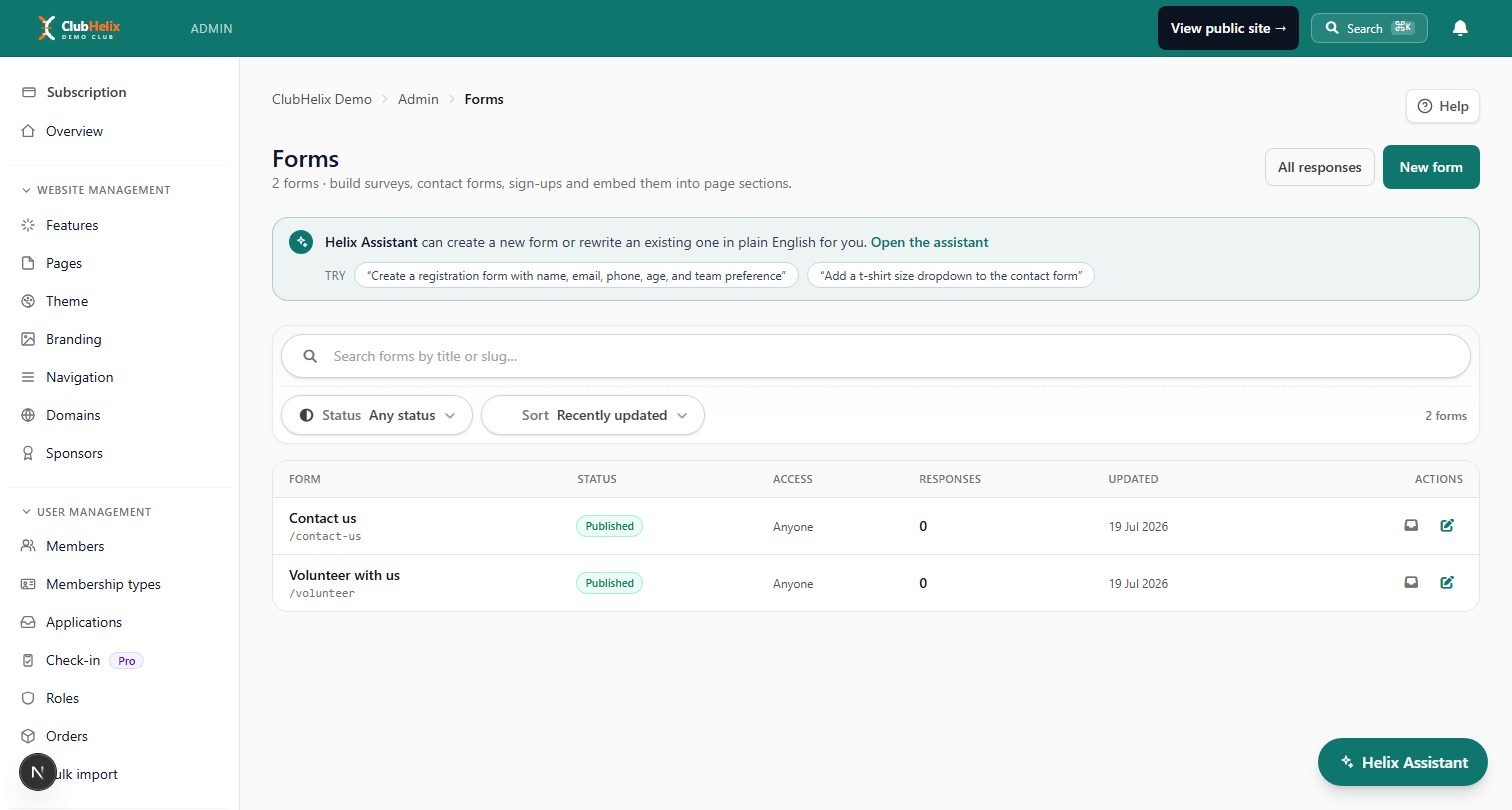
ClubHelix applies role-based access across all of it — committee roles see what their job requires, coaches see their team's essentials, and sensitive records like incident reports stay locked to named officers. Member data lives in one place with per-tenant isolation and forced row-level security; the platform's security page covers the engineering underneath. The habits that complete the picture cost nothing: no member lists in personal inboxes or USB sticks, no full-membership exports "just in case", access reviewed at every AGM when roles change, and old data actually deleted when your retention period ends.
When something goes wrong
Data incidents happen to small organisations too — a stolen laptop with a member export, an email to the wrong list, a website misconfiguration. Have a two-line plan before you need it: contain it (revoke access, recall what can be recalled), then assess honestly who's affected and how badly. The Notifiable Data Breaches scheme requires covered organisations to notify the OAIC and affected individuals of eligible breaches — the OAIC's data breach pages explain the scheme and, whatever your club's coverage status, its guidance is the sensible playbook: be prompt, be straight with affected members, and fix the cause. A club that fronts up to a mistake keeps more trust than one that hopes nobody notices.
Frequently asked questions
Does the Privacy Act apply to our small sports club?
Maybe — the small business exemption (annual turnover under $3 million) covers many clubs, but there are important carve-outs, including for organisations that provide health services and hold health information, and clubs collecting medical details at registration should read the OAIC's guidance on where the line falls — the OAIC's own example of a club losing the exemption is one running a program to assist members with injuries or to improve fitness or health. Note too that the exemption answers the Privacy Act question and not the whole question: the statutory tort for serious invasion of privacy, which commenced on 10 June 2025, is broader in application than the Act and extends to entities that may not be APP entities at all. Your sport's affiliation requirements may also bind you to privacy standards regardless. The practical answer: run the club to APP standards anyway — it's what members expect and it's not onerous.
Do we need photo consent for team photos and match-day shots?
Get consent at registration for all club photography, with the granular options in the template above, and honour it operationally — especially for juniors. Crowd and incidental shots at public events sit in greyer territory legally, but the club standard should be simple: know your no-consent list, check identifiable shots against it before publishing, and remove images promptly on request. Never publish a junior's full name alongside their photo as a matter of course.
How long should a club keep member data?
Only as long as there's a genuine purpose: current member records for the membership plus your association's requirements, financial records typically seven years, and incident/injury records much longer because claims can surface years later (and minors can claim after turning 18). What shouldn't persist is everything else — old exports, superseded spreadsheets, ex-members' medical details. An annual clean-out, minuted at committee, is a fine tradition.
Who at the club should be able to see medical information?
Only the people who need it to keep the member safe: typically the relevant team's coach or manager (allergies, conditions that matter at training, emergency contacts) and the first aid officer — not the whole committee, and never the general membership. This "need to know" test is the heart of good club privacy practice, and it's why medical details belong in a system with role-based access rather than a spreadsheet where seeing one member's asthma plan means being able to read everyone's. Decide the access rules once, write them into your privacy policy, and review who actually holds access at every AGM when roles change hands.
Can we share our member list with sponsors?
Not without explicit, opt-in consent collected for that specific purpose — repurposing member data for third-party marketing is exactly what privacy principles prohibit and exactly what erodes member trust fastest. If sponsors want reach, offer club-controlled channels instead: sponsored posts in the club newsletter, logos on the website, a sponsor page. The list itself is never the product.
Collect consent once, respect it everywhere. ClubHelix's forms capture registration, medical and photo-consent answers straight into access-controlled member records — read about the security underneath or see pricing.


