
What this guide answers
- How do we get more volunteers at our sports club?
Stop broadcasting and start asking: break the work into named, time-boxed roles ("90 minutes, twice a season"), have a specific person ask a specific member for a specific job, and collect willingness on the…
- Why do club volunteers quit?
The evidence and the anecdotes agree: volunteers quit because they feel taken for granted, because a small yes silently became a giant unbounded job, or because the same overloaded few carry everyone.
- Should we pay club volunteers or offer incentives?
Cash wages change the legal relationship and most community clubs should steer clear, but low-cost recognition is fair game and works: canteen credit or a free feed for shift workers, fee discounts for families who…
- How many volunteers does a small club need?
Count jobs, not people: list every recurring task for a season (shifts × weeks), and you'll usually land between 200 and 600 volunteer-slots for a small-to-medium club.
- What should go in a volunteer role description?
Two sentences and a number: what the job is, what (if anything) it requires, and exactly how much time it takes ("Scoreboard: sit with the scorer's tablet at home games, we'll teach you in five minutes — one hour…
Every club committee has sent the email: "We urgently need volunteers! Please help — many hands make light work!" And every committee knows what happens next: silence, followed by the same five people doing everything, again, while a hundred families who'd genuinely help if asked properly scroll straight past.
Here's the reframe this whole guide hangs on: your club does not have a volunteer shortage. It has an asking problem. Research on community sport keeps finding the same thing — the top reason people give for not volunteering is that nobody personally asked them, and the top reason volunteers quit is feeling taken for granted. Both are completely fixable, without a single extra dollar, by changing how you design roles, how you ask, and how you treat people afterwards.
Why the "we need help" email always fails
The broadcast plea fails for predictable, human reasons:
- It's addressed to everyone, so it's addressed to no one. Everyone assumes someone else will answer. Psychologists call it diffusion of responsibility; canteen managers call it Saturday.
- It's an unbounded commitment. "Help needed" could mean an hour or a decade. People aren't declining the task — they're declining the uncertainty.
- It smells like a trap. Every parent knows the club legend: someone offered to cut oranges in 2019 and is now the treasurer. If saying yes to something small leads to being volunteered for everything, rational people never say yes to anything.
- It arrives with no easy way to act. "Contact Sharon if you can help" adds three steps (find Sharon, work out what's needed, negotiate) to something that should be one tap.
Fix those four and recruitment stops being begging.
Step 1: Design roles people can say yes to
Before recruiting anyone, break your club's work into small, named, bounded jobs. The difference between "help with the canteen" and "canteen: one 90-minute shift, twice a season, roster below, kids' canteen credit included" is the difference between silence and a full roster.
Good role design follows four rules:
- Time-boxed. State the shift length and how many times a season. "90 minutes, twice a season" gets yeses that "ongoing help" never will.
- Skill-matched or skill-free. Say clearly whether a job needs nothing ("BBQ — we'll show you"), or something specific ("bookkeeping experience", "a trailer"). Skilled people love being asked for their actual skill.
- Named. "Team photographer", "line-marking crew", "Friday-night scoreboard". Names make roles feel real, ownable and — crucially — finite.
- Laddered. Advertise honestly that small roles are just small roles, and keep a separate, visible ladder (helper → coordinator → committee) for people who want more. The ladder is how you solve committee succession — but only if stepping onto rung one doesn't mean being dragged up the rest.
One more design decision: state up front which roles need a formal screening check because they involve juniors, and which don't. Most club jobs don't — saying so removes a quiet barrier — and for the roles that do, promise that the club will walk new volunteers through the process.
In Australia that means a Working With Children Check for child-related roles (names and rules vary by state) — our guide to Working With Children Check requirements for clubs covers who needs one and how the club verifies it.
Write each role in two sentences with an hours figure. That document becomes your menu for everything below.
Step 2: Make the ask personal
The single highest-conversion recruitment technique in community sport costs nothing: a named person asks a specific person to do a specific thing.
- "Priya, you're here every Saturday anyway — would you do scoreboard for the 10am game this month?" beats a hundred group emails.
- Ask face-to-face or by personal message, never only via the group chat.
- Ask new members and new parents early — in their first month, while enthusiasm is high and habits aren't set. The registration form itself is prime real estate: a "happy to help with…" tick-list (canteen, transport, coaching, photography, maintenance days) during online sign-up builds you a warm list of people who literally raised their hands.
- Aim the ask one notch below what you think someone would accept. It's easier to promote a happy orange-cutter than to re-recruit a scared-off parent.
The committee's job each pre-season: take the role menu, take the member list, and match names to jobs before asking. Recruitment is casting, not broadcasting.
Step 3: Remove every gram of friction
Once someone's willing, the time between "yes, I could do that" and being locked in must be seconds, not days:
- Publish the roster with open slots and let people claim a slot themselves from their phone. A volunteer rostering system turns "email Sharon" into one tap — and shows everyone else that slots are filling, which is its own social proof.
- Send the details automatically. Confirmation, what to bring, where to stand, and a reminder the day before. Most "no-shows" are actually "nobody reminded me".
- Never make helpers chase information. The BBQ volunteer should get the gas-bottle location and the float amount without asking.
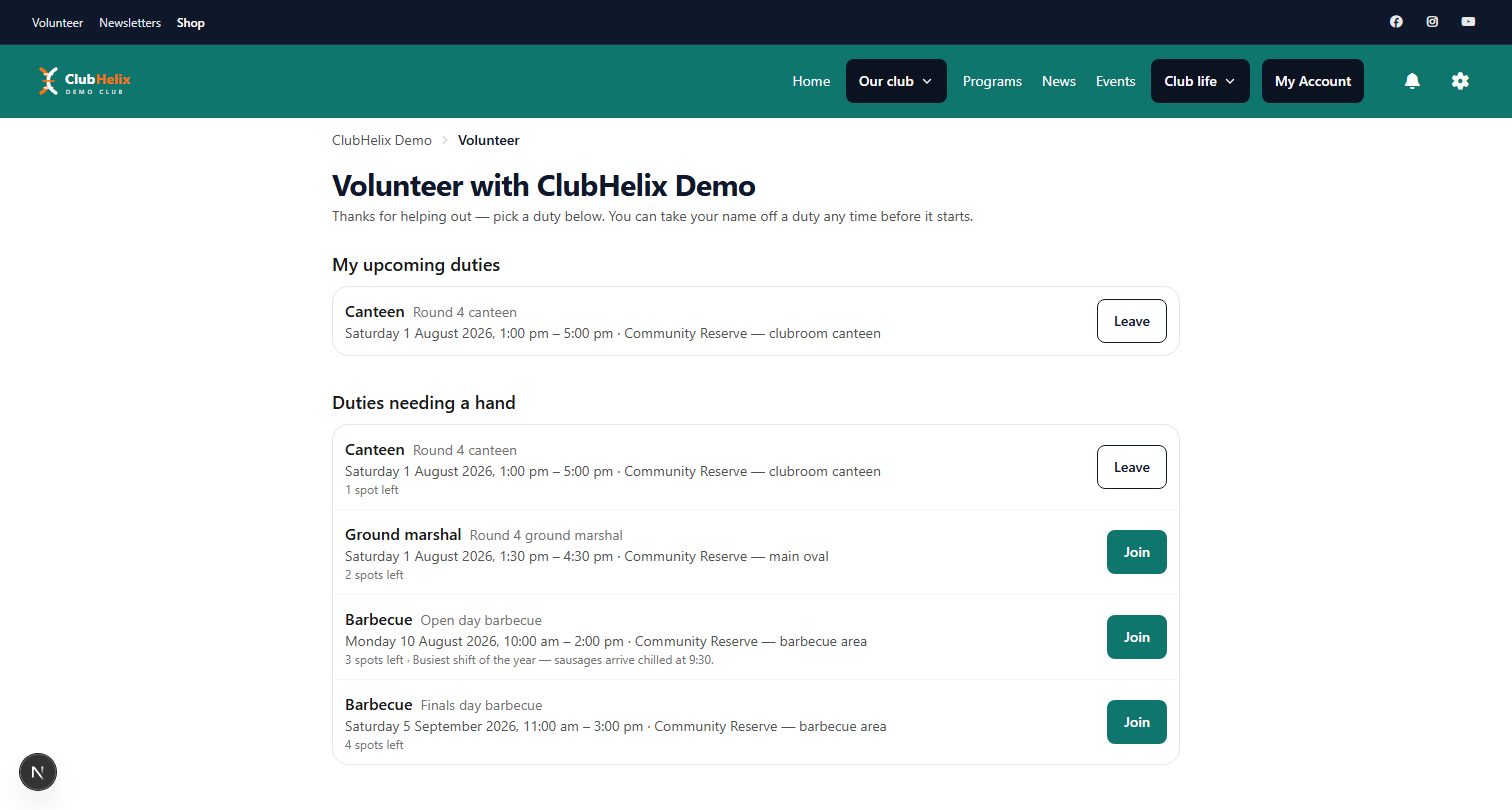
And keep the recruitment channel warm all season: a short, well-written club broadcast that celebrates volunteers by name and lists two or three specific open roles ("we need one more person on the line-marking crew — 40 minutes on Friday afternoons, fortnightly") outperforms the generic plea every time.

Step 4: Retention — the recruitment strategy nobody budgets for
Keeping a volunteer costs a tenth of finding one. Retention in a community club comes down to five habits:
Thank people specifically and publicly. Not "thanks to all our helpers" — "thanks to Marco, who marked the lines in the rain on Friday". Name names in the newsletter, on socials, at presentation night. A volunteer-of-the-month certificate costs nothing and gets photographed for the family group chat.
Never punish reliability. The classic club sin: the person who always says yes gets asked for everything until they quit. Track load across the season — a roster system shows you at a glance who's done six shifts while forty families have done none — and deliberately spread the next asks to the zeros, not the heroes.
Feed back the impact. "Canteen raised $2,400 this season — that's the new junior kits" turns sausage-turning into meaning. People stay where they can see their effort mattering.
Make it social. Roster friends together. Put two people on every job even when one would do — company halves the burden and doubles the show-up rate. The BBQ crew that laughs together re-rosters itself.
Exit gracefully, re-recruit later. When someone steps back, thank them properly and leave the door open. Life stages change; the parent who vanished during the newborn years is often your best returner three seasons later — if leaving was pleasant.
Your season recruitment calendar
| When | Action |
|---|---|
| Registration period | "Happy to help with…" tick-list on the registration form; welcome email mentions volunteering |
| Pre-season | Committee matches names to the role menu; personal asks made; rosters published with open slots |
| Round 1–2 | New-family welcome at the ground includes one small, immediate ask ("grab the flags with me?") |
| Mid-season | Broadcast thanking volunteers by name + two specific open roles; check the load spread, rest the overloaded |
| Late season | Quiet succession conversations with next year's candidates (see the succession guide) |
| Presentation night | Volunteer awards with names and numbers ("312 canteen shifts filled this year") |
| Off-season | Thank-you note to every volunteer; survey: keep going, change roles, or rest next year? |
Frequently asked questions
How do we get more volunteers at our sports club?
Stop broadcasting and start asking: break the work into named, time-boxed roles ("90 minutes, twice a season"), have a specific person ask a specific member for a specific job, and collect willingness on the registration form so you're always asking warm names. Then make sign-up one tap on a published roster rather than "email the coordinator". Clubs that do these four things consistently fill rosters that broadcast pleas never touch.
Why do club volunteers quit?
The evidence and the anecdotes agree: volunteers quit because they feel taken for granted, because a small yes silently became a giant unbounded job, or because the same overloaded few carry everyone. They almost never quit because the work itself was hard. The fixes are retention habits, not perks — specific public thanks, honouring the original time-box, spreading load visibly across the season, and rostering people with friends.
Should we pay club volunteers or offer incentives?
Cash wages change the legal relationship and most community clubs should steer clear, but low-cost recognition is fair game and works: canteen credit or a free feed for shift workers, fee discounts for families who complete a set number of shifts, priority for club awards. Some clubs use a volunteer levy refunded after a family's shifts are done — it fills rosters, but pair it with genuine appreciation, because people who feel merely fined do the minimum and disappear.
How many volunteers does a small club need?
Count jobs, not people: list every recurring task for a season (shifts × weeks), and you'll usually land between 200 and 600 volunteer-slots for a small-to-medium club. The healthy pattern is many people doing little — 60 families doing three to five slots each — rather than five people doing fifty. If your roster maths says the current crew each need double-digit shifts, you don't need them to work harder; you need the role-design and asking steps in this guide.
What should go in a volunteer role description?
Two sentences and a number: what the job is, what (if anything) it requires, and exactly how much time it takes ("Scoreboard: sit with the scorer's tablet at home games, we'll teach you in five minutes — one hour, three Saturdays a season"). Add who to stand with and any screening requirement — such as your country's volunteer check for junior-sport roles — where the role involves juniors. If you can't write the description that tightly, the role isn't designed yet — design it before you ask anyone.
ClubHelix gives your club self-serve volunteer rosters members fill from their phones, broadcasts that thank people by name, and registration forms that capture who's happy to help. Start free and fill next season's roster properly.


