
What this guide answers
- How many people will actually turn up to a student society event?
For a routine mid-week social, expect 8–12% of the names on your list, and 55–70% of the people who RSVP'd for free.
- Our events attract the same twelve people every time. How do we widen it?
Track the new-face ratio for three events and you will usually find the cause.
- Should we charge for a social that costs us nothing to run?
A small token price on a catered event is worth it, because it converts a vague RSVP into a firm number and stops you buying food for 80 when 40 arrive.
- Do we need permission to run a society event off campus?
Almost always, yes — and it is the deadline societies miss most often, because the approval sits with your student association rather than with the venue.
- How far ahead should we announce a social?
Two weeks for a routine free social and six to eight weeks for anything ticketed, with the reminder rhythm mattering more than the lead time: an announcement, a mid-point nudge, and a message the day before to the…
Someone types "ideas??" into the committee chat on a Sunday night. Two people react with a laugh, one replies "trivia?", and then nothing happens for nine days. In week six the society runs a hastily organised night that costs $180, twelve people come, and the treasurer quietly stops asking about the budget.
This is not an imagination problem. Committees are full of ideas. What they are short of is a list of events that are known to work at student scale, with the real cost, the real turnout and the specific thing that goes wrong — so that choosing next month's social takes ten minutes instead of three weeks of silence.
So here are forty, sorted by what they cost you and how much committee time they eat. They come in four tiers: free anchors that run themselves, socials under $200 that one person can own, ticketed nights that have to break even, and the flagship events that carry real financial risk. At the end there is a seven-day run sheet for the cheapest tier and a repeat test for deciding which ideas earn a second outing.
What actually fills a room
Before the list, the mechanics. Four things separate the event with 45 people from the identical event with nine.
A fixed slot beats a good idea. An average social at the same hour every week will out-draw a brilliant one-off every time, because it takes three or four repetitions before people stop deciding and start defaulting. If you move it, you restart the clock.
Somebody has to have a job for the newcomer. The single strongest predictor of whether a first-timer returns is whether anyone spoke to them in the first four minutes. Roster a greeter whose only task is names — not the president, who will get trapped in a conversation about the constitution.
One named owner, not the committee. "The committee is running it" means nobody has booked the room. Every event on your calendar should have one person's name against it, and that person should be allowed to make small decisions without asking.
No surprises about money. If the price appears at the door, a third of the people who intended to come will find a reason not to.
The numbers to plan against, for a society with 200 to 350 names on its list and 40 to 80 genuinely active members:
| Event type | Share of your list who attend | RSVP-to-attendance conversion |
|---|---|---|
| Weekly anchor, once it is established | 4–8% | n/a — people just come |
| Routine mid-week social | 8–12% | 55–70% for free RSVPs |
| Big free event with real promotion | 15–20% | 55–70% |
| Ticketed night at $10–$25 | 12–25% | 90%+ once paid |
| The flagship formal | 20–35% | 95%+ |
That gap between free and paid is why a $2 or $5 token ticket on a catered "free" event is not really about the money. It is the difference between catering for 40 and catering for 80.
Ten anchors that cost nothing and run themselves (1–10)
The anchor is the small repeatable thing that happens whether or not anybody feels inspired. It builds the friendships that make people come to the expensive events later. A society without one is a series of unrelated nights with a fresh audience each time.
| # | Idea | Cost | Turnout | Watch out for |
|---|---|---|---|---|
| 1 | The standing hour — same room, same time, weekly | $0 | 8–20 from week three | Moving it "just this once" resets three weeks of habit |
| 2 | Study co-working — two hours, phones face down | $0–$15 | 6–15, spiking to 30 near deadlines | Booking a room that cannot hold the assessment-week rush |
| 3 | Board games afternoon, games brought by members | $0 | 10–25 | One four-hour game locks out latecomers; keep a short-game table |
| 4 | Walk-and-talk loop, 45 minutes before the meeting | $0 | 5–12 | Pace — nominate a deliberately slow group |
| 5 | Speed friending: rotating four-minute pairs | $0 | 20–40 in weeks 1–3 | Running it in week eight, when the friendship groups have set |
| 6 | Skill swap — three members teach 15 minutes each | $0 | 12–25 | No prep; ask each teacher for three slides in advance |
| 7 | Shared dinner, everyone brings one dish | $0–$20 | 15–30 | Allergens — a name card with ingredients beside every dish |
| 8 | Taster hour at absolute beginner level | $0 | 10–30 | Regulars showing off and frightening off the beginners |
| 9 | New-member coffee, first-years only, 45 minutes | $0–$30 | 8–20 | The committee clustering in one corner talking to each other |
| 10 | Watch-along — a film or a broadcast final | $0–$30 | 10–35 | Screening rights; check with the venue before you advertise |
Two of these deserve special mention. Speed friending (5) is the highest-return 40 minutes a committee can spend all year — run it in the first fortnight, keep the rounds to four minutes, and give people a prompt card so nobody has to invent small talk. The standing hour (1) is the one that makes everything else possible, and it is the one committees abandon first because ten people feels like failure. Ten people every week is 40 different relationships a month.
Twelve socials under $200 that one person can own (11–22)
This is the workhorse tier: enough production value to feel like an event, small enough that one committee member with a $150 budget and eight hours can deliver it.
| # | Idea | Cost | Turnout | Watch out for |
|---|---|---|---|---|
| 11 | Trivia night, questions written in-house | $30–$80 | 30–70 | Rounds that run long — six rounds of eight questions, no more |
| 12 | Bake-off or cook-off judged by members | $20–$60 | 20–45 | Members with no oven; add a no-bake category |
| 13 | Inter-year sports afternoon: dodgeball, relays, pick-up games | $40–$120 | 25–50 | Not enough substitutes; smaller teams, more rotations |
| 14 | Careers panel: three graduates, pizza after | $80–$180 | 25–60 | Scheduling it in the last fortnight of term |
| 15 | Craft night — badge-making, tote painting, zines | $60–$150 | 15–35 | Buying materials for 40 when 22 turn up |
| 16 | Karaoke in a booked room | $50–$150 | 20–50 | One microphone; hire two or the shy half never sings |
| 17 | Campus scavenger hunt, teams of five | $20–$60 | 20–45 | Clues inside buildings that lock at 5pm |
| 18 | Themed film double bill with costumes | $30–$100 | 15–40 | Programming four films; two is already long |
| 19 | Open-mic night — music, poetry, stand-up | $50–$150 | 25–60 | No host, so the room dies between acts |
| 20 | Games tournament with a printed bracket | $30–$100 | 16–48 entrants | Bracket admin on the night; publish the draw the day before |
| 21 | Debate night or "worst ideas" pitch contest | $20–$60 | 15–40 | No adjudicator; use three member judges and a timer |
| 22 | Volunteering morning — clean-up or food relief | $0–$50 | 8–25 | Promising the partner 30 helpers and delivering nine |
The trivia night (11) is the most reliably over-performing event in this tier, which is why every society runs one and why half of them are dull. The fix is structural rather than clever: teams of six, six rounds, a picture round, a music round, an interval, and a hard stop at 90 minutes. Our trivia night guide has the round-by-round format and the scoring sheet.
Who pays for a $150 social
Most societies fund this tier from membership income and a small grant. The rule that catches committees out is that grant money is almost always reimbursed against receipts after the event, so you need a float in the account first — and the person who paid on their own card needs to be repaid before they start resenting the society.
Your guild or student association runs grant rounds funded from the student services and amenities fee, usually once or twice a year against a submitted budget, with smaller ad-hoc requests possible in between. Typical rules: the grant is paid on production of receipts, alcohol and prizes are excluded, and you must acquit last round's funding before the next application is considered. Faculties and schools often hold small discretionary funds for societies attached to their discipline — a careers panel for a course society is exactly what those funds exist for, and a two-paragraph email to the school manager is often all it takes. Equity, diversity and access offices frequently fund events that are free to attend and open to everyone. Panels reward specifics: how many students benefit, cost per head, and whether last year's money was spent on what you promised. Two practical points that decide more applications than the writing does: attach real quotes rather than estimates, because a panel comparing twenty applications rewards the one it does not have to question; and get the claim in inside the window the guidelines set, which is often 30 days from the event and is enforced far more strictly than the application deadline. Keep the attendance count from every funded event — that number is the whole application next time. General information; the C&S office's own grant guidelines govern.
For the wider money picture — grant writing, sponsorship and fundraising that actually returns something per volunteer hour — start with the funding and grants guide and the fundraising ideas ranked by return.
Eighteen ticketed events, from a $10 dinner to the ball (23–40)
Once you sell a ticket, the society is carrying risk. Write the break-even down before the event is announced: fixed costs divided by the ticket price gives the number you must sell before the society's own money is exposed. If that number is above 60% of capacity, it is a gamble rather than a plan.
A worked example. A venue wants $900 for the room and a $1,200 minimum spend behind the bar, and you plan to charge $18. Fixed exposure is $900, so you break even at 50 tickets — but the bar minimum means that if only 60 people come and they spend $14 each, the society owes the shortfall. That second number is the one that ends societies, and it is why nobody on a student committee should ever sign a minimum-spend guarantee in their own name.
Ten ticketed nights (23–32)
| # | Idea | Ticket | Turnout | Watch out for |
|---|---|---|---|---|
| 23 | Society dinner, set menu at a restaurant | $25–$45 | 20–60 | Deposit and minimum numbers — get the terms in writing |
| 24 | Fundraiser quiz with sponsored rounds | $5–$10 | 50–120 | Raffle and prize-draw rules; check what a permit requires |
| 25 | Venue takeover or club night | $10–$20 | 60–200 | Minimum bar spend; never guarantee it personally |
| 26 | Learn-as-you-go dance night with a caller | $10–$15 | 40–100 | Booking the caller before you have confirmed the hall |
| 27 | Bowling, escape rooms or mini-golf | $15–$30 | 12–40 | Group rates that depend on a minimum; collect money first |
| 28 | Day trip with a hired bus | $20–$45 | 30–50 | 47 seats and 38 paid; set a go/no-go at 80% two weeks out |
| 29 | Tasting evening with a local supplier | $15–$25 | 20–40 | Overbuying stock you cannot return |
| 30 | Food festival with member-run stalls | $5 or per plate | 60–200 | Food handling rules and power supply for the stalls |
| 31 | Block booking for a match, gig or show | Face + $2 | 15–45 | Buying the block before the sign-ups are paid |
| 32 | Weekend away or society camp | $60–$180 | 20–40 | Deposits, cancellations and who eats the loss |
Eight flagship events (33–40)
| # | Idea | Ticket | Turnout | Watch out for |
|---|---|---|---|---|
| 33 | The end-of-year formal or ball | $60–$140 | 80–300 | The venue minimum; sell in waves, never panic-discount |
| 34 | Awards night, real awards and joke awards | $15–$35 | 40–120 | In-jokes that exclude everyone who joined this year |
| 35 | Charity gala or talent show | $10–$25 | 60–200 | Mixing charity money with society money in one account |
| 36 | Three-society collaboration night | Shared | 80–250 | Agree the income split in writing before anything is booked |
| 37 | Symposium or mini-conference of student talks | $0–$20 | 40–120 | Catering ordered against registrations rather than attendance |
| 38 | Showcase — production, concert, exhibition | $10–$25 | 50–250 | The hall fee falls due long before ticket income arrives |
| 39 | Alumni reunion night | $20–$50 | 25–80 | Contact records; university addresses die at graduation |
| 40 | Handover dinner for both committees | $20–$40 | 10–25 | Treating it as a party instead of the actual handover |
The ball (33) deserves its own treatment because it is the largest financial decision most committees make — pricing against a venue minimum, selling in waves, tables and plus-ones, running the door and refunding fairly are all covered in the ball ticketing guide. For the general mechanics of any ticketed event, from the room booking to the debrief, work through how to run a society event end to end and keep the risk assessment proportionate to the actual hazards.
Drinks, and the half of your society that does not drink
Somewhere between a third and a half of your members will not drink, or will not drink much — for faith, health, cost, medication, sport, recovery or simply preference. If every social of yours happens in a bar after 9pm, you have not chosen a venue, you have chosen a membership.
None of this requires a dry society. It requires the alternative to be real rather than apologetic: at least one alcohol-free social a month, a daytime option each term, non-alcoholic drinks that are not just tap water, and event listings that say plainly what the night involves so nobody has to ask. The societies that do this well simply describe each event honestly — "6pm, room 2.14, no alcohol, snacks provided" or "8pm, licensed venue, quiet room upstairs" — and let people choose.
The legal side changes a great deal depending on where you are, and it changes what you can plan.
Your guild's club policies govern any event where alcohol is served, and most C&S offices require the event to be registered in advance. You cannot run your own bar: alcohol has to be served by a licensed venue whose staff hold responsible service of alcohol certification, or under a one-off limited licence from the state liquor regulator that takes weeks to obtain and is rarely worth it for a society social. The drinking age is 18, so most of your members can drink — but school leavers who are still 17 turn up more often than committees expect, and a venue will refuse the whole group over one under-age guest. Two rules almost every guild enforces: alcohol cannot be used as an incentive to join or as a prize in a membership draw, and initiation-style drinking is banned outright with affiliation on the line. Grant money will not cover alcohol, so budget it separately from the funded part of the night. Practical protections regardless of the rules: free water and substantial food all night, one committee member rostered as the sober contact, and a plan for how the last person gets home. General information — check with your C&S office.
The inclusion side of this — accessible venues, timing, cost, and a welfare officer who knows where to refer someone — is worked through in the welfare and inclusion guide. It is an hour of committee time that changes who stays.
Where each idea belongs in the year
The same event succeeds in week two and fails in week ten. Front-load the calendar: the first four weeks after the start-of-year club fair produce most of the friendships that carry the rest of the year, so that is when the free, high-contact ideas belong — speed friending, the taster hour, the new-member coffee, the first anchor session. Mid-year is for the flagship, because you finally have enough regulars to fill a room and enough attendance evidence to win the funding. The weeks before exams are for the standing hour and the study session and nothing else; societies that schedule a ticketed night into a revision period discover exactly how few people will pay $20 to be distracted.
Semester one runs from late February to early June with a break around Easter and exams in June; semester two runs from late July to November with exams from late October. O-Week sits at the start of each semester and gives you two recruitment windows, not one — the February fair is bigger, but the mid-year intake is less contested and worth a stall. March and October are the reliable outdoor months: barbecues, sports afternoons and anything on grass belong there. June and July are cold, dark by 5.30pm and half-empty as members go home for the mid-year break, so plan small, indoor and warm, or plan nothing and rest the committee. The ball or formal usually lands in September or October, before exams swallow the last month. December to February is the long summer break — nothing runs, but it is precisely when next year's calendar, grant applications and fair booking get done, because the committee that waits until first week is already late. One quirk worth planning for: the two-week gap between the end of exams in June and the start of semester two is the cheapest time to get a good venue, and a mid-year dinner in that window costs less and fills faster than the same event in September.
If a recurring slot depends on a room you have to book each week, read the room bookings guide before you promise members a permanent home — recurring bookings are usually released on a single date months ahead, and missing it costs you the whole term.
The seven-day run sheet for a $0 Tuesday social
Here is the entire process for the cheapest tier of event, written out so it can be handed to a committee member who has never run one. It takes about three hours of work spread across two weeks.
Day −14. Book the room. Put the event on the society's website with the date, room number, start time, what it involves and whether it costs anything. Open RSVPs. Put one person's name against it.
Day −10. One line in the weekly email and one message in the members' chat. Not a poster — a sentence that says what will happen and who it is for.
Day −7. The owner confirms the room booking still exists. (Rooms get reassigned. Check.)
Day −3. Look at the RSVP count and multiply by 0.65 for a free event. That is your catering number. If RSVPs are under ten, this is the moment to fix it with direct messages, not a broadcast — five personal invitations beat a fifth announcement.
Day −1. Buy supplies. Send one short message to the people who have RSVP'd: room, time, what to bring (nothing), and who to look for at the door.
Day 0, minus 60 minutes. Two committee members arrive early. Chairs in a circle or around small tables — never rows facing the front, which turns a social into a lecture nobody speaks at.
Day 0, doors. One person on names at the door, marking attendance as people arrive. That person does not get to leave the door for the first twenty minutes.
Day 0, plus 15 minutes. A two-minute welcome: who we are, what is happening tonight, what is on next, and then get out of the way. Nobody has ever wished a society announcement were longer.
Day +1. Record the attendance number, post two photos, and send a short thank-you to anyone who came for the first time. Write the number down somewhere permanent.
That last step is what turns a night out into evidence. Attendance recorded against the event, in the same place the RSVPs live, is what your next grant application, your annual report and your sponsorship pitch all run on — and it takes about eleven seconds if you are marking people in as they walk through the door rather than reconstructing it from memory in November.
The repeat test: which ideas earn a second run
Four numbers, recorded in one line per event, decide your calendar next year better than any committee debate:
- Cost per head. Under $6 for a routine social is healthy. Above $15 for anything that is not a flagship, ask what the money bought.
- New-face ratio. At least 20% of attendees should be people who did not come to the last one. Below that, the society is quietly becoming a friendship group with a constitution.
- Committee hours. Under six for a routine social, under 25 for a flagship. An event that eats 30 hours and draws 25 people is a hobby, not a program.
- The honest sentence. One line from the owner: what worked, what to change, and whether they would run it again.
Then apply the two-run rule: judge nothing on a single outing. New events under-perform the first time because nobody knows what they are. If the second run is worse than the first with the same effort behind it, retire the idea without ceremony and give the slot to something on this list you have not tried.
Frequently asked questions
How many people will actually turn up to a student society event?
For a routine mid-week social, expect 8–12% of the names on your list, and 55–70% of the people who RSVP'd for free. A ticketed event converts above 90% because paying is the commitment. The flagship formal will draw 20–35% of your list if it has been promoted for a month. If your numbers sit well below those bands, the problem is almost always reach and timing rather than the idea itself — a message sent on the day of the event reaches a fraction of the people a message sent the week before does.
Our events attract the same twelve people every time. How do we widen it?
Track the new-face ratio for three events and you will usually find the cause. The three common ones are timing (everything at 8pm excludes commuters, carers and anyone with a job), cost (a run of $20 nights quietly filters your membership by income), and social geometry — rows of chairs and a committee talking to each other in the corner. Fix all three at once with one free daytime event a month, a rostered greeter, and a format that forces mixing, like speed friending or teams drawn at random. Then ask the people who stopped coming, using a short member survey rather than a guess.
Should we charge for a social that costs us nothing to run?
A small token price on a catered event is worth it, because it converts a vague RSVP into a firm number and stops you buying food for 80 when 40 arrive. Somewhere around $2–$5 is enough to signal commitment without excluding anyone. What matters far more than the amount is that the price is visible before people commit, and that at least one event a month is genuinely free to attend so cost never becomes the reason someone drops out.
Do we need permission to run a society event off campus?
Almost always, yes — and it is the deadline societies miss most often, because the approval sits with your student association rather than with the venue. Registering the event in advance is usually what keeps you covered by whatever insurance your affiliation provides, so an unregistered event is not just a paperwork problem. Ask the venue for evidence of its own public liability cover, and never sign a venue contract or a minimum-spend guarantee in your personal name. This is general information — check with your student association or a professional.
Your guild's cover typically extends only to activities registered in advance with the C&S office, usually with a risk assessment attached and a lead time of one to three weeks. Larger or higher-risk events may need sign-off from the guild's activities staff, and the venue's certificate of currency is often part of the form.
How far ahead should we announce a social?
Two weeks for a routine free social and six to eight weeks for anything ticketed, with the reminder rhythm mattering more than the lead time: an announcement, a mid-point nudge, and a message the day before to the people who said they were coming. Anything announced only on the day reaches whoever happens to be looking at their phone. The promoting a club event guide has the full sequence, and how to run a society event end to end covers everything after the announcement.
Where ClubHelix fits
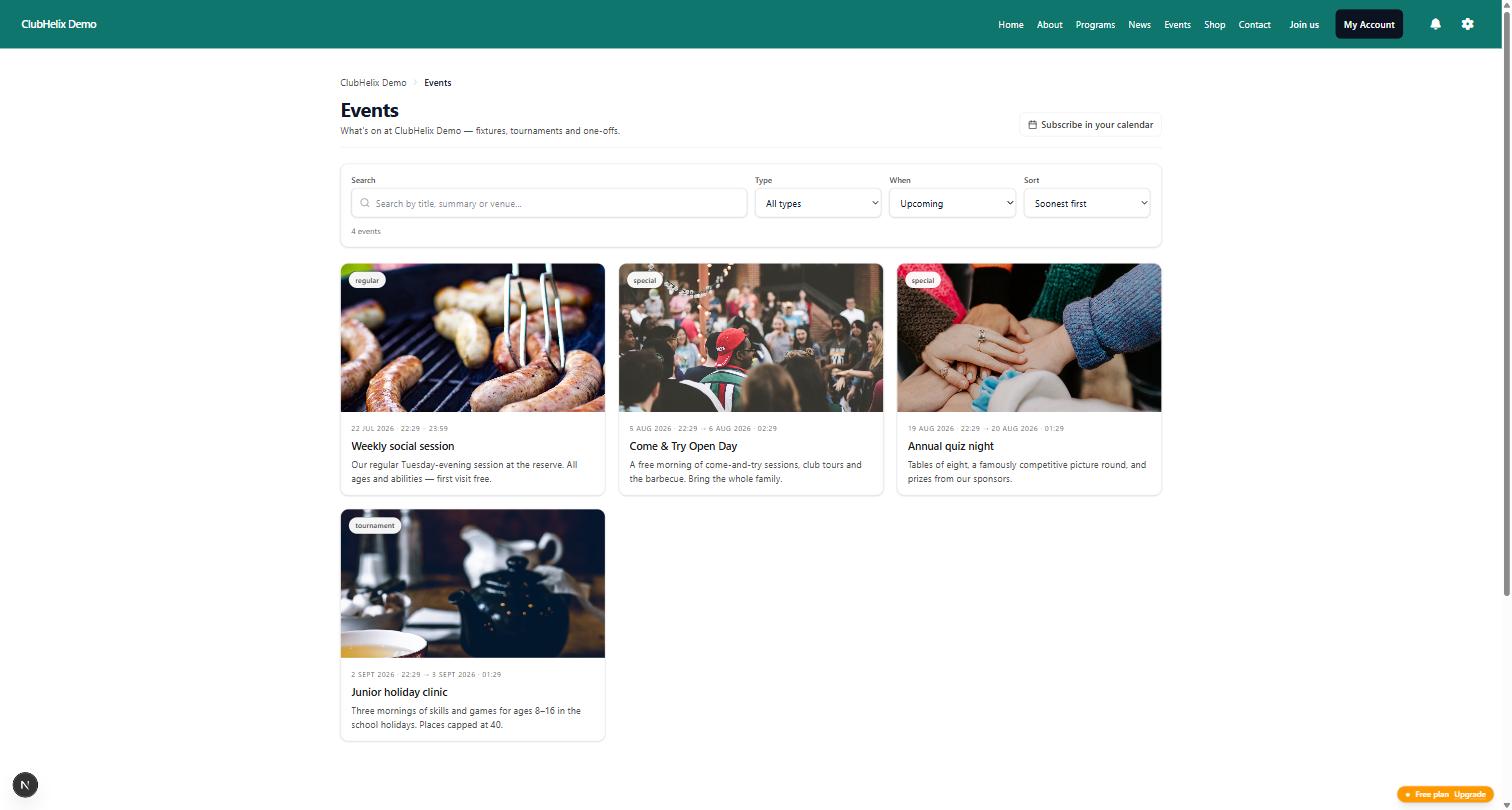
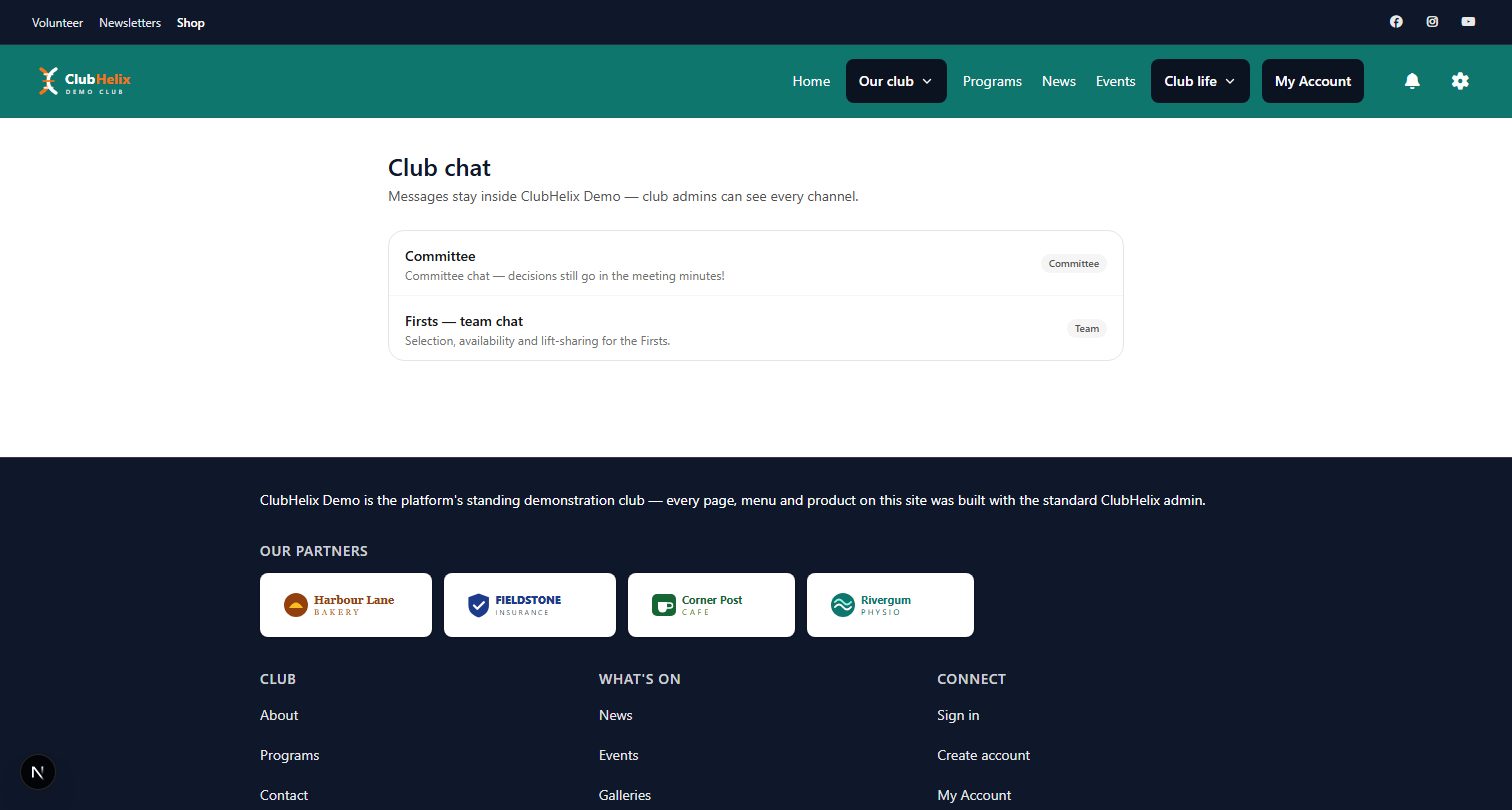
Every idea on this list gets easier when the event, the RSVP, the ticket and the attendance record all live in one place that belongs to the society rather than to whichever committee member set it up. ClubHelix gives your society a public site with an events page members can actually find, free RSVPs and paid tickets on the same event, attendance you can mark on a phone at the door, and a member chat for the day-to-day noise — so the number that wins your next grant is recorded rather than remembered.
If you are still choosing what to run this term, pair this list with the end-to-end event guide and the society running guide. Ready-made site templates will get your events page live in an evening, and the pricing page includes a free tier for building the site and trying it out, with taking payments online and being found in search on the paid plans.
ClubHelix gives your society events with RSVPs and ticketing, attendance you can mark at the door and a members' chat that survives the handover. Start free before your next social.


