
What this guide answers
- Do youth sports volunteers legally need a background check?
It depends on your state, your sport and your affiliations. Some states have screening laws, organizations affiliated with a national governing body may have mandatory screening requirements, and insurers and facility…
- How often should coaches' background checks be renewed?
Follow your governing body, state or insurer where they set a cycle.
- What is abuse-prevention training, and do our coaches need it?
It is training for adults on recognizing grooming behavior, keeping appropriate boundaries, responding to a disclosure, and reporting concerns.
- What is the two-adult rule in youth sports?
A widely adopted good practice that no adult is ever alone with a child who is not their own, whether at practice, in a vehicle, in a locker room or in online messages.
- What should a league keep on file after a background check?
The outcome, not the report: the person's name and role, the type and date of the check, whether they were cleared, who reviewed it, and when it is due for renewal.
Ask a youth sports board whether their coaches are background checked and the answer is almost always "yes". Ask who checked the assistant coach who joined in week three, when the U12 team manager's check expires, or whether the parent driving four kids to the away tournament was ever screened, and the answer gets slower. Most leagues don't fail at screening because they don't care. They fail because the system lives in one volunteer's inbox, and nobody notices the gaps until something goes wrong.
This guide sets out a practical system for youth sports coach background checks: who needs one, when it has to happen, how often to renew, where abuse-prevention training fits, what a safeguarding policy should cover, and how to keep the records without keeping more than you need. ClubHelix appears in the last third as the worked example.
A clear warning before anything else: this is general information, not legal advice. Screening requirements for youth sports vary by state, by sport, and by the organizations you are affiliated with, and they change. Nothing below states what the law or any governing body requires of you. Use it to build a system, then confirm the specific requirements with your national governing body, your state association, your insurer and, where needed, a lawyer.
Where the requirements come from — and why you have to ask
A youth sports league usually answers to several sets of rules at once, and each can impose its own screening requirement. Before you design anything, find out what each of these expects of you:
| Source | What it may require | Who to ask |
|---|---|---|
| Your state | Some states have laws on screening people who work or volunteer with children; the detail varies widely | Your state association, or a lawyer familiar with nonprofits in your state |
| Your national governing body | Organizations affiliated with a national governing body may have mandatory screening and abuse-prevention training for coaches and other adults | Your governing body's safeguarding or membership office |
| Your state or regional association | Additional rules for sanctioned competition, tournaments or travel | The association's registrar or risk manager |
| Your insurer | Screening conditions attached to your liability or abuse coverage | Your broker, in writing |
| Facility owners | School districts and park departments may require screening for anyone using their facilities with children | Whoever signs your field or gym agreement |
The strictest of those rules is your floor. Write down which requirement came from where, with the date you confirmed it, because the answer to "why do we check assistant coaches every two years?" should never be "that's what we've always done".
If your league is fully independent — no governing body, no sanctioned play — you may find few formal requirements at all. That is not a reason to screen less. Parents assume every adult on the field has been checked, and your insurer and your facility owners may assume it too.
Who needs a background check
Start with a list of every adult role in your league, then decide for each one whether it needs a check. Decide by what the role involves, not by its title. Four questions do most of the work:
- Regular contact. Does the role involve contact with children, week after week?
- Authority. Does the person hold authority over children, such as picking teams or setting playing time?
- Unsupervised access. Could the person ever be alone with a child, even briefly?
- Travel and overnight. Does the role involve driving children, or staying with them away from home?
A "yes" to any of them is a strong signal the role should be screened. Here is how that tends to play out, as a starting point for your own list rather than a statement of any rule:
| Role | Commonly screened? | Why |
|---|---|---|
| Head coach | Yes | Regular contact, authority, and often unsupervised moments |
| Assistant coach | Yes | Same contact as the head coach, and often the one who arrives early |
| Team manager / team parent | Usually | Contact details, communications, and often travel logistics |
| Board members | Often | Authority over the program and access to records about children |
| Trainers, clinicians, private coaches using your facilities | Yes | Contact and authority, often one-to-one |
| Travel chaperones and drivers | Yes | Overnight or unsupervised time with children |
| Referees and officials | Depends | Adult officials usually yes; youth officials are minors themselves and need a different approach |
| Occasional concession or field-setup volunteers | Often not | Brief, supervised, in public — but decide it, don't assume it |
Two groups deserve a separate conversation with your governing body. Teenage volunteers, such as a 16-year-old assistant coaching the U8s, are children themselves, and screening rules for minors usually differ. Guest adults, such as a college player running one clinic, still meet your kids; decide whether they need a check or must be supervised by a screened adult at all times.
Once the board has decided, publish the list. When a new volunteer steps up, the answer already exists, and no one has to make a judgment call on a Tuesday night.
When: before the first practice, not during the season
The rule that closes most gaps is simple to say and hard to keep: no clearance, no roster. A coach is not assigned to a team, added to the team's messages, or given the practice schedule until their check has come back clear and been recorded.
The pressure against that rule is real. Registration runs late, a coach drops out, a parent volunteers the day before the first practice, and the check takes days or weeks. So build the timing into your season plan:
- Recruit coaches early. Most of the delay is not the check itself. It is the gap between a volunteer saying yes and filling in the consent form, so start that process the week they agree.
- Set a screening deadline a few weeks before the first practice, and treat it like a registration deadline.
- Have a fallback for late volunteers. A screened adult is always present, and the new volunteer is never alone with children, until their clearance is recorded.
- Re-screen on a role change. A parent helper who becomes a head coach, or a coach who starts traveling with a team, gets their clearance checked against the new role.
How often to renew: a decision your board makes
Background checks describe the past up to the day they were run. They go stale, so every screening system needs a renewal cycle. Where your governing body, state or insurer sets one, follow it. Where nobody does, the board sets it, and it is worth making the decision deliberately:
- Shorter cycles catch more, cost more, and add more volunteer admin.
- Longer cycles are easier to manage, but leave a longer window in which something could change unseen.
- Count from the date of the last check, not from the start of the season, so renewals are spread across the year rather than arriving all at once.
- Ask for self-disclosure between checks. Your volunteer agreement should require a person to tell the league promptly about any arrest, charge or conviction during their involvement. That is your early warning between checks.
Whatever cycle you choose, record it in your safeguarding policy with the reason, and review it once a year.
A check is one layer — screening is the whole system
A clean background check tells you that nothing disqualifying was found in the records that were searched. It does not tell you a person is safe around children, and most people who harm children have no record at all. Treat the check as one layer in a screening process that also includes:
- An application form for every screened role, asking about previous involvement with youth programs.
- References, at least one from a previous youth program where possible, followed up by phone.
- A short conversation with a board member or coordinator before appointment, covering your code of conduct and your safeguarding rules.
- Abuse-prevention training before the season starts.
- Supervision and follow-up during the season: coordinators who drop in to practices, and parents who know how to raise a concern.
Abuse-prevention training
Organizations affiliated with a national governing body may be required to make sure coaches and other adults complete abuse-prevention training, often with a refresher on a set cycle. Check with your governing body what is required and which courses count. Even where nothing is required, it is one of the most effective things a league can do. Good training usually covers recognizing grooming behavior, appropriate boundaries and communications, how to respond when a child discloses something, and how and to whom to report.
Track training the same way you track checks: who completed it, on what date, and when the refresher is due. A training certificate that expired last spring is a gap, even if the background check is current.
Your youth sports safeguarding policy
Screening keeps some people out. A safeguarding policy sets the rules for everyone who is let in. Keep it short enough to read, specific enough to act on, and publish it on your website where families can see it. A workable policy covers:
- Code of conduct for coaches, volunteers, players and spectators. Our player code of conduct template is a starting point for the player version.
- The two-adult rule. A widely adopted good practice is that no adult is ever alone with a child who is not their own, whether at practice, in a car, in a locker room or online. Where a one-to-one moment is unavoidable, it happens in plain view and interruptible. Check whether your governing body sets a specific version of this rule.
- Electronic communication. Coaches message teams through league channels or group messages that include parents. No private one-to-one messages or social media contact with players.
- Travel and overnight stays. Who may drive whom, rooming arrangements, and parental consent for every trip.
- Locker rooms and changing areas. Supervision rules, and a ban on phones and cameras.
- Reporting concerns. Who a parent, player or volunteer tells, how the league responds, and the duty to contact law enforcement or child protective services where abuse is suspected. Laws on who is a mandated reporter vary by state; find out what yours says and put it in the policy.
- A named safeguarding lead on the board, and a deputy, so every concern has a clear owner.
For more on turning a policy into everyday practice, our guide to child-safe standards walks through one government's ten-principle framework. It was written for clubs in another jurisdiction, but its themes of culture, complaint handling and ongoing review translate well. Our guide to inducting and training volunteers covers getting new coaches through all of this before their first practice.

Record-keeping: keep the result, not the report
Screening produces sensitive information, and every piece you keep has to be protected for as long as you hold it. The principle is simple: record the outcome, not the content.
| Record this | Don't keep this (unless you are required to) |
|---|---|
| Name and role | The full background report |
| Type of check and date completed | Social Security numbers or copies of ID documents |
| Outcome: cleared or not cleared | Details of anything the check found |
| Who reviewed it | Screenshots emailed between board members |
| Expiry or renewal date | Anything held in a personal inbox or phone |
| Training completed, with its date and refresher date |
Some practical rules follow from that:
- Limit access. Only the safeguarding lead and one or two named board members should see screening records. Coaches don't need to see each other's status, and team managers don't need to see anyone's.
- Decide adverse results with criteria, not personalities. Agree in advance, in writing, what kinds of findings disqualify someone from which roles, so a hard decision is consistent and defensible. There may be legal requirements about how you tell a volunteer that a check affects their eligibility, so follow your screening provider's process and take legal advice where needed.
- Set a retention period for the records of volunteers who have left, and delete them when it ends, unless your governing body or insurer requires you to keep them longer.
- Keep the register somewhere that outlives the volunteer. A spreadsheet on one board member's laptop leaves when they leave.
A season checklist
- Confirm this season's screening and training requirements with your governing body, state association, insurer and facility owners.
- Review the list of roles that need a check, and publish it.
- Start checks the week each coach or volunteer is recruited.
- Record every clearance: type, date, outcome, reviewer, renewal date.
- Record abuse-prevention training completion and refresher dates.
- Apply "no clearance, no roster", with a two-adult fallback for anyone still pending.
- Get every coach and volunteer to accept the code of conduct and safeguarding policy.
- Run a mid-season review for anything expiring before the season ends.
- After the season, delete records past your retention period.
If you are setting up a new program, the youth sports leagues page shows how the whole league fits together, and travel teams covers the extra care that overnight trips need.
Doing it in ClubHelix
Everything above can run on paper and a well-kept spreadsheet. What software changes is that the dates watch themselves, and the register stays with the league instead of with one volunteer. Here is how the pieces fit in ClubHelix. One honest note first: ClubHelix is not a background-checking service. It records the outcome your screening provider or governing body gives you. It does not run checks.
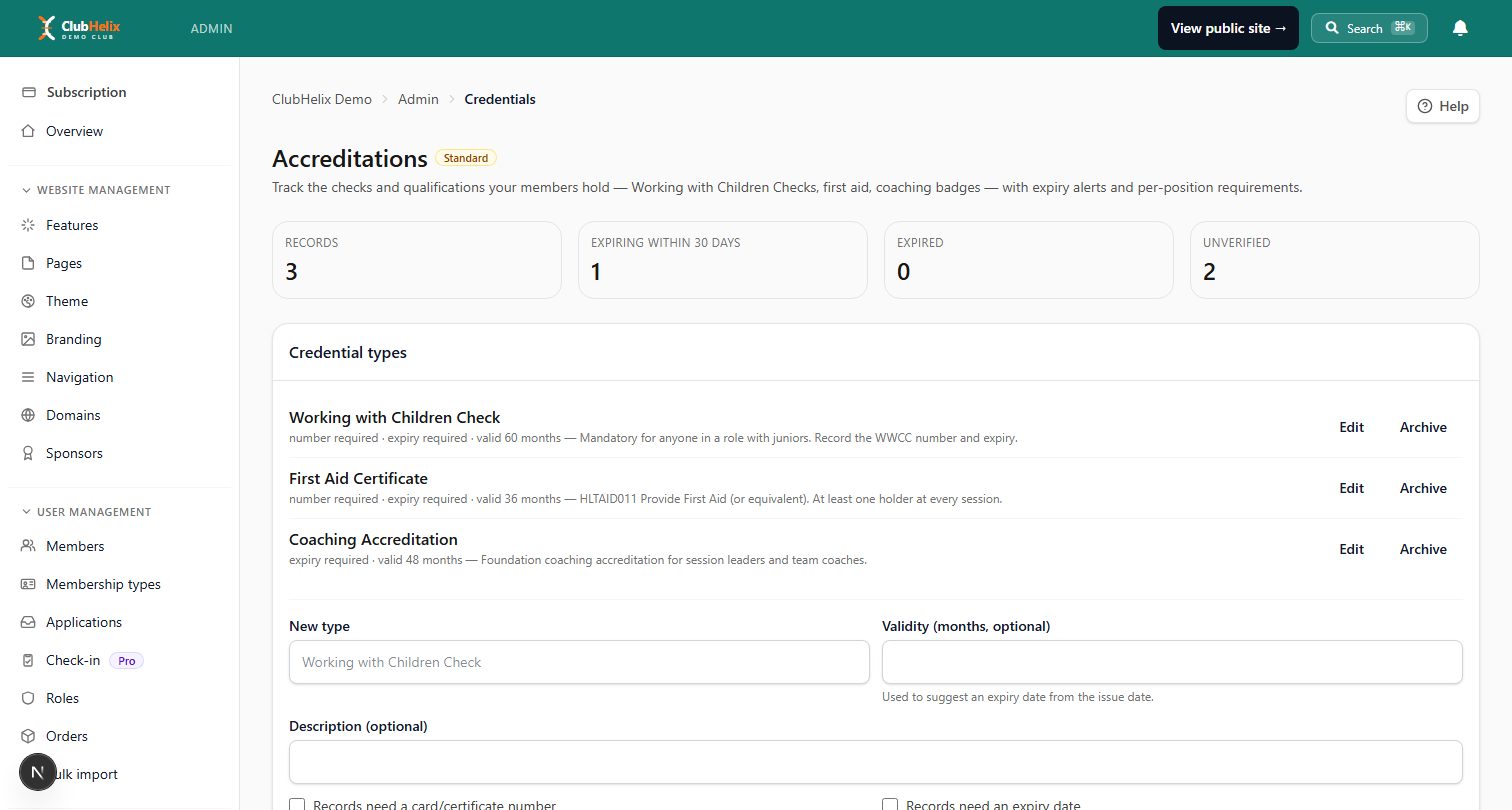
- Accreditations (on the Standard plan and above) let you define your own credential types, such as "Background check", "Abuse-prevention training" or "First aid", and record who holds each one with its expiry date. Give a type a standard validity that matches your board's renewal cycle, and recording the date of a check suggests the expiry automatically.
- Automatic reminders go to the member and to every accreditation manager 30 days and again 7 days before a credential expires, and re-arm when a renewal is recorded.
- A Verified tick can only be set by an admin who has seen the evidence, never by the member. Credential numbers are masked in the register, and the whole page sits behind its own Manage accreditations permission, so screening records are visible only to the people you choose.
- A verification record captures how each clearance was actually checked and by whom, with a re-check cadence counted from the last check rather than the expiry date.
- Position requirements attach a credential to a role, such as "Coach needs a current background check and training", and the gap list shows every position holder who is missing something. That is your pre-season "no clearance, no roster" check.
- Digital waivers record each volunteer's acceptance of your code of conduct and safeguarding policy, versioned so you can always show which wording they agreed to.
- Forms handle the volunteer application and references, and volunteer rostering puts people on duties once they are cleared.
Our ClubHelix for US organizations page covers the rest of a US setup, and the junior clubs page shows the same system at club scale. Plans are on the pricing page, and you can start on the free tier and move to Standard when you are ready to run your screening register in it.
Frequently asked questions
Do youth sports volunteers legally need a background check?
It depends on your state, your sport and your affiliations. Some states have screening laws, organizations affiliated with a national governing body may have mandatory screening requirements, and insurers and facility owners often set their own. Confirm with your governing body, state association and insurer, and whatever the minimum turns out to be, screen every adult with regular, unsupervised or overnight access to children.
How often should coaches' background checks be renewed?
Follow your governing body, state or insurer where they set a cycle. Where nobody does, the board decides, weighing cost and admin against how long a gap it can accept. Count renewals from the date of each person's last check, and require volunteers to tell you about any charge or conviction between checks.
What is abuse-prevention training, and do our coaches need it?
It is training for adults on recognizing grooming behavior, keeping appropriate boundaries, responding to a disclosure, and reporting concerns. Organizations affiliated with a national governing body may be required to have coaches and other adults complete it, often with periodic refreshers. Ask your governing body what applies and which courses count. Even where it isn't required, it is one of the most valuable things a league can do.
What is the two-adult rule in youth sports?
A widely adopted good practice that no adult is ever alone with a child who is not their own, whether at practice, in a vehicle, in a locker room or in online messages. It protects children, and it protects coaches from misunderstandings. Some governing bodies set their own version, so check yours, and write the rule into your safeguarding policy.
What should a league keep on file after a background check?
The outcome, not the report: the person's name and role, the type and date of the check, whether they were cleared, who reviewed it, and when it is due for renewal. Avoid keeping full reports, Social Security numbers or ID copies unless you are required to, limit who can see the records, and delete them after a set retention period once the person leaves.
Can a volunteer start coaching while their check is pending?
The safest rule is no clearance, no roster. If you do allow a pending volunteer to help, make sure a screened adult is always present and the new volunteer is never alone with children until the clearance is recorded. Check whether your governing body or insurer allows even that.

