
What this guide answers
- Does our club legally need a code of conduct?
Codes of conduct themselves are generally a governance requirement of your sport's governing body rather than legislation — most national and state bodies require affiliated clubs to adopt or operate under their codes…
- Should parents really have to sign a code of conduct?
Yes, and clubs that require it at junior registration report the sideline conversations become dramatically easier.
- What do we do when someone breaches the code?
Follow your graduated process: informal reminder, then formal warning, then suspension, then membership review — documenting from the formal warning onward and always giving the person a chance to respond before…
- Can we stop a spectator attending our games?
Generally, clubs (with their venue owner, often the council) can require people to leave and can exclude persistent offenders from club activities — check your venue agreement and your governing body's policies for the…
- Where should the codes live so people actually see them?
Four places: inside the registration flow as a required acknowledgement (the one that guarantees everyone has agreed), on the club website's policies page, on the clubroom noticeboard, and in the pre-season briefing…
Every club believes its people behave well — right up until a grand final, a contentious umpiring decision, or a junior parent who's had a bad week. A code of conduct is the document that lets a club deal with that moment calmly: it says, in advance and in writing, what behaviour the club expects from players, parents and spectators, and what happens when someone falls short. Without one, every incident becomes a personality contest; with one, it's a process.
This guide gives you full template outlines for the three codes every club needs — player, parent/guardian, and spectator — plus the surrounding pieces that make a code real: how to adopt it, how to get people to actually agree to it, and how to enforce it without splitting the club.
General information only. This guide is general information for community clubs, not legal advice. Your national or state sporting body may mandate specific codes, member protection policies or complaint processes that take precedence — always check with them, and adapt these templates to your sport's official framework.
Start with what already exists
Before writing anything, check what you're already bound by. Almost every club sits under a governing body whose member protection policy and codes of behaviour automatically apply to affiliated clubs — your club code should extend and localise those, never contradict them.
The official resources worth reading first:
-
Sport Integrity Australia — the national agency for safeguarding and integrity in sport, including the National Integrity Framework many sports have adopted, and free education courses your committee can take.
-
Play by the Rules — the long-running joint initiative on safe, fair and inclusive sport, with free template codes of conduct, scenario training and club resources built precisely for community clubs.
-
Your sport's national and state body — search "[your sport] codes of behaviour" and "[your sport] member protection policy". If these exist, your club code's job is to make them local and visible, and to add club-specific expectations (canteen behaviour, social media, clubroom rules).
If your club runs junior sport, the codes below also connect to your broader child-safety obligations — read our child safe standards guide alongside this one.
What makes a code of conduct actually work
Four properties separate a working code from a laminated poster:
- It's specific. "Show respect" is a vibe; "no dissent toward match officials, no sledging, phones away in change rooms" is a rule someone can be held to.
- It's agreed, not displayed. People sign or tick it — at registration, ideally — so nobody can later claim they never saw it.
- It has consequences with a process. A graduated response (reminder → formal warning → suspension → membership review) with named decision-makers, so enforcement is neither toothless nor arbitrary.
- It applies to everyone. Committee members, coaches and life members are bound the loudest. The first time a club excuses its best player or its president, the code is dead.
Player code of conduct template
Adapt the wording to your sport and age groups. For junior teams, add a simplified version in age-appropriate language.
[Club Name] Player Code of Conduct
As a player of [Club Name], I will:
- Play by the rules — the laws of the game, competition rules, and this code — and accept the decisions of match officials without dissent, protest gestures or ongoing argument.
- Respect opponents, teammates, officials and volunteers. No sledging, taunting, intimidation or deliberate provocation. I'll shake hands / thank officials and opponents after every game, win or lose.
- Never abuse, threaten or harass anyone — verbally, physically or online. This includes racial, religious, disability-related, gender-based and sexuality-based abuse, which will be treated at the highest level of seriousness.
- Give my best and support my teammates. Effort and encouragement over blame; errors are part of sport at every level.
- Attend training and games as committed, and tell my coach or manager as early as possible when I can't.
- Look after club and venue property, wear club uniform as required, and leave change rooms as I'd want to find them.
- Not take the field or attend club activities under the influence of alcohol or illicit drugs, and follow the club's policies on alcohol at club events, in line with my age group's rules.
- Represent the club well on social media — nothing abusive about opponents, officials, teammates or the club; no posting of teammates without their consent, especially juniors.
- Report concerns — unsafe equipment or grounds, injuries, and behaviour that breaches this code — to my coach, team manager or a committee member.
- Accept the club's process if my behaviour is questioned, including the graduated consequences set out below.
I have read and agree to the [Club Name] Player Code of Conduct. Name / Signature (parent/guardian for players under 18) / Date
Parent and guardian code of conduct template
The parent code matters most in junior sport, where research and every coach's lived experience agree: sideline behaviour shapes whether kids stay in sport.
[Club Name] Parent & Guardian Code of Conduct
As a parent or guardian of a [Club Name] junior member, I will:
- Remember children play for their own enjoyment, not mine. My role on the sideline is encouragement — of every child, both teams.
- Never yell instructions over the coach, criticise a child's performance (mine or anyone's), or "coach from the fence". One voice per team.
- Respect match officials absolutely — many are teenagers doing their first paid job. I will never approach, question or abuse an official before, during or after a game; concerns go to the team manager through the club's process.
- Model good sportsmanship: applaud good play from both sides, accept results, and keep post-game conversations positive ("I loved watching you play" beats a car-ride review).
- Support the club's volunteers — coaches, managers, canteen, ground crew — and take my turn on the roster where I can.
- Raise concerns properly: through the team manager or the club's complaints process, not at the coach at training, not in the team group chat, not on Facebook.
- Follow the club's photography and social media rules, including consent requirements for images of other people's children.
- Accept that repeated breaches may result in being asked to leave the venue, and ultimately in my child's club deciding I cannot attend — a step no club wants and every club must reserve.
I have read and agree to the [Club Name] Parent & Guardian Code of Conduct.
Spectator behaviour policy template
Shorter, because it must be enforceable against people who never signed anything — its authority comes from the club's right, usually with its venue, to require people to leave.
[Club Name] Spectator Behaviour Policy
All spectators at [Club Name] games and events are expected to:
- Encourage positively; never abuse, ridicule or intimidate any player, official, coach or other spectator.
- Respect match officials' decisions — abuse of officials is never acceptable and is grounds for immediate removal.
- Refrain from discriminatory language or behaviour of any kind; such conduct will be reported to the relevant governing body and may be reported to police.
- Stay off the playing area and out of player/official zones at all times.
- Comply with venue rules on alcohol and smoking, and with any direction from club officials, who may require any spectator breaching this policy to leave the venue.
Post this one at the ground and on the website; announce it before finals. Print it on the back of the canteen menu during finals season — genuinely.
Adopting and embedding the codes
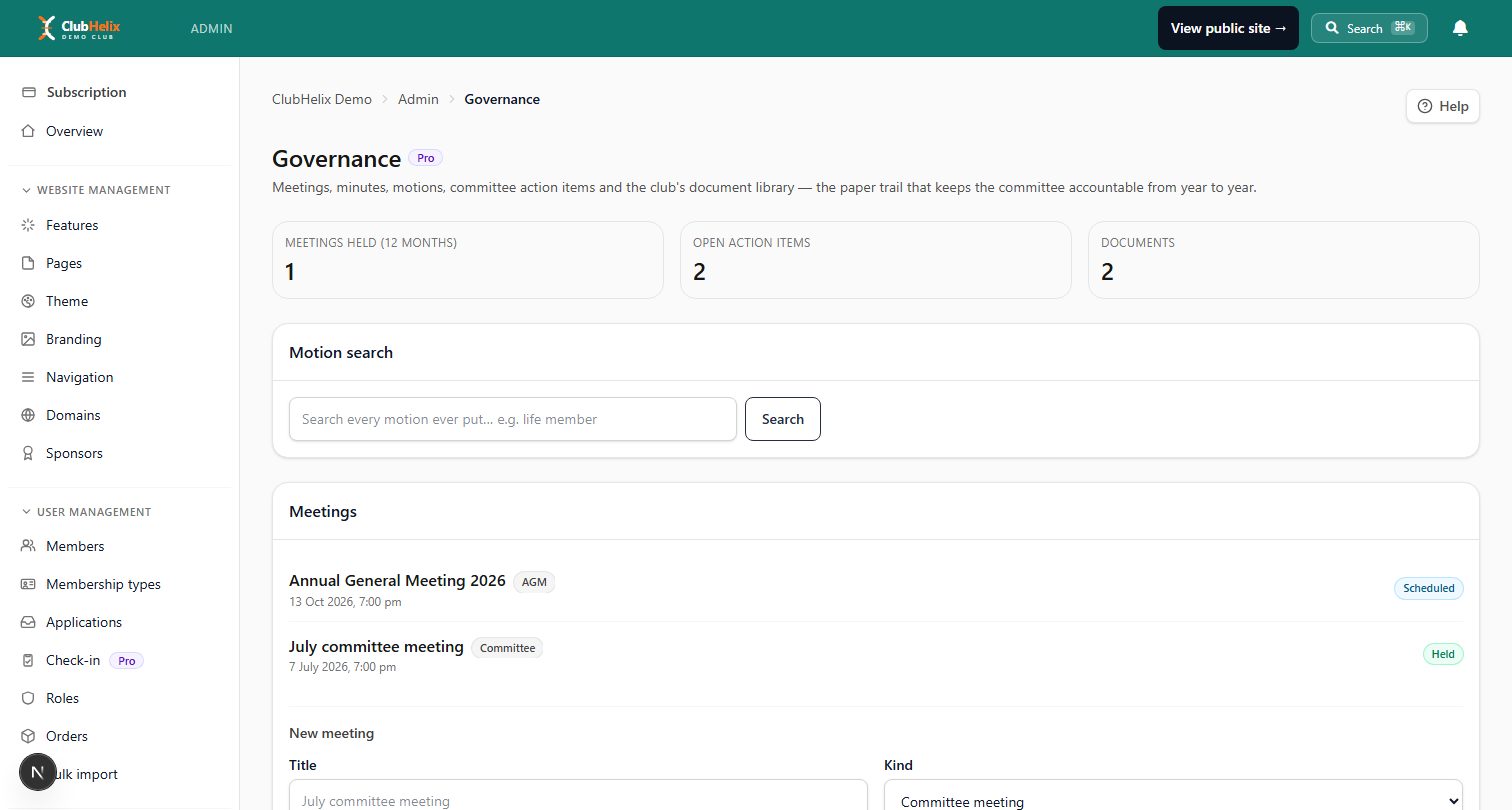
Adopt formally. Take all three codes to a committee meeting, minute the adoption with a version date, and store them with your policies — a proper governance and meetings record means the version history and the adopting minutes stay findable when a dispute puts the code under a microscope.
Get agreement at registration. The single highest-leverage move: make the player and parent codes a required acknowledgement in your online registration form. Every member (and every junior's parent) ticks agreement before they can pay — done once, recorded forever, no chasing paper. If your registration is still paper-based, this alone is a good reason to move it online.
Brief the people who enforce it. Coaches and team managers are the front line — walk them through the codes pre-season, agree the ladder of responses, and make sure they know the club backs them when they act.
Enforcement: the graduated process
Write this into each code so consequences are predictable:
- Informal reminder — a quiet word from coach, manager or a committee member at the time. Resolves 90% of incidents.
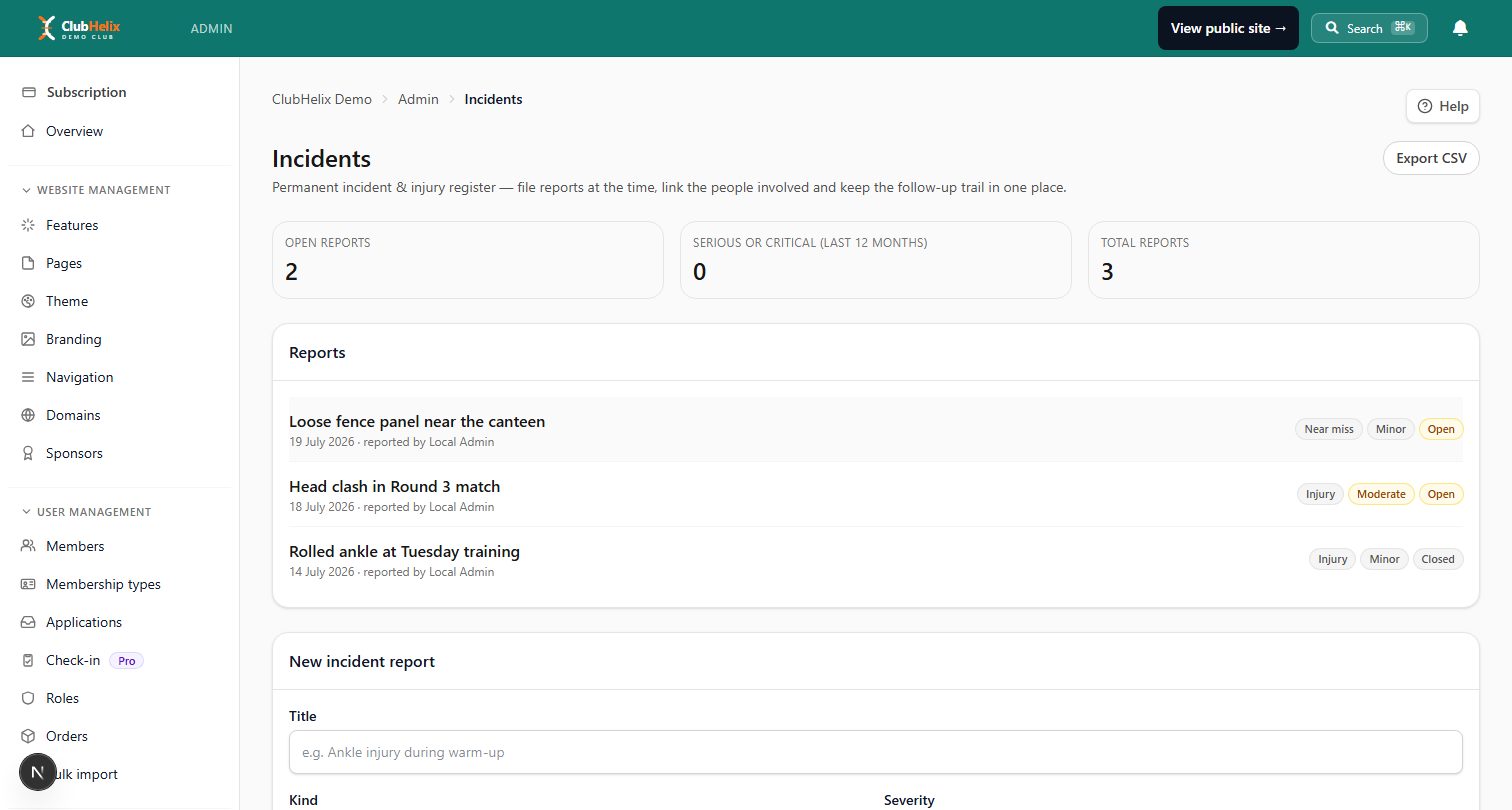
- Formal warning — a documented conversation or letter from the committee, recorded against the incident. Use an incident report so the facts are captured while fresh; our incident report form template covers what to record.
- Suspension or exclusion — from games, from the venue, or from a role, for a defined period, decided by the committee with the person given a chance to respond.
- Membership review — the constitutional process for ending a membership, reserved for serious or repeated breaches, following your constitution's natural-justice requirements.
Two rules keep the process fair: the person hears the specific allegation and gets to respond before any formal sanction, and anything involving a child's safety bypasses this ladder entirely — it goes straight to your child-safety process and, where required, to authorities.
Frequently asked questions
Does our club legally need a code of conduct?
Codes of conduct themselves are generally a governance requirement of your sport's governing body rather than legislation — most national and state bodies require affiliated clubs to adopt or operate under their codes of behaviour and member protection policies. Child-safety obligations, by contrast, do carry legal weight in every state. Practically: check your governing body's requirements first, adopt codes that align with them, and treat the code as essential infrastructure regardless — it's the document that lets you act when behaviour goes wrong.
Should parents really have to sign a code of conduct?
Yes, and clubs that require it at junior registration report the sideline conversations become dramatically easier. The signature isn't a contract you'll sue over — it's the shared reference point: when a parent is coaching from the fence, "remember the code we all agreed to at rego" is a two-line conversation instead of a confrontation. Building the acknowledgement into online registration makes it universal and effortless.
What do we do when someone breaches the code?
Follow your graduated process: informal reminder, then formal warning, then suspension, then membership review — documenting from the formal warning onward and always giving the person a chance to respond before sanctions. The two exceptions: spectator abuse of officials warrants immediate removal from the venue, and anything touching child safety goes straight to your child-safeguarding process and authorities, not up the behaviour ladder.
Can we stop a spectator attending our games?
Generally, clubs (with their venue owner, often the council) can require people to leave and can exclude persistent offenders from club activities — check your venue agreement and your governing body's policies for the specifics. The spectator policy's job is to make that power visible and legitimate before you need it: posted at the ground, announced at finals, applied consistently.
Where should the codes live so people actually see them?
Four places: inside the registration flow as a required acknowledgement (the one that guarantees everyone has agreed), on the club website's policies page, on the clubroom noticeboard, and in the pre-season briefing for coaches and team managers. Version-date the documents and keep the adopting minutes filed with them so there's never doubt about which version applies.
ClubHelix keeps your codes where they work — acknowledged at registration, stored with your governance records, and backed by incident reporting when something needs documenting. See how it fits together on /features.


