
What this guide answers
- How long does it take to start a youth sports league?
Allow the better part of a year for a first season. Field permits and insurance are the long poles: parks departments often allocate fields well ahead of the season, and facilities want proof of insurance before they…
- How many kids do you need to start a youth sports league?
Enough to make at least two or three teams in the same age band, so they have someone to play.
- Does a youth sports league need to be a nonprofit?
Not on day one, but most become one as they grow. Many incorporate as a nonprofit in their state and apply for federal tax-exempt status.
- Should a new league affiliate with a governing body?
Usually, yes. Affiliation tends to bring rules, age-group standards, coach education, insurance options and a screening program, all of which a new league would otherwise have to source itself.
- What is the best youth sports league software for a new league?
Look for one system that covers your website, registration, waivers, payments and team rosters, so nothing lives on a single volunteer's phone.
Almost every youth sports league starts the same way. The nearest program has a waitlist, or it costs more than a rec season should, or it plays forty minutes away on a Tuesday night. A few parents grumble about it on the sideline, one of them says "how hard can it be?", and a year later that parent is president of a youth sports organization with three hundred kids, a field permit and a treasurer.
It is not hard, exactly. But it is a long list of small jobs that only work in a particular order, and new leagues tend to get the order wrong: they print flyers before they have fields, take money before they have insurance, or recruit coaches before anyone has decided how coaches get screened. This guide walks through how to start a youth sports league in the order the decisions actually arrive, from "what kind of league are we?" to opening day. ClubHelix turns up in the last third as the worked example, and nowhere before that.
First decide what kind of league you are
"Youth sports league" covers three quite different operations, and the right answers to almost every later question depend on which one you are building. Settle this first, out loud, with whoever is starting it with you.
| Model | Who it is for | Typical shape | What it demands of you |
|---|---|---|---|
| Rec league | Every kid who wants to play, regardless of skill | Open registration, balanced teams, local games, modest fees | Volume: lots of families, lots of volunteer coaches, lots of fields |
| Travel / club / select | Kids selected at tryouts for a higher level | Tryouts, rostered teams, tournaments, higher fees | Selection policy, bigger budgets, travel logistics, fee collection |
| Clinic or program | Beginners, or skills work alongside a season | Fixed number of sessions, capped places, coach-led instruction | Capacity management, qualified coaches, a repeatable term |
Plenty of organizations end up running all three: a rec league as the base, a clinic to feed it and a travel program for the players who outgrow it. Start with one. A first-year board that tries to launch rec and travel at the same time usually does both badly, and the rec families notice that the travel teams got the good fields.
If you are starting a rec league, the rest of this guide applies almost line for line. If you are starting a single travel team, much of it still applies, but the money and tryout sections matter more. Our travel teams page covers that shape in detail.
Prove the demand before you build anything
Before you write bylaws or call the parks department, find out whether the families exist. The cheapest way is a free, low-commitment event: a Saturday skills clinic at a park, a "come and try" afternoon at a school gym, or an interest form shared through school newsletters and local parent groups.
What you are looking for is not likes. It is names, ages and a way to contact the families again. Three signals tell you it is time to go ahead:
- Enough kids in the same age bands to make teams. Thirty interested children spread evenly from age four to fourteen is not a league. Thirty children aged seven to ten might be.
- At least a handful of parents willing to coach or help. If nobody puts their hand up at the demand stage, nobody will in March either.
- A realistic idea of when and where you would play. A league with no plausible field is a mailing list.
Keep the interest list. It becomes your first registration invitation, and the families on it will forgive a rough first season because they asked for it.
Form a small board and write it down
A youth sports organization handles children, money and other people's time, so it needs a structure people can trust from day one. That does not mean a large committee. Most leagues start with:
- President — runs meetings, speaks for the league, makes the calls nobody else wants to.
- Treasurer — owns the bank account, the budget and the fee schedule.
- Secretary — keeps minutes, records decisions and handles correspondence.
- Registrar — runs sign-ups, eligibility and rosters. In a youth league this is the busiest volunteer in the building for about eight weeks a year.
- Safety or child-protection coordinator — owns screening, training records and the incident process.
One person can hold two of these in year one. Nobody should hold the treasurer's job and the only signature on the bank account, and nobody should be both the person who screens coaches and the only coach being screened.
Write short bylaws early: the league's name and purpose, who is a member, how board members are elected, how decisions are made, and what happens to money and equipment if the league folds. Our guide to committee roles covers each position in more depth.
Legal structure: a decision, not a default
Most US youth leagues move along the same ladder over time: an informal group with a shared bank account, then a nonprofit corporation formed in your state, then federal tax-exempt status. Many youth sports organizations pursue 501(c)(3) recognition from the IRS, which can make donations tax-deductible for donors; others sit under a different category or operate under a national body's group exemption. Which route suits you depends on your state, your budget and what your sanctioning body offers, and the requirements change.
This is general information, not legal or tax advice. Check current requirements with your state's official offices, the IRS at irs.gov, and an accountant who works with nonprofits. Our guide to starting a sports club covers the structures in more detail.
Affiliate, or go independent?
Most sports have a national governing body or several sanctioning organizations that youth leagues can affiliate with. Affiliation typically brings a rulebook, age-group standards, coach education, a route into insurance and, often, a screening program for adults. Some also run the tournaments and pathways your older players will eventually want.
Independent leagues exist and some thrive, but they have to source all of that themselves. For a first-year league, affiliation usually removes more work than it adds. Ask any organization you are considering four questions before you sign:
- What does it cost per player, per team and per season?
- What insurance does it provide, and what does it leave to you?
- What does it require of coaches and volunteers (screening, training, certifications)?
- What rules does it impose on age divisions, rosters and playing time?
The answers feed straight into your budget and your registration form, so get them in writing.
Insurance and the safety baseline
Do not take a dollar from a family, and do not run a single practice, until the league's insurance is in place. Facilities will almost always ask for a certificate of insurance before they give you a permit, so this sits on the critical path to fields as well.
Leagues usually look at general liability cover, accident cover for participants, and cover for the board's decisions. Youth programs should also ask specifically about abuse and molestation coverage. The most common route is a group program through your governing body; an independent broker who works with youth sport can tell you what that leaves uncovered.
Alongside insurance, set your safety baseline before recruitment starts:
- Adult screening. Decide who is screened (coaches, assistant coaches, team parents, board members), how, and how often. Your governing body or insurer may set a minimum. Our guide to youth sports coach background checks goes through the decisions.
- Abuse-prevention training and reporting. Depending on your sport and affiliation, federal law, state law and your governing body may all place training and reporting obligations on the adults in your league. Check what applies to you before the season starts.
- Concussion. Many states have laws on concussion in youth sport, typically covering education, removal from play and return-to-play clearance. Find out what yours requires before your first practice, not after the first knock.
- Waivers and medical information. Collect a participation waiver, emergency contacts and medical notes at registration, every season, from the parent or guardian.
Screening and safeguarding rules vary by state and by sport. Confirm the current requirements with your governing body, your insurer and your state.
Secure fields and facilities
Fields are the constraint that shapes everything else: how many teams you can run, which nights they play and whether the season happens at all. Start this conversation as early as you can.
Parks and recreation is usually the first call. Public fields are allocated by permit, often by season and often well ahead, with established leagues holding priority. Ask when the application window opens for your season, what the fees are, and what insurance they need to see.
School districts are the second call. Many have community facility-use agreements for gyms and fields outside school hours. They also want proof of insurance, and school events will bump you, so ask how much notice you get.
Churches, YMCAs, private facilities and businesses with land round out the list. A church with a big lawn has started more than one under-eight soccer league.
Whatever you secure, get it in writing: which fields, which days, which hours, which weekends are blacked out, who lines the fields and who holds the key to the lights. That written allocation is what you will build your divisions and schedule around.

Set age divisions, rosters and playing rules
Once you know your field capacity, decide how kids will be grouped. Most leagues group by birth year or by age on a set cutoff date, and many follow whatever their governing body uses so players can move between leagues cleanly. Decide:
- The age cutoff date and which document proves age.
- Division bands (single-year or two-year groupings), and what happens when a division is too small.
- Roster sizes and small-sided formats for the youngest players.
- Playing-time rules for rec: many leagues guarantee a minimum share of each game for every child.
- Whether you keep scores and standings for the youngest divisions at all.
Our guide to youth sports age divisions covers the trade-offs, including the siblings and "play up" requests that land on the registrar every season.
Recruit coaches and volunteers early
A rec league lives or dies on volunteer coaches, and most of them are parents who have never coached before. Make it easy to say yes:
- Ask for coaches on the registration form itself, with a tick-box for head coach, assistant and team parent.
- Tell people exactly what the job is: how many practices, how many games, what training and screening they need, and when.
- Pair every first-time head coach with an assistant.
- Give coaches a practice plan for week one so nobody stands in front of twelve seven-year-olds with no idea what to do.
Every league also needs people who never coach: field setup, the concession stand, scorekeeping, photos, equipment. A fair-share volunteer expectation, stated at registration, stops it from falling to the same eight families every week. Our guide to recruiting volunteers has more on this.
Registration and fees
Registration is where the league becomes real: families commit, money arrives and you find out whether you have eight teams or eleven. It deserves its own plan, and it has one: our guide on how to run youth sports registration covers what to collect, when to open and close, and how to handle waitlists and late sign-ups.
Fees deserve their own plan too. Price the season from a budget, not from what the next league charges, and decide your sibling discount and scholarship policy before registration opens. Our guide to youth sports league budgets and fees walks through building that budget line by line.
A first-season timeline
The exact spacing depends on your sport, your season and when your parks department allocates fields, but the order rarely changes. Count backwards from opening day.
| Months before opening day | What has to happen |
|---|---|
| 9–12 | Demand test; founding board formed; interest list started |
| 7–9 | Bylaws adopted; bank account opened; affiliation and insurance researched |
| 6–7 | Field permit applications lodged; insurance bound; screening process decided |
| 4–5 | Budget and fee schedule approved; age divisions and rules set; website live |
| 3–4 | Registration opens; coach recruitment starts; equipment and uniforms quoted |
| 2 | Registration closes; coaches screened and trained; teams formed |
| 1 | Uniforms ordered and delivered; schedule published; parent meetings held |
| 0 | Opening day |
Mistakes new leagues make
- Taking money before insurance and fields are confirmed. Refunding a whole season because a permit fell through is the fastest way to lose the families you worked to find.
- Running everything from one parent's phone and inbox. When that parent steps back, the league loses its contact list, its payment history and its field contacts in one go.
- Pricing from the neighbors. Your costs are yours. A fee copied from another league will be wrong in one direction or the other.
- Leaving screening until the week before practice. Background checks take time, and an unscreened coach at the first practice is a problem nobody wants to explain.
- No written roster or playing-time policy. The first complaint about teams or minutes arrives in week two. Have the answer already written down.
Doing it with ClubHelix
Everything above works with spreadsheets, paper forms and a shared inbox. It just stops working at about the point the league succeeds. ClubHelix is youth sports league software built for a volunteer board: one place for the league's website, registration, fees, teams, schedules and communication, with nothing held on one parent's phone. Here is how the jobs above map onto it, with the limits stated as plainly as the features.
A public home from week one. Your league gets a website with pages for divisions, fees, fields and the season calendar, so the families from your demand test have somewhere to look. You can start on the free plan, which has no time limit, and connect your own domain on a paid plan.
Registration with your own questions. Families register on your site through a form you build: self-registration lets a parent sign up several children from one account, and each child lands on the roster under their own name. On the Standard plan and above, each division can run as its own paid registration form with its own fee. One limit to know before you plan around it: a registration form does not cap its own headcount, so you watch the count and close the form when a division is full. Anything that must cap itself, such as a clinic or camp, runs as a program enrollment instead, which holds a capacity and an ordered waitlist (Pro plan).
Waivers signed on the way in. Digital waivers attach to the registration form, so a guardian accepts the current version with a typed-name signature at checkout, recorded against each child by name. Update the wording next season and old acceptances still point at the text each family agreed to.
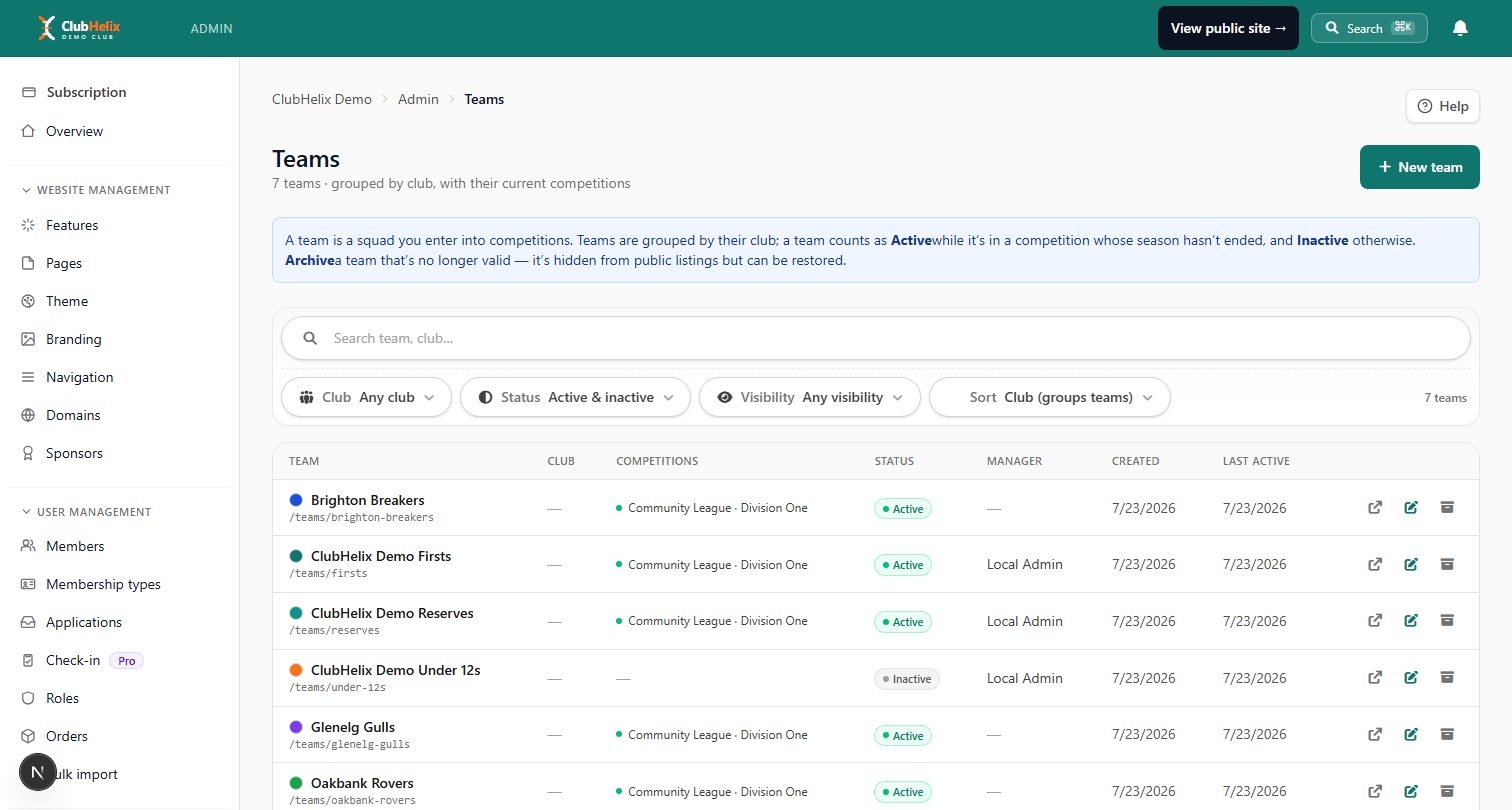
Teams, coaches and practices. Once teams are formed, team management gives each one a roster with jersey numbers, a coach and team manager whose access is scoped to that team alone, and a weekly practice schedule families can mark their availability against.
Screening records with expiry dates. ClubHelix does not run background checks; your governing body or screening provider does that. What it does (on the Standard plan and above) is record each adult's clearances and certifications with their expiry dates, so the safety coordinator can see who is cleared before opening day and whose training lapses mid-season.
Money into the league's own account. Online payments, including fees in installments, settle directly into the league's own Stripe account. ClubHelix never holds the league's funds. Online fee collection is part of the paid plans, which carry a 14-day free trial, bill on a 28-day cycle and can be canceled at any time; the details are on the pricing page.
For how the pieces fit a whole league, including field permits, schedules, standings and umpires, see the youth sports leagues page. If your league has a parent-run fundraising arm, the booster clubs page covers that side, and the ClubHelix page for US organizations covers the rest. When you are ready, you can create your league in an afternoon and look established before your first registration opens.
Frequently asked questions
How long does it take to start a youth sports league?
Allow the better part of a year for a first season. Field permits and insurance are the long poles: parks departments often allocate fields well ahead of the season, and facilities want proof of insurance before they will issue a permit. Registration usually opens three to four months before opening day.
How many kids do you need to start a youth sports league?
Enough to make at least two or three teams in the same age band, so they have someone to play. Many new leagues start with one or two divisions and grow, rather than launching every age group at once.
Does a youth sports league need to be a nonprofit?
Not on day one, but most become one as they grow. Many incorporate as a nonprofit in their state and apply for federal tax-exempt status. The right route depends on your state and your governing body, so check with your state's official offices, the IRS and an accountant before deciding.
Should a new league affiliate with a governing body?
Usually, yes. Affiliation tends to bring rules, age-group standards, coach education, insurance options and a screening program, all of which a new league would otherwise have to source itself. Compare costs and requirements before you sign.
What is the best youth sports league software for a new league?
Look for one system that covers your website, registration, waivers, payments and team rosters, so nothing lives on a single volunteer's phone. Check that money settles to the league's own account, that coaches can be given access to only their team, and that you can start without a long contract.


