
What this guide answers
- How much should a youth sports league charge for registration?
There is no standard figure: fees vary widely by sport, region, facilities and whether the program is rec or travel.
- What costs go into a youth sports league budget?
Typically field permits and lights, affiliation or governing-body fees, insurance, referees or umpires, uniforms, equipment, coach screening and training, software and payment processing, end-of-season awards…
- How do youth sports scholarships usually work?
The board sets aside a number of funded places or a dollar amount each season, paid for by the budget, sponsors, donations or grants.
- Should siblings get a discount?
Most youth leagues offer one, either a reduced rate from the second child or a family maximum.
- Should card processing fees be a separate charge?
The simpler approach is to treat processing as a cost in the budget and build it into the registration fee, like any other cost of running the season.
Ask a new youth league board how they set their registration fee and the honest answer is usually "we looked at what the other league charges and came in a bit under". It feels safe. It is not. The league across town has different fields, a different referee bill, different sponsors and a different number of kids, and its fee might be quietly subsidized by a reserve built up over twenty years, or quietly losing money every season.
Your fee should come from your own budget. That sounds like more work, and the first time it is, but it gives the board something it badly needs when a parent asks "why does it cost this much?": an answer. This guide walks through building a youth sports league budget from the ground up, turning it into a registration fee, and paying for the sibling discounts and scholarships that keep the league open to every family. ClubHelix appears in the last third as the worked example.
Start from costs, not from the neighbors
A league budget has two halves: what the season costs, and where the money comes from. Registration fees are the biggest source for almost every youth league, but they are the last number you set, not the first. The order is:
- List every cost for the season.
- Subtract income you can reasonably count on from other sources.
- Add a contingency and, once you can afford it, a contribution to reserves.
- Divide what is left by the number of paying players.
Everything below is that sequence in detail.
Three kinds of cost
The most useful thing to understand about a youth sports league budget is that costs grow in three different ways. Mixing them up is how leagues end up losing money in a year when registration was strong.
| Cost type | Grows with… | Examples | Why it matters |
|---|---|---|---|
| Fixed | Nothing: you pay it either way | Base insurance, software, website, storage, board costs | A small league pays the same fixed costs as a big one, so per-player cost is higher |
| Per team | Number of teams | Field time, lights, referees or umpires, team equipment bags, trophies | A division with nine players still needs a whole team's fields and officials |
| Per player | Number of players | Uniforms, affiliation or governing-body fees, per-player insurance, medals | These track registration closely, so they rarely cause surprises |
The practical lesson: a half-full team is the most expensive thing in your league. Every team you form carries a full share of field time and officials, whether it has fourteen players or nine. That is why division caps and team counts belong in the budget conversation, not just the registrar's spreadsheet.
The line items
Here is a checklist of costs most youth leagues face. Not every league has every line; some affiliations bundle insurance, some fields come free with a school partnership, some leagues use volunteer referees for the youngest divisions.
- Field and facility costs. Permits, rental, lights, field lining, portable toilets, storage.
- Governing-body and affiliation fees. Often charged per player, sometimes with a per-team or per-league fee on top.
- Insurance. Whatever your affiliation does not already cover. Ask what the group policy includes before you buy anything separately.
- Officials. Referees or umpires per game, plus any assignor fee.
- Uniforms. Jerseys, shorts or pants, socks; decide whether families keep them.
- Equipment. Balls, goals, nets, bases, pitching machines, cones, first-aid kits, replacement stock.
- Coach screening and training. Background checks, required courses and certifications, coach clinics.
- Software and payments. Website, registration and communications tools, plus card processing fees on online payments.
- End of season. Trophies, medals, photos, a picnic.
- Administration. Bank fees, postage, printing, state filing fees, accounting help.
- Contingency. Rainout makeups, a replaced goal, a price rise mid-season. Ten percent is a common starting point.
An illustrative sample budget
The table below is an illustrative example only. The figures are made up to show the method; they are not typical prices, and your costs will differ, often a lot, by sport, region and facilities. Replace every number with your own quotes.
The example assumes a rec league with 200 players in 16 teams, each team playing eight games.
| Line | How it's calculated (illustrative) | Amount (illustrative) |
|---|---|---|
| Field permits and lights | Quote from parks department | $6,000 |
| Affiliation fees | 200 players × $15 | $3,000 |
| Additional insurance | Broker quote | $2,000 |
| Officials | 64 games × $100 | $6,400 |
| Uniforms | 200 players × $25 | $5,000 |
| Equipment | Replacement plus new-team bags | $2,500 |
| Coach screening and training | Checks and courses for 40 coaches | $1,000 |
| Software and card processing | Subscription plus processing on fees | $2,000 |
| End of season | Medals and trophies | $1,200 |
| Subtotal | $29,100 | |
| Contingency | 10% of subtotal | $2,910 |
| Total costs | $32,010 | |
| Sponsorships | Four local sponsors | –$4,000 |
| Fundraising (concession stand) | Season estimate | –$3,000 |
| Needed from registration fees | $25,010 |
Now check a proposed fee against that target, remembering that not every registration pays the full price:
| Fee check at $150 (illustrative) | Amount |
|---|---|
| 200 players × $150 | $30,000 |
| Sibling discounts (30 second children × $20) | –$600 |
| Scholarship places (20 full places × $150) | –$3,000 |
| Fee income | $26,400 |
| Needed from fees | $25,010 |
| Surplus toward reserves | $1,390 |
Two things the example shows. First, the break-even fee is not "costs divided by players": sibling discounts and scholarships mean fewer full-price registrations than you have kids, so you divide by paying players. Second, a small surplus is not profit. It is the reserve that pays for the goal that blows over in March, or the season registration comes in twenty kids short.
A general club budget template is a good place to lay out your own version.
Income beyond registration fees
Every dollar from somewhere else is a dollar you do not have to charge a family. Most leagues combine:
- Sponsorships. Local businesses sponsoring a team, a field banner or the whole season. Put sponsors on the jerseys or the website and thank them publicly; it is what gets them to renew.
- Fundraising. The concession stand, a car wash, a raffle, picture day. Our list of fundraising ideas has more. Budget conservatively: count last year's actual result, not this year's hopes.
- Donations. A "sponsor a player" appeal is the most direct way to fund scholarships. Whether donations are tax-deductible for the donor depends on your league's tax status.
- Grants. Community foundations, local businesses and some national programs fund youth sport, often for equipment or access programs. Treat grant income as a bonus until the money is confirmed.
Many leagues also run a booster club or parent group for this side of the finances. The booster clubs page covers how that works.

Setting the registration fee
With the budget done, setting youth sports registration fees is arithmetic plus judgment:
- Start from the break-even fee per paying player, then round to a number that is easy to explain.
- Price divisions differently only when their costs differ. Older divisions often need bigger fields, longer games and paid officials; the youngest may need none of those. A fee per division is fairer than one price for everyone.
- Keep rec and travel separate. Travel teams carry tournament entries, extra coaching and more field time. Rec families should not subsidize them, and travel families should see exactly what their larger fee covers. Our travel teams page covers how select programs usually break that fee down.
- Build card processing into the price. Online payments cost something to process. Treat it as a line in the budget, like field lights, rather than a separate charge added at checkout.
- Set the early-bird and late fees around the base price, not the other way round. The early-bird discount should still cover costs; the late fee should reflect the real extra work.
How much to charge for youth sports is ultimately the board's decision, but a fee that comes from a written budget is one you can defend to any parent who asks.
Sibling discounts and family caps
Most youth leagues offer a sibling discount, and families expect one. There are two common shapes:
- A reduced rate from the second or third child, for example a fixed amount off each additional child.
- A family maximum, where no household pays more than a set total however many children register.
Both are good policy. Both also cost money, and the most common budgeting mistake is to set the discount after the fee, as if it were free. Estimate how many siblings you will have from last season's list, put the discount into the fee check as in the example above, and set the base fee accordingly. Our guide to family membership pricing covers the trade-offs in more depth.
Scholarships and fee assistance
Cost is one of the biggest barriers in youth sport, and a league that means "every kid who wants to play" needs a way for families who cannot afford the fee to play anyway. Scholarships in youth sports work best when they are:
- Budgeted. Decide how many places, or how many dollars, the league will fund this season, and where that money comes from: a line in the budget, a sponsor, a "sponsor a player" appeal, or a grant.
- Easy to ask for. A short, private request on or beside the registration form. Many leagues ask families to self-certify need rather than produce documents, which keeps the process dignified; decide what your board is comfortable with.
- Private. Only the person who decides, and the treasurer, should know who received assistance. Coaches and other families never need to.
- Partial as well as full. Many families need a reduced fee or installments rather than a free place.
- Decided consistently. Write down who decides and on what basis, so it does not depend on who happens to know whom.
Installments and cash flow
A budget can balance on paper and still run out of cash. Field permits, insurance and uniform deposits are usually due before the season starts, sometimes before registration closes, while fee income arrives over the registration window, and installment payments arrive over months.
- Map when each bill is due against when fee income lands.
- If you offer installments, make the first payment large enough to cover the up-front bills.
- Keep a reserve of at least one season's up-front costs as the league matures.
Installments are worth the planning. For a travel fee in the thousands, they are often the difference between a family saying yes and quietly not registering.
Tax, nonprofit status and sales tax
Several money questions depend on your league's legal and tax situation, which differs by state and by structure:
- Whether the league is a nonprofit in your state, and whether it has federal tax-exempt status such as 501(c)(3).
- Whether donations are tax-deductible for the donor.
- Whether sales tax applies to merchandise, concessions or even registration fees in your state.
- What records and filings the league must keep each year.
This is general information, not legal or tax advice. Check with an accountant who works with nonprofits, your state's official offices and the IRS at irs.gov before you decide.
Tell families where the money goes
Publish a simple breakdown beside the fee: fields, officials, uniforms, insurance, equipment, scholarships. Families who can see that most of their fee goes to fields and referees are far less likely to argue about it, and far more likely to volunteer at the concession stand when they understand what it funds.
Budgeting and collecting fees with ClubHelix
ClubHelix is a league platform, not accounting software; your treasurer will still keep the books. What it does is collect the money the way your budget assumes, and show you whether it is arriving. Here is how the decisions above map onto it, with the limits stated plainly.
Fees per division. Each division can run as its own paid registration form with its own fee through self-registration, so older and younger divisions, or rec and travel, are priced and sold separately. Paid registration is part of the Standard plan.
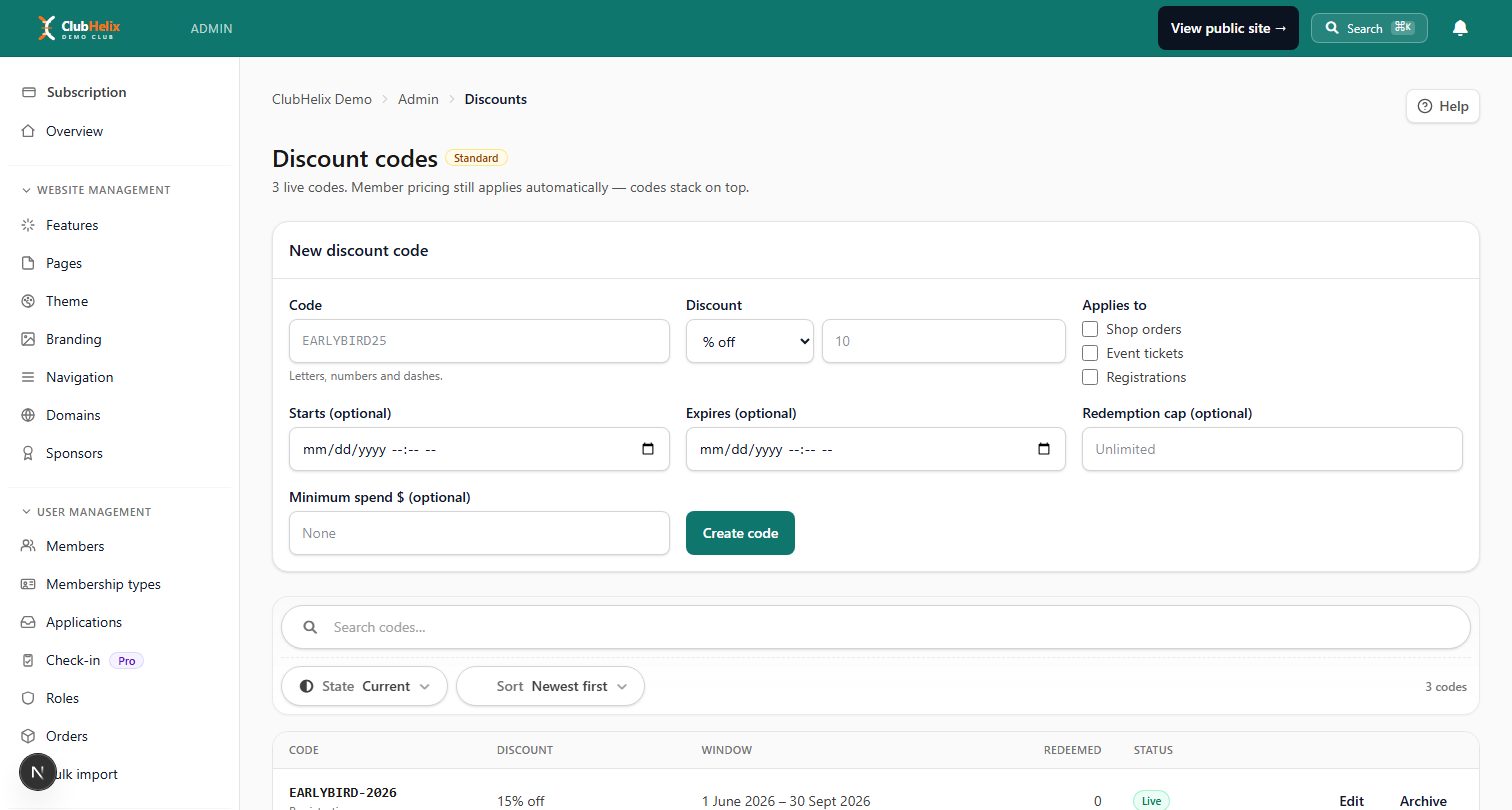
Sibling rates and family maximums, applied automatically. Set a reduced rate from the second or third child, or a maximum any one family pays, once from the Discounts page. It comes off the registration total at checkout, with no code for the family to type, and it counts what the household has already paid on that form, so a second child registered weeks later is still priced as the second child.
Early birds and scholarships. An early-bird cutoff is a date and a discount on the registration form itself, applied automatically before the deadline. For a scholarship, the board issues a single-use discount code to that family privately, for a percentage or a fixed amount, so a partial scholarship is as easy as a full one. Who qualifies is your board's decision, not a rule in the software.
Installments. Registration can take payment in 2 to 12 installments, weekly, every two weeks or monthly, with pro-rata pricing for a player who joins mid-season.
Sponsor-a-player donations. A donations page takes one-off and recurring gifts into a ledger of its own, and donors can tick a box to cover the processing fee on their gift.
Money into your own account. Payments settle directly into the league's own Stripe account, and ClubHelix never holds your funds. ClubHelix's published platform fee comes out of the league's settlement and is never surcharged to families; the payment provider's own processing fee applies separately at its published rates, which is why it belongs in your budget.
Knowing where you stand. Reports show who is paid, part-paid and outstanding, and an accounting export covers every payment in a period, online, cash and check, refunds included, for the treasurer to reconcile against the budget.
For how this fits a whole league, see the youth sports leagues page. There is a free plan with no time limit; paid plans carry a 14-day free trial and bill on a 28-day cycle. Current prices are on the pricing page.
Frequently asked questions
How much should a youth sports league charge for registration?
There is no standard figure: fees vary widely by sport, region, facilities and whether the program is rec or travel. Build a budget of your league's real costs, subtract sponsorship and fundraising income, add a contingency, and divide by the number of paying players. That gives you a fee you can explain.
What costs go into a youth sports league budget?
Typically field permits and lights, affiliation or governing-body fees, insurance, referees or umpires, uniforms, equipment, coach screening and training, software and payment processing, end-of-season awards, administration and a contingency. Some leagues also budget a scholarship fund.
How do youth sports scholarships usually work?
The board sets aside a number of funded places or a dollar amount each season, paid for by the budget, sponsors, donations or grants. Families request help privately, one or two people decide against a written policy, and assistance can be a full place, a reduced fee or an installment plan.
Should siblings get a discount?
Most youth leagues offer one, either a reduced rate from the second child or a family maximum. Budget for it before you set the base fee, because every discount reduces fee income.
Should card processing fees be a separate charge?
The simpler approach is to treat processing as a cost in the budget and build it into the registration fee, like any other cost of running the season. Families see one clear price, and the budget stays honest.


