
What this guide answers
- How are youth sports age groups determined?
By the child's age on a cutoff date. Most leagues use either a birth-year model, where kids born in the same calendar year play together, or a school-year model, where the cutoff lines up with the school calendar so…
- What does U10 mean in youth sports?
It usually means "under 10 on the cutoff date": a player in U10 had not turned 10 by the date your league uses to calculate age.
- Can a child play up an age group?
Often yes, but only under a written policy. A good policy says which divisions allow it, who can request it, what is assessed (skill, size and safety, social readiness), who decides, and that approval lasts one season.
- Does a child move up a division when they have a birthday during the season?
No. In almost every league the division is set by age on the cutoff date and stays fixed for the whole season.
- Should our rec league use birth year or school year?
If you are affiliated, follow your governing body. If you are independent, weigh simplicity and alignment with other competitions (a birth-year model) against keeping classmates together (a school-year model), and pick…
Every youth sports season opens with the same email, sent by a dozen different parents in slightly different words: "Which division is my kid in?" It sounds like a question with a one-line answer. It usually isn't. The answer depends on the child's date of birth, on your league's cutoff date, on whether your league groups kids by birth year or by school year, on whether your divisions are one year wide or two, and — for the child who is bigger, faster or simply keener than everyone else in their group — on your playing-up policy.
Get the system clear and published before registration opens, and the question answers itself. Leave it to be worked out case by case and your registrar spends the first month of the season adjudicating birthdays. This guide explains how youth sports age groups work, the two models leagues use to set them, the decisions your board actually has to make, and how to write the answers down so families can find them. ClubHelix turns up in the last third as the worked example.
One thing up front: if your league or club is affiliated with a national governing body or a state association, the age rules for sanctioned play are usually theirs, not yours — and several sports have changed their rules in recent years. Nothing below is a statement of any governing body's current rule. Treat it as a way to understand the options and ask the right questions, then check the current rule with your governing body before you publish anything.
What "U10" actually means
Most youth sports use "under" labels: U6, U8, U10, U12, U14 and so on. The convention is that a player in the U10 division is under 10 on the cutoff date your league uses — so the label is really a statement about age on one particular day, not about the child's age during the season.
That one detail explains most of the confusion. A child can be 10 for most of a U10 season and still be perfectly eligible, because what counts is how old she was on the cutoff date. Equally, a child who turns 9 the week after the cutoff can spend the whole season as one of the youngest in the division.
A few things vary by sport and by league, and you should confirm each one rather than assume it:
- Where the cutoff sits. Some organizations use January 1 (a calendar or birth-year model); others use a date tied to the school year or to the start of the season.
- How the label is calculated. "Under 10 on the cutoff date" is common, but some sports calculate the division from the season year minus the birth year, which can land a child in a different-looking label for the same birthday.
- How wide a division is. A U10 division might be one birth year or two.
- Whether divisions are coed. Many rec leagues run mixed divisions at the youngest ages and split later; sanctioned competition may have its own rules.
If your league is independent — a rec league not playing in anyone else's sanctioned competition — these are genuinely your board's decisions. If you are affiliated, most of them are made for you, and your job is to apply the rule correctly and explain it clearly.
The two models: birth year versus school year
Almost every youth sports age system is a variant of one of two models. Knowing which one you are running, and why, is what lets you answer parents with confidence.
| Birth-year model | School-year (cutoff date) model | |
|---|---|---|
| How it works | Kids born in the same calendar year play together | Kids are grouped by age on a cutoff date aligned with the school year |
| What families see | "Born in a given year → this division" | Teammates are mostly in the same grade at school |
| Main strength | Simple, easy to verify, and lines up with any competition that also groups by calendar year | Friends from class play together; carpools and school-based recruiting are easier |
| Main friction | Classmates can be split across two divisions | Harder to align with competitions that use calendar years |
| Tricky cases | Late-in-year birthdays are the youngest in the group | Kids who repeated or skipped a grade, and districts with different school cutoffs |
Neither model is "right". Sports and associations have moved from one to the other and, in some cases, back again, precisely because each solves one problem and creates another. A birth-year model is the easiest to administer — one date of birth, one answer, no arguments about grades. A school-year model tends to be easier on families and on recruiting, because a second-grade teacher's class ends up largely on the same field.
The relative age effect, briefly
Whichever model you use, the children born just after the cutoff are up to a year older than those born just before it. At age seven, a year is a big slice of a life. Researchers call the resulting pattern the relative age effect: the relatively older kids in a group are more likely to be picked for advanced teams, which gives them more coaching, which widens the gap.
You cannot abolish the effect by choosing a different cutoff — you only move it. What you can do is not make it worse. Delay selective "A team / B team" splits as long as your sport allows, rotate positions and playing time at the younger ages, and make sure the coaches picking travel or select squads know the effect exists. Our team selection policy template covers how to write fair selection criteria down before tryouts, rather than after the arguments start.
One-year or two-year divisions
Once you know how age is calculated, the next choice is how wide each division is. Most leagues end up with a mix: two-year bands at the youngest ages, where numbers are small and the aim is fun and basic skills, and one-year bands later, where the gap between a 13-year-old and a 14-year-old starts to matter.

Here is an illustrative structure for a mid-sized rec league. It is an example of the shape, not a recommendation for your sport — small-sided formats, field sizes and ball sizes are exactly the things your governing body may specify, so check its player development guidance first.
| Division (example) | Width | What the league might prioritize |
|---|---|---|
| U6 | Two birth years | Fun, lots of touches, no standings, parent helpers welcome |
| U8 | Two birth years | Small-sided games, rotating positions, equal playing time |
| U10 | Two birth years, or one if numbers allow | Introduce positions and simple rules; still no selective teams |
| U12 | One or two birth years | Larger sides; optional travel or select team alongside rec |
| U14 and up | One birth year, or merged into a wider band when numbers thin out | Competitive and rec pathways; retention becomes the main job |
Two practical rules help whatever widths you choose. First, decide widths from last season's registration numbers, not from habit. A two-year U10 band that produced eleven teams might split cleanly into two one-year divisions; a one-year U14 division that produced one and a half teams probably needs to merge with U15. Second, publish the widths with the registration opening, not after it closes, so no family registers believing their kids will be in the same division when they won't be.
Playing up and playing down
Every league eventually gets the request: "She's been playing with her older brother's friends for years — can she play up?" A written policy turns that from a favor into a decision with criteria, which protects the child, the coach and the board.
Writing a playing-up policy
A defensible playing-up policy answers six questions:
- Is it allowed at all in this division? Many leagues forbid playing up at the youngest ages, where the gains are small and the risk of a child being overwhelmed is real. If you are affiliated, your governing body may limit it too.
- Who asks? Usually the parent or guardian, in writing, before a stated deadline — never a coach recruiting a child into their own team.
- What is assessed? Skill is the obvious one, but physical size and safety matter more in contact and collision sports, and social readiness matters at every age. Some sports require a specific safety or size assessment; check yours.
- Who decides? A named role — typically the age-group coordinator plus one other board member — not the coach of the receiving team alone.
- For how long? One season, reviewed at the end. A child who played up last year is not automatically playing up this year.
- What if it doesn't work? A clear route back to their own division mid-season, without it being framed as a failure.
Write the answer to each on one page, put it on your website next to the age chart, and record every approval against the child's registration with the date and who approved it. If a result is ever protested, a player who played up without the approval on file is an ineligible player, whatever everyone remembers agreeing.
Playing down is a different request
Requests to play down an age group are rarer and deserve more caution, because an older child among younger ones raises safety and fairness concerns that playing up doesn't. Leagues that allow it at all tend to limit it to documented developmental, medical or accessibility reasons, and require board approval each season. In sanctioned competition it may simply not be permitted — ask your governing body before you promise a family anything.
Proof of age: verify once, store as little as possible
An age system is only as good as the date of birth behind it. Most leagues ask families to show proof of age once, at a child's first registration, and many governing bodies require it for sanctioned play.
The good-practice version looks like this:
- Sight a document, record the fact. A board member or registrar views a birth certificate or passport (in person or by a short-lived upload), then records "date of birth verified", the date and who verified it.
- Don't keep the copy unless you genuinely must. A folder of scanned birth certificates is a liability sitting in someone's email. If your governing body requires you to retain a copy, follow its instructions; otherwise, keep the verification record and delete the document.
- Verify once, not every season. A date of birth doesn't change. Re-verify only when something looks wrong — a transfer from another league with a different birthday on file, say.
- Limit who can see it. Coaches need to know which division a child is in, not their full date of birth.
Publish an age chart families can actually read
The single most effective thing you can do about the "which division?" email is to publish a chart before registration opens. It should be one table, on your website, on the registration page, and in the welcome email.
Here is the shape, using a hypothetical league that runs a birth-year model for its fall season. The years are purely an example of the format — do not copy them as a rule.
| If your child was born in… | They play in… (example only) | Division width |
|---|---|---|
| 2019 or 2020 | U8 | Two years |
| 2017 or 2018 | U10 | Two years |
| 2016 | U11 | One year |
| 2015 | U12 | One year |
Underneath the chart, add three sentences that cover almost every follow-up question: "Divisions are set by date of birth and stay fixed for the whole season, even if your child has a birthday during it. Requests to play up close on [date] and are decided by [role] using the policy linked here. If your child's date of birth on file is wrong, contact the registrar before [date]."
For a school-year model, swap the first column for the date range around your cutoff ("born between [date] and [date]"), and add a line explaining what happens for children who are a grade ahead of or behind their age, because those families will ask.
Edge cases your board should decide in advance
A few situations come up every season. Decide them once, write them down, and you won't be improvising at the field.
- Birthdays mid-season. The division is set on the cutoff date and holds all season. Put that sentence in the welcome email.
- Too few kids for a division. Merge with the next band up or down, combine with a neighboring league, or run a smaller-sided format. Decide which order you'll try those in before numbers come in.
- Too many kids. Split by birth year, or add teams within the division — and make team assignment rules (friend requests, siblings, neighborhoods) public.
- Transfers. A child arriving from a league that used a different model may land in a different division from the one they expected. Explain why, kindly and early.
- Kids with disabilities. An inclusive league has a route for a child to play in the group where they'll be safe and included, even if it isn't their age group — decided case by case, recorded, and reviewed each season.
- Travel and select teams. If you run a travel program alongside rec, confirm its age rules match the competition it enters, which may differ from your rec divisions.
A pre-season checklist for age groups
Run through this before registration opens, ideally at the board meeting where you set fees:
- Confirm with your governing body or state association that the age rule and cutoff date you plan to use are current for this season.
- Set division widths from last season's numbers.
- Update and publish the age chart for this season.
- Review the playing-up and playing-down policy; confirm the request deadline and who decides.
- Make date of birth a required registration field, and decide how proof of age is sighted and recorded.
- Decide the merge and split rules for thin or overfull divisions.
- Brief coordinators and coaches on the policy, so every parent gets the same answer.
If you are building a league from scratch rather than renewing one, our guide to registering a junior team walks through the rest of the pre-season countdown, and the youth sports leagues page sets out what a league-wide setup looks like.
Doing it in ClubHelix
Everything above works on paper. What software removes is the retyping: the same child's date of birth copied from a form into a spreadsheet into a team list, differently each time. Here is how the pieces fit in ClubHelix, described as what it does rather than what it might one day do.
- Online registration lets families register on your league's own site. Each member record carries an optional date of birth and gender — ask for it at registration and use it to place each child in the right age group.
- Registration forms let you add your own questions with conditional fields — "Are you requesting to play up?", "School grade", "Previous league" — so a play-up request arrives as an answer on the child's record, with a date, rather than as a sideline conversation.
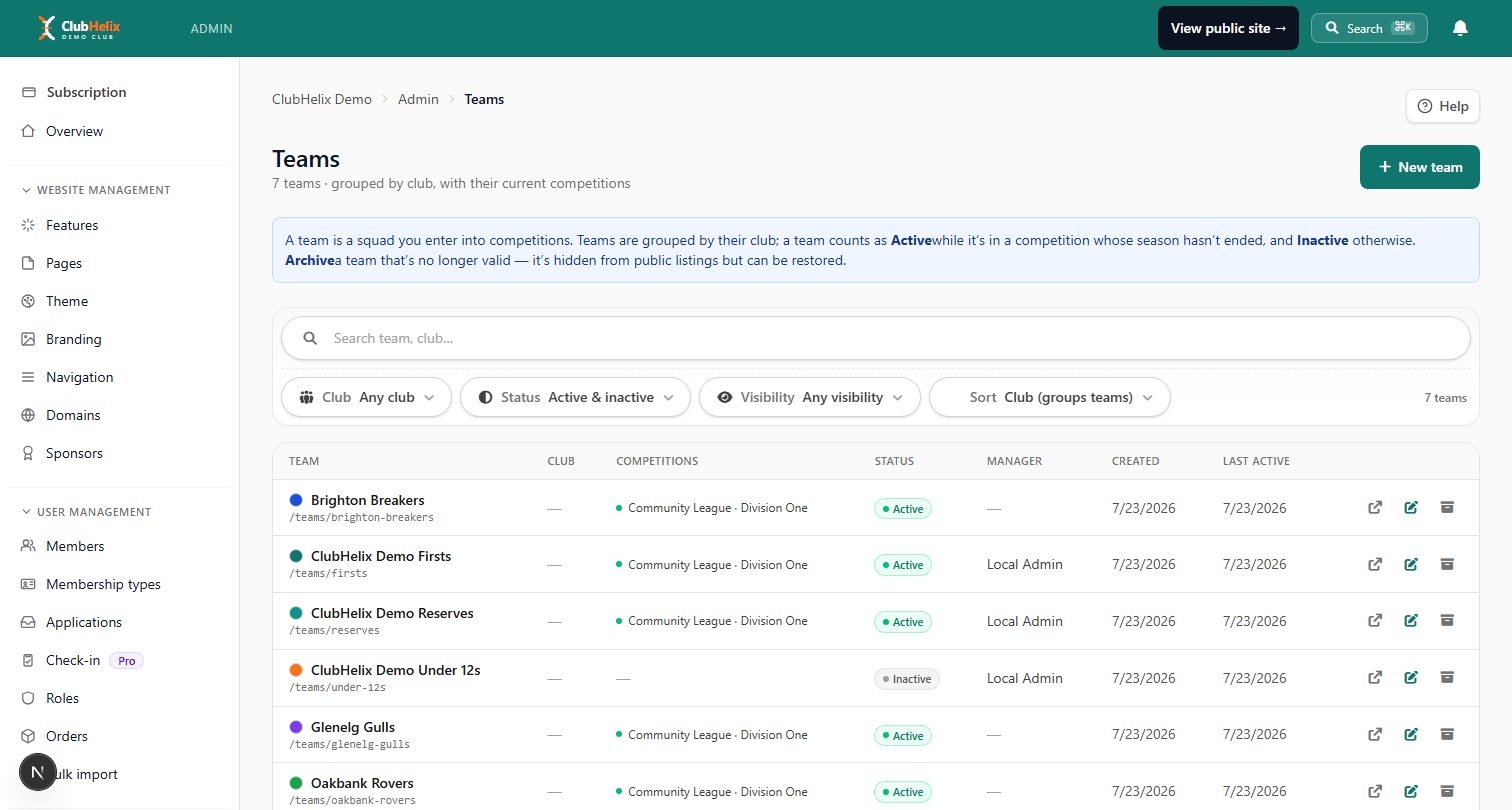
- Teams holds each division's rosters with coaches and team managers, and gives a team manager access scoped to just their own team, so a coach can see who is on their roster without seeing every family's details.
- Family and sibling pricing applies a reduced rate from the second or third child, or a family maximum, automatically at checkout — useful when siblings land in different divisions but register at once.
- Digital waivers attach to the registration, and a guardian's acceptance is recorded against each child by name.
ClubHelix does not decide your age rules or apply a governing body's cutoff for you — the chart is still yours to set and publish, and a page on your league's site is the natural home for it. Our ClubHelix for US organizations page covers the wider setup, and the rec leagues and junior clubs pages show how smaller programs set it up. Plans are on the pricing page, and you can start on the free tier and have your age chart and registration live before the first parent email arrives.
Frequently asked questions
How are youth sports age groups determined?
By the child's age on a cutoff date. Most leagues use either a birth-year model, where kids born in the same calendar year play together, or a school-year model, where the cutoff lines up with the school calendar so classmates mostly play together. If your league is affiliated with a national governing body or state association, that body usually sets the rule for sanctioned play, and rules have changed in some sports, so always confirm the current one before you publish your age chart.
What does U10 mean in youth sports?
It usually means "under 10 on the cutoff date": a player in U10 had not turned 10 by the date your league uses to calculate age. Some sports calculate divisions from the season year minus the birth year instead, which can produce a different label for the same birthday, so check how your governing body does it.
Can a child play up an age group?
Often yes, but only under a written policy. A good policy says which divisions allow it, who can request it, what is assessed (skill, size and safety, social readiness), who decides, and that approval lasts one season. Record each approval against the child's registration, because a player who plays up without approval on file may be ineligible if a result is protested.
Does a child move up a division when they have a birthday during the season?
No. In almost every league the division is set by age on the cutoff date and stays fixed for the whole season. Saying so in your welcome email saves a lot of questions.
Should our rec league use birth year or school year?
If you are affiliated, follow your governing body. If you are independent, weigh simplicity and alignment with other competitions (a birth-year model) against keeping classmates together (a school-year model), and pick whichever your families and coaches will find easiest to live with. Whichever you choose, publish it clearly and keep it stable from season to season.
Do we need to keep a copy of each child's birth certificate?
Usually not, unless your governing body requires it. Good practice is to sight the document once, record that the date of birth was verified, when and by whom, and not keep the copy. The less sensitive paperwork your league holds, the less it has to protect.

