
What this guide answers
- Do we need to be a nonprofit to start a sports club in the USA?
No — you can operate as an informal association first. Clubs usually incorporate at state level and pursue IRS tax-exempt status once they handle significant money, run youth programs or want donations to be deductible.
- What's the difference between 501(c)(3) and 501(c)(7) for a sports club?
Broadly, 501(c)(3) covers charitable and educational purposes (which can include youth sport development) and can accept tax-deductible donations, while 501(c)(7) covers member-funded social and recreational clubs.
- How much does it cost to start a youth sports club?
Expect first-season costs for insurance, field or gym permits, league and governing-body fees, equipment and uniforms, plus modest state filing fees if you incorporate.
- How do we find fields or gym time?
Start with your parks and recreation department's permit process, then ask school districts about community facility-use agreements.
Community sport in the USA is built by volunteers — the parents who start a youth soccer club because the nearest one has a waitlist, the runners who turn a Saturday group into a real club, the adult-league organisers who finally give their competition a name and a bank account. If that's you, this guide covers the practical steps to start a sports club in the USA, in the order you'll actually face them.
The American landscape adds a couple of distinctive ingredients — state-level incorporation and federal nonprofit status — but the fundamentals are universal: prove demand, form a small committee, secure a place to play, and make it easy to join.
Why start a sports club?
A formal club can do things a pickup group can't: affiliate with a national governing body, enter sanctioned leagues and tournaments, reserve public fields and gym time, open a bank account in the club's name, buy insurance, apply for community funding, and run a youth program parents can trust. It also creates continuity — a structure that keeps the club alive when the founding organiser steps back.
Before any paperwork, test the water. Run free sessions for a month at a park or school gym, collect names, and watch who returns. A core of ten to twenty regulars — or, for a youth sports club, a season's worth of committed families — is your green light.
Choosing a structure — from informal group to nonprofit
Most US community clubs sit somewhere on this ladder:
- Unincorporated association. The default starting point — a group of people with bylaws and a shared bank account. Quick and free, but the club isn't a separate legal entity.
- State nonprofit corporation. Incorporating as a nonprofit in your state (usually through the secretary of state's office) makes the club its own legal entity, able to sign leases and contracts, and gives organisers a layer of personal protection. Requirements and fees vary by state, so check your own state's official site.
- Federal tax-exempt status. Separately from state incorporation, many clubs apply to the IRS for recognition as a tax-exempt nonprofit — commonly under section 501(c)(3) for charitable/educational purposes such as youth sport, or 501(c)(7) for social and recreational clubs. Each category has its own rules about purpose, funding and what donors can deduct. The official guidance lives at irs.gov, including how to apply and what records exempt organisations must keep.
You don't need all of this on day one. Plenty of clubs run their first season as a simple association, then incorporate and pursue tax-exempt status once there's real money, equipment and a youth program involved. Your sport's national governing body may also offer group exemption or model bylaws — ask before you draft from scratch.
This is general information, not legal or tax advice — check the current requirements with the IRS and your state's official offices.
Build your board and bylaws
Youth and community clubs typically start with three officers: a president to lead and be the public face, a secretary for records, meetings and correspondence, and a treasurer who owns the budget and the bank account. Add a registrar once sign-ups start and, for any youth sports club, a safety/child-protection coordinator — background screening for coaches and volunteers is a baseline expectation (and often a governing-body requirement) in American youth sport.
Write short bylaws early: the club's name and purpose, membership classes and dues, how officers are elected, how decisions are made, and what happens to assets if the club dissolves. Our guides on committee roles and recruiting volunteers will help you fill the roster around the officers.
Funding your club in the American market
- Dues and registration fees. The backbone. Price them to cover known costs — league fees, field rental, uniforms, insurance, officials — and be transparent with families about where the money goes. Offer instalments or scholarships where you can; cost is the biggest barrier in youth sport.
- Sponsorships. Local businesses sponsoring a team or a season is a deep tradition in US community sport. A visible website and a thank-you at every event keep sponsors renewing.
- Fundraising and donations. Concession stands, car washes, raffles and giving days all work — and if your club gains 501(c)(3) recognition, donations may be tax-deductible for donors, which materially helps online donations and end-of-year appeals. See our fundraising ideas for a menu.
- Community grants. Community foundations, park districts and some national programs fund grassroots and youth sport. Criteria change by cycle — always verify the current round on the funder's official site.
Insurance pointers
Before your first official practice, most clubs arrange general liability insurance (covering injury and property-damage claims arising from club activities — often required by facilities before they'll rent to you) and accident insurance for participants. Youth clubs should also ask insurers about abuse and molestation coverage and directors-and-officers cover for the board. The most common route is a group program through your sport's national governing body, which bundles the coverages clubs in that sport typically need — start there, then compare with an independent broker.
This is general information, not legal or financial advice — confirm requirements with your governing body, facility and insurer.
Finding fields, courts and gym time
Your city or county parks and recreation department is the first call — public fields and courts are usually allocated by permit, often seasonally and well in advance. Schools are the second: many districts have community facility-use agreements that open gyms and fields outside school hours, typically requiring proof of insurance. Churches, YMCAs and private facilities round out the options. Whatever you secure, get the permit or rental agreement in writing, and note insurance requirements early — they drive your timeline.
Recruiting your first members

Launch with a free clinic or open house: equipment provided, coaches on hand, food if you can manage it. Promote through schools, community centres, local Facebook groups and neighbourhood apps, and ask everyone who attends to register interest on the spot. For a youth club, parents are your real audience — be ready to answer the three questions they always ask: who's coaching, how are volunteers screened, and what does the season cost all-in.
Then reduce friction. Every interested family should get one link where they can read the details and register online in five minutes — no printed forms, no paper payments, no waiting on a reply from a volunteer's personal inbox.
Give your club an online home
In the US market, families expect to find a club online, judge it in thirty seconds, and register from their phone. That means a clean website with programs, fees and schedules; online registration with payments handled; and a published events calendar for practices, games and fundraisers.
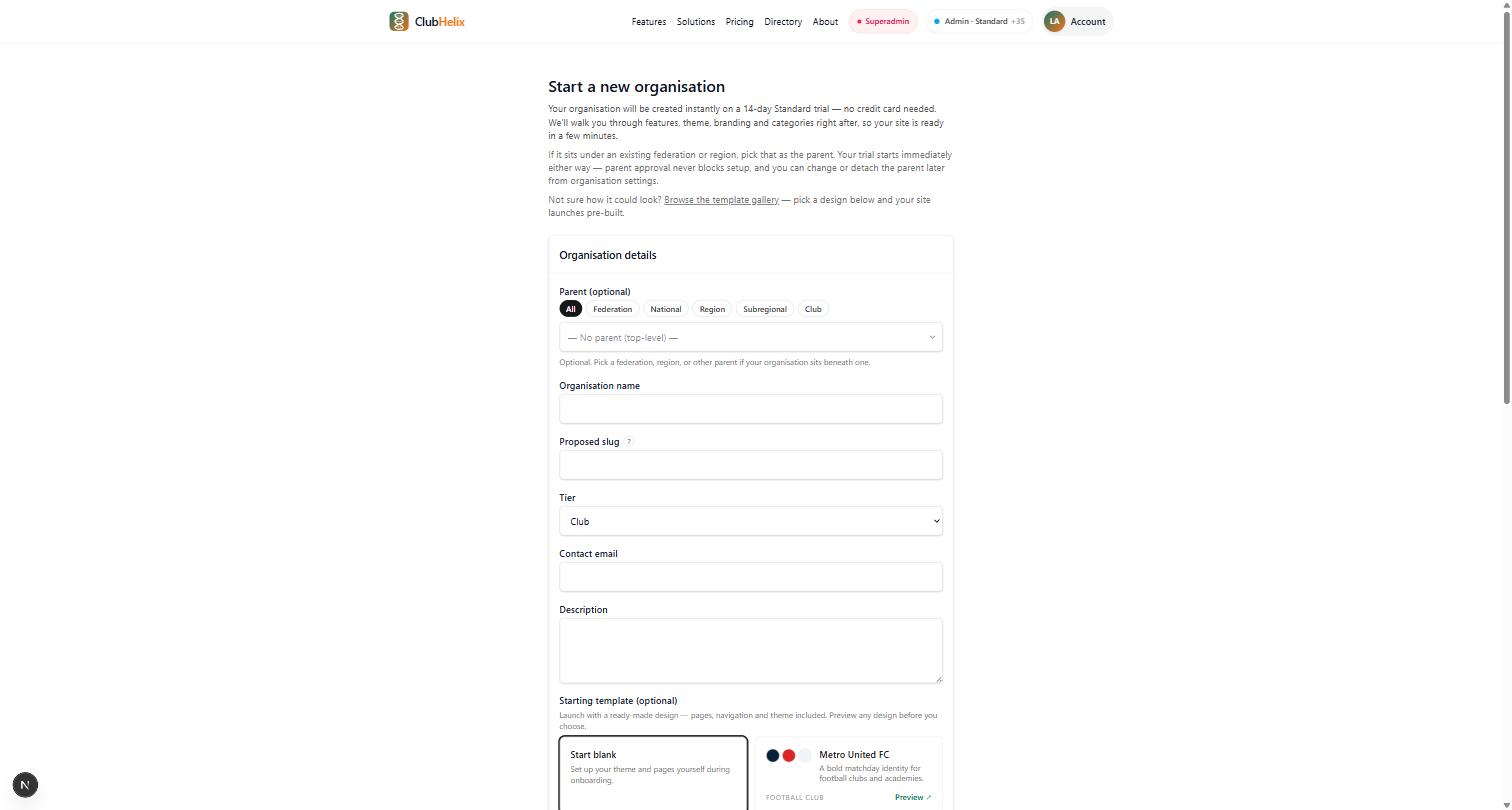
ClubHelix gives a volunteer board all of that without a technical volunteer: website, registration, payments, events, communications and more in one place, with a free tier to start and pricing that only grows as the club does. You can create your club in an afternoon and look established before your first season begins.
Frequently asked questions
Do we need to be a nonprofit to start a sports club in the USA?
No — you can operate as an informal association first. Clubs usually incorporate at state level and pursue IRS tax-exempt status once they handle significant money, run youth programs or want donations to be deductible. Check irs.gov and your state's official site for current requirements.
What's the difference between 501(c)(3) and 501(c)(7) for a sports club?
Broadly, 501(c)(3) covers charitable and educational purposes (which can include youth sport development) and can accept tax-deductible donations, while 501(c)(7) covers member-funded social and recreational clubs. The categories have different rules on funding and activities — read the current IRS guidance before choosing.
How much does it cost to start a youth sports club?
Expect first-season costs for insurance, field or gym permits, league and governing-body fees, equipment and uniforms, plus modest state filing fees if you incorporate. Most clubs cover these through registration fees, a sponsor or two, and simple fundraising.
How do we find fields or gym time?
Start with your parks and recreation department's permit process, then ask school districts about community facility-use agreements. Both usually require proof of insurance, so arrange coverage before you apply.

