
What this guide answers
- Which is better, Team App or Spond?
They are close enough that the honest answer depends on your club.
- Are Team App and Spond both actually free?
Both are free to install and run, with no club subscription for the app itself, but they earn differently.
- Do either of them give our club a website?
One free, one paid. Team App automatically generates a site alongside the app, which is better than nothing but is a by-product rather than pages you designed, and it does not sit on your own domain.
- Can we run both apps at once?
You can, and some clubs do during a transition, but two notification channels means members eventually ignore both.
- What about payment fees — how do we compare them fairly?
Add up the total cost of getting a dollar from a member into your bank account, not just the headline percentage.
It is Thursday night, the coach needs eleven confirmed for Sunday, and eight people have replied to a group chat with a thumbs up, two have replied "maybe if my back is right", and one has replied to a message from three weeks ago. Somewhere in that thread is a photo of a dog. This is the problem both of these apps were built to solve, and both of them solve it well.
They are also both free, which is why committees treat the choice as a coin toss and pick whichever one a neighbouring club uses. That is a reasonable instinct and it usually works out, but it skips the one thing worth ten minutes of a meeting: these two products are free in genuinely different ways. One is funded by advertising shown to your members. The other is funded by taking a share of money that moves through it — subscriptions you collect, fundraising you run. Neither model is sinister. They simply put the cost in different places, and they point the two products in different directions over time.
This guide is for the club committee or team manager choosing between them, and it is deliberately practical: what each is, how the funding models work out for a real club, how they compare on the RSVP and messaging job you are actually hiring them for, and the website question. Our position, stated up front: we build ClubHelix, an all-in-one club platform, and we are the third option nobody asked for in this particular comparison — so we will keep the referee's hat on for most of it and be explicit when we take it off. Facts below come from public sources as at July 2026.
What each one actually is
Team App — properly Stack Team App, Melbourne-based and part of the Stack Sports family — gives your club a branded app on the iOS and Android stores plus an automatically generated website. It is communication-first: news, push notifications, schedules, team pages, live scores, and enough structure to run a whole club's worth of teams rather than a single squad. It is free to clubs and funded by advertising, with paid add-ons available. Members who would rather not see ads can pay a small annual fee — around A$4.49 according to its app-store listing — to remove them from their own view. In this part of the world it is close to being the default meaning of the phrase "club app".
Spond is an Oslo-built club and team organiser, strongest across the Nordics, the United Kingdom and Europe, with a growing presence elsewhere. Its reputation is built on the day-to-day organising loop — events, availability, RSVPs, messaging — and it is widely regarded as best in class at exactly that. The organiser carries no subscription; the one paid line is an optional Club Website add-on for Spond Club, at A$22 a month (£19 + VAT in the UK) after a free trial, checked October 2026. Otherwise it monetises the money that passes through it: transaction fees when you collect fees or payments, and its Superdraw fundraising product, where the club keeps 65% of ticket sales according to its own site.
The short version: Team App is a broader club app funded by ads, Spond is a sharper organising app funded by your cashflow. Both are genuinely free to install and run.
Two ways to be free, and who ends up paying
Here is the comparison that actually differs, laid out honestly.
| Team App | Spond | |
|---|---|---|
| Subscription to the club | None | None for the organiser; website add-on A$22 a month |
| How the company earns | Advertising, plus paid add-ons | Payment processing on fees you collect, plus fundraising |
| Who bears the cost | Members, in attention — ads inside your branded app | The club, as a slice of money it collects or raises |
| Cost if you never collect money in it | Still ad-supported | Effectively nothing |
| Cost if you collect everything in it | Unchanged | Scales with your turnover |
| Member opt-out | Around A$4.49/yr to remove ads, per its app-store listing | Not applicable |
The way to make this concrete is to run your own club through both models.
A club that uses the app purely for organising. Say a football club with six teams that collects registration fees by bank transfer or through its governing body's system, and only wants the app for training, fixtures and availability. In the ad-funded model, several hundred members see advertising all season inside an app wearing your crest. In the transaction-funded model, you pay nothing at all, because no money moved. On these facts the payment-funded product is the cheaper option, and it is not close.
A club that collects everything in the app. Now the same club puts 300 registrations at A$180 through the platform. The ad-funded product still costs the club nothing directly. The transaction-funded product now earns from every one of those payments, at a rate we are deliberately not quoting because we cannot verify a current published figure — which is itself the point. Ask for the current rate in writing, and compare it against what your existing payment provider charges, since you are almost certainly paying a processing fee somewhere already. Our guide to collecting membership fees online covers what a fair total looks like.
A club that fundraises through the app. Spond's Superdraw returns 65% of ticket sales to the club, per its site. On A$4,000 of tickets that is A$2,600 to your club and A$1,400 retained. Whether that is good value depends entirely on your alternative: if the comparison is a raffle your volunteers run themselves — see how to run a club raffle for what that involves — you are trading a substantial share of the proceeds for not having to sell books at the clubrooms. Some clubs will take that trade happily. Others will look at the number and organise their own.
The general principle worth minuting: a free product's funding model is also its roadmap. An ad-funded app is incentivised toward attention and installs. A payment-funded app is incentivised toward being where your money moves. Neither is wrong, but it tells you where each product's next three years of investment will go.

Getting a straight answer out of a squad
This is the job you are hiring either app for, so evaluate it properly instead of on brand impressions.
| Capability | Team App | Spond |
|---|---|---|
| Native app-store apps | Yes, branded to your club | Yes |
| Push notifications | Yes, the primary channel | Yes, the primary channel |
| Event and training RSVPs | Yes | Yes, and the feature the product is best known for |
| Availability tracking | Yes | Yes, with strong going/maybe/unavailable handling |
| Group and team messaging | Yes | Yes, including guardian-aware messaging for junior teams |
| Schedules and fixtures | Yes | Yes |
| Live scores | Yes | Not its focus |
| Whole-club structure | Yes — many teams and groups under one club app | Yes |
| Payments and fee collection | Not the funding model | Yes, and central to how the product earns |
| Fundraising product | No | Yes — Superdraw, club keeps 65% of ticket sales |
| Public website | An automatically generated site | Paid Spond Club add-on, A$22 a month (October 2026) |
| Home base | Melbourne, Australia | Oslo, Norway |
Rather than take anyone's word on which RSVP experience is better, run the same five-question trial on both with one real team for a fortnight:
- How many taps from notification to answer? If a parent has to open an app, find an event and scroll, your response rate drops. The whole game is measured in taps.
- What happens to non-responders? Can the manager see who has not answered and chase only them, without spamming the whole squad? This is the single biggest time saver in the whole category.
- Can a parent answer for a child? Junior sport lives or dies on this. Guardian-aware handling is not a nice-to-have when half your squad is eleven years old.
- Does a "maybe" mean anything? A three-state answer is far more useful than yes/no, but only if the coach's selection view treats it sensibly.
- Does attendance get recorded? Who said yes is not who turned up. If the app captures actual attendance, you have data worth having — see club attendance tracking for what to do with it.
Score both with the same team, in the same fortnight, and let the manager who does the chasing cast the deciding vote. They will know within a week.
Where each is genuinely strong
Team App wins on breadth and on installed base. A branded club app across every team, with news, schedules and live scores, at no cost to the club, is a lot of product for zero dollars — and because so many clubs already run it, a new family joining your club may well have it on their phone already. That familiarity is worth more than a feature grid suggests.
Spond wins on the organising loop itself. Events, availability and messaging are the product rather than a module of it, and the guardian and safeguarding handling around junior communication is noticeably more considered than most of the category. If your club's single biggest pain is not knowing who is coming on Sunday, this is a product built precisely for that pain and very little else.
And our own limit, stated where it counts rather than buried at the end: ClubHelix does not publish native app-store apps. We ship an installable web app with push notifications that members add from your club's site. It behaves like an app on the home screen, but it is not a store listing, and if a store listing is your requirement then one of the two products above is a better fit than we are. We would rather say that plainly than pretend.
The download wall
Now the thing both products share, which is not a criticism so much as a description of what an app is.
An app lives behind a download. To reach anything inside either of these products, a person must already know your club exists, decide to install something, and often be invited or given a code. That is completely appropriate for the people already in your club, and completely useless for everybody else — because a search engine cannot walk through a download wall. Content inside an app is not indexed, cannot be linked to, and does not appear when someone searches for a club near them on a Tuesday night in January.
Consider what that means for the four moments that actually grow a club:
- A family moves into the area and searches for junior football near their suburb. If your club has nothing findable, they join the one that does. Your beautifully organised squad app played no part in the decision.
- A local business considers sponsoring you. They will look you up before replying to your email. There is nothing to look up.
- A grant assessor checks you are real — a committee, an address, programs that match your application. A grant application supported by a live website reads very differently to one that is not.
- A lapsed member's mate asks where you train. They google, find a fixture list on someone else's site, and give up.
Team App does generate a site alongside the app, so it is not literally nothing — but it is an automatic by-product rather than pages you designed, and it is not on your own domain. Spond now sells a Club Website as a paid add-on to Spond Club, with customisable designs and your own domain (checked October 2026). We haven't assessed how deep it goes, so if you are leaning Spond, put its website through the same tests as everything else here.
The honest conclusion is that an app and a website are different tools for different people. An app retains the members you have. A website recruits the ones you do not. A club that has only solved the first will feel extremely well organised while quietly shrinking, and it takes a couple of seasons to notice. If that is a live risk for you, how to build a sports club website is the practical next read, along with setting up a Google Business Profile so you exist on a map as well as in a search result.
One member list, on the phone and on the web
The reason we ended up building both halves is that clubs kept telling us the same story: the app was great, the website was a five-year-old page nobody could edit, and the member list lived in three places. So in ClubHelix the same records drive both. Event RSVPs and attendance work on the public events pages and in the installable app with push notifications, and your public site sits on your own custom domain where search engines can actually read it.
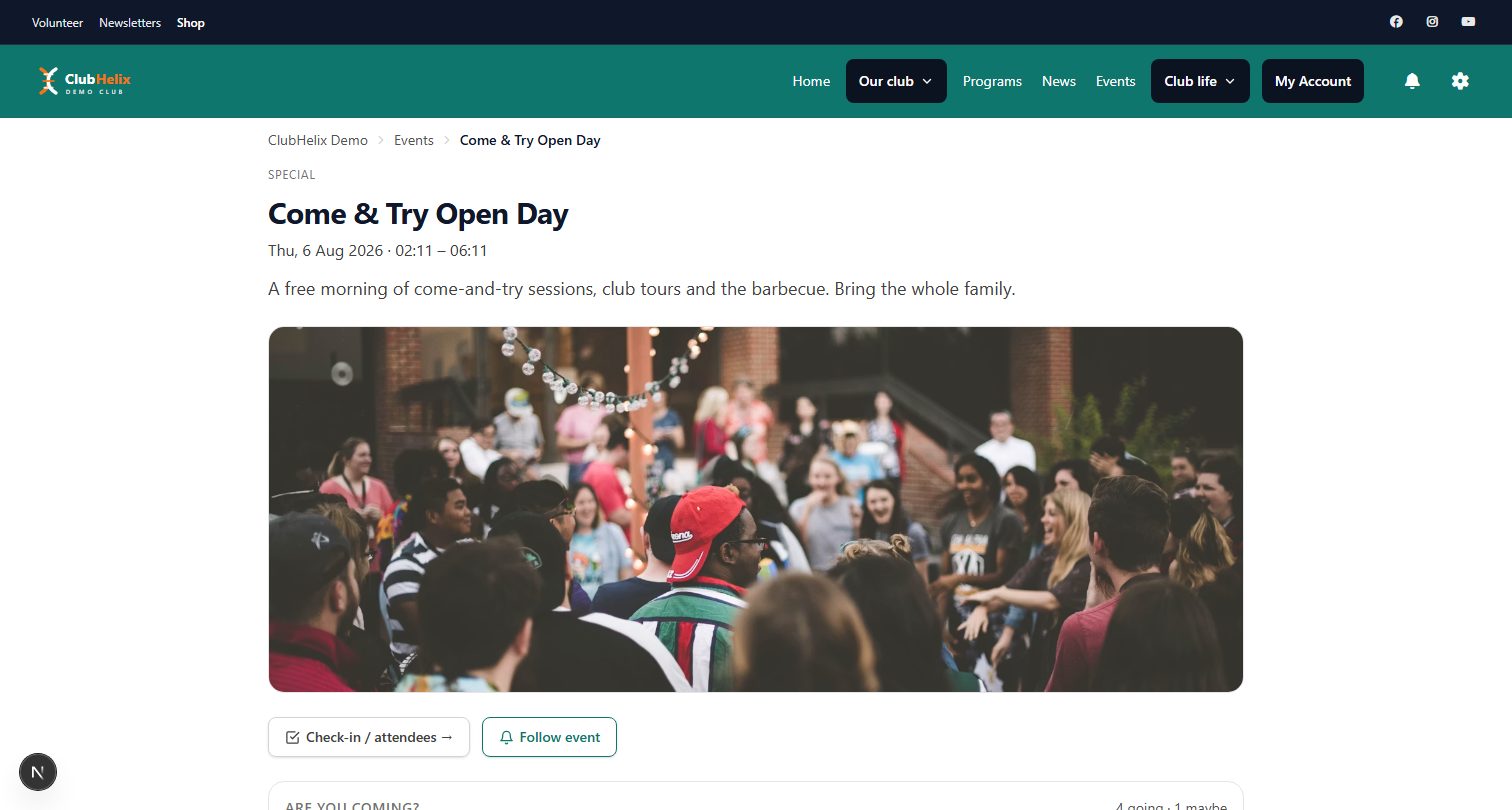
There is a free tier, every price sits on a single pricing page, and the product carries no advertising of any kind — it is funded by clubs on plans, which we think is the least conflicted of the three models on this page. Built and hosted in Australia, and most committees have a real site and their first event live within an afternoon of signing up. The longer head-to-heads are at /compare/team-app-alternative and /compare/spond-alternative.
Frequently asked questions
Which is better, Team App or Spond?
They are close enough that the honest answer depends on your club. Team App is the broader club-wide app with news, schedules and live scores, and an installed base that means many families already have it. Spond is sharper at the specific organising loop of events, availability and messaging, with particularly considered handling of junior and guardian communication. Trial both with one real team for a fortnight and let the person who chases RSVPs decide.
Are Team App and Spond both actually free?
Both are free to install and run, with no club subscription for the app itself, but they earn differently. One is funded by advertising shown to your members inside your branded app, with a small annual fee available to individuals who want ads removed. The other earns from money moving through it — transaction fees on fees you collect, and a fundraising product where the club keeps 65% of ticket sales. If you never collect money in the second and skip its paid website add-on, it costs you effectively nothing.
Do either of them give our club a website?
One free, one paid. Team App automatically generates a site alongside the app, which is better than nothing but is a by-product rather than pages you designed, and it does not sit on your own domain. Spond sells one as a paid add-on to Spond Club, at A$22 a month after a free trial (checked October 2026), with your own domain. Since a website is the only asset here that works on people who have never heard of your club, most committees should judge it as a separate decision rather than assuming the app covered it.
Can we run both apps at once?
You can, and some clubs do during a transition, but two notification channels means members eventually ignore both. If you must overlap, set an end date, tell everyone which app is authoritative for what, and stick to it. Writing a short communication plan first will save more grief than the software choice itself.
What about payment fees — how do we compare them fairly?
Add up the total cost of getting a dollar from a member into your bank account, not just the headline percentage. That means the percentage, any fixed per-transaction amount, whether the member or the club wears it, how long disbursement takes, and what happens to fees on a refund. Then compare that total against whatever you use now, because bank transfers are not free either once you count the treasurer's reconciliation time.
Keep reading — TidyHQ vs Team App covers the admin side of the same question, and best apps for sports clubs maps the whole category if you would rather see the field before picking.


