
What this guide answers
- Is TidyHQ or Team App better for a sports club?
They solve different halves of the problem, so the better question is which half hurts.
- Is Team App really free?
Free to the club, yes — it is funded by advertising rather than club subscriptions, and there are paid add-ons available.
- Can we use both together?
Many clubs do, and it works as long as someone owns the join between them.
- Do either of them give us a proper club website?
Not in the sense a committee usually means. One is an administration platform and is not a website builder at all; the other generates a site automatically alongside the app, which is better than nothing but is a…
- What should a small volunteer-run club prioritise?
Work out your scarcest resource first. If it is money, a free tool is a completely defensible choice and you should use one without guilt.
Open the phone of any long-serving club volunteer and you will often find both of these installed, along with a group chat, a shared drive and a photo library nobody has opened since 2023. Which is the first useful observation about this comparison: most clubs that ask "TidyHQ or Team App?" are already running both, without ever having decided to, and the friction they are feeling is not that they picked wrong. It is that the two halves do not talk.
These products are frequently listed side by side because they both show up when a committee searches for club software, but they were built to solve opposite problems. One is an administration engine for the people who keep the organisation legally and financially alive — the secretary, the treasurer, the membership officer. The other is a communication channel for the people who turn up on the day — the team manager, the coach, the parent checking whether training is on. Comparing them on a feature grid produces a nonsense result, because each will lose badly on the other's home ground.
So this guide does something slightly different. It compares the two on the three axes that actually determine which one your club should invest in — how each is funded and what that costs you, where your member data ends up living, and the front door neither one gives you — and then says plainly which kind of club should choose which. We build ClubHelix and therefore have a view, which we will make obvious rather than sneak in. Everything factual here is from public sources as at July 2026, and worth re-checking before you commit.
Two products that were never really competing
TidyHQ is an Adelaide-born administration platform for clubs and associations of every kind — membership records, subscriptions, finances, meetings and communications — sold globally with its stronghold in Australia. Its natural constituency is the whole enormous category of organisation that is not a sporting club: service clubs, scouting and youth groups, hobby societies, professional associations, community boards. The centre of gravity is the committee. There is a free plan, a Pro plan at US$69 per month (quoted as A$89, £49 or NZ$99) which carries unlimited contacts and administrators along with a monthly email allowance in the tens of thousands, and an Enterprise tier for governing bodies and federations.
Team App — properly Stack Team App, Melbourne-based and part of the Stack Sports family alongside GameDay — gives a club a branded app on the iOS and Android app stores plus an automatically generated website, built around communication: news, notifications, schedules, team pages, live scores. It is free to clubs, funded by advertising, and it is close to being the category owner of the phrase "club app" in this part of the world. Members can pay a small annual fee — around A$4.49 a year according to its app-store listing — to remove ads from their own view, and there are paid add-ons available to clubs.
Read those two paragraphs again and notice that almost nothing overlaps. Subscriptions, invoices, minutes and motions on one side; push notifications, schedules and team chat on the other. A club that adopts one has not solved the other's problem, and the reason this comparison gets searched so often is that clubs discover this several months in.
The business models, and what free actually costs
This is the axis committees under-think, because "free" ends the analysis prematurely. Both models are legitimate. They simply move the cost to different people.
| TidyHQ | Team App | |
|---|---|---|
| Who pays | The club, on a plan | Advertisers, and members who opt out of ads |
| Published cost to the club | Free plan; Pro US$69/mo (A$89 / £49 / NZ$99); Enterprise custom | Free, with paid add-ons available |
| Cost to the individual member | None beyond their subscription | Ads by default; around A$4.49/yr to remove them, per its app-store listing |
| What the club is buying | Administrative capability | Distribution — an app your members will actually install |
| What scales the bill | Your plan, not your headcount | Nothing, at the club level |
A paid administration platform costs the club real money and buys the committee real time. The honest counter-argument is the one every treasurer makes in July: the club has 90 members, a A$4,000 turnover and a president who does the books at the kitchen table, and an annual software line is a genuine strain. That is a fair objection and the free plan exists for exactly that club.
An ad-supported free app costs the club nothing and buys enormous reach — a branded icon on hundreds of phones, with notification permissions, which is a distribution asset most clubs could never build themselves. The honest counter-argument here is subtler. Advertising is a cost paid in your members' attention, inside a product wearing your club's logo, and some of those members are children. It is worth a committee conversation rather than a shrug, particularly for a junior club, and it is worth knowing that individual members can pay to opt out — because if your parents are quietly doing that, your "free" solution is not free to them.
The practical framing we would put to a committee: decide what your scarce resource is. If it is money, the free app is a strong answer and you should not feel bad about it. If it is volunteer hours — a secretary who is drowning, a treasurer chasing subs by bank transfer — then a platform that removes administrative work is cheaper than the burnout it prevents, and you should measure it against the cost of replacing the person who quits.

Where your member data ends up living
Here is a test worth running in your next meeting. Draw this table on a whiteboard and fill in the right-hand column for your own club as it stands today.
| Record | Typically ends up in | The question to ask |
|---|---|---|
| Contact details and membership status | The administration tool | Is it the single source, or one of three copies? |
| Subscription payments and invoices | The administration tool | Can the treasurer reconcile without a spreadsheet in the middle? |
| Meeting agendas, minutes, motions | The administration tool | Will next year's secretary find them? |
| Team lists and schedules | The app | Who re-types these each season, and from where? |
| Match-day messages and chat | The app | Is there any record if a complaint is raised months later? |
| Photos and results | Wherever they were posted | Do you own them, or does a personal account? |
| Event attendance and RSVPs | Split, usually | Do the numbers ever reach the person doing the catering? |
Most clubs running both products end up with the top half in one system and the bottom half in another, joined by a person. That person exports a member list at the start of the season, imports it into the app, and then spends the year patching the two as people join, leave and change teams. It works, right up until that volunteer stands down — which is why committee handover is where split systems actually fail, not day-to-day.
Two governance points fall out of this, and both are worth minuting. First, member communication is a record. If a parent raises a concern about something said in a team chat, "the coach ran that group and has since left the club" is not a comfortable answer. Club-run channels where a committee can see what was said exist for a reason. Second, your privacy obligations do not split neatly across systems. If you tell members in your privacy policy what you collect and where it goes, that statement has to cover both tools, including advertising in an ad-supported product. Write it once, accurately, for whatever stack you actually run.
Side by side
| Area | TidyHQ | Team App |
|---|---|---|
| Built for | Committees and administrators | Members, players and parents |
| Home base | Adelaide-born, Australia; sold globally | Melbourne, Australia; part of the Stack Sports family |
| Membership records | Yes — the core of the product | Member lists inside the app |
| Subscriptions and finance | Yes, with accounting-adjacent workflows | Not its purpose |
| Meetings and governance | A mature focus of the product | No |
| Native app-store apps | No | Yes — branded iOS and Android apps, and its main strength |
| Push notifications | Email-centred communication | Yes, the primary channel |
| Schedules and live scores | No | Yes |
| Public website | Not a website builder | An automatically generated site alongside the app |
| Pricing | Free plan; Pro US$69/mo (A$89 / £49 / NZ$99); Enterprise | Free to clubs, ad-supported; member ad-removal around A$4.49/yr |
Where each is genuinely strong
TidyHQ is strong wherever a club's real problem is the paperwork. Membership records that stay accurate, subscriptions that reconcile, a meeting history that survives a change of secretary, finance workflows that a volunteer treasurer can operate without an accounting degree. Its community mindshare among non-sporting groups is not an accident — for a service club or a hobby society with no fixtures, it fits the shape of the organisation almost exactly.
Team App is strong at the thing that is genuinely hard to buy: getting onto members' phones. A branded icon, notification permissions and an installed base built over years is real distribution, and the price of entry is zero. For a club whose main failure mode is "half the team did not know training moved", that is a direct fix, and its schedule and live-score features land it squarely in match-day life where administration platforms never go.
We should also state our own limit here plainly, because it is relevant to any reader weighing an app: ClubHelix does not publish native app-store apps. We ship an installable web app with push notifications, which members add from your site rather than from a store. That is a real difference and you should factor it in. What we would say in return is that the store listing is not the same as the audience — see the next section.
The front door neither was designed to be
Both products leave the same hole, for the same structural reason: a public website was never the point of either. TidyHQ is not a website builder and does not claim to be. Team App does generate a site alongside the app, which is more than nothing, but it is an automatic by-product of an app-first product rather than a page you designed.
That matters because of who is on the outside of your club looking in. Consider the four people who will not install anything:
- The family deciding between your club and the one two suburbs over. They will search, land on whatever comes up, and form a view in about eight seconds. They are not downloading an app to evaluate you.
- The potential sponsor doing a quick check before returning your email. Their question is whether you look like an organisation that will represent their brand credibly.
- The grant assessor confirming you exist, have a committee and run the programs your application describes. Our grant application guide covers what they are actually looking for.
- The local journalist, the council officer, the new volunteer. All of them arrive via search, and all of them leave if there is nothing to read.
An app is a retention tool — superb for people who have already joined. A website is an acquisition tool, and it is the only asset in this comparison that works on someone who has never heard of you. Those are different jobs, and a club that has solved only the first will feel busy but not grow. If that has landed, our guide to what a club website actually needs is the practical follow-on, and best apps for sports clubs maps the wider landscape.
Closing the gap between the office and the phone
The specific pain this article describes — a member list in one system, the people who need it in another, and a volunteer manually keeping the two aligned — is the reason we built ClubHelix as one platform rather than a suite. Your member records, your club-run chat channels where the committee can see what was said, your email broadcasts sent from your own domain, and an installable app with push notifications all read the same member list, because there is only one. The public site is built in a canvas page editor on your own domain, so the front door is a page you designed rather than a by-product.
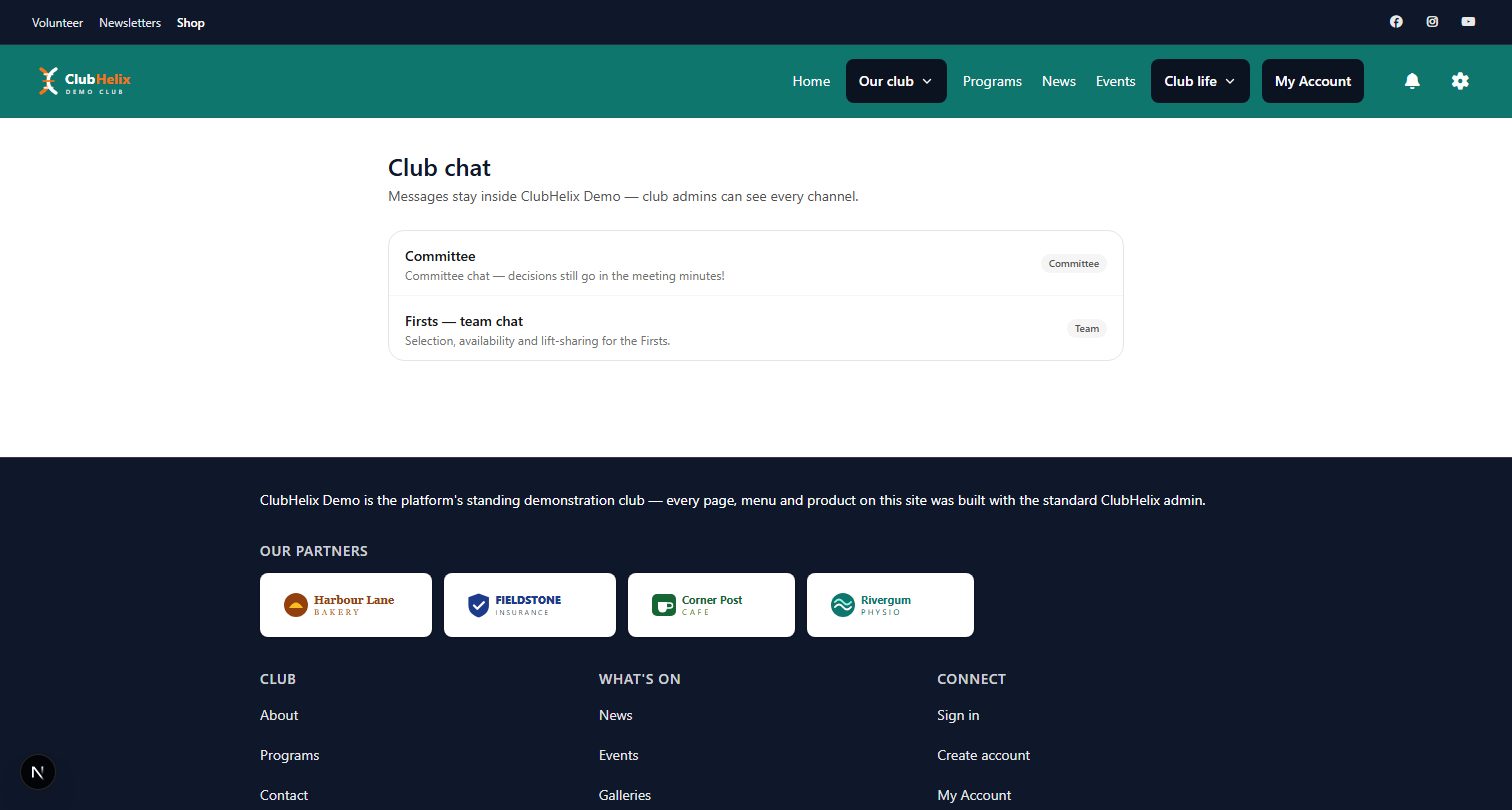
Start on the free tier, read every price on one pricing page, and know that it is built and hosted in Australia with no advertising anywhere in the product, ever. Most committees have something real standing up the same evening they start an account. If you want the longer head-to-heads, they live at /compare/tidyhq-alternative and /compare/team-app-alternative.
Frequently asked questions
Is TidyHQ or Team App better for a sports club?
They solve different halves of the problem, so the better question is which half hurts. If your committee is drowning in subscriptions, invoices, minutes and member records, an administration platform is the fix. If your members keep missing information about training, fixtures and events, a communication app is the fix. Sporting clubs frequently need both, which is the usual reason they end up looking for a single platform instead.
Is Team App really free?
Free to the club, yes — it is funded by advertising rather than club subscriptions, and there are paid add-ons available. The cost sits with your members, who see ads inside an app carrying your club's branding, and who can pay a small annual fee (around A$4.49 according to its app-store listing) to remove them. Whether that trade is acceptable is a committee decision, and it is worth taking deliberately rather than by default, especially in junior clubs.
Can we use both together?
Many clubs do, and it works as long as someone owns the join between them. That person exports the member list, imports it into the app, and keeps the two aligned through a season of joiners, leavers and team changes. Plan explicitly for what happens when that volunteer stands down, because a manual join between two systems is the piece that does not survive handover.
Do either of them give us a proper club website?
Not in the sense a committee usually means. One is an administration platform and is not a website builder at all; the other generates a site automatically alongside the app, which is better than nothing but is a by-product rather than a designed page. If being findable by families, sponsors and grant assessors matters to your club, treat the website as a separate decision rather than assuming either product has covered it.
What should a small volunteer-run club prioritise?
Work out your scarcest resource first. If it is money, a free tool is a completely defensible choice and you should use one without guilt. If it is volunteer hours, spend money to remove administrative work before you spend it on anything else, because the real cost of an overloaded secretary is the year they resign. Either way, write a simple communication plan so the tool you choose is used consistently rather than in parallel with three group chats.
Keep reading — Team App vs Spond compares the two big free club apps head to head, and revolutioniseSPORT vs TidyHQ is the one to read if your shortlist is two administration platforms.

