
What this guide answers
- Can TidyHQ run a sports club?
It can run the administrative half of one — members, subscriptions, invoices, meetings, communications — and plenty of sporting clubs use it happily for exactly that.
- Is revolutioniseSPORT overkill for a small social club?
Possibly, but the pricing makes it a cheaper mistake than most.
- Which one is better for our committee and AGM?
Committee and meeting tooling is the area where the general administration platform has the most maturity, and it is the reason so many non-sporting groups chose it.
- What does each cost?
63. TidyHQ has a free plan and a Pro plan at US$69 per month, quoted locally at A$89, £49 or NZ$99, with an Enterprise tier for governing bodies (prices unchanged at our October 2026 re-check).
- We are about to enter our first competition. What should we sort out first?
Read your affiliation agreement before you buy any software, because it may name a registration platform and settle the question.
There is one question that settles most of this comparison before you open either website: does your club run a draw? Not a social ladder somebody maintains in a spreadsheet — an actual fixture list, with teams entered into a competition, grades, eligibility, results that count, and a governing body somewhere above you that wants to know who played.
If the answer is yes, one of these two products was designed for your shape of organisation and the other was not. If the answer is no — you are a club with members, subscriptions, a committee, an AGM and a bank account, but no fixtures — the picture flips, and the sports-specific option starts looking like a suit two sizes too big.
This guide is for the committee sitting between those two answers, which is a surprisingly crowded place: the archery club that has just entered a regional league, the bowls club with forty social members and one pennant side, the martial arts school running gradings but no competition, the masters group that has always been social and is now being asked to affiliate. Fair disclosure first — we build ClubHelix, an Australian club platform that sits in the overlap and therefore has a view. Facts about both products below come from public sources as at July 2026; check anything you plan to sign, since pricing pages move.
What each product actually is
revolutioniseSPORT (revSPORT) is a Sydney-built cloud platform for club and governing-body management — memberships, finances, registrations, events, competitions and governance in one system. Its structural signature is the hierarchy: a national or state body can sit above its clubs, distribute registration products downward and pull census and compliance reporting upward. Its core market is Australia and New Zealand, with expansion into Singapore and South Africa, and it publishes annual pricing bands so a club can buy it without anyone's permission.
TidyHQ is an Adelaide-born administration platform for clubs and associations generally — membership, finances, meetings and communications — sold globally with its stronghold in Australia. It is the default answer for the enormous category of organisation that is not a sporting club at all: service clubs, scouting and youth groups, hobby societies, professional associations, community boards. Its centre of gravity is the committee, not the competition. There is a free plan, a Pro plan at US$69 per month (quoted as A$89, £49 or NZ$99), and an Enterprise tier for governing bodies and federations.
The one-line version: revSPORT is built around a season, TidyHQ is built around a committee. Most clubs have both, but only one of them is where their pain lives.
Sport-shaped data versus a contact record
This is the difference that survives every feature-list comparison, and it is not about which product has more screens. It is about what a member record is allowed to know.
A general administration platform models a person as a contact with a membership status and a payment history. That is genuinely most of what a community group needs. A sporting club needs the same record to carry a second layer that only makes sense inside a season:
| What the club needs to know | A general membership record | A sport-shaped record |
|---|---|---|
| Who they are, contact details | Yes — this is the core of the product | Yes |
| What they have paid, and until when | Yes — subscriptions and invoices | Yes, usually tied to a season rather than a rolling year |
| Which team they are in | A custom field or a group, if you build it | A first-class relationship that fixtures and selections read from |
| Which season a record belongs to | Usually implicit in dates | Explicit — last year's team list does not contaminate this year's |
| Grade, division, age group | A tag you maintain by hand | Structural, and used for eligibility |
| Clearances and transfers in or out | Not modelled | Modelled, because a governing body has to approve it |
| Accreditation and screening expiry | A date field you must remember to check | Tracked with expiry, because compliance is seasonal |
| Eligibility and suspensions | Not modelled | Affects whether the person can be selected at all |
The practical test is not "can I store this?" — you can store anything in a custom field. The test is "does anything else in the system read it?" A team field that no fixture, selection screen or team sheet consumes is a note, and notes rot. That is the honest reason sports clubs drift off general administration tools: not missing fields, but fields nothing else uses.
The reverse is equally true and less often admitted. A community group with no fixtures gets no value from clearance workflows, grade structures or competition modules. It gets complexity, extra configuration during onboarding, and a product surface where 60% of the navigation is permanently irrelevant.

Committee and governance tooling, compared
Every club has a committee, so this is the one area where both products genuinely compete — and it is TidyHQ's home ground. Committee and meeting tooling is where the product has the most maturity, alongside finance workflows that sit comfortably next to accounting software, which is precisely why so many non-sporting groups landed there. revSPORT includes governance as part of its core product rather than as its centrepiece.
Rather than guess at feature depth neither company documents publicly, here is the checklist to take into both trials. Ask the same eight questions of each, and score them yourself:
- Agendas. Can you build a meeting agenda from the previous meeting's unfinished business without retyping it?
- Minutes. Are minutes captured in the system against the meeting, or written in a word processor and attached as a file? The second option is fine until the secretary changes.
- Motions. Is a motion a first-class record with a mover, seconder and outcome — and can you find every motion the club has ever passed about, say, life membership, in one search?
- Action items. Do actions carry an owner and a due date, and do they appear on the next agenda automatically?
- Document library. Constitution, policies, insurance certificates, grant deeds — one place, with permissions, or a shared drive nobody can find?
- AGM machinery. Notice periods, nominations, member registers and voting eligibility. Our guide to running a club AGM lists what you will need to produce.
- Handover. When the committee turns over, does the new secretary inherit the record, or a box? This is the failure mode that quietly kills small clubs.
- Finance. Invoices, reconciliation and whether it plays nicely with the accounting package your treasurer already uses.
Score both, and weight the questions by which committee role is currently drowning. A club whose secretary is drowning and whose registrar is fine has a different answer to a club where it is the other way around.
Side by side
| Area | revolutioniseSPORT | TidyHQ |
|---|---|---|
| Built for | Sporting clubs inside a governing-body hierarchy | Clubs, associations and community groups generally |
| Home base | Sydney, Australia | Adelaide-born, Australia; sold globally |
| Core market | AU/NZ, plus Singapore and South Africa | Australia stronghold, global sales |
| Membership and subscriptions | Yes | Yes |
| Competitions and fixtures | Yes | Not its purpose |
| Clearances and transfers | Yes, at federation scale | Not modelled |
| Committee and meetings | Part of the core product | A mature focus of the product |
| Finance | Part of the core product | A mature focus, with accounting-adjacent workflows |
| Governing-body hierarchy | Native club-under-body structure | Enterprise tier for governing bodies and federations |
| Club website | A basic club-site module | Not a website builder |
| Published pricing | Annual bands — A$112 (≤100 members), A$396 (≤500), A$989 (≤1,500) | Free plan; Pro US$69/mo (A$89 / £49 / NZ$99); Enterprise custom |
| Payment fees | Pin Payments 2% + A$1.60 per transaction; PayPal 2.6% + A$1.63 | Payment processing charged on collections — check current rates |
Both publish pricing, which makes this a rarer comparison than the ones where you have to ring a salesperson. Note the different shapes, though: revSPORT charges by how many members you have, TidyHQ by which plan you are on. A 900-member club pays revSPORT considerably more than a 90-member one; on a flat plan it pays the same as everybody else. Pro also carries unlimited contacts and admins along with a monthly email allowance in the tens of thousands, which is generous for a group whose main outbound channel is email.
Work your own numbers rather than ours. A club of 140 members is in revSPORT's middle band; annualised, Pro at US$69 a month is a meaningfully larger commitment than A$396 a year — but if the club's actual bottleneck is the secretary rather than the registrar, that may be money well spent. The mistake is comparing the two subscription lines and ignoring transaction fees, which for any club collecting subscriptions online are usually the bigger number.
When a social club grows a competitive arm
This is the transition that breaks tooling, and it almost never arrives as a decision. It arrives as a conversation in a car park: a few members want to enter a league next season, and someone says yes.
Here is the order things break, roughly, over the following twelve months. Use it as a readiness checklist rather than a warning:
- Affiliation lands first. You join a district or state body, and with it comes an affiliation agreement that may name a registration platform. Read it before you buy anything — this can settle your software question for you.
- The member record splits in two. You now have social members and registered players, and they have different fees, different insurance status and different renewal dates. If your system has one flat membership type, this is the week it stops working.
- Screening becomes non-negotiable. Coaches and volunteers working with juniors need current checks, tracked with expiry dates. Our working with children check guide is general information — your state authority and governing body are the ones to follow.
- Selection needs somewhere to live. Who is available, who is picked, who has been notified. This is the point where most clubs invent a group chat and lose the record.
- Fixtures generate work every single week. Draws, venues, wet-weather calls, results, ladders. A committee that has never done this underestimates it by a factor of about three.
- Reporting upward starts. Census numbers, participation data, insurance declarations. If your records were tidy, this is an afternoon; if they were not, it is a fortnight.
- The website suddenly matters. New players search for you. A community group can survive on word of mouth; a club recruiting into teams cannot.
The question that follows from that list is not "which product is better", it is "which end of the transition are we at, and how long until the other end?" A club two years from fixtures should not buy competition tooling today. A club entering a league in March should not spend the summer configuring a general administration system it will outgrow by winter.
One system that does not force the choice
The reason we built ClubHelix the way we did is that this transition kept costing clubs a migration. A club runs on committee machinery for a decade, adds a competitive arm, and has to move everything at exactly the moment it is busiest. So the same platform carries governance, meetings and motions for the committee, membership and self-registration for the money, and full competitions with fixtures, ladders and finals plus team management for the day your first side takes the field — plus the branded website neither of the products above really sets out to give you, and a Xero connection for the treasurer.
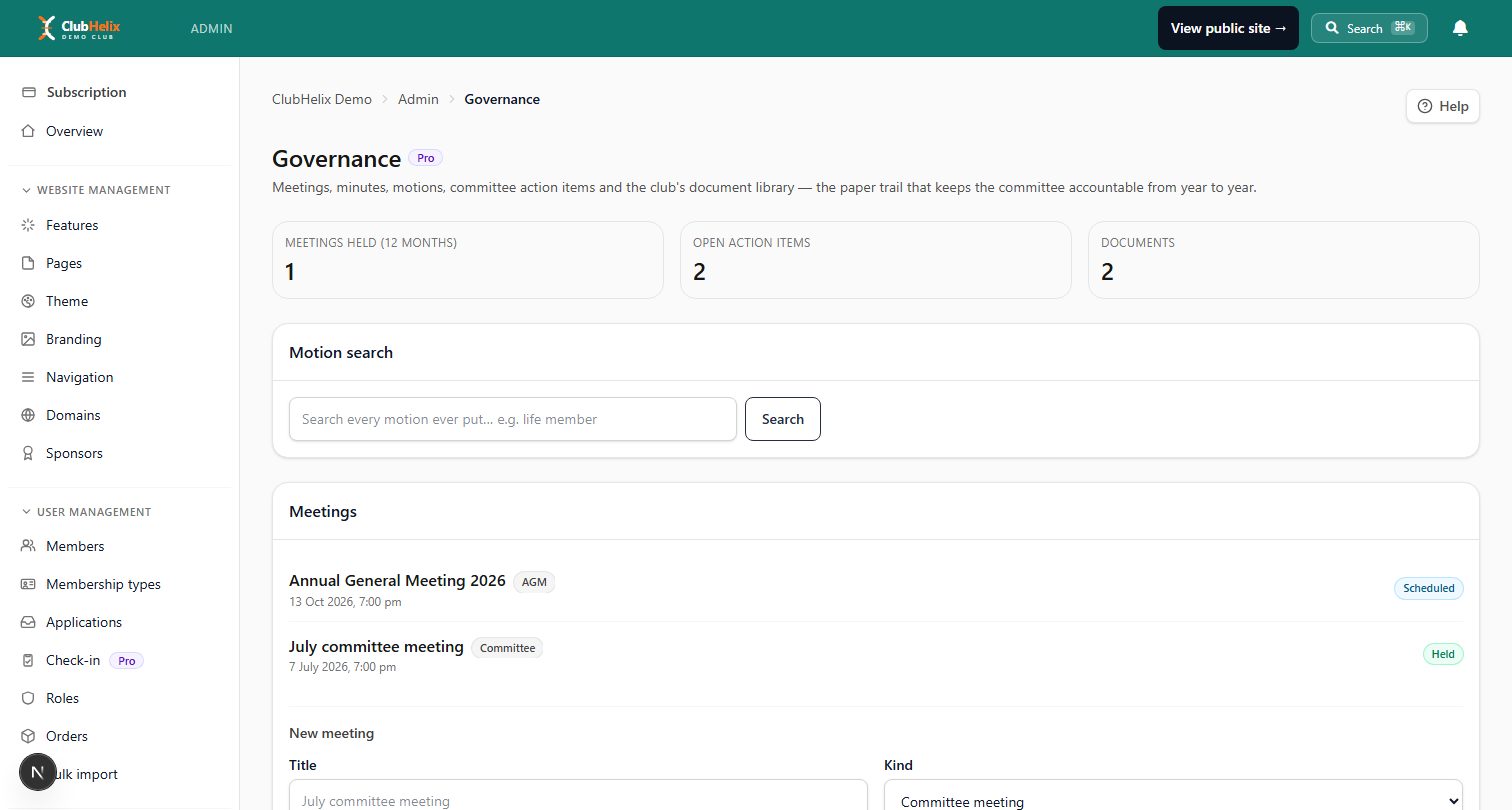
There is a free tier to start on, every price is on the pricing page, and it is built and hosted in Australia. Clubs typically have a working site and a member list set up inside an afternoon. Longer head-to-heads live at /compare/tidyhq-alternative and /compare/revolutionise-sport-alternative.
Where we do not compete: we hold no governing-body distribution deals, so if your sport mandates a registration platform, that stays. We have no native app-store apps, and if your organisation genuinely has no sport in it at all — a service club, a professional body, a board — a general administration platform with a decade of committee polish is a perfectly rational answer, and we would rather you were happy than converted.
Frequently asked questions
Can TidyHQ run a sports club?
It can run the administrative half of one — members, subscriptions, invoices, meetings, communications — and plenty of sporting clubs use it happily for exactly that. What it is not built to do is the season layer: fixtures, ladders, grades, clearances, selection and eligibility. If your club runs a draw and reports participation upward to a governing body, you will either need a second system for that or a platform that models it natively.
Is revolutioniseSPORT overkill for a small social club?
Possibly, but the pricing makes it a cheaper mistake than most. As at July 2026 the published band for clubs up to 100 members is A$112 a year, so the risk is complexity rather than cost — a product organised around seasons, competitions and governing-body reporting has a lot of navigation a purely social group will never open. Judge it in a trial with your actual committee, not from a feature list.
Which one is better for our committee and AGM?
Committee and meeting tooling is the area where the general administration platform has the most maturity, and it is the reason so many non-sporting groups chose it. That said, "better" depends on which of your officers is struggling. Take the eight-question checklist above into both trials and let your secretary and treasurer score them, because they are the two people who will use this daily.
What does each cost?
As at July 2026, revolutioniseSPORT publishes annual bands by club size — A$112 for up to 100 members, A$396 up to 500, A$989 up to 1,500 — with online payments through Pin Payments at 2% + A$1.60 per transaction, or PayPal at 2.6% + A$1.63. TidyHQ has a free plan and a Pro plan at US$69 per month, quoted locally at A$89, £49 or NZ$99, with an Enterprise tier for governing bodies (prices unchanged at our October 2026 re-check). When we re-checked in October 2026, TidyHQ also charged its own service fee on payments, on top of Stripe's: 3% + A$0.20 on Free and 1% + A$0.20 on Pro. Confirm current figures on both pricing pages before budgeting.
We are about to enter our first competition. What should we sort out first?
Read your affiliation agreement before you buy any software, because it may name a registration platform and settle the question. Then split your membership types so social members and registered players are distinguishable, get screening checks tracked with expiry dates, and decide where selection and availability will live before the first round rather than after it. Fixtures generate more weekly work than a first-year committee expects.
Next in this series — revolutioniseSPORT vs GameDay if your shortlist is two sports platforms rather than two philosophies, and TidyHQ vs Team App if what you actually need is better communication rather than better admin.


