
What this guide answers
- What is the difference between revolutioniseSPORT and GameDay?
Both are club and governing-body administration platforms covering memberships, registrations, payments and competitions.
- Which one is cheaper for a small club?
As at July 2026 only one of them can be answered from public information.
- Can our club just switch from one to the other?
Only if the choice is genuinely yours. Where a national or state body mandates a registration platform, moving your registrations off it can break clearances, insurance cover and competition eligibility, and no…
- Does either platform give our club a proper website?
Both include something. revolutioniseSPORT has a basic club-site module and GameDay has a long-serving websites product, and either beats having no web presence at all.
- We are mandated onto one of these. What can we actually improve?
Everything the mandate does not touch, which is more than most committees assume.
Somebody on your committee has a browser tab open on revolutionise.com.au and another on the GameDay site, and the meeting is on Tuesday. It usually happens for one of three reasons: your state body sent an email with the word "transition" in it, your registrar has spent one winter too many exporting spreadsheets, or your registration platform renewal has landed and the treasurer wants to know why the club is paying for it.
Here is the reframe that saves most committees an hour of circular argument. These two platforms are the incumbent administration systems of community sport, and they are usually inherited rather than chosen. Both sell to national and state bodies as well as to clubs, and where your sport has a contract in place, your registration and clearance data flow through whatever that contract says. The useful committee question is rarely "which one do we pick" — it is "which one has already picked us, what does it cover, and what is still ours to solve".
We should declare our position before we referee. We are ClubHelix, an Australian all-in-one club platform. We do not bid for governing-body registration contracts, so on the specific question of revolutioniseSPORT versus GameDay we have no dog in the fight — but we do build the club-facing layer, and the third section of this article argues that both platforms leave that layer thin. Read that part with our bias visible. Everything factual below is from public sources as at July 2026; both companies change things, so verify anything you are about to sign, and tell us if something here has gone stale.
What each platform actually is
revolutioniseSPORT (usually shortened to revSPORT) is a Sydney-built cloud platform for club and governing-body management — memberships, finances, registrations, events, competitions and governance in one administration system. Its core market is Australia and New Zealand, with expansion into Singapore and South Africa. The structural thing to understand about it is that it models the club-under-governing-body hierarchy directly: a state body can sit above its clubs, push down registration products and pull up census and compliance reporting. It is also sold self-serve to individual clubs at published prices, which matters more than it sounds — it means a club can buy it without waiting for anyone's permission.
GameDay — previously SportsTG, headquartered in Melbourne and owned by US-based Stack Sports — is the legacy workhorse of sports administration in this part of the world. It provides registrations, payments, competition management and websites for clubs, leagues and national bodies across Australia, New Zealand and the United Kingdom, with AFL heritage in its foundations. If you have administered community sport in the past decade you have almost certainly met it, or its "mygameday" portals: national membership databases, mandated registration pipelines, clearances and transfers, and competition management at association scale.
So the honest taxonomy is that these are two products of the same species, at different points in their lives. revSPORT is the newer, published-price, hierarchy-native challenger with a strong direct-to-club channel. GameDay is the entrenched, quote-priced, association-scale incumbent with deep national-body distribution and a websites product on the side.
Who actually picks, and what your committee vote is worth
Before you compare feature lists, work out which of three situations you are actually in. The answer changes what your vote is for.
| How the platform arrives | What it looks like | What your committee actually controls |
|---|---|---|
| National or state mandate | Affiliation requires registrations through a named system; clearances and insurance flow through it | Nothing about the platform itself. You control how well you use it, and everything around it |
| Association default | Your league runs one platform and strongly prefers you match it; no contractual obligation on paper | A real but expensive choice — going your own way means manual reconciliation with the league |
| Club's own decision | Nobody upstream cares what you use for your own membership records | The whole decision, including whether an administration platform is the right shape of tool at all |
Finding out which one you are in takes about twenty minutes and is worth doing before the meeting, not during it:
- Read the affiliation agreement. Not the newsletter — the actual signed document. Look for a named system, or the phrase "the approved registration platform".
- Ask your registrar where clearances live. The system that processes a player transfer is almost always the mandated one, because that is the record the governing body trusts.
- Follow the insurance. Community sport insurance is usually triggered by a registration record. Whichever system creates that record is load-bearing and cannot be swapped casually.
- Ask the state body a direct question in writing. "Is the platform contractual, or recommended?" Staff will answer this plainly, and having it in writing protects the next committee.
- Check the money path. Ask who receives registration funds first and when they are disbursed. That answer often reveals the real contractual relationship faster than any document.
If the answer is "mandated", your vote is not about revSPORT versus GameDay at all. It is about the club layer — the website, the communications, the events, the shop, the volunteers — and you should spend the meeting there instead. If the answer is "our own decision", read on, because the pricing shapes are genuinely different and the difference is not small.

Pricing shapes side by side, with the honesty notes
This is where the two products diverge most visibly, and where most online comparisons quietly make things up. We will not.
| Cost element | revolutioniseSPORT | GameDay |
|---|---|---|
| Pricing model | Published annual SaaS, banded by club size | Not published — quote-based |
| Small club | A$112/yr for up to 100 members | Ask for a quote |
| Medium club | A$396/yr for up to 500 members | Ask for a quote |
| Large club | A$989/yr for up to 1,500 members | Ask for a quote |
| Governing bodies | Custom | Custom |
| Online payment fees | Via Pin Payments at 2% + A$1.60 per transaction; PayPal at 2.6% + A$1.63 | Processing fees apply; current exact rates are not published clearly enough for us to quote |
| Billing rhythm | Annual, by member band | Monthly or annual on quote |
Two honesty notes, because they change how you should read that table.
First, "cheaper" is not established by the subscription line. revSPORT's published small-club band is remarkably low, and for a club of 90 members with modest registration income it is genuinely inexpensive. But for most clubs the transaction fees are the larger number by a wide margin, and a fixed per-transaction component hits small fees hardest. A A$25 junior social membership carrying a A$1.60 fixed fee plus 2% is paying roughly 8.4% to be processed. The same fee structure on a A$400 senior registration is about 2.4%. Model your own fee mix before you conclude anything.
Second, an unpublished price is not automatically a bad one. GameDay's quote-based approach is normal for platforms that mostly sell through associations, and a negotiated deal via your league can land somewhere a published band never would. What it does mean is that you cannot compare the two from your desk — you have to ask, in writing, and get both numbers.
The five numbers to demand in any quote
Whichever way you lean, do not accept a single headline figure. Ask for:
- The annual subscription, stated with the member ceiling that applies to it and what happens the day you exceed it.
- Every transaction fee, split into percentage and fixed components, for card, direct debit and any wallet option — and who wears it, the club or the member.
- Disbursement timing — how many days between a member paying and the money reaching the club account. Cashflow at registration time is a real constraint for a volunteer treasurer.
- Refund handling — whether fees are returned when a registration is refunded. Ours is not the only refunds policy that turns on this.
- Exit terms — what a member data export contains, in what format, and whether it costs anything. A club that cannot leave has not chosen anything.
An illustrative model, clearly labelled
Take a fictional 320-member club charging an average A$180 registration, all paid by card. On revSPORT's published figures that is A$396 for the Medium band plus 320 transactions at (2% × A$180) + A$1.60 = A$5.20 each, or A$1,664 — about A$2,060 all up, roughly A$6.44 per member. Run the identical model on GameDay and you cannot complete it, because two of the three inputs are not public. That is not an accusation, it is the practical consequence: budget season needs numbers, so book the sales call early enough that your treasurer can build the budget with real figures rather than estimates.
Capability, side by side
| Area | revolutioniseSPORT | GameDay |
|---|---|---|
| Home base | Sydney, Australia | Melbourne, Australia; owned by Stack Sports (US) |
| Main markets | AU/NZ core, plus Singapore and South Africa | Australia, New Zealand, United Kingdom |
| Governing-body hierarchy | Native — club sits under its state or national body | Yes — association and national-body scale |
| Registrations and payments | Yes, with published fee structure | Yes, long-established mandated pipelines |
| Clearances and transfers | Yes, at federation scale | Yes, national membership databases |
| Competition management | Yes | Yes, association scale |
| Finance and governance tooling | Yes, part of the core product | Administration-focused |
| Club website | A basic club-site module | A long-serving websites product |
| Self-serve purchase by a club | Yes, published bands | Contact sales |
Where each one is genuinely strong
revolutioniseSPORT earns its position on three things. Published pricing is the most underrated — a treasurer can build a budget from a web page instead of a sales call. Its hierarchy is real rather than bolted on, so a state body running census and compliance reporting across its clubs is doing what the product was designed for. And a club can adopt it alone, with no mandate and nobody's permission, which makes it the more plausible answer when the choice is genuinely yours.
GameDay earns its position on incumbency, and incumbency is not a slur. Clearances, transfers and national membership databases are unglamorous, high-stakes plumbing, and GameDay has run them across multiple sports and three countries for a long time. Breadth is the second strength — registrations, payments, competitions and websites under one roof. Our honest assessment of that websites product, offered by a company that builds club websites for a living and is therefore not neutral: it works, and for a club with nothing it beats nothing, but it is the platform's weakest flank and a generation behind what a club site can be today.
The layer neither one hands you
Here is the part where our bias is most relevant, so weigh it accordingly. Both of these are administration platforms, and they are shaped by the job of getting accurate participant data to a governing body. That is a real job, done well. It is also not the job of representing your club to the world.
What sits outside both, on any plan:
- A public face you control. Not a member portal, not a login screen — the pages a new family, a prospective sponsor or a grant assessor actually reads. Our guide to what a club website really needs covers the difference at length.
- Everything between match days. Events and ticketing, the canteen roster, uniform orders, presentation night, the newsletter, sponsor acknowledgements. Administration platforms record participants; they do not run community.
- Your own view of your members. Governing-body systems hold data in the shape the governing body needs. The club still needs its own: who has paid the club as distinct from the rego, who is coaching, whose screening check lapses in May. Keeping that straight is exactly what reporting to your governing body is easiest with — one club-side record, one clean upward report.
- Communication that is not an email blast. Wet-weather calls, selection notices, volunteer reminders. These are time-critical and member-specific, and they are usually the first thing a committee ends up doing in a group chat instead.
Filling the club-side gap without touching your rego
If your sport mandates one of these platforms, keep it — the registration, clearance and competition rails are not the fight worth picking. What we would replace is the duct tape wrapped around them: a real club website on your own domain built in a canvas page editor, your own member records and self-registration for everything the governing body does not process, and reports that answer the treasurer's questions without an export. Clubs sitting under a state body can also mirror that structure with our federation and region hierarchy.
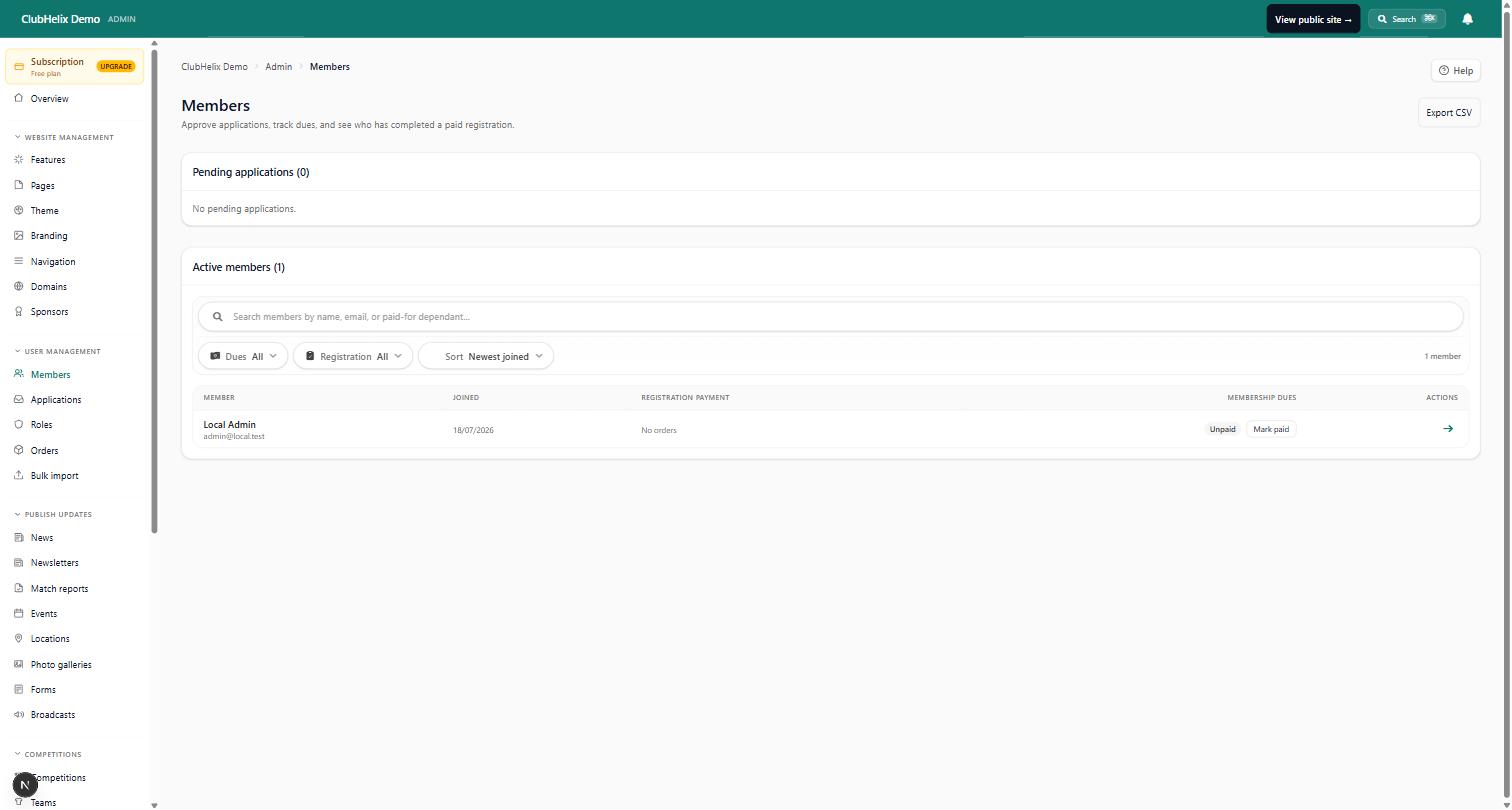
ClubHelix has a free tier, publishes every price on one pricing page, and is built and hosted in Australia. Most committees have a club site standing up the same afternoon they create an account — and if you would rather not, our done-for-you setup does it for you. If you would like the longer head-to-head, we keep one at /compare/revolutionise-sport-alternative and another at /compare/gameday-alternative.
The fair statement of our limits: we hold no governing-body distribution deals, so we will never be the platform your national body hands you. We do not ship native app-store apps, we have no video streaming or analysis product, and if GameDay's all-in-one administration already covers your club and you are happy with the site, you do not need us.
Frequently asked questions
What is the difference between revolutioniseSPORT and GameDay?
Both are club and governing-body administration platforms covering memberships, registrations, payments and competitions. revolutioniseSPORT is Sydney-based, models the club-under-governing-body hierarchy natively, and publishes annual pricing bands by club size. GameDay is Melbourne-based, owned by US company Stack Sports, operates across Australia, New Zealand and the United Kingdom, and prices by quote rather than publishing rates. GameDay has the longer incumbency and a websites product; revSPORT has the more transparent commercial model.
Which one is cheaper for a small club?
As at July 2026 only one of them can be answered from public information. revolutioniseSPORT publishes A$112 a year for clubs up to 100 members, A$396 up to 500 and A$989 up to 1,500, with online payments through Pin Payments at 2% + A$1.60 per transaction. GameDay does not publish subscription pricing, so any figure you find online is someone's guess. Get a written quote covering subscription and every transaction fee before comparing, and remember that transaction fees usually dwarf the subscription.
Can our club just switch from one to the other?
Only if the choice is genuinely yours. Where a national or state body mandates a registration platform, moving your registrations off it can break clearances, insurance cover and competition eligibility, and no software saving is worth that. Check your affiliation agreement first. Where there is no mandate, switching is a data-migration project — plan it between seasons, export everything before you cancel anything, and confirm the export format is usable.
Does either platform give our club a proper website?
Both include something. revolutioniseSPORT has a basic club-site module and GameDay has a long-serving websites product, and either beats having no web presence at all. Neither is a modern website builder, and we would say that even without a commercial interest in the answer — the pages a sponsor or a new family judges you on are worth more attention than an administration platform's side product tends to give them.
We are mandated onto one of these. What can we actually improve?
Everything the mandate does not touch, which is more than most committees assume. Your public website, your communications, your events and ticketing, your merchandise, your volunteer rostering, your sponsor relationships and your own internal member records are all yours to run however you like. Use the mandated platform for what it is genuinely good at — participants, clearances, competitions — and stop asking it to be your club's front door.
Related reading for the committee pack — GameDay vs PlayHQ covers the competition-rails side of the same question, and revolutioniseSPORT vs TidyHQ is the comparison to read if your club is more community than competition.


