
What this guide answers
- Do sports clubs have to give refunds?
It depends on the circumstances. Where Australian Consumer Law applies, consumer guarantees generally entitle people to a remedy when a paid service isn't delivered as promised — but not for a simple change of mind.
- Can our club have a "no refunds" policy?
A blanket "no refunds under any circumstances" position is risky, because consumer guarantee rights can't be excluded where they apply — regulators specifically call out no-refund signs as misleading.
- Should we refund the whole fee or just the club's portion?
Most clubs refund the club component and exclude components already paid to third parties — association affiliation, insurance, ordered uniforms — because that money has left the club.
- What about refunds when a season is cancelled?
If the club cancels a season or program and can't offer a reasonable alternative, the starting point is refunding what wasn't delivered — and this is broadly the direction consumer guarantees point where they apply.
- How quickly should a club process a refund?
Set a service standard in your policy — 14 days is common and achievable — and beat it where you can.
Every club treasurer eventually faces the email: a family moved interstate in round three, a junior broke an arm at the first training session, a new member changed their mind a week after paying, or a whole season got cancelled and forty families want to know what happens to their fees. Refunds are where money, goodwill and rules collide — and clubs that handle them without a written policy end up making it up case by case, which is slower, less fair, and far more likely to end in a committee argument or an unhappy family posting about it.
This guide covers how refund obligations generally work for Australian community clubs, what a good refund policy contains (with a template outline you can adapt), how to handle the scenarios that actually come up, and how to make the mechanics of refunding painless.
General information only. This guide is general information for community clubs, not legal or financial advice. Consumer law obligations depend on the circumstances, and club situations vary — always confirm with the official sources linked below, and get advice for anything contested or significant.
What the law says, in general terms
Australian Consumer Law applies to businesses supplying goods and services — and depending on the circumstances, a club charging fees for services (registration, programs, events, merchandise) can have obligations under it. The two ideas worth understanding:
Consumer guarantees are not a change-of-mind right. Under the consumer guarantees, people are generally entitled to a remedy when a service isn't provided with due care and skill, isn't fit for its purpose, or isn't supplied within a reasonable time — not simply because they changed their mind. Equally, a "no refunds under any circumstances" sign or clause is a problem, because consumer guarantee rights can't be signed away where they apply. The ACCC's plain-English pages on consumer rights to repair, replacement and refund are the best starting point.
Your state or territory consumer affairs body is the local authority. Fair trading regulators publish guidance and handle complaints: NSW Fair Trading, Consumer Affairs Victoria, Queensland Office of Fair Trading, Consumer and Business Services SA, Consumer Protection WA, Consumer, Building and Occupational Services Tasmania, Access Canberra and NT Consumer Affairs. If a refund dispute escalates, these are the bodies both sides can turn to.
Beyond the legal floor, remember what a club refund policy is actually for: your members are your community, not customers you'll never see again. The reputational cost of fighting a family over $180 usually dwarfs the $180. A good policy is generous where it can be, clear where it can't, and applied the same way to everyone — including committee members' kids.
Why "we don't do refunds" fails clubs
Aside from the legal problem with blanket no-refund positions where consumer guarantees apply, a no-refunds stance fails practically:
- It doesn't survive contact with sympathy. The first injured seven-year-old whose parents ask nicely gets a refund anyway, and now you have an unwritten policy of "refunds if you know who to ask" — the worst policy of all.
- It deters sign-ups. Parents hesitant about a new sport are more likely to register when they can see a fair "if it doesn't work out" position up front.
- It ignores that some money is genuinely gone. The honest position is usually that part of a fee is refundable and part isn't — insurance and affiliation components paid to the association on registration often can't come back, while the club portion can. A policy lets you say that precisely instead of arguing it each time.
Refund policy template outline
Adapt this structure, fill in your club's numbers, have the committee adopt it formally, and publish it where people register. Keep the whole thing under a page.
1. Purpose and scope. One sentence: this policy covers refunds of registration and membership fees, program fees, event tickets and merchandise for [Club Name]. Note that nothing in the policy limits rights under Australian Consumer Law.
2. Cooling-off on registration. A defined change-of-mind window before the season starts — commonly full refund (less any non-recoverable third-party components) for cancellations before round one or before a stated date. This is your generosity zone: it costs little and builds trust.
3. What's non-refundable and why. Name the components the club itself cannot recover: association/affiliation fees and insurance already remitted upward, payment processing costs where they aren't returned, uniform items already ordered. Transparency here is what makes the rest of the policy feel fair.
4. Mid-season withdrawal. The standard approach is a pro-rata refund of the club component based on rounds or weeks remaining, with a cut-off (for example, no refunds after two-thirds of the season). State it as a formula so nobody negotiates.
5. Injury and medical withdrawal. Most clubs are more generous here — pro-rata without the cut-off, on request with a simple statement or certificate. Decide and write it down.
6. Club-cancelled activities. If the club cancels a program, event or season and can't offer a reasonable alternative, the default is a refund of what wasn't delivered — this is also broadly where consumer guarantee obligations point. Cover partial seasons (weather, facility loss) with a stated approach: credit, partial refund, or carry-over to next season, ideally at the member's choice.
7. Events and tickets. Cancelled event: refund or transfer. Attendee can't come: state your position (transfer to another person is a low-cost yes; refund deadlines tied to catering commitments are reasonable).
8. Merchandise. Consumer guarantees cover faulty items regardless of policy. For change of mind on sized items like uniforms, many clubs offer exchange rather than refund for unworn items with tags — state it.
9. How to request, who decides, how fast. One channel (a form or the club email), one decision-maker for standard cases (treasurer applying the formula), committee only for exceptions, and a service standard ("processed within 14 days, refunded to the original payment method").
10. Review date. Re-adopt annually alongside fee setting — refund terms and fee levels belong in the same conversation.
The scenarios that actually happen
"My child hated it after two sessions." Inside your cooling-off window: refund per clause 2, warmly. Outside it: pro-rata per clause 4. Either way the policy answers, not the loudest committee member.
"We're moving away in June." Pro-rata of the club component. If the destination club is in the same association, point the family at the association's transfer process — affiliation components sometimes travel with the player rather than being refunded.
Season-ending injury in round one. Clause 5. This is the scenario to be generous in; it's also the one families remember forever, in either direction.
The association component question. When a family asks for "the full $250 back" and $95 of it went to the state body on day three, show them the split. This is much easier when your registration receipts itemise components — if your platform showed "$155 club + $95 association/insurance" at checkout, the conversation is already half done.
The chargeback. Occasionally a member disputes the card charge with their bank instead of asking you. Respond to the dispute with your records — the registration form, the policy they accepted, delivery evidence — and reach out to the member directly; most chargebacks from members are misunderstandings that a phone call resolves faster than the bank process.
Make the mechanics painless
A fair policy dies if every refund means finding a bank detail, a spreadsheet row and a committee vote. Two structural fixes:
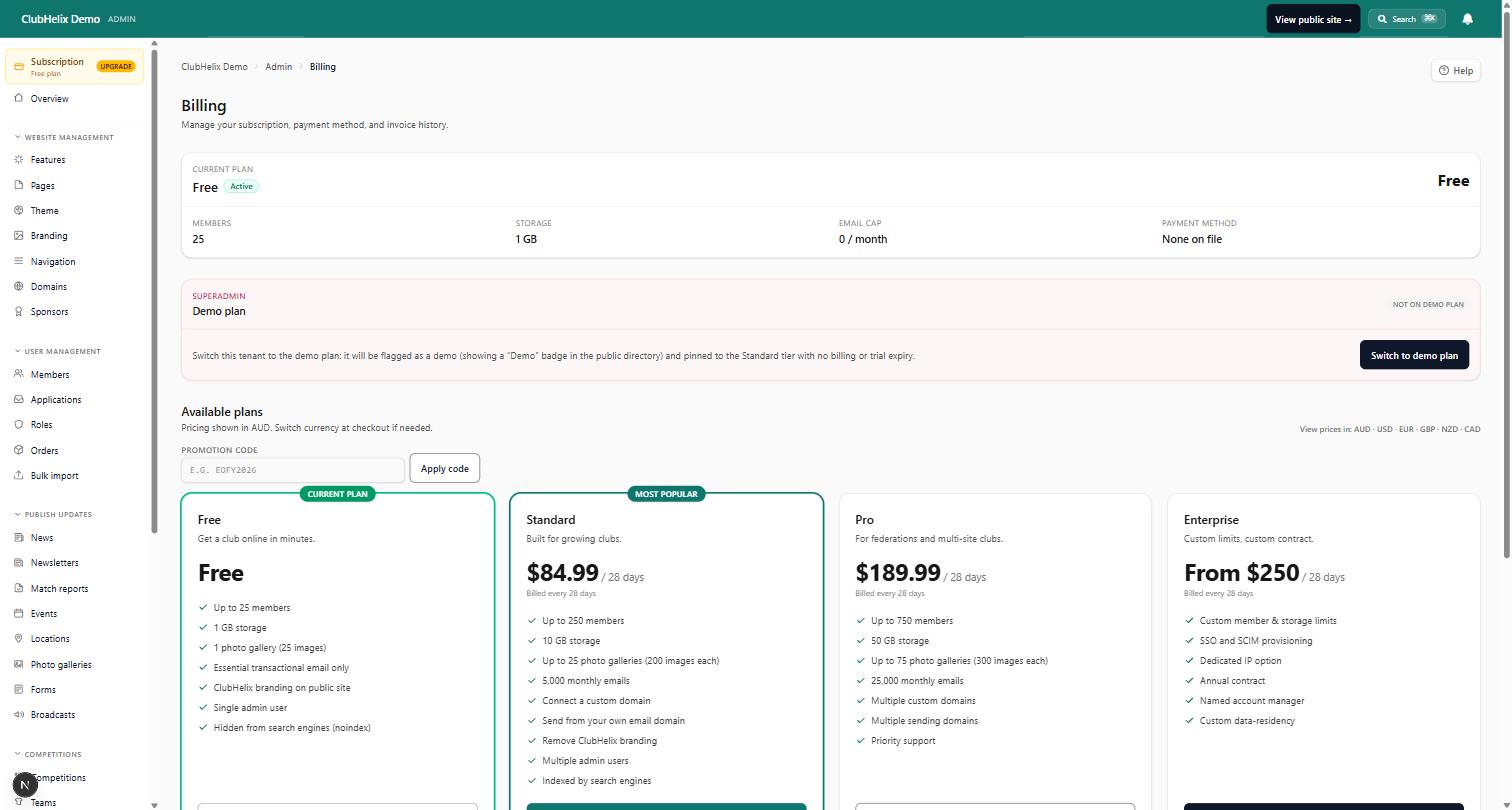
Collect fees through a system that can refund to source. When registrations are paid online through your club platform, a refund goes back to the original card in a couple of clicks, with the payment record, the member record and the paper trail in one place. That's dramatically better than collecting by bank transfer and refunding by asking families for their BSB over email. If you're still collecting fees manually, start with how to collect club membership fees online.
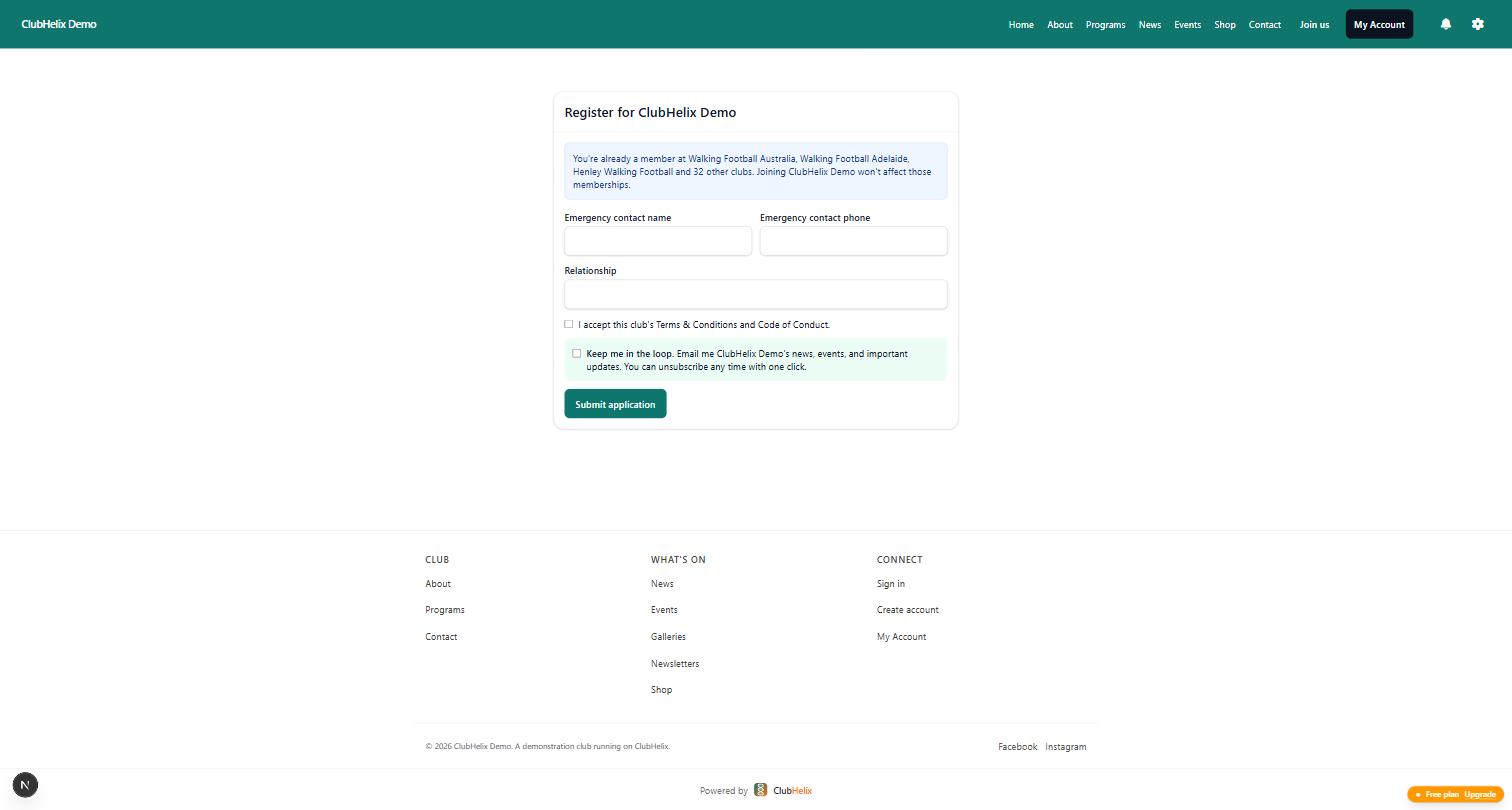
Put the policy inside the registration flow. Consent at the moment of payment beats a PDF nobody found: link the refund policy on your registration form with a required acknowledgement, so every member has seen the terms before paying. It also means the "I never agreed to that" conversation never happens — the form record shows they did.
Record every refund with a reason code (cooling-off, injury, pro-rata, cancelled activity, goodwill) in your payments records. At season's end the treasurer can report "we refunded $1,840 across 11 requests, 9 within policy, 2 goodwill" — which is how a committee learns whether the policy is set right.
Communicating refunds without the grief
- Publish the policy on the website next to fees, link it from the registration form, and include it in the welcome pack.
- Answer requests fast, even if the answer is a timeline. Silence converts a routine request into a grievance.
- When declining, cite the clause and offer what you can — a credit, a transfer, a partial amount. "Under our policy adopted at the March committee meeting, withdrawals after round 12 aren't refunded, but we'd be glad to credit $40 toward next season" lands very differently to "no".
- Never litigate a refund in a Facebook comment thread. Take it to email, resolve it, and let the outcome speak.
Frequently asked questions
Do sports clubs have to give refunds?
It depends on the circumstances. Where Australian Consumer Law applies, consumer guarantees generally entitle people to a remedy when a paid service isn't delivered as promised — but not for a simple change of mind. Many everyday club refund questions (change of mind, mid-season withdrawal) sit in territory where your own published policy governs, which is exactly why having a clear, fair one matters. Check the ACCC's consumer guarantee guidance and your state fair trading body's pages, and seek advice for contested cases.
Can our club have a "no refunds" policy?
A blanket "no refunds under any circumstances" position is risky, because consumer guarantee rights can't be excluded where they apply — regulators specifically call out no-refund signs as misleading. A better approach is a policy that spells out what is refundable (cooling-off window, pro-rata club component, club-cancelled activities) and what genuinely isn't (association fees already remitted, insurance components), and that always leaves room for consumer law rights.
Should we refund the whole fee or just the club's portion?
Most clubs refund the club component and exclude components already paid to third parties — association affiliation, insurance, ordered uniforms — because that money has left the club. The key is transparency: itemise the components at registration and in the policy so members can see the split before they pay, not just when they ask for money back.
What about refunds when a season is cancelled?
If the club cancels a season or program and can't offer a reasonable alternative, the starting point is refunding what wasn't delivered — and this is broadly the direction consumer guarantees point where they apply. For partial cancellations (weather, lost facilities), decide your approach in advance — pro-rata refund, credit toward next season, or the member's choice — and put it in the policy before you need it.
How quickly should a club process a refund?
Set a service standard in your policy — 14 days is common and achievable — and beat it where you can. If fees were paid online through your club platform, refunding to the original payment method takes minutes; the delay is usually decision-making, which a formula-based policy removes for standard cases.
ClubHelix takes registrations with online payment and policy acknowledgement built in, keeps every payment against the member record in one billing view, and makes refunds a two-click job — see pricing to get your fees, terms and money in one place.


