
What this guide answers
- What's the best way to collect membership fees online?
Attach card payment directly to your online registration form so joining and paying are a single step.
- How do we handle members who genuinely can't afford fees?
With a pre-agreed, discreet hardship policy: a sentence on your join page inviting confidential contact, authority delegated to one or two officers to approve discounts or extended plans, and no visibility to coaches…
- Are card transaction fees worth it for a small club?
Almost always. A typical card fee of a couple of percent on a membership is small against the volunteer hours spent reconciling transfers and chasing payments, and smaller still against the fees that never arrive under…
- How long should we let someone play without paying?
Set the line before the season and publish it — commonly two or three rounds, after which payment or an approved plan is required for selection.
Ask any club treasurer what they'd change about the job and "chasing unpaid fees" is usually first out of their mouth. The spreadsheet of who's paid, the bank statement archaeology to match "J SMITH" against three Smith families, the awkward conversation at training with a parent who's sure they transferred it in March — none of it is why anyone volunteers for a club.
Here's the uncomfortable truth behind all that chasing: unpaid fees are usually a process problem, not a people problem. When paying is easy, immediate, and attached to the moment of registration, almost everyone pays. When it requires remembering a BSB, finding the right reference format, and trusting it'll be reconciled — payment becomes a chore people defer, and deferred payments become the treasurer's winter project.
This guide covers how to move your club to online fee collection properly: the setup, the policies (instalments, discounts, hardship), the record-keeping, and a follow-up system for the small number of genuinely unpaid fees that remain.
Why bank transfers and cash are costing you more than card fees
Committees often resist online payments because of transaction fees — typically a couple of percent. Set that against what the manual system actually costs:
- Volunteer hours. Reconciling transfers, updating the spreadsheet, sending reminders, handling cash floats. For a 200-member club this is easily dozens of hours a season — your scarcest resource, spent on your least rewarding task.
- Leakage. Every club running on transfers carries a tail of members who played all season and never quite paid. Two or three unpaid family memberships usually outweigh a whole season of card fees.
- Errors and disputes. Cash tins go missing; transfers arrive with no reference; someone is marked unpaid who paid. Each error costs goodwill, which is more expensive than money.
- Slower joins. A new member who can't pay on the spot is a registration that might not finish. Friction at the payment step directly suppresses membership growth.
Priced honestly, a card fee is the cheapest admin your club will ever buy.
Build the cost into your fee rather than adding it at the end, because from 1 October 2026 a card payment here cannot be surcharged. The mechanism is worth understanding, since it is not a law aimed at your club: the Reserve Bank of Australia removed the rule that had stopped the card networks banning surcharges — its Standard No. 3 of 2016, as varied in 2026 — so eftpos, Mastercard and Visa each enforce a no-surcharge rule of their own from that date. American Express sits in the RBA's own table alongside them, having decided to remove surcharging while not being formally regulated by the RBA. The RBA does not regulate merchants directly; your payment provider and the card schemes do.
Three things a treasurer should know. There is no not-for-profit exemption — the RBA's guidance says businesses, including not-for-profit organisations, are not exempt unless a card network's rules or a law provide one. The date follows the payment rather than the invoice, so a card payment taken on or after 1 October cannot be surcharged even against a fee note you issued in September, and some providers are expected to switch the function off entirely. And discounts are still permitted, with costs able to be reflected in your overall pricing — so an early-bird or pay-in-full discount does the same work the surcharge was doing, and reads better to a family. The Reserve Bank publishes surcharging FAQs. This is general information, not financial or legal advice — confirm your own position with your payment provider.
Step 1: attach payment to registration — one flow, not two
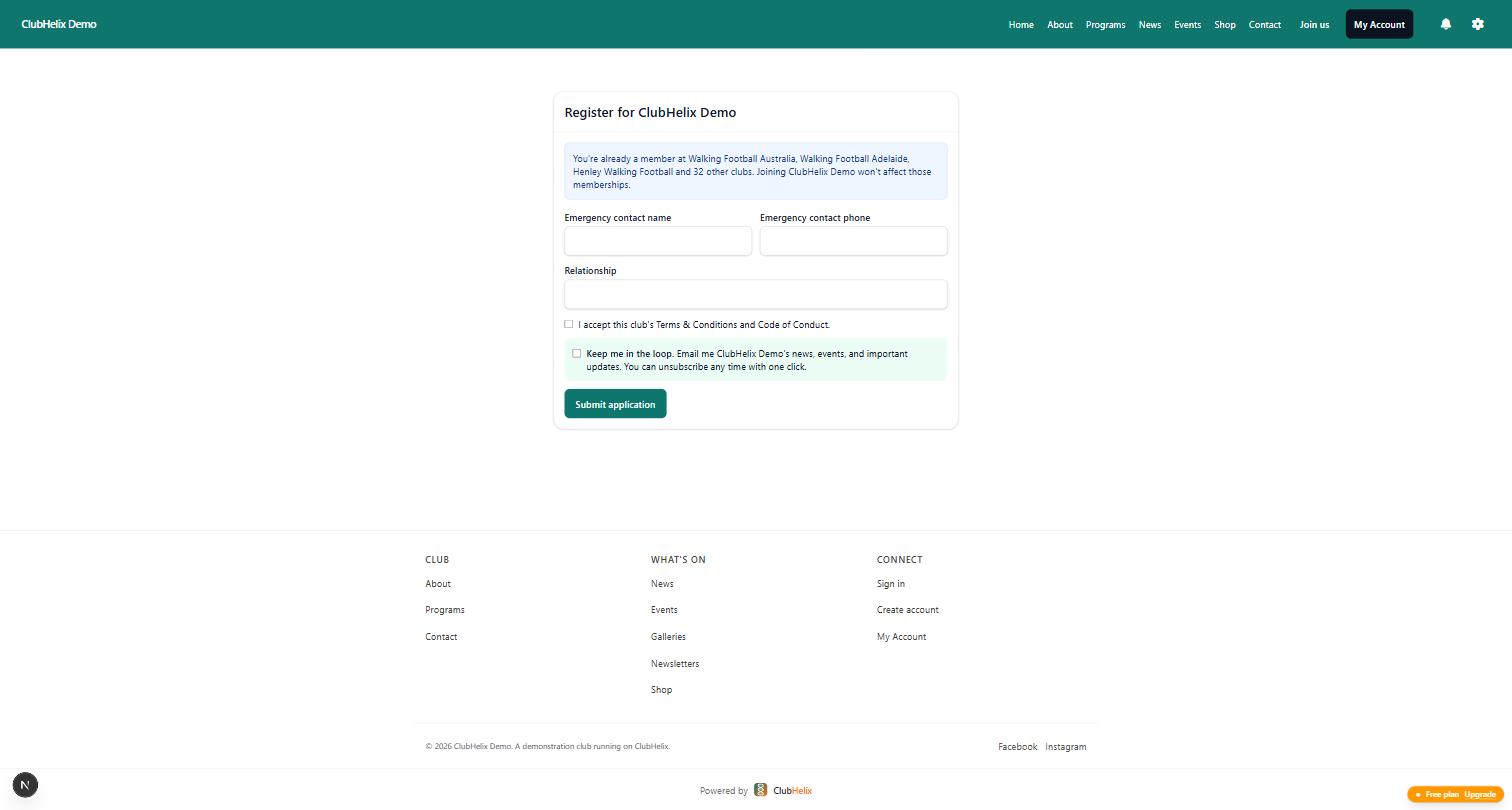
The single most important design decision: registration and payment must be one step. The moment someone fills in your membership form, they should choose their membership category, see the price, and pay by card — before the confirmation screen.
Splitting these ("register now, we'll invoice you") re-creates the chasing problem you're trying to kill. Every gap between commitment and payment fills with life: the tab gets closed, the invoice gets buried, the season starts anyway.
A proper self-registration flow handles the whole pass: the member picks a category (senior, junior, family, concession), the form collects the details you need, payment happens on the spot, the member record is created with a paid status, and a receipt goes out automatically. No spreadsheet, no reconciliation, no volunteer in the loop at 9pm when most sign-ups actually happen.
If your club runs registrations through a governing body system, the same principle applies to everything else you collect — club top-up fees, uniform levies, event tickets — bring them online rather than falling back to transfers for the "little" payments. The little payments are where the chasing lives.
Step 2: decide your payment policies before the season, not during it
The committee decisions that make or break fee collection are policy decisions. Settle these before registrations open and write them on the join page:
Instalments. The biggest reason genuine, willing members don't pay isn't unwillingness — it's the start of the school year. School fees, uniforms and holidays all land at once. Offering a fee split into two or three scheduled payments removes the cashflow objection without discounting a cent, and it converts "I'll register when I get paid" into a completed registration today. Decide which categories can use instalments and whether there's a small admin loading.
Early-bird pricing. A modest discount for paying by a set date pulls your revenue forward, funds pre-season spending, and gives your reminder emails a real deadline. It works better than late fees, which punish the disorganised and create arguments.
Family caps and discounts. If you charge per person, a three-child family faces a bill that can push them to a cheaper club — or out of sport. A family cap (e.g. pay for the first two juniors, third plays free) is common; for the full framework see our guide to setting membership fees.
A quiet hardship policy. Every club has families doing it tough. Agree in advance that the registrar or president can approve a discreet discount or extended plan, and put one line on the join page: "If fees are a barrier, contact us confidentially." This keeps kids playing and prevents the worst outcome — families ghosting the club out of embarrassment.
The play-without-paying line. Decide it now: how many rounds can someone play before payment (or a plan) is required? Whatever you choose, an automated system enforces it far more kindly than a volunteer having to eyeball a teammate.
Step 3: keep records that answer "who hasn't paid?" in one click
The treasurer's core question — who has paid, who hasn't, and how much have we collected? — should be answerable in seconds, not by cross-referencing a bank feed against a form export.
That means payments must land against the member record, not in a separate system. When a payment is taken through your registration flow, the member's status flips to paid automatically, their paid-until date is set, and the transaction sits in a ledger the treasurer can filter and export.
What good looks like day-to-day:
- A member list filterable by payment status — the "unpaid" view is the chase list.
- Automatic receipts to the payer, so "did my payment go through?" answers itself.
- An export the treasurer can drop into the club budget and treasurer report without re-typing.
- Refunds handled in the same system, so the ledger stays true.
Step 4: chase the stragglers with a system, not with awkwardness
Even with a good online flow, a handful of fees will be outstanding — usually mid-season joiners, instalment hiccups, or families in genuine difficulty. Replace ad-hoc chasing with a standard sequence, so no volunteer has to decide whether to remind anyone:
- Reminder 1 (automatic, friendly), a week after the due date. "A quick note that your membership payment is still pending — here's the link. If anything's wrong, just reply."
- Reminder 2 (automatic, plainer), two weeks later. Restate the amount, the link, and the club's play-without-paying line, plus the hardship sentence.
- Personal contact, two weeks after that. A call or message from the registrar — not the coach, and never in front of the team. Most cases resolve here; many turn out to be a failed card or a misunderstanding.
- Committee decision for the rest. The few remaining cases get a human decision: a plan, a hardship arrangement, or a pause on selection — applied consistently, per the policy you wrote in step 2.
The tone throughout is "the system is reminding you", not "the club is judging you". Automation is what makes kindness scalable: because reminders go to everyone on the same schedule, nobody is singled out, and the treasurer's relationships survive the season intact.
Step 5: close the loop with members
Fee collection gets easier every year at clubs where members can see what fees deliver. Once or twice a season, tell members plainly where the money went — equipment, ground hire, insurance, umpires. Members who understand the value renew earlier and pay faster; it's the same trust that powers retention. Rounded honest numbers are fine; the format is in our treasurer report outline.
The migration plan (one pre-season, done)
- Committee signs off policies: fees, instalments, early-bird, family cap, hardship line, play-without-pay rule.
- Set up your club's payment account and online registration with fee categories matching the policy.
- Publish the join page with fees visible and a pay-now flow; retire the PDF form.
- Announce the change: "faster, instant receipts, no more bank transfer references."
- Keep one manual fallback (the registrar can record a cash/EFT payment against a member) for the rare exception — as an exception, not a channel.
Frequently asked questions
What's the best way to collect membership fees online?
Attach card payment directly to your online registration form so joining and paying are a single step. This eliminates most unpaid fees at the source, because payment happens at the moment of highest motivation. Standalone invoice links and bank transfer instructions both re-introduce a gap between registering and paying — and that gap is where chasing comes from.
How do we handle members who genuinely can't afford fees?
With a pre-agreed, discreet hardship policy: a sentence on your join page inviting confidential contact, authority delegated to one or two officers to approve discounts or extended plans, and no visibility to coaches or teammates. Instalment options solve most affordability issues before they become hardship conversations. What you want to avoid is having no policy — that's how families quietly disappear rather than ask.
Are card transaction fees worth it for a small club?
Almost always. A typical card fee of a couple of percent on a membership is small against the volunteer hours spent reconciling transfers and chasing payments, and smaller still against the fees that never arrive under a manual system. Most clubs build it into the headline fee, which works in every market; whether it can instead be shown as a separate line at the end depends on local rules, and the note for your country above has the position. Treat the card fee as what it is: outsourcing your least-loved admin job for a few dollars a member.
How long should we let someone play without paying?
Set the line before the season and publish it — commonly two or three rounds, after which payment or an approved plan is required for selection. The exact number matters less than consistency: a published rule enforced by the system treats everyone equally, while case-by-case decisions at training breed resentment and put volunteers in unfair positions.
ClubHelix takes fees at registration, keeps every payment against the member record with club billing tools, and gives your treasurer the paid/unpaid picture in one click. See pricing to get started.


