
What this guide answers
- What's the actual difference between GameDay and PlayHQ?
Scope. GameDay is a broad sports-administration platform — registrations, payments, national membership databases, clearances, competition management and hosted websites — used across many sports in Australia, New…
- How much do GameDay and PlayHQ cost a club?
As at July 2026, GameDay doesn't publish subscription pricing — it's quote-based, and payment processing fees apply on top (exact current rates aren't published clearly enough to quote responsibly).
- Can my club choose PlayHQ instead of GameDay (or vice versa)?
Usually not. Both are adopted at governing-body level — PlayHQ by the national bodies of AFL, cricket, basketball and netball, GameDay by various other national and state bodies — and clubs inherit the decision through…
- Does PlayHQ give my club a website?
It can, as a separate purchase. The competition platform gives you public fixture, ladder and results pages, which are the competition's pages rather than yours.
- We're unhappy with our sport's platform — what can we actually do?
Realistically: raise it through your association or state body (platform decisions get reviewed, and club feedback genuinely feeds those reviews), and meanwhile control what you can control — your club's own website…
GameDay versus PlayHQ is the comparison Australian club committees google after a season launch email announces "we're moving platforms" — usually with no vote and no warning. Here's the first honest thing to say about it, and it reframes the whole question: for most clubs, you don't choose between GameDay and PlayHQ. Your sport does. These are governing-body administration platforms, adopted at national or state level and handed down; the club's job is mostly to understand what it's been given and what's still missing.
That makes this a different kind of comparison article. We'll still put the two side by side properly — what each is, what it costs as far as anyone can tell publicly, and where each is strong — but the genuinely useful part for a committee is the second half: what each platform does for your club, what neither does, and how to run a good club on top of whichever one your sport mandates.
Full disclosure before we referee: we're ClubHelix, an Australian all-in-one club platform. We don't compete for NGB competition contracts. Our lane is the club-facing layer, and that now overlaps with both vendors, since each sells a club website product, so weigh our views on websites with that in mind. Facts below are from public sources, current as at July 2026, with PlayHQ's pricing and websites and GameDay's pricing re-checked in October 2026; both companies change things, so verify anything critical, and tell us if we've got something wrong.
What each platform actually is
GameDay — formerly SportsTG, owned by US-based Stack Sports and headquartered in Melbourne — is the legacy workhorse of Australian sport administration, with AFL heritage in its bones. It provides registrations, payments, competition management and websites for clubs, leagues and national bodies across Australia, New Zealand and the UK. If you've administered community sport in the last decade, you've probably met it (or its "mygameday" portals): national membership databases, registration pipelines mandated by governing bodies, clearances and transfers, and competition management at association scale, with thousands of club and league sites hosted on its infrastructure.
PlayHQ, also Melbourne-based, is the newer national competition platform for four of the biggest participation sports in the country: AFL, cricket (Cricket Australia), basketball (Basketball Australia) and netball (Netball Australia). It runs fixtures, ladders, results and registrations at national scale, and it has moved further into payments, acquiring the payments product TeamPay. At its core, the platform your association runs on is competition rails: the registration, fixture, ladder and results layer for the sports it serves. Around that core it now sells more, including a club website product, covered below.
A correction we owe you: this article used to say PlayHQ left the club website to the club. That is no longer true. When we re-read PlayHQ's own pages in October 2026, it sold PlayHQ Websites: a club site built from your PlayHQ data, with a drag-and-drop editor, club and league templates, fixtures, ladders and results that sync in real time, and registration and payment widgets that hand off to the PlayHQ portal. You can use your own domain (for a separate fee) or a free playhq-sites.com subdomain. It is a yearly subscription with no lock-in, the site goes offline and is archived if you cancel, and no price is published. PlayHQ also now publishes per-registration pricing (below) and lists apps, shop and merchandise, program management and communications modules. We haven't used the Websites product, so treat this as what PlayHQ says it does.
So the honest taxonomy, as of October 2026: GameDay is a broad sports-administration platform that includes a club websites product; PlayHQ is a competition platform first, now with its own website product and a growing set of modules around it.
Side by side
From public sources, as at July 2026, with PlayHQ's pricing and websites and GameDay's pricing re-checked in October 2026. Where pricing isn't published, we say so rather than repeating internet guesses.
| Area | GameDay | PlayHQ |
|---|---|---|
| What it is | Registrations, payments, competition management and websites for clubs, leagues and NGBs | National competition platform — fixtures, ladders, results, registrations |
| Who adopts it | Governing bodies, leagues, associations, clubs | National governing bodies (AFL, Cricket Australia, Basketball Australia, Netball Australia) |
| Club subscription cost | Not published — quote-based | Published per registration: A$10 to A$6 for registration and competition management, A$7 to A$4 for registration only, by volume (October 2026) |
| Transaction fees | Payment processing fees apply; current exact rates aren't published clearly enough for us to quote | Participant-side fees — e.g. in cricket, a 1.49% processing fee added to the participant and 1.80% deducted before disbursement (per Cricket Australia support) |
| Competition management | Yes — association-scale | Yes — its entire reason for existing, at national scale |
| Registrations & clearances | National membership databases, clearances/transfers | National registration rails for its four sports |
| Club websites | Yes — a long-serving websites product | PlayHQ Websites: built from your PlayHQ data, own domain or free subdomain, yearly subscription, price not published (October 2026) |
| Club admin (comms, shop, volunteers…) | Partial — administration-focused | Lists shop and merchandise, program management and communications modules (October 2026); not assessed by us |
| Home market | Melbourne; AU/NZ/UK; owned by Stack Sports (US) | Melbourne; Australia |
Two pricing honesty notes. First, GameDay doesn't publish subscription pricing — it's quote-based, so any specific dollar figure you read online is a guess, and we won't repeat one. Second, PlayHQ now publishes a per-registration price list: A$10 per registration under 2,000 registrations, A$8 under 10,000 and A$6 under 50,000 for registration and competition management, and A$7, A$5 and A$4 over similar bands for registration only, with no mandatory setup fee. Who pays that, and how it reaches families, depends on your sport's arrangement. The cricket processing fees above are the example Cricket Australia documents; check your own governing body's fee schedule rather than extrapolating.

Where GameDay is strong
- Breadth. Registration, payments, membership databases, competition management and a websites product under one roof — it's a genuine administration platform, not just rails.
- Incumbency and coverage. It serves sports and associations across Australia, New Zealand and the UK, and many governing bodies have years of member data and process built on it. Clearances and transfers across a national database are unglamorous and vital, and GameDay has done them for a long time.
- A websites product exists. For clubs with nothing, a hosted GameDay site is better than no site. Our honest assessment, as a company that builds club websites for a living: it's the platform's weakest flank — functional, but a generation behind what a modern club site can be. Weigh that view with our bias in mind.
Where PlayHQ is strong
- Competition depth. It does competitions — fixtures, ladders, results, registration — for four enormous sports, at national scale. Everything else it sells is built on that data.
- The public data layer. PlayHQ's public fixture, ladder and results pages have become where Australians in its sports simply look things up. Your club's fixtures being on the same rails as every other club's is genuinely convenient for players and parents.
- Published pricing. Unlike GameDay, PlayHQ puts a per-registration price list on its site, so an association can do the sums before a demo.
- A website that already knows your fixtures. PlayHQ Websites syncs fixtures, ladders and results from the competition data. For a club that wants exactly that and little else, it's the path of least resistance.
So which one "should" your club pick?
Here's the referee's answer nobody else will give you plainly: in most cases this is not your decision. If your sport is AFL, cricket, basketball or netball, your competition and registration rails are (or are heading to) PlayHQ because your national body decided so. In many other sports, your state body or association runs GameDay, and your registrations flow through it. The comparison question that actually faces a committee is almost never "GameDay or PlayHQ?" — it's "our sport uses X; what does that cover, and what's left for us to solve?"
What the mandated platform covers: registrations, the money pipeline attached to them, fixtures, ladders, results, and your sport's compliance and clearance machinery. Be grateful for it — running a fixture draw across hundreds of clubs is exactly what national rails are for.
What's left for the club — on either platform:
- Your public face, unless you buy it from the platform. A PlayHQ ladder page is not a club website. Both vendors will now sell you one; the question is whether a site built around competition data tells your club's story, and (in our biased-but-considered view) a dated hosted site undersells a good club. Sponsors, new families and grant assessors judge you on what you control. Here's what a real club website needs.
- Everything between match days. Events, canteen and volunteer rosters, merchandise, sponsors, newsletters, member communication — governing-body rails don't do the community half of running a club.
- Your own member relationship. NGB platforms hold your data in the shape the governing body needs. The club still needs its own view: who's paid the club (not just the rego), who's coaching, whose Working with Children Check lapses in May.
Where ClubHelix fits (and doesn't)
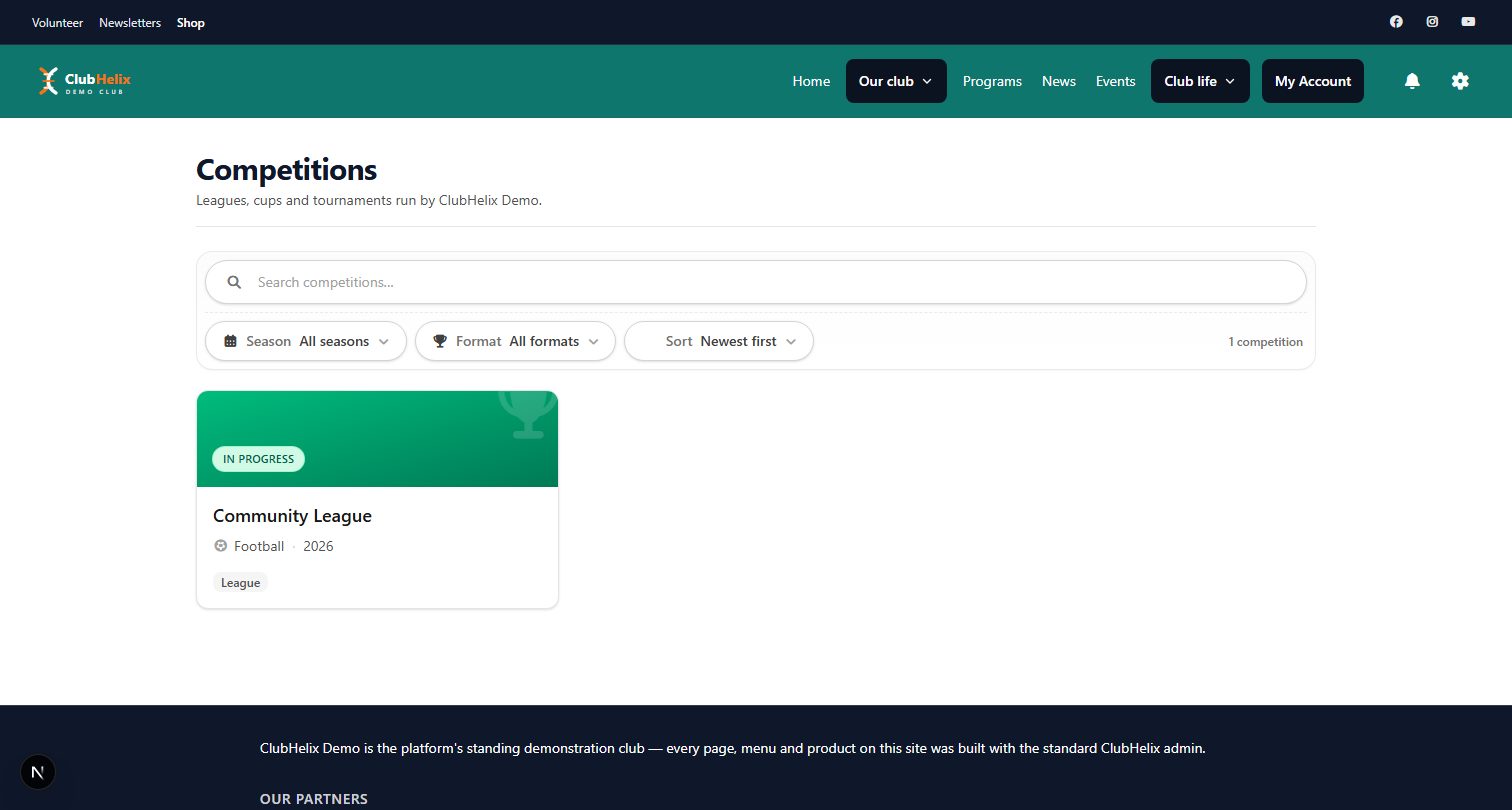
This is the part where most comparison articles pivot to a sales pitch; ours is genuinely a lane clarification. ClubHelix doesn't replace your sport's mandated rails, and doesn't try to. If your NGB runs PlayHQ or GameDay for registrations and competitions, you'll keep using it. What we replace is the duct tape around it: the club's public website — built with a modern canvas page editor on your own domain — plus club-run registrations and payments for the things your NGB doesn't process, events, shop, volunteers, sponsors and member comms in one system. For competitions your club runs itself — internal comps, social leagues, carnivals — we ship full fixtures, ladders and finals with a live match centre. Transparent pricing, free tier, Australian-built and hosted.
The fair statement of limits: ClubHelix has no NGB-mandated distribution deals, so we will never be the platform your national body forces on you — for your sport's official competition data, PlayHQ or GameDay remains the system of record, and clubs typically link or feed that data rather than re-keying it. If GameDay's all-in-one administration already covers everything your club needs and you're happy with the website, you don't need us either. Our fuller write-ups are at /compare (GameDay, and the "club website alongside PlayHQ" case). The revolutioniseSPORT vs GameDay comparison covers the other pairing clubs often shortlist.
Frequently asked questions
What's the actual difference between GameDay and PlayHQ?
Scope. GameDay is a broad sports-administration platform — registrations, payments, national membership databases, clearances, competition management and hosted websites — used across many sports in Australia, New Zealand and the UK. PlayHQ is a focused national competition platform for AFL, cricket, basketball and netball: fixtures, ladders, results and registrations, plus, as of October 2026, a PlayHQ Websites product built from that data and a set of shop, program and communications modules.
How much do GameDay and PlayHQ cost a club?
As at July 2026, GameDay doesn't publish subscription pricing — it's quote-based, and payment processing fees apply on top (exact current rates aren't published clearly enough to quote responsibly). PlayHQ publishes per-registration pricing (checked October 2026): A$10, A$8 or A$6 per registration for registration and competition management depending on volume, or A$7, A$5 or A$4 for registration only, with larger volumes on contact. Processing fees can sit on top; Cricket Australia, for example, documents a 1.49% processing fee added to the participant and 1.80% deducted before funds are disbursed. PlayHQ Websites is a separate yearly subscription with no published price. Check your own sport's fee schedule, because arrangements vary.
Can my club choose PlayHQ instead of GameDay (or vice versa)?
Usually not. Both are adopted at governing-body level — PlayHQ by the national bodies of AFL, cricket, basketball and netball, GameDay by various other national and state bodies — and clubs inherit the decision through their affiliation. The productive committee question is what your sport's platform covers and what the club must still provide itself, not which one to pick.
Does PlayHQ give my club a website?
It can, as a separate purchase. The competition platform gives you public fixture, ladder and results pages, which are the competition's pages rather than yours. PlayHQ Websites (checked October 2026) builds a club site from your PlayHQ data, with a drag-and-drop editor, your own domain for a separate fee or a free subdomain, and registration widgets that hand off to the PlayHQ portal. It's a yearly subscription with no published price, and the site is archived if you cancel. Weigh it against a site you own outright, from an all-in-one club platform or any good website builder, that runs alongside the mandated rails.
We're unhappy with our sport's platform — what can we actually do?
Realistically: raise it through your association or state body (platform decisions get reviewed, and club feedback genuinely feeds those reviews), and meanwhile control what you can control — your club's own website, communications, events and commerce, which don't depend on the NGB's choice. What we'd caution against is a club unilaterally moving its registrations off the mandated pipeline; clearances, insurance and competition eligibility usually flow through it.
More context for your committee: our category guide to the best apps for sports clubs maps the whole landscape, and how to build a sports club website covers the club-side gap in detail. See something outdated or unfair above? Corrections welcome via contact — this page only works if it stays honest.


