
What this guide answers
- Is Spond or TeamSnap cheaper?
On headline price, Spond — its organiser is free with no subscription (the website is a paid add-on), while TeamSnap publishes no prices: single teams are "$0 to start" and clubs and leagues are quoted individually…
- Does TeamSnap work for clubs here?
It functions perfectly well, but it was built for its home market first — expect its own youth-sport vernacular (rosters, dues, divisions), season structures shaped around a northern calendar, and ecosystem features…
- Can Spond replace TeamSnap for a whole club?
For the organising layer — events, availability, messaging, fee collection — largely yes, and at no subscription cost, via its club-level Spond Club layer.
- Do either of these give my club a proper website?
Spond: yes, for a fee — a Club Website add-on for Spond Club with your own domain, at £19 + VAT, A$22 or C$24 a month after a free trial (checked October 2026).
Spond versus TeamSnap is the classic "free challenger versus paid incumbent" match-up in team sport software: a free, polished European organiser against the US brand that practically defined the team-management app category. Search for a comparison and you'll mostly find each company's own marketing or affiliate round-ups ranked by commission. This one is different in a way we should declare immediately: we're ClubHelix, an all-in-one club platform — a third party with our own horse in a nearby race. We'll referee these two fairly on their merits, then tell you honestly where we fit and where we don't.
Everything here is based on public information current as at July 2026, with pricing and websites re-checked against both companies' own pages in October 2026. Both products iterate constantly, so verify anything decision-critical against their own sites before committing — and if you spot an error, let us know and we'll correct it.
What each platform actually is
TeamSnap, from Boulder, Colorado, is the dominant team-management app in its home market: scheduling, availability, messaging, payments and registration, wrapped in native mobile apps with an enormous consumer brand behind it. When we re-checked its pricing page in October 2026 it showed no dollar figures at all: single teams are "$0 to start", and clubs and leagues get TeamSnap ONE on "flexible, customized pricing", so budgeting a club means a sales conversation. What web presence comes with each plan varies, so ask. Around the product sits an ecosystem built for its home market: background-check integration for coaches and volunteers, and a sponsorship advertising network.
Spond, from Oslo, is the European counterweight: a free club and team organiser — events, availability, RSVPs, guardian-safe messaging and payment collection — with native apps that parents genuinely like using, and a club-level admin layer (Spond Club) above the team apps. The organiser carries no subscription; Spond monetises payment processing, its Superdraw fundraising product, in which clubs keep 65% of ticket sales, and a paid Club Website add-on for Spond Club (£19 + VAT, A$22 or C$24 a month after a free trial, checked October 2026). It's dominant in the Nordics and strong across the UK and Europe.
Its presence here is growing steadily but still trails the local incumbents, so adopting it usually means introducing something new rather than standardising on what half your coaches already use.
One vernacular note, since this is a US product versus a Norwegian one: TeamSnap speaks fluent US youth-sports — "rosters" where we'd say team lists, "dues" where we'd say fees or rego, seasons organised the northern way. Spond's language is more neutral and travels better. Neither speaks Australian, but one of them is at least not speaking US youth-sport at you.
Feature-by-feature comparison
Facts drawn from public sources, current as at July 2026; pricing and websites re-checked October 2026.
| Area | Spond | TeamSnap |
|---|---|---|
| Core product | Free team/club organiser app | Team management app; TeamSnap ONE for clubs and leagues |
| Subscription cost | Organiser free; website add-on from A$22/month | "$0 to start" for single teams; clubs/leagues on custom pricing; no figures published |
| Mobile apps | Native apps — the primary interface | Native apps — the primary interface |
| Availability / RSVPs | Best-in-class; the product's calling card | Core feature, long-established |
| Messaging | Guardian-safe messaging, safeguarding polish | Team and club messaging |
| Payments | Free to use; Spond earns on processing | Payments and registration built in |
| Registration | Payment/fee collection focused | Registration is a core strength, especially at club/league level |
| Fundraising | Superdraw — clubs keep 65% of ticket sales | Sponsorship ad network (US-flavoured) |
| Background checks | Not the model — guardian-linked accounts instead | US background-check ecosystem integration |
| Public club website | Paid Spond Club add-on (October 2026) | Varies by plan; ask TeamSnap |
| Home market | Norway; Nordics, UK and Europe | US; Boulder, Colorado |
Pricing, honestly
Spond's organiser is free. There is no subscription for events, availability, messaging or payment collection; the one paid line is the optional Club Website add-on. The company earns on the payment side: processing fees when money moves through the platform, and its share of Superdraw fundraising (the club keeps 65% of ticket sales). For a team that organises through Spond but collects little money in it, the cost is effectively zero.
TeamSnap publishes no prices. Its pricing page (October 2026) says single teams are "$0 to start" and TeamSnap ONE, the club and league product, is on customised pricing, so budgeting requires a sales conversation. That's not a criticism on its own; quote-based pricing is common at club scale. But it is a real difference in how the two companies think: Spond removed the price objection for organising, TeamSnap sells through quotes.
The honest framing: Spond costs you transaction fees; TeamSnap costs you subscription fees (and quotes). Which is cheaper for your club depends entirely on how much money you push through the app versus how many teams you're paying subscriptions for. Do the sums on your actual volumes, not the headline price.

Where Spond wins
- Price, obviously. A free organiser versus a quoted club product. For a volunteer treasurer, that argument writes itself.
- The availability loop. Spond's RSVP and availability flows are, in our honest view, the best in the category — and its massive free adoption across Europe suggests plenty of parents agree.
- Safeguarding-conscious messaging. Guardian-linked accounts and messaging design that junior clubs can adopt without a policy headache. For clubs whose main anxiety is "coaches messaging kids", this is the decisive feature.
- Fundraising that pays the club. Superdraw is a genuine fundraising product with a clear split — the club keeps 65% of ticket sales — rather than an ad network monetising your members' attention.
Where TeamSnap wins
-
Registration and club-scale admin. TeamSnap ONE is a real club/league product: registration, payments and season administration at organisational scale, which is a different job from organising one team's Saturdays.
-
The home-market ecosystem. TeamSnap's background-check integration and sponsorship network are real advantages — in its home market. Neither travels: the screening integrations don't cover your jurisdiction's checks, and the ad network doesn't sell into your market.
-
Brand and longevity. TeamSnap is close to a generic verb for team apps in its home market, and that maturity shows in the product. Locally, though, it's just another name your committee will have to be persuaded to trust — so the brand advantage that makes it a safe default at home is largely absent here.
-
Live streaming in the box. TeamSnap's pricing page lists free, built-in live streaming (checked October 2026). For families who can't make the away game, that's a real extra.
So which should you pick?
Our referee's call:
-
Pick Spond if you're a team or club outside TeamSnap's home market whose priority is the weekly organising loop — availability, RSVPs, safe messaging — at zero subscription cost. For that job, in our view, it's the best product in this article.
-
Pick TeamSnap if your organisation sits inside the youth-sport system it was built for, especially one needing registration and background checks at league scale — that's the market it was built for, and its ecosystem advantages are real there.
-
An Australian club choosing between exactly these two should probably lean Spond on price and neutrality of vernacular — but should also notice that neither is built for Australia, and neither is built around a public website (Spond's is a paid add-on, and TeamSnap's web offering is one to ask about), which for most clubs is the bigger gap. Our guide to a club communication plan is a useful exercise before committing to either.
The third option: an all-in-one club platform
Now our declared interest, kept honest. Both Spond and TeamSnap are team-organiser-shaped: brilliant at the week-to-week, thin-to-absent on the club's public face and whole-of-club administration. ClubHelix approaches from the other direction — an all-in-one club platform where RSVPs and attendance, member chat and team management sit inside the same system as a real public website, member registration, events, competitions, a shop and email — one member database, one bill, with a free tier and transparent pricing (no quote required).
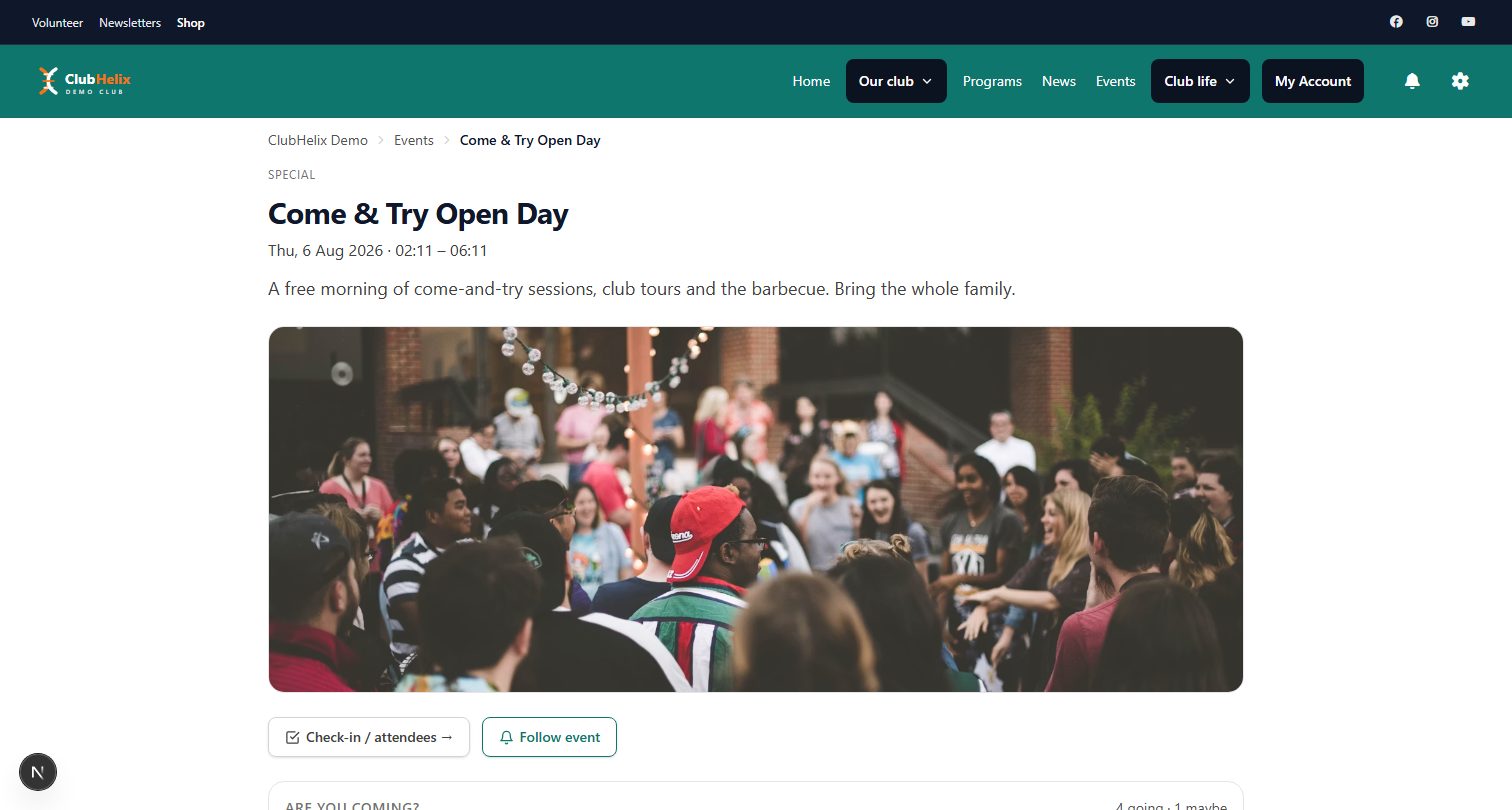
The fair trade-offs, stated plainly: Spond and TeamSnap both ship native app-store apps, while ClubHelix is an installable web app rather than an app-store download; TeamSnap's US background-check ecosystem has no ClubHelix equivalent; and if free team comms is genuinely all you need, Spond's price cannot be argued with. Where ClubHelix wins is when the team app was only ever half the problem — when the club also needs a website that recruits members, registration that feeds a real database, and money that reconciles itself. The direct head-to-heads live at /compare (TeamSnap, Spond).
If this article has told you Spond or TeamSnap is the right fit, pick it happily — both are mature products that sporting families across their home markets use every week. A comparison you can trust is one that's allowed to end that way.
Frequently asked questions
Is Spond or TeamSnap cheaper?
On headline price, Spond — its organiser is free with no subscription (the website is a paid add-on), while TeamSnap publishes no prices: single teams are "$0 to start" and clubs and leagues are quoted individually (both checked October 2026). The full picture depends on payments: Spond earns on processing fees when you collect money through it, so a club moving serious money through Spond should compare its transaction costs against TeamSnap's subscription-plus-processing before calling it.
Does TeamSnap work for clubs here?
It functions perfectly well, but it was built for its home market first — expect its own youth-sport vernacular (rosters, dues, divisions), season structures shaped around a northern calendar, and ecosystem features like background-check integration that simply don't map onto the checks your club actually has to run. Clubs here commonly find Spond's neutral language and free model an easier fit, and neither product removes the need for a real club website.
Can Spond replace TeamSnap for a whole club?
For the organising layer — events, availability, messaging, fee collection — largely yes, and at no subscription cost, via its club-level Spond Club layer. What Spond doesn't replace is club-scale registration workflow depth. On websites, Spond now sells a Club Website add-on for Spond Club, and what TeamSnap includes varies by plan. Clubs that need the public-facing half usually pair either app with a website platform, or consolidate onto an all-in-one club platform.
Do either of these give my club a proper website?
Spond: yes, for a fee — a Club Website add-on for Spond Club with your own domain, at £19 + VAT, A$22 or C$24 a month after a free trial (checked October 2026). TeamSnap: it varies by plan, so ask before you sign. Either way, check whether the site is built around your club or around the team app. If your club's public face is a priority — and for recruiting members it usually should be — you'll need a dedicated solution either way. Start with our guide on how to build a sports club website to scope what you actually need.
Comparing the wider landscape? Our best apps for sports clubs guide covers every category, and if the UK website incumbent is also on your shortlist, read Pitchero vs Spond. Spotted an error above? Corrections welcome via contact — we'd rather be right than flattering.


