
What this guide answers
- Do we need an app for this?
Not necessarily, but you do need one place. Paper rolls work for a single team and fail at club level, because nobody transcribes them.
- What about casual participants and visitors?
Record them as attendances against the session even if they are not members.
- How far back is attendance data useful?
Two seasons gives you a genuine trend. One season gives you the intervention list, which is where most of the value is anyway — you do not need history to see who stopped coming in March.
- Does attendance really predict renewal?
In most clubs, strongly. Test it on your own data before relying on it: take last season's non-renewers and look at their attendance in the final two months.
- Can we use attendance for fee discounts or selection?
You can, and think carefully first. Data collected for one purpose and used for another erodes trust quickly.
A member who is about to leave your club almost never announces it. They stop coming. Then, months later, they do not renew — and the club records that as a renewal problem when it was an attendance problem that nobody was watching.
Attendance is the only routinely available leading indicator a club has. Renewal tells you what already happened; attendance tells you what is about to. It is also the number that funders, insurers and coaches all want for completely different reasons, which makes it unusually good value for the effort.
The catch is that recording it has to cost almost nothing, or it will not happen.
The four reasons to track attendance
1. Retention. A member who has not attended in eight weeks is dramatically more likely to lapse. That is a list you can act on while the season is still running, and it is the highest-value use of attendance data by a distance.
2. Safety and duty of care. Knowing who was present matters when something goes wrong — an incident, an injury, a safeguarding question, or a child not collected. "We think about fifteen kids were there" is not an answer anyone wants to give.
3. Delivery evidence. Funders and councils increasingly ask for participation rather than registration. Sessions delivered and people attending is the difference between "we have 300 members" and "we delivered 96 sessions to an average of 41 participants", which is a far stronger sentence in an application.
4. Coaching and selection. Attendance at training is a fact. Selection conversations built on facts are shorter and calmer than selection conversations built on impressions.
What to record
Less than you think. Four fields cover almost every use:
| Field | Why |
|---|---|
| Who | The member or participant |
| What | Which session, training, fixture or activity |
| When | Date and time |
| Present or absent | And, ideally, apology versus no-show |
That last distinction earns its keep. A member who apologises is engaged; a member who silently does not appear is drifting. Collapsing both into "absent" throws away the most useful signal in the dataset.
Optional extras worth having where they are cheap: arrival time for a session with a safety cut-off, and who marked the roll — useful when a record is later questioned.
Resist adding more. Every extra field is a reason for a coach not to do it.
Capturing it without slowing anyone down
Whatever method you pick, it has to work in under a minute, in the cold, on a phone, by a volunteer who is also setting up cones.
Coach marks the roll. Simplest and most common. A team list on a phone, tap present or absent, done. Works well for training and squads; requires the coach to actually do it, which means it must take seconds.
Self check-in at the door. A QR code on a poster or a kiosk tablet at the entrance. Members scan themselves in. Scales beautifully for open sessions, gyms and clubrooms where no one is holding a team list. The trade-off is that it depends on members remembering.
RSVP plus confirmation. Members RSVP in advance, and the coach confirms who actually turned up. This gives you two useful numbers — intent and actuality — and the gap between them tells you a great deal about how much notice to take of RSVPs when catering.
Derived from the roster. For duties and officiating, the roster already knows who was assigned. Confirming the shift happened is one tap.
Most clubs end up using two of these: a marked roll for teams and self check-in for open sessions. Whatever you choose, put it in one system rather than one per team, or the club-level picture never assembles.
What the numbers tell you
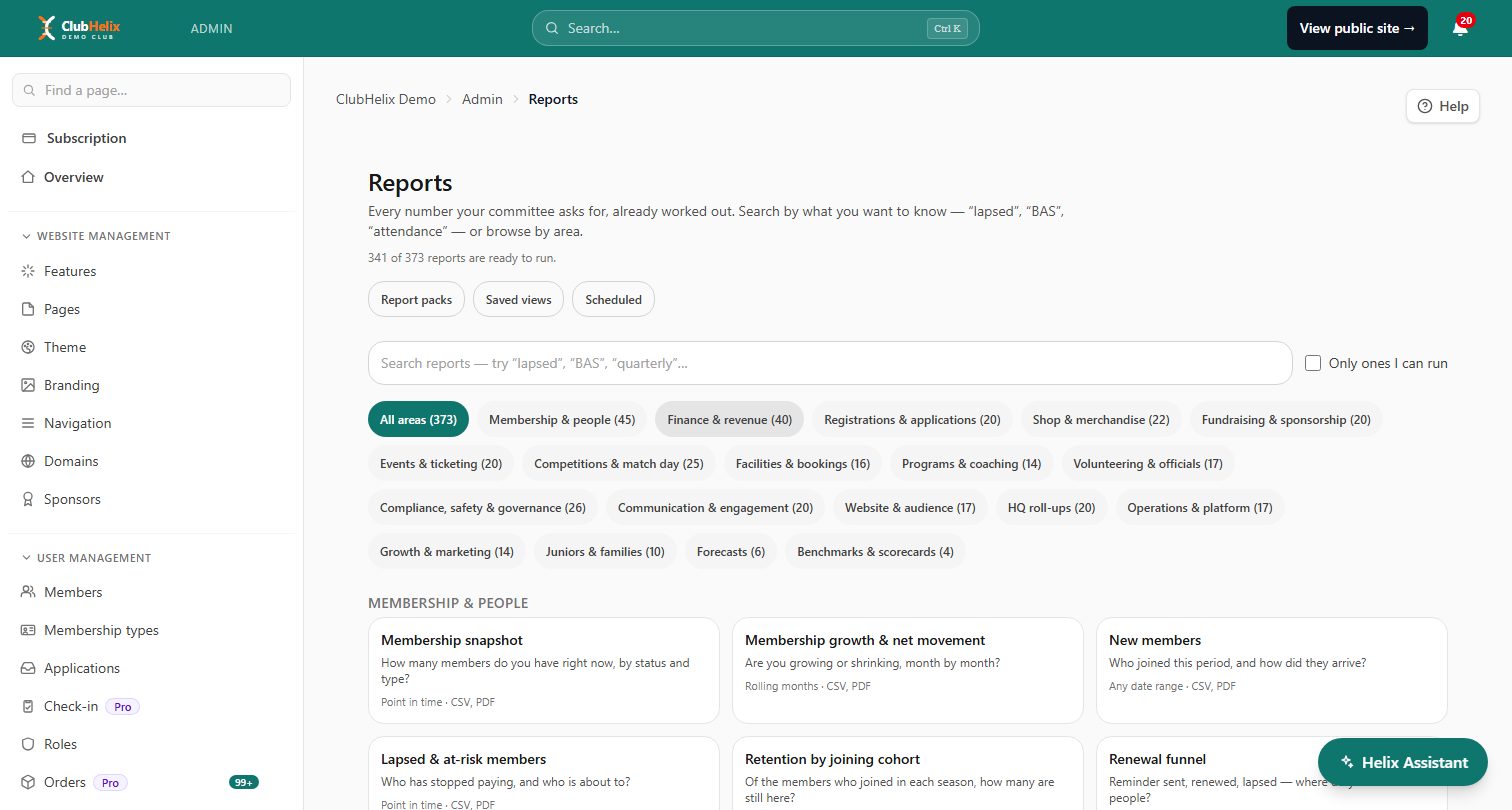
Once you have a season of data, four reports do most of the work.
Participation rate. Members with at least one attendance in the last 60 days, over active members. This is your club's real size, as opposed to its roster size. Most clubs are startled the first time they see it.
Attendance trend by session. Which nights are holding and which are fading. A Thursday session that has drifted from 22 to 9 over eight weeks is a decision waiting to be made, and it is invisible in a headcount.
Members with no recent attendance. The intervention list. A short, specific message to someone who has missed four weeks — from their coach, not from the club generally — recovers members at a rate no renewal campaign matches.
Sessions delivered. The denominator for everything above, and the figure funding acquittals ask for.
Pair the participation rate with cohort retention and the causal story becomes visible: attendance falls, then renewal falls, in that order, with a lag of a season or so. Once you have seen that in your own data, the case for acting on attendance stops needing to be argued.

Attendance and children
Two points that matter more than the analytics.
Records involving children need care. Attendance data about juniors is personal information about minors. Collect only what you need, restrict who can see it, and be clear in your privacy notice about why you hold it. Coaches should see their own squad, not the whole club.
Sign-in and sign-out is a different thing. If your club has a duty-of-care obligation for children between arrival and collection, that requires a deliberate process — often a physical or supervised one — rather than an analytics feature. Do not let a convenient attendance tool become the club's answer to a safeguarding question it was not designed for.
Getting a club to actually do it
The pattern that works is not enthusiasm. It is:
- Start with one squad or one session. Prove it takes under a minute. A coach who has done it four times will keep doing it.
- Show the coach something useful within a month. Their own squad's attendance trend. If the data only ever flows upward to the committee, the person entering it correctly concludes it is admin.
- Make it the same everywhere. Two teams using different apps produces no club-level picture at all.
- Put the participation rate in the committee pack. Once it is a standing item, it stops being optional.
- Never use it punitively. The fastest way to kill attendance data is for the first visible use of it to be a selection dispute or a fee argument.
Six months of consistent attendance data changes what a club can see about itself. Two years of it changes what a club can prove to a funder.
Frequently asked questions
Do we need an app for this?
Not necessarily, but you do need one place. Paper rolls work for a single team and fail at club level, because nobody transcribes them. The requirement is that every squad records into the same system, however simple.
What about casual participants and visitors?
Record them as attendances against the session even if they are not members. That is exactly the number a funder means by participation, and it is also the group your recruitment should be following up.
How far back is attendance data useful?
Two seasons gives you a genuine trend. One season gives you the intervention list, which is where most of the value is anyway — you do not need history to see who stopped coming in March.
Does attendance really predict renewal?
In most clubs, strongly. Test it on your own data before relying on it: take last season's non-renewers and look at their attendance in the final two months. The pattern is usually unmistakable, and seeing it in your own numbers persuades a committee in a way general claims never will.
Can we use attendance for fee discounts or selection?
You can, and think carefully first. Data collected for one purpose and used for another erodes trust quickly. If attendance will inform selection, say so up front in the team selection policy rather than revealing it in a dispute.


