
What this guide answers
- Can a club stop someone attending its games?
Generally a club, together with whoever owns or controls the venue, can set conditions of entry and direct a person who breaches them to leave, and can exclude repeat offenders from future events.
- What is the difference between a spectator code and a player code?
Players and coaches are members who agreed to their code at registration, so a breach runs through the club's member disciplinary process.
- Who should enforce the code on match day?
A named duty officer for every home fixture, identifiable by a vest, supported by a second adult when a conversation is heated, and never a match official or a coach — both are already occupied and already emotionally…
- What should happen if a spectator racially abuses a player or official?
Treat it as the most serious category, outside the graduated ladder — immediate removal from the venue, a written record made the same day, a report to the competition or governing body through their prescribed process…
- How do we make sure people have actually seen the code?
Publish it in more than one place and capture agreement where you can — a policy page on the website, a required acknowledgement in the registration flow, a line in the conditions on event tickets, short-form signage…
UK edition. This guide is written for volunteer-run clubs in the UK. Where rules differ — grants, tax, incorporation, safeguarding — follow the UK-specific pointers below or check with your national body.
It is an under-13s game on a Saturday morning. The official is fifteen years old and in their fourth match ever. A man on the sideline — nobody is quite sure whose father he is, and it turns out he is somebody's uncle — has been commenting on every decision for twenty minutes, and has just crossed from commentary into something worse. Three parents look at each other. Nobody moves, because nobody knows whether they are allowed to, or what they would say, or whether the club would back them if it went badly.
That paralysis is the actual problem, and a spectator code fixes it — not by changing anyone's personality, but by giving an ordinary volunteer a sentence to say and an obvious right to say it. The code is written for the ninety seconds before the situation becomes an incident, and its readers are not really the badly behaved. They are the duty officer, the team manager and the committee member who need to know the club has already decided what happens next.
A spectator code also has to be built differently from the codes you write for players and coaches, for one structural reason: a spectator has not signed anything. They are not a member, they may not be related to anyone on your list, and no membership contract binds them. Your authority over them comes from somewhere else entirely — from the conditions on which people are admitted to the venue. Get that distinction right and the policy holds up under pressure. Get it wrong and you have a document that reads well and does nothing. This guide gives you the full copy-paste code, a short version for signage, a clause for visiting clubs, scripts for the person who has to act, the enforcement ladder from quiet word to governing-body referral, and the publication plan that makes it stick. Its companion, player code of conduct template, covers the member-facing codes for players, parents and coaches.
General information only. This is a starting point for community clubs, not legal advice. What a club may enforce depends on your venue agreement, your governing body's rules and the law where you operate, and serious matters — discriminatory abuse, threats, anything involving a child's safety — carry obligations well beyond a club policy. Confirm the specifics with your governing body, your venue owner and, where needed, an adviser.
Why a spectator code is a different document
Four groups stand on the same sideline, and the club's power over each of them comes from a different place. This is the table worth showing your committee, because it explains why a single "code of conduct" pinned to the wall does not cover the field.
| Who | What binds them | Where the club's authority comes from | What the club can realistically do |
|---|---|---|---|
| Players and coaches | Membership and the codes agreed at registration | The membership relationship and your constitution | Warn, suspend, refer, terminate membership |
| Parents of junior members | The parent code agreed when they enrolled the child | The membership relationship, via their child's enrolment | Warn, exclude from venue, review the enrolment |
| Your own supporters | Nothing signed, unless they are also members | Conditions of entry to the venue, and your venue agreement | Direct them to leave, exclude from future events |
| Visiting supporters | Nothing signed, and no relationship with your club at all | Conditions of entry, plus the visiting club's own obligations to your competition | Direct them to leave, report to the visiting club and the competition |
The practical consequences are worth stating plainly. First, your code must be published as a condition of entry rather than as a membership rule — that is what gives a duty officer the standing to ask someone to leave. Second, the sanction that actually works against a non-member is exclusion from the venue, not a disciplinary process. Third, for visiting supporters the real lever is not your club at all; it is the visiting club and the competition, both of which have obligations your code should reference explicitly.
The spectator code of conduct — full template
Adapt the bracketed parts, take it to a committee meeting, minute the adoption with a version date, and publish it in every place listed later in this guide.
[Club Name] Spectator Code of Conduct
Version [1.0], adopted [date] by the [Club Name] committee. Review annually.
Where this applies. This code applies to every person attending a [Club Name] training session, match, event or facility, whether or not they are a member of the club — including parents, family members, friends, visiting supporters and members of the public. Entry to [Club Name] venues and events is on the condition that you accept this code.
What we expect of you. At [Club Name] venues and events you will:
- Support positively. Encourage effort and good play from both teams. Applause, not instruction.
- Leave the coaching to the coach and the officiating to the official. One voice guides a team, and it is not yours from the fence.
- Respect match officials without exception. Many are volunteers, and many are teenagers. Do not question, approach, follow or comment on an official before, during or after a match. Concerns go to the club through the process below.
- Never abuse, threaten, ridicule or intimidate any player, official, coach, volunteer or other spectator — in person or online, during the match or afterwards.
- Use no discriminatory language or behaviour of any kind, including on the basis of race, religion, ethnicity, disability, gender, sexuality, age or background. This is treated as the most serious breach in this code and carries the shortest path to exclusion.
- Stay off the playing area and out of team benches, technical areas, change rooms and officials' areas at all times, including before and after play.
- Supervise the children in your care, including younger siblings, and keep them off the playing area and away from equipment.
- Follow venue rules on alcohol, smoking and vaping, and do not attend in a state that affects your behaviour toward others.
- Respect the venue — park lawfully, use the bins, keep dogs where the venue allows them and on a lead, and leave the area as you found it.
- Photograph and film responsibly. Do not photograph or film other people's children without the consent of their parent or guardian, and do not post images of junior players in a way that identifies them without consent.
- Follow any reasonable direction from a club official, duty officer, ground official or venue staff member. Officials will identify themselves.
- Raise concerns through the club, using the process in this document, rather than at the coach on the sideline, at an official after the match, in a team group chat or on social media.
What we will do. [Club Name] will make this code visible at our venues and online, brief our duty officials on how to apply it, apply it consistently to our own supporters as strictly as to visitors, respond to reports within our published process, and support any volunteer who acts under it in good faith.
If you breach this code. A club official may ask you to change your behaviour, and may direct you to leave the venue. Serious breaches may result in exclusion from club venues and events for a defined period, referral to the competition or governing body, and — where conduct may be criminal — a report to the police. Where the person is also a member of the club, the club's member disciplinary process applies in addition.
Raising a concern. Report conduct that breaches this code to the duty official on the day, or afterwards to [role and contact]. Reports are recorded, the person complained about is told what is alleged and given a chance to respond before any formal sanction, and the outcome is communicated to the person who reported it as far as privacy allows.
The short version for signage and match programs
Long policies do not fit on a fence. Publish this condensed version at the gate, in the program and on your event pages — it does the work of putting people on notice, with the full document a link away.
[Club Name] — conditions of entry
Entry to this venue is on the condition that you support positively, respect match officials and volunteers absolutely, use no abusive or discriminatory language, stay off the playing area, supervise children in your care, and follow any reasonable direction from a club official. Club officials may direct any person breaching these conditions to leave. Our full spectator code of conduct is at [club website address].
Six lines, one address, no ambiguity. Put it at every entrance, at the canteen or refreshment point where people queue, and on the back of the team sheet.

Visiting clubs, away games and the mutual obligation
Most sideline incidents in community sport involve two clubs, and the club that handles them best is the one that made contact before the game rather than after it.
Send a fixture note to the visiting club in the week of the match. Four lines, sent by the team manager, doing more work than it looks like it does:
"Looking forward to Saturday. A few practical notes — parking is on [street], the canteen opens at [time], and our duty officer on the day is [name] in a [colour] vest. Our conditions of entry apply to all spectators at our venue and are on our website at [address]. If anything comes up on the day, please come to our duty officer rather than to the officials or the opposition sideline, and we will do the same at your ground."
That last sentence is the mutual obligation, and it changes the dynamic. You are not policing their supporters; you are agreeing a channel with a peer club, in writing, before anyone is upset.
Brief your own supporters before away games. Your code follows your people to other venues — say so in the code itself and repeat it in the message that goes out with away fixtures. Nothing damages a club's standing in a competition faster than travelling supporters, because you are not there to manage them and the host club has no relationship with them.
Know the reporting path. When a visiting supporter's conduct crosses a line, three things happen in order: the duty officer deals with the immediate situation at the venue, the club writes it up the same weekend, and the club reports it to the visiting club and to the competition through whatever mechanism your competition specifies. Do not skip the middle step — a written record made within forty-eight hours is worth ten times a recollection three weeks later at a hearing.
Discipline generally runs through your county association or league, which will have a prescribed misconduct report form and a strict deadline after the fixture. Most national governing bodies operate reporting routes for discriminatory abuse that sit above the county process, and several run confidential reporting lines. Know which route applies to which category of incident before the season starts, because the deadlines are short and unforgiving.
The people who apply it — duty officers and scripts
A policy with no named person is a policy with no effect. Roster a duty officer for every home fixture — one named adult, identifiable by a coloured vest, whose job for the day is the venue rather than a team.
Three rules make the role workable. The duty officer never approaches alone if the situation is heated — a second adult stands within a few metres. They never touch anyone. And they never argue the merits of a refereeing decision, because that is not the conversation.
What they say matters more than what they are entitled to do, so give them the words. Practise these once at a pre-season briefing and they come out calmly on the day.
First approach, quiet and private, from beside rather than in front:
"Morning — I'm [name], I'm the duty officer today. I need to ask you to keep the comments off the referee. He's fifteen and it's his fourth game. Are we good?"
Second approach, if it continues:
"I asked once already, so this is the formal one. Our conditions of entry cover this, and they're on the fence behind you. If it happens again I'll have to ask you to leave the ground. I'd much rather you stayed and watched the game."
Removal:
"I'm asking you to leave the venue now. This isn't a discussion and I'm not going to debate the incident with you. If you'd like to raise something with the club, email [address] and it will be looked at properly. If you don't leave, I'll ask the venue to deal with it."
Immediately, for discriminatory abuse or a threat — no ladder, no warning:
"You need to leave the venue now. That language is reportable and I will be reporting it. The club will be in touch, and so may the competition."
Then, either way, the duty officer writes it down before they go home. Ten lines while it is fresh — time, location, who was involved, exactly what was said as closely as they can recall it, who else saw it, what the officer did and what happened next. Our incident report form template covers the fields, and logging it through incident reporting rather than a text message means the record has a timestamp, an author and a follow-up owner instead of vanishing into a phone.
Vernacular varies, so write the code in the words your members use — the touchline, the clubhouse, the committee, the ground. If your venue is owned by the local authority or held on a lease, check the clause covering directions to leave, because it is often the venue owner's power that a duty officer is ultimately exercising on the club's behalf.
The enforcement ladder — warning to tribunal referral
Predictability is what makes enforcement survivable. Publish the ladder inside the code so nobody can claim the club invented a sanction on the spot.
| Step | Who decides | What is recorded | What the person is told |
|---|---|---|---|
| 1. Quiet word | Duty officer or team manager | A one-line note if it stops there | What specifically needs to change, and that it is a first ask |
| 2. Formal on-day warning | Duty officer | Incident record with time, words used and witnesses | That this is the formal warning and the next step is removal |
| 3. Directed to leave | Duty officer | Incident record completed the same day | To leave now, and how to contact the club afterwards |
| 4. Exclusion for a period | Committee, in writing | Decision, reasons, dates, and the person's response | The allegation, a chance to respond, then the decision and its length |
| 5. Referral upward | Committee, via the set process | The competition's own report form, filed by its deadline | That the matter has been referred and by whom |
Three carve-outs sit outside the ladder and should be printed alongside it. Discriminatory abuse and threats start at step three or four, never at step one. Anything that may be criminal — assault, threats to a person's safety — is a police matter first and a club matter afterwards. And anything touching a child's safety leaves this process entirely and goes to your club's child-safeguarding process and the relevant authority, immediately and regardless of who is involved.
Two fairness rules protect the club as much as the person. Before any sanction beyond a removal on the day, the person is told the specific allegation and given a genuine chance to respond — in writing is fine. And the decision-maker at step four must not be the person who was involved in the incident; if the duty officer was abused, someone else decides the exclusion. Minute the decision, the reasons and the period, and store it with your other governance records — governance and meeting records keep the adopted version of the code, the minutes and the decision in one place, which is exactly what an appeal or a governing-body query will ask to see.
Publishing it so nobody can say they never saw it
This is the step that decides whether the document does anything, and it is the one clubs skip. A code that lives in a policy folder gives a duty officer nothing to point at. Six placements cover every audience.
| Placement | Who it reaches | How |
|---|---|---|
| A policy page on the club website | Everyone, permanently, and searchable | One page per policy with a version date, linked from the footer |
| An acknowledgement in the registration flow | Every member and every junior parent | A required tick at sign-up, recorded against the person |
| Conditions of entry on tickets and event pages | Anyone attending a ticketed event | A line in the terms shown before payment, and on the confirmation |
| Signage at every entrance and the refreshment point | Casual and visiting spectators | The short version, weatherproof, at eye height where people already stop |
| A pre-match note to visiting clubs | Opposition supporters | The four-line fixture note, sent by the team manager each home game |
| A pre-season briefing for coaches and managers | The people who will apply it | Fifteen minutes, with the scripts practised out loud |
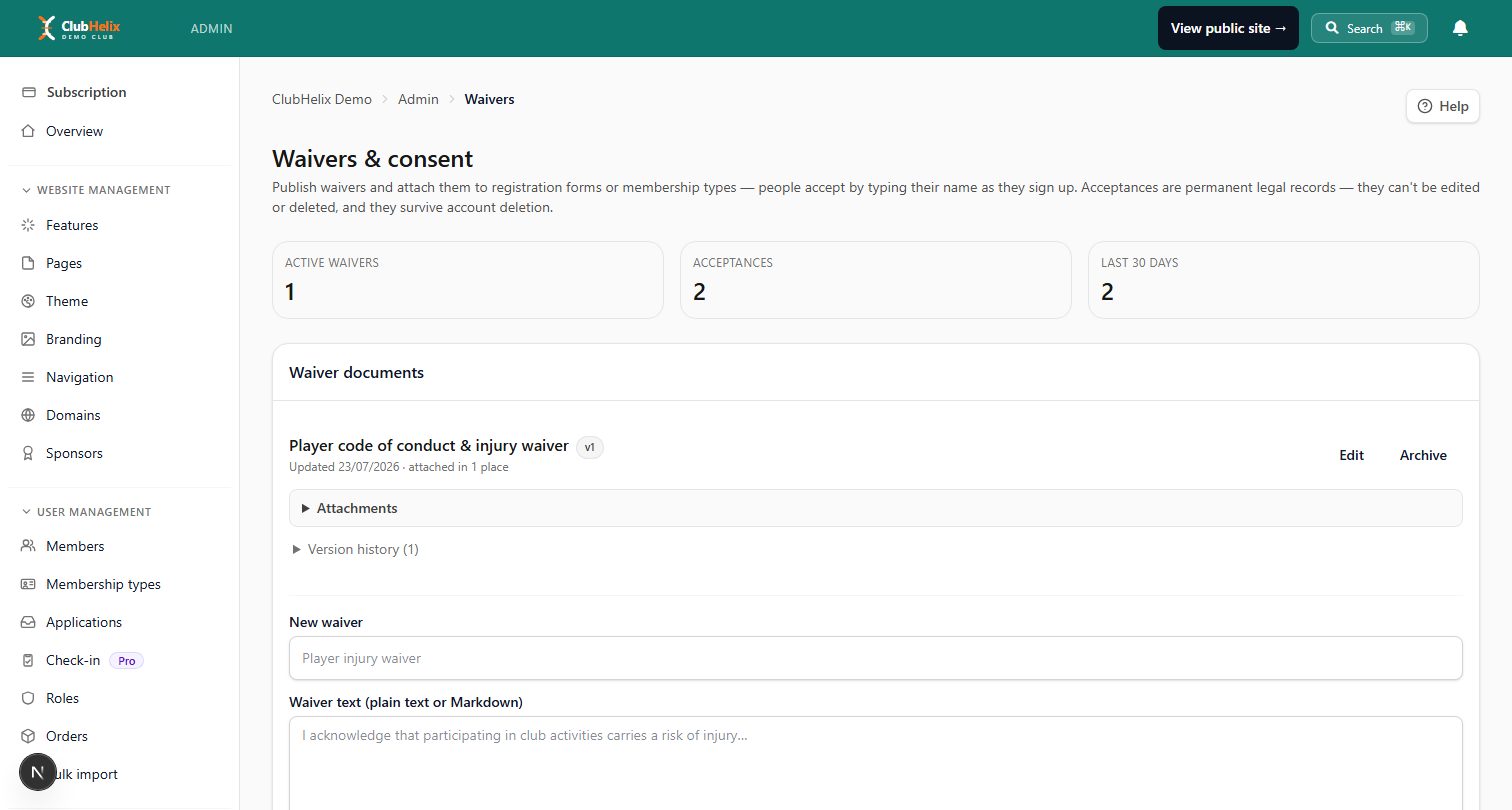
The registration acknowledgement is the highest-leverage of the six, because it converts a policy into something a specific person agreed to on a specific date. Building the code into online registration means every member and every junior parent has ticked it before they paid, and using digital waivers for event entry and casual attendance gives you the same record for people who are not members at all. That record is what turns "the club has a policy" into "you agreed to this on 4 March", which is a very different conversation.
Two habits keep it alive after publication. Announce it before finals and at any fixture with history — thirty seconds over the microphone before the first match, in the same words every time. And re-adopt the code annually at a committee meeting with a fresh version date, even when nothing changes, so there is never an argument about which version was in force.
Making the paperwork the easy part
Everything in this guide reduces to a handful of records that must exist before you need them — an adopted, version-dated policy; an acknowledgement against each member and parent; an entry condition on every ticket; and an incident record written the same day by the person who was there. ClubHelix keeps those together on your own club site, with digital waivers and registration acknowledgements capturing agreement, incident reporting capturing what happened with a timestamp and an owner, and governance records holding the adopted version and the minutes behind it.
You can set that up on the free tier and never pay a cent, the pricing if you outgrow it is published rather than quoted, and the whole thing is built and hosted by a small team who have sat on committees themselves. If your club's policies currently live in a shared folder nobody can find on a Saturday morning, build your club's site and give your duty officer something to point at.
Frequently asked questions
Can a club stop someone attending its games?
Generally a club, together with whoever owns or controls the venue, can set conditions of entry and direct a person who breaches them to leave, and can exclude repeat offenders from future events. The power comes from the venue and the conditions of entry rather than from membership, which is why publishing the conditions at the entrance matters so much. Check your venue agreement and your governing body's rules for the specifics before you rely on it.
What is the difference between a spectator code and a player code?
Players and coaches are members who agreed to their code at registration, so a breach runs through the club's member disciplinary process. Spectators may have agreed to nothing and may have no connection to the club, so the code has to operate as a condition of entry and the practical sanction is exclusion from the venue rather than a disciplinary hearing. Clubs need both documents, written differently.
Who should enforce the code on match day?
A named duty officer for every home fixture, identifiable by a vest, supported by a second adult when a conversation is heated, and never a match official or a coach — both are already occupied and already emotionally involved. Give the duty officer prepared words for the first approach, the formal warning and the removal, and make it clear the committee will back a volunteer who acts in good faith.
What should happen if a spectator racially abuses a player or official?
Treat it as the most serious category, outside the graduated ladder — immediate removal from the venue, a written record made the same day, a report to the competition or governing body through their prescribed process and deadline, and consideration of a police report where the conduct may be criminal. Support the person targeted first and ask what they want to happen, and never leave them to make the report alone.
How do we make sure people have actually seen the code?
Publish it in more than one place and capture agreement where you can — a policy page on the website, a required acknowledgement in the registration flow, a line in the conditions on event tickets, short-form signage at every entrance, a note to visiting clubs each home game, and a pre-season briefing for coaches and managers. The recorded acknowledgement is the one that ends arguments about whether someone knew.
Keep reading — player code of conduct template for the member-facing codes, and incident report form template for the record that makes a decision defensible.

