
What this guide answers
- What equipment does a lacrosse club need to provide?
At minimum, enough complete sets for the largest group of brand-new players you expect at once, plus goalkeeping kit.
- How do you run a club gear pool?
Buy in cohorts so kit ages and gets replaced together, number every item, grade condition as A, B or C so match kit and clinic kit are separated, and keep a loan register showing who has what and when it is due back.
- How do clubs recruit juniors into lacrosse?
School clinics are the most reliable route, because families rarely go looking for a sport their children have never seen.
- How much does it cost to start playing lacrosse?
It depends heavily on the discipline. The women's field game requires far less protective equipment than the men's game or the indoor game, so it is substantially cheaper to enter.
- How does a small club find enough umpires?
Grow them. Recruit from your own juniors at fifteen or sixteen, pay for their accreditation course out of club funds, pay them promptly, never let them officiate alone, and put a club adult on the sideline to handle…
Ask a lacrosse committee what limits the club and you will get an honest, unglamorous answer: the crate in the shed. Not the coaching, not the ground, not the fixture — the number of working helmets, gloves and sticks the club can put in the hands of someone who has never played. Almost every other community sport can absorb a curious newcomer for the price of a mouthguard. Lacrosse asks for a full kit bag before a first training session, and that single fact shapes everything about how a lacrosse club grows.
Which means the two things most clubs treat as side projects — the gear pool and the school program — are actually the strategy. A club with sixty sets of loanable kit and three schools running a term of lacrosse each year will grow. A club with a great senior side, a beautiful ground and eleven usable helmets will not, however well it plays.
This guide is for the committee of a community lacrosse club, senior or junior, field or box. It covers costing and running a gear pool including the loan agreement, building juniors out of school clinics and converting them into members, sharing a ground with other tenants, and growing umpires from inside the club rather than hoping the association sends some. Figures used are illustrative planning examples, not benchmarks — price your own market before budgeting.
What it costs to put one new player on the field
Before you can design a gear pool you need to know what a full set actually is, and it differs sharply by discipline. Equipment rules are set by your governing body and do change, so treat this as the shape of the problem and confirm the current mandatory list before you buy anything.
| Item | Women's field | Men's field | Box / indoor | Goalkeeper |
|---|---|---|---|---|
| Stick | Required | Required | Required | Specialised head |
| Mouthguard | Required, personal | Required, personal | Required, personal | Required, personal |
| Eyewear / helmet | Eye protection | Helmet with facemask | Helmet with facemask | Helmet with throat guard |
| Gloves | Optional, common | Required | Required, heavier | Required |
| Arm protection | Not typical | Arm pads | Arm pads | Optional |
| Shoulder / chest | Not typical | Shoulder pads | Shoulder pads, ribs | Chest protector |
| Footwear | Boots or turf shoes | Boots or turf shoes | Court shoes | As per surface |
Two consequences fall straight out of that table. First, the women's game is dramatically cheaper to start someone in, which is why many clubs' fastest growth comes from the women's and girls' side even when their history is in the men's game. Second, goalkeepers are expensive and scarce, so club-owned goalkeeping kit is non-negotiable — no family should have to buy a chest protector to find out whether their child likes standing in front of shots.
The personal-items line matters too. Mouthguards are personal and cheap; everything else can and should be club property in the first season. A club that says "borrow everything except a mouthguard for your first year" removes the entire financial objection from a family's decision.
As a planning figure, a complete men's field set bought new commonly lands somewhere between $600 and $1,100, a women's field set between $180 and $400, and a full goalkeeper set between $700 and $1,400. Buying a pool of ten sets in one order will usually beat retail meaningfully, so pool your purchases with neighbouring clubs where you can.
Building a gear pool that actually survives
A gear pool is a small library with a maintenance problem. Treat it like one.
Buy in cohorts, not in dribs and drabs. Ten sets bought together are cheaper, arrive matched, wear out together and can be replaced together. Kit acquired one bargain at a time becomes an unmanageable mixture of sizes and standards that nobody can allocate quickly on registration night.
Size the pool to your intake, not your membership. You need enough for the largest group of brand-new players you expect at once — a school clinic squad, a come-and-try day, a first-year junior team — plus a working margin for breakages. Existing players buy their own gear within a season or two.
Grade every item A, B or C. A-grade goes to match days and to visiting players you are trying to impress. B-grade is the training pool. C-grade is for clinics and taster sessions, where wear is heaviest and the standard demanded is lowest. Nothing goes back into circulation ungraded.
Quarantine properly. Have a physical bin marked "do not use" for anything with a cracked shell, a failed strap or a suspect helmet. Kit that is "probably fine" always finds its way back onto a child unless there is somewhere else for it to go.
Number everything and photograph the pool once a year. A paint-pen number on each helmet and a tag on each stick turns "we think we're missing a few" into a countable fact.

The loan agreement — what it needs to say
Season-long loans need something in writing, and it does not need to be legalistic. A single page covering these points is enough:
- The items, listed with their numbers and their condition grade at issue.
- The period — issue date and the date they must come back, which should be a specific club event, not "the end of the season".
- The condition — return in the condition issued, fair wear excepted.
- Damage — report it, do not repair it yourself; the club decides what gets fixed and what gets retired.
- Loss — a stated replacement value per item, agreed at issue rather than argued about in October.
- A bond or a card authority, if your club takes one, and exactly what triggers it.
- Safety acknowledgement — the borrower agrees not to modify protective equipment.
Collect it as a form at registration rather than a clipboard on the night, and store the signed version against the member's record so any committee member can find it. Our club equipment register template is a sensible starting shape for the underlying list.
Budgeting so the pool never collapses at once
The failure mode is predictable: a club buys thirty sets in a grant year, uses them hard for five years, and then faces the entire replacement bill in one season with no reserve. Avoid it with two habits.
Set a working life per category — helmets shortest, sticks and gloves in the middle, protective padding longer — and put one year's share of the replacement cost into the budget every year whether or not you spend it. Then stagger purchases so no more than about a third of the pool ages together, even if that means buying eight sets a year rather than twenty-four every three.
Add a small gear levy to junior registration rather than fundraising for equipment separately. Families accept an equipment component in a registration fee far more readily than a separate appeal, and it makes the pool self-funding.
Building juniors out of school clinics
School programs are the only reliable junior pipeline most lacrosse clubs will ever have, because families do not go looking for a sport their children have never seen. The clinic is a recruitment mechanism disguised as a PE lesson, and it works when it is designed to convert.
A clinic that converts
A four-session in-school block, one session a week, run by two club coaches:
| Session | Focus | Conversion move |
|---|---|---|
| 1 | Cradling, scooping, catch and throw at pace | Names collected; every child holds a stick within a minute |
| 2 | Small-sided games, no contact | Club flyer home with the after-school session time |
| 3 | Shooting, goalkeeping try-outs | Talent-spotted keepers invited personally |
| 4 | Class tournament, club coaches in club kit | Free two-week trial offer with the joining link on it |
Five practical rules make the difference between a clinic that fills your under-13s and one that is a pleasant afternoon:
- Use soft-stick or modified equipment for the school block. It removes the entire safety approval conversation and lets a teacher run follow-up sessions themselves.
- Take enough sticks for a full class, not for a demonstration group. Children watching are children lost.
- Bring the coach who will run the junior session, so a child arriving at the club sees a face they know.
- Give the teacher something to keep — a session plan, a rules card and a contact who will answer.
- Make the offer specific and dated. "Come along sometime" converts nobody; "Tuesday at 4:30, first two sessions free, all gear provided, here is the link" converts.
School access usually runs through the physical education staff and the school's sport coordinator, with a term's notice needed to get into the timetable. Interschool competition through the local school sport association is the natural next step after a clinic block, and a club that offers to run the officiating for a school gala day gets invited back.
The handover from clinic to club
The gap between "loved the clinic" and "joined the club" is where lacrosse programs leak. Close it deliberately:
- Capture contact details at the school, with the school's consent and the right permissions, rather than hoping a flyer survives a schoolbag.
- Run the first club session within two weeks of the clinic ending, while it is still fresh.
- Have someone whose only job that night is greeting new families, checking gear out and pairing children with a buddy.
- Send a follow-up to every family who came once and not twice. That single message recovers more players than any advertising a small club can afford.
- Track the funnel — clinic participants, trial attendees, registered members — so you can tell which schools are worth returning to. Our guide on increasing junior participation goes deeper on the pipeline, and how to start a junior program covers ratios and supervision.
Sharing a ground without losing it
Very few lacrosse clubs have a ground to themselves. Most are a secondary tenant on a surface owned by a council, a school or a bigger club, and the tenancy is more fragile than it looks.
Get these in writing before the season:
- Training and match slots for the whole season, including finals dates and any carnival you host.
- Goal storage. Lacrosse goals are bulky, get borrowed, and disappear. Lockable storage or a chained anchor point is worth negotiating hard for.
- Line marking responsibility. Lacrosse markings rarely coincide with the primary tenant's, so agree who marks, who pays and what the primary tenant will tolerate being painted on their surface.
- Ball containment. Hard balls, high shot speeds and neighbouring properties are a genuine risk. Netting behind goals is often the condition on which everything else depends.
- Wet-weather decision rights. Know who decides the ground is unfit, by when, and how that decision reaches your members. A wet weather communication plan that is written down beats a frantic morning of phone calls.
Most clubs sit on council-owned grounds shared with winter football codes and summer cricket, which means your season is squeezed at both ends and your line markings are always somebody's second priority. Build the relationship with the ground's primary tenant, not just the council — in practice they decide whether your goals stay up midweek.
Growing your own umpires
Officiating shortages cancel more junior lacrosse than weather does, and no association will solve it for you. Clubs that treat umpire development as a program rather than a favour end up with a pool.
A workable pathway:
- Recruit from your own juniors at fifteen or sixteen. They already know the rules and they want the money.
- Pay them properly and pay them promptly. A teenager who has to chase a payment for six weeks does not come back.
- Never let a junior umpire stand alone. Pair them with an experienced official or a designated club adult who handles sideline behaviour so the young umpire only has to referee.
- Publish an umpire code of conduct for spectators and have a committee member enforce it. This is the single biggest reason young officials quit.
- Roster them like players, with availability collected in advance rather than by text message on Friday night.
- Run one club rules night a year for coaches, parents and players. Most sideline abuse is genuinely people not knowing the rule.
Fund the accreditation courses out of club funds and treat it as recruitment spending, because it is. Six trained umpires is the difference between a junior competition that runs and one that folds.
The committee calendar and the volunteer load
Lacrosse clubs are usually small, which means the same six people do everything. The fix is to slice roles small and give each one a defined season rather than an open-ended commitment.
| Role | Peak period | The actual job |
|---|---|---|
| Gear officer | Pre-season and end of year | Issue, collect, grade, repair, order |
| School program lead | Term blocks | Book schools, run clinics, hand over to junior coaches |
| Junior coordinator | Whole season | Teams, coaches, parent communication |
| Umpire coordinator | Whole season | Recruit, roster, mentor, pay |
| Ground liaison | Pre-season, wet weeks | Bookings, storage, marking, cancellations |
| Registrar | Registration window | Memberships, payments, eligibility, team lists |
Recruiting for those roles is easier when the ask is bounded — "run four school clinics in term two" gets a yes far more often than "join the committee". Our guide on recruiting club volunteers has the playbook, and a volunteer roster that shows the gaps publicly does more to fill them than any appeal at a general meeting.
Clubs affiliate through their state association to the national body, and the safeguarding baseline for anyone working with juniors is the Working with Children Check or its state equivalent, alongside child safe standards — see WWCC requirements for clubs. For equipment purchases, state sport and recreation grants and local council community rounds are the realistic funding sources; our grants for sports clubs guide covers what selection panels look for.
This is general information rather than legal advice — confirm current requirements with your governing body and the relevant authority where you play.
Money that goes where the barrier is
Lacrosse fundraising works best when the ask is concrete, because "help fund the club" is abstract and "help us put ten more children in helmets" is not. Three approaches that suit the sport's particular problem:
- Sponsor a kit set. A local business funds one numbered set for a season and gets named on the club site and in the presentation night program. It is a small enough number that a suburban business can say yes, and it scales one set at a time.
- Run a pre-season gear swap where outgrown kit is sold or donated back to the pool. It costs nothing, restocks the middle sizes and gets families into the clubrooms before the season starts.
- Charge visiting programs at cost, not free. If schools and community groups borrow your pool, a modest hire fee funds its replacement and makes the arrangement sustainable rather than resented.
For the wider sponsorship conversation, how to get sponsors for a sports club covers what businesses actually want in return.
Running the club from one place
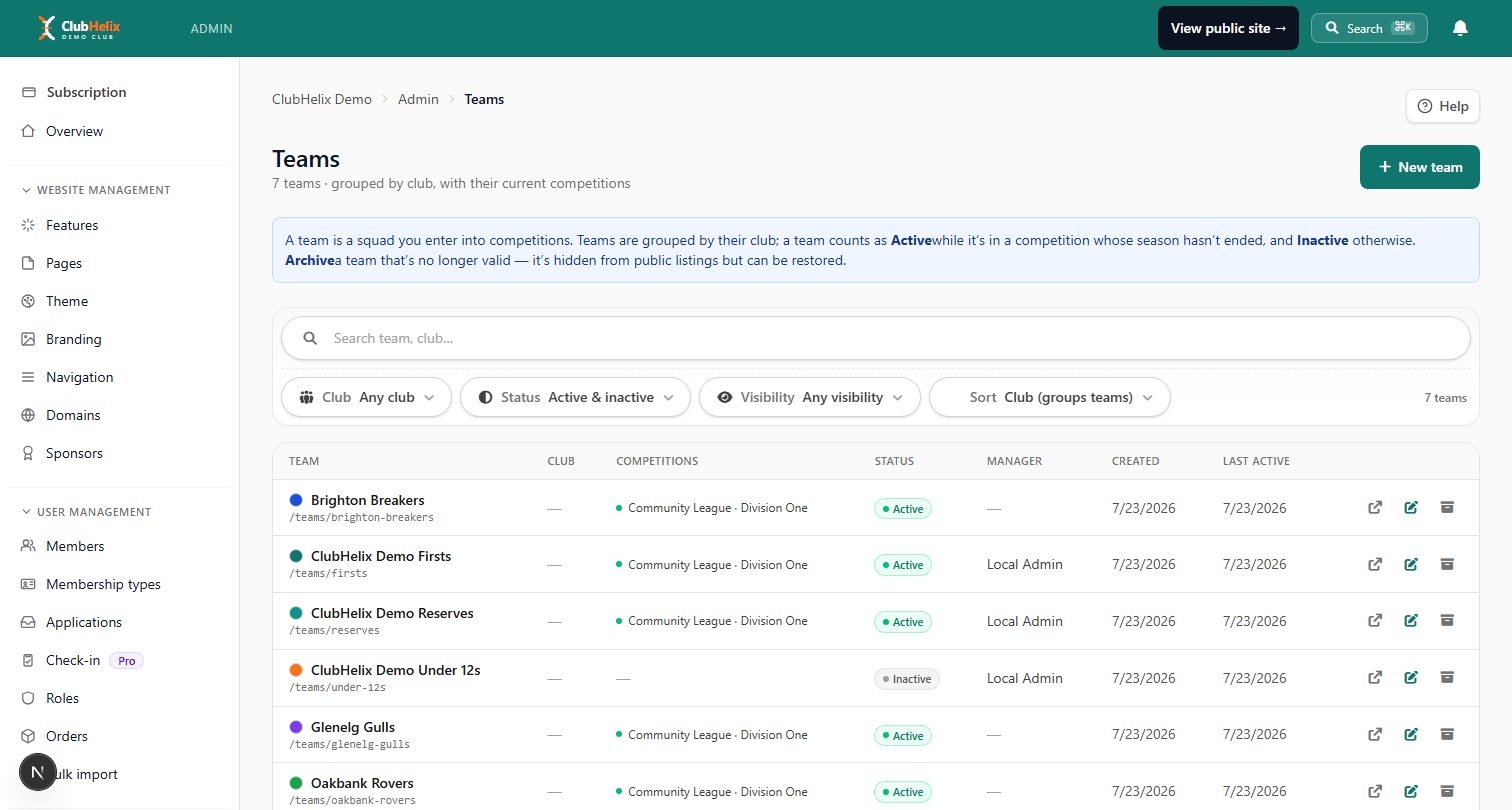
Gear issues, school clinic sign-ups, registrations, team lists, umpire rosters and wet-weather notices are all the same job — keeping accurate lists and getting messages to the right people. ClubHelix puts them on one club website: team management for squads, coaches and season lists, online registration and payments so the gear levy and membership arrive together, competitions for fixtures, results and ladders on your own site, and volunteer rostering so the umpire and canteen gaps are visible rather than remembered. The lacrosse club management software page walks through the same setup from a committee's side.
The free tier is enough for a single-team club to run on properly, and the pricing is published rather than quoted. You can create your club site in an afternoon and have the next school clinic taking sign-ups on it.
Frequently asked questions
What equipment does a lacrosse club need to provide?
At minimum, enough complete sets for the largest group of brand-new players you expect at once, plus goalkeeping kit. Goalkeeping equipment should always be club-owned — no family should have to buy a chest protector to find out whether their child enjoys the position. Mouthguards are personal; treat everything else as loanable in a player's first season.
How do you run a club gear pool?
Buy in cohorts so kit ages and gets replaced together, number every item, grade condition as A, B or C so match kit and clinic kit are separated, and keep a loan register showing who has what and when it is due back. Take a signed loan agreement for season-long loans, and quarantine anything damaged in a physical bin rather than putting it back.
How do clubs recruit juniors into lacrosse?
School clinics are the most reliable route, because families rarely go looking for a sport their children have never seen. Run a short block of in-school sessions with modified equipment, take enough sticks for the whole class, and finish with a specific dated offer — a named session time, a free trial and gear provided — rather than a general invitation.
How much does it cost to start playing lacrosse?
It depends heavily on the discipline. The women's field game requires far less protective equipment than the men's game or the indoor game, so it is substantially cheaper to enter. That is one reason many clubs grow fastest on the women's and girls' side, and it is why a loan pool matters more in lacrosse than in almost any comparable sport.
How does a small club find enough umpires?
Grow them. Recruit from your own juniors at fifteen or sixteen, pay for their accreditation course out of club funds, pay them promptly, never let them officiate alone, and put a club adult on the sideline to handle spectator behaviour so the young official only has to umpire. Six trained umpires is usually the difference between a junior competition running and folding.
Keep reading — how to start a junior program and how to run a hockey club.


