
What this guide answers
- What should be included in a club equipment register?
Every item the club owns with real value or match-day importance: playing and training equipment, first-aid and safety gear, canteen and clubroom equipment, tools and maintenance gear.
- How often should we update the equipment register?
Do a full stocktake at the end of every season, and update during the season only when something is bought, broken or lent out.
- Is an equipment register the same as an asset register?
Effectively yes — an asset register is the accounting term, and larger clubs may also track depreciation and book value for their financial reports.
- Who should look after the register?
Give it one named owner — an equipment officer if you have one, otherwise the treasurer, since purchases flow through them anyway.
Every club owns more gear than anyone realises — until it goes missing. Balls, bibs, nets, line markers, the barbecue, the defibrillator, the trestle tables, three generations of trophies and a storage shed nobody has fully opened since 2019. A club equipment register is the simple fix: one list of everything the club owns, where it lives, what condition it's in, and when it will need replacing.
It takes one working bee to build and ten minutes a season to maintain, and it pays for itself the first time you make an insurance claim, hand over to a new committee, or discover in March that the junior match balls were actually lost in November. Here's a template you can copy today, plus the handful of habits that keep it accurate.
The club equipment register template
Copy this table into a spreadsheet or document and start filling it in. One row per item (or per batch of identical items — you don't need a row for every training cone).
| Item | Quantity | Condition | Location | Purchase date | Replacement due |
|---|---|---|---|---|---|
| Match balls (size 5) | 12 | Good | Clubroom store | Jan 2026 | Jan 2028 |
| Training bibs (yellow) | 20 | Fair | Coach's kit bag | Mar 2024 | Mar 2027 |
| Portable goals (junior) | 4 | Good | Equipment shed | Sep 2025 | Sep 2030 |
| First-aid kits | 3 | Good | Canteen + kit bags | Feb 2026 | Restock termly |
| Defibrillator | 1 | Good | Clubroom wall | Jul 2024 | Pads Jul 2026 |
| Barbecue (6-burner) | 1 | Fair | Shed, rear left | Nov 2021 | Nov 2027 |
| Line marker + paint | 1 | Good | Equipment shed | Apr 2025 | Apr 2029 |
| Trestle tables | 6 | Mixed | Shed, rear right | Unknown | Review 2027 |
A few notes on the columns:
- Item. Be specific enough that a stranger could identify it — "portable goals (junior, aluminium)" not "goals".
- Quantity. Count what you can actually find, not what you think you bought.
- Condition. Keep it to three or four words: Good / Fair / Poor / Unsafe. Anything marked Unsafe comes out of use immediately and goes on the next committee meeting agenda.
- Location. The single most valuable column. "Shed" isn't a location if your shed looks like most club sheds — "shed, rear left shelf" is.
- Purchase date. Write "Unknown" honestly rather than guessing; you'll fix it over time as items are replaced.
- Replacement due. A rough expected end-of-life date. This turns your register into a forward budget: the treasurer can see that next year needs new bibs and defibrillator pads before the season starts.
Worth adding if you want more detail: a cost column (what you paid, for insurance and budgeting), a serial number column for anything electronic or valuable, and a responsible person column for items that live in someone's car all season.
Your register is insurance evidence
If the equipment shed floods or the clubrooms are broken into, your insurer's first question is: what exactly was lost, and what was it worth? A club that answers with an up-to-date asset register — items, quantities, purchase dates, costs, ideally a few photos — settles a claim in weeks. A club that answers with "well, there was a barbecue, and some nets, we think…" spends months reconstructing it from old bank statements.
Three habits make your register claim-ready:
- Record cost and purchase date for anything worth real money, and keep receipts for major items.
- Photograph the big stuff — the barbecue, mowers, goals, electronics — and store the photos alongside the register.
- Keep a copy off-site. A register stored only on the clubroom computer is no help when the clubroom is what burned down.
While you're at it, check your policy actually covers contents and equipment, not just public liability.
Our guide to whether your club needs insurance covers the difference between liability, contents and the other covers Australian clubs typically hold.
This is general information, not legal or financial advice — check your cover with your insurer or broker.

The end-of-season stocktake
A register is only as good as its last update, so build one fixed habit: an end-of-season stocktake. It takes an hour with two people and a printed copy of the register.
- Collect everything in. Team gear comes back from coaches and managers — make return-of-equipment part of your final-round routine, not a favour you chase in the off-season.
- Count and inspect. Walk the shed and clubrooms with the register. Update quantities, downgrade condition where honest, and flag anything unsafe.
- Record losses. Missing gear gets noted, not silently deleted — patterns (bibs vanish every year; one team loses more than the rest) tell you where to tighten up.
- Write the shopping list. Everything marked Poor or past its replacement date becomes a costed list for the treasurer while grant rounds and pre-season sales are still ahead of you.
- Report it. A three-line summary in the annual report — items held, items lost, replacement budget needed — makes the club's asset position visible at the AGM. It slots neatly into your end-of-season report.
Do the same walk in reverse at the start of the season — issuing gear out to teams against the register — and mid-season losses stop being mysteries. Our pre-season checklist has a slot for exactly this.
Handover: the register outlives the committee
Ask any long-serving volunteer and they'll tell you a version of the same story: the old equipment officer moved away, and with them went all knowledge of what the club owned and where it was. An equipment register is one of the core documents that should survive every changeover, alongside the constitution, insurance policies and bank details — see our committee handover checklist for the full list.
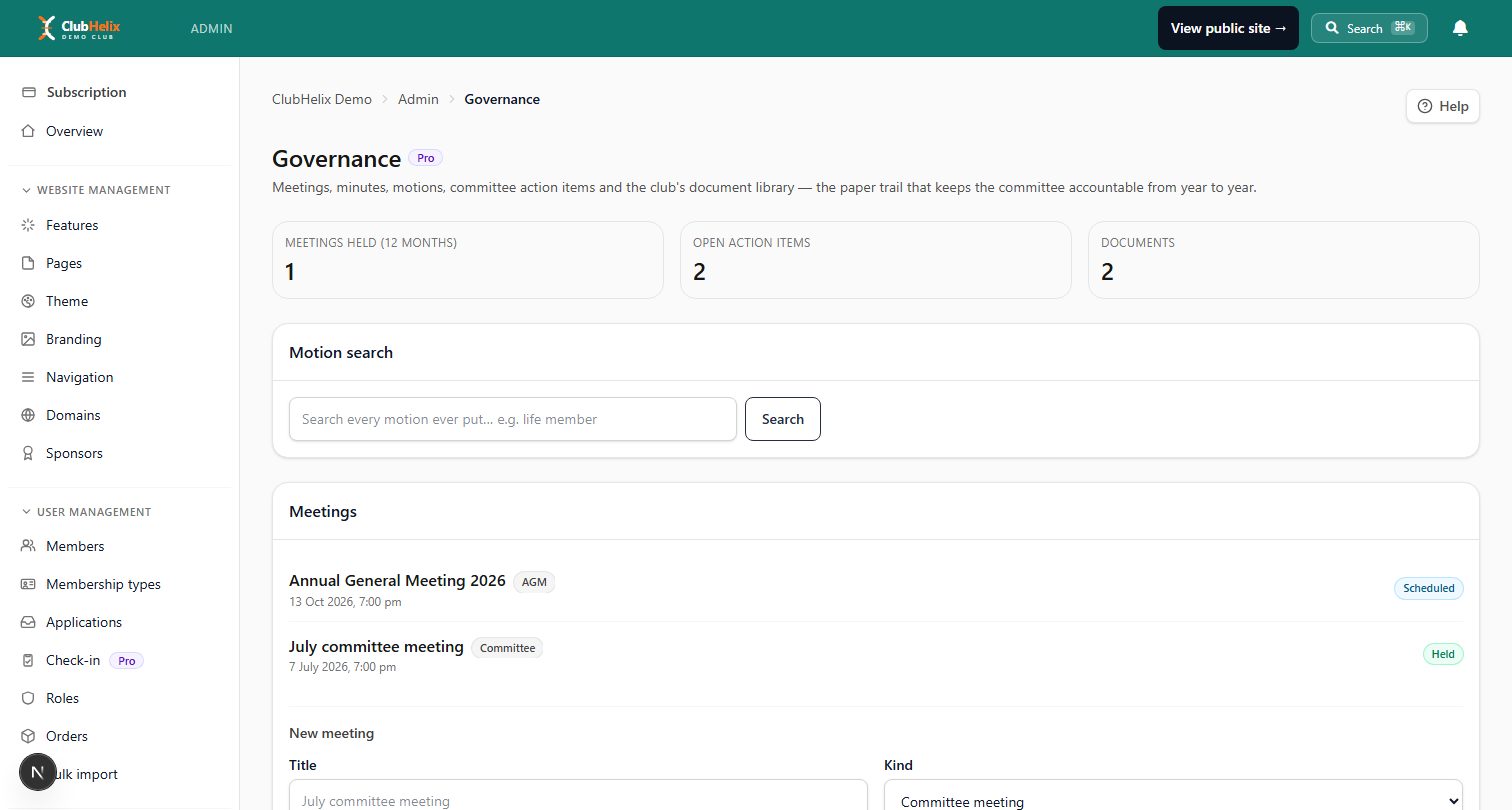
That only works if the register lives somewhere the club controls, not in one volunteer's personal files. Clubs on ClubHelix keep the register with the rest of their governance documents — minutes, policies, insurance certificates — in governance and document storage, where the incoming committee inherits access automatically instead of hoping for a USB stick at the AGM.
Keeping it alive during the season
You don't need to update the register every time a ball goes over the fence. Three triggers are enough:
- Something is bought → add a row (whoever reimburses the purchase adds the entry — the treasurer is the natural gatekeeper).
- Something breaks or is declared unsafe → update condition and flag it for the committee.
- Something is lent out beyond normal team use — to another club, a school, a member's backyard — → note who has it and when it's due back.
Everything else waits for the stocktake. A register that's 95% accurate and actually maintained beats a perfect one that was abandoned in week three.
If your club's paperwork still lives across five volunteers' laptops, ClubHelix gives you one home for the lot — documents and minutes, your team gear assignments, membership and communication — with a free tier to start on. Create your club and upload the register you built today as your first document.
Frequently asked questions
What should be included in a club equipment register?
Every item the club owns with real value or match-day importance: playing and training equipment, first-aid and safety gear, canteen and clubroom equipment, tools and maintenance gear. For each, record quantity, condition, location, purchase date and an expected replacement date — plus cost and serial numbers for valuable items.
How often should we update the equipment register?
Do a full stocktake at the end of every season, and update during the season only when something is bought, broken or lent out. An annual rhythm is sustainable; anything more ambitious tends to get abandoned.
Is an equipment register the same as an asset register?
Effectively yes — an asset register is the accounting term, and larger clubs may also track depreciation and book value for their financial reports. For most volunteer clubs, the equipment register above is the asset register, with a cost column doing the financial work.
Who should look after the register?
Give it one named owner — an equipment officer if you have one, otherwise the treasurer, since purchases flow through them anyway. Store it in shared club systems, not personal files, so it survives committee changeovers.

