
What this guide answers
- Who writes the end of season report?
Everyone with a portfolio writes their own one-to-two-page section against a supplied outline; the secretary compiles, writes the front summary, and the committee adopts the whole document before it goes to the AGM.
- When should the report be written?
Section outlines go out within two weeks of the last game, drafts are due three weeks later, and the adopted report should exist before your AGM (which most club constitutions require within a few months of season's or…
- How long should an end of season report be?
For a typical community club: a two-page summary plus season-at-a-glance table up front, one to three pages per portfolio behind it, and the recommendations register at the back — usually 12 to 20 pages all up.
- What's the difference between the annual report and the end of season report?
For most clubs they're the same document wearing different hats: the "annual report" is the formal AGM/statutory package (which for incorporated or registered clubs must include the financial statements), while "end of…
Every club season ends twice. Once on the field, at the final siren of the last game — and once in the clubrooms, weeks later, when the committee sits down and asks what actually happened. Most clubs do the first ending well and skip the second entirely, which is why they start every pre-season re-learning things last year's committee already knew: which fundraiser actually made money, why the under-14s folded, where the equipment went, what the council promised about the lights.
The end-of-season report is how a club remembers. It's not a compliance chore (though your AGM and your incorporation rules likely require some of it) — it's the handover document that makes next season start further ahead than this one did. This guide gives you the full template, portfolio by portfolio, plus the process for producing it without it becoming one exhausted secretary's lost weekend.
What an end-of-season report is for
Three audiences, three jobs:
- The AGM and the members. The formal account of the season — results, money, membership — presented for adoption. This is the accountability job, and for formally incorporated or registered clubs parts of it (particularly the financial statement) are a legal requirement.
- Next season's committee. The handover job. Half the value of the report is the "recommendations" lines — every "next season we should…" becomes a row in the pre-season checklist, which is exactly where a well-run club's planning cycle begins.
- Grant bodies and sponsors. The credibility job. Participation numbers, volunteer hours, finances in order — a club that can produce last season's report on request looks fundable, because it is.
One report serves all three if it's structured well: a short readable core, with each portfolio's detail as a titled section, and the numbers presented plainly.
The process: compile, don't compose
The report fails when one person tries to write it. The pattern that works:
- Two weeks after the last game, the secretary sends each portfolio holder their section outline (below) with a three-week deadline. Each section is one to two pages — a form to fill, not an essay to dread.
- Coaches file one page per team to the coaching coordinator, who synthesises. Chase these at presentation night while everyone's in the room and the season is fresh.
- The secretary compiles, writes the two-page summary at the front, and circulates a draft to the committee a week before the meeting that adopts it.
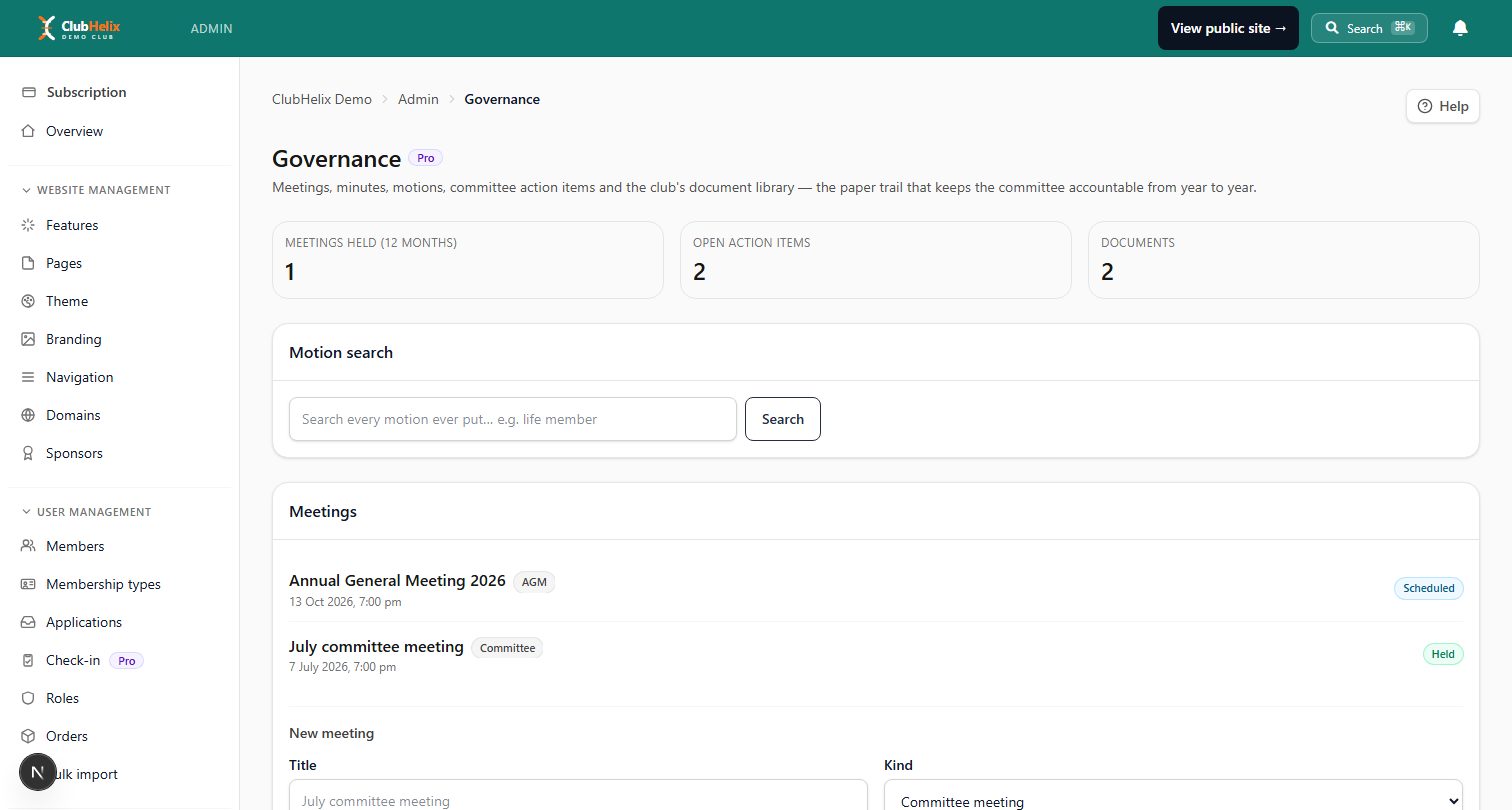
- The committee adopts it at a properly minuted meeting, and the adopted version goes to the AGM. Clubs that keep their agendas, minutes and reports in a governance system rather than a folder of attachments make this — and every future "what did we decide in 2024?" question — trivially easy.
- Recommendations get owners. The final act: every recommendation in the report is either accepted (and assigned) or explicitly parked. A recommendation nobody owns is a sentence, not a plan.
The template, portfolio by portfolio
Copy the outlines below into one document. Bracketed prompts are what to replace; the questions in each outline are the ones next year's committee will wish you'd answered.
1. President's report (1–2 pages)
The narrative of the season, written for members:
-
Season overview — the story in three paragraphs: on-field summary, off-field highlights, the honest challenges.
-
Key achievements — five to eight bullets: premierships and finals, membership growth, facility wins, grants received, milestone events.
-
Club health — one paragraph each on volunteers, finances (headline only — the treasurer has the detail), and community standing.
-
Thanks — sponsors by name, life members, standout volunteers, the committee.
-
Looking ahead — the three priorities the president recommends for next season.
2. Treasurer's report (2–3 pages + statements)
The section with statutory weight. Attach the financial statements; the written report explains them:
-
Headline result — surplus/deficit vs budget, in one sentence, then the two or three drivers of the variance.
-
Income breakdown — registrations, canteen/bar, fundraising (by event, with net not gross — "the trivia night grossed $4,200 and netted $3,100" is the number that matters), sponsorship, grants.
-
Expense breakdown — affiliation and insurance, ground hire and utilities, equipment and uniforms, events.
-
Balance sheet notes — cash position, any debts owed to or by the club, asset register changes.
-
Recommendations — fee settings for next season (with the modelling), cost risks on the horizon, reserves policy.
3. Registrar / membership report (1–2 pages)
The numbers that drive every other decision:
- Membership table — per age group/category: this season vs last season vs two seasons ago. Three-year trends tell the truth that single-year numbers hide.
- Retention — what percentage of last season's members returned? (The single most valuable number in the report.) Where did the losses concentrate?
- Recruitment — where new members came from: registration day, word of mouth, website, school programs. Which promotion was worth repeating?
- Process notes — how registration ran: what percentage online, payment issues, the questions families asked most.
- Recommendations — categories to add or retire, fee friction observed, timing changes.
4. Coaching / on-field operations report (1 page + 1 page per team)
The coordinator's synthesis, then per-team pages:
-
Per team: final ladder position and finals result; player numbers (started vs finished — mid-season attrition is a flag worth raising); development highlights; award winners; coach's three recommendations (grading, training nights, equipment).
-
Coordinator's synthesis: coaching appointments and accreditation status; how grading and the selection policy held up in practice (grievance count and themes); umpiring/officiating relationships; equipment condition and needs.
5. Volunteers & operations report (1 page)
- The volunteer ledger — roles filled vs vacant across the season, roster health (did match-day catering run on five people or fifteen?), estimated volunteer hours (grant applications love this number).
- Facilities — ground and clubroom condition, council interactions, maintenance done and needed.
- Events — each major event in two lines: attendance, net result, keep/change/drop verdict.
- Recommendations — the roles to recruit for first, the event to retire, the working bee timing that worked.
6. Communications & club administration (half–1 page)
- Reach — website traffic trend, email list size and open rates, social following, app adoption.
- What cut through — the announcements that worked and the ones that didn't; wet-weather comms performance.
- Admin systems — what's working, what's manual that shouldn't be, access and handover status (who holds which admin roles — reviewed now, alongside the bank signatories, not discovered broken at pre-season).
7. Compliance & safety (half page)
- Incidents summary (count and severity, not names), insurance claims, working-with-children check currency, first-aid coverage, policy reviews due.
8. Season at a glance (1 page, up front)
The page most people will actually read — the summary table:
| Measure | This season | Last season | Trend |
|---|---|---|---|
| Registered members | [412] | [388] | ▲ 6% |
| Member retention | [78%] | [74%] | ▲ |
| Teams fielded | [18] | [17] | ▲ |
| Finals appearances / titles won | [6 / 2] | [5 / 1] | ▲ |
| Net financial result | [+8,400] | [−1,200] | ▲ |
| Sponsorship income | [14,000] | [11,500] | ▲ |
| Active volunteers | [64] | [58] | ▲ |
| Incidents reported | [3] | [7] | ▼ |
If your club runs on an integrated platform, most of this table is a read-off, not a research project — membership counts, retention, event attendance and payment totals are already sitting in the admin, which is the quiet difference between a report that takes a season's worth of shoebox archaeology and one that takes an afternoon.
9. Recommendations register (1 page, at the back)
Every recommendation from every section, in one table: recommendation, raised by, accepted/parked, owner, due. This page is the handover — it's the first document next season's committee opens.
Writing it so people read it
- Numbers over adjectives. "Membership grew 6% to 412" beats "another strong year of growth". Adjectives age badly; numbers compound in value every year the reports accumulate.
- Honesty over gloss. The report that admits "the under-16s folded because we lost two coaches mid-season" is the one that prevents a repeat. AGM reports written as pure celebration teach the club nothing.
- Short front, deep back. Two-page summary + season-at-a-glance up front for the AGM; portfolio detail behind for the people who need it.
- Publish appropriately. The adopted report (minus any sensitive personnel or hardship matters) goes on the club website — members who missed the AGM still deserve the account, and next year's grant application will link to it.

Frequently asked questions
Who writes the end of season report?
Everyone with a portfolio writes their own one-to-two-page section against a supplied outline; the secretary compiles, writes the front summary, and the committee adopts the whole document before it goes to the AGM. The report fails when it's treated as one person's authorship — both because the workload is unreasonable and because the registrar's numbers, the treasurer's accounts and the coaches' assessments are only accurate from their own hands.
When should the report be written?
Section outlines go out within two weeks of the last game, drafts are due three weeks later, and the adopted report should exist before your AGM (which most club constitutions require within a few months of season's or financial year's end). The real deadline is memory: recommendations written in the fortnight after the season are specific and useful; the same section written in the pre-season rush is a paragraph of vague goodwill.
How long should an end of season report be?
For a typical community club: a two-page summary plus season-at-a-glance table up front, one to three pages per portfolio behind it, and the recommendations register at the back — usually 12 to 20 pages all up. Length is not the goal; the discipline of the outline is. A four-page report that states the membership trend, the true financial result and five owned recommendations beats a forty-page scrapbook.
What's the difference between the annual report and the end of season report?
For most clubs they're the same document wearing different hats: the "annual report" is the formal AGM/statutory package (which for incorporated or registered clubs must include the financial statements), while "end of season report" describes the operational content inside it. Clubs whose season doesn't align with their financial year sometimes split them — an operational season report soon after the last game, and the statutory financials at the AGM — in which case the season report should still feed its numbers and recommendations into the annual one.
ClubHelix keeps the raw material of a great report in one place all season — meeting agendas, minutes and documents, membership and payment numbers ready to read off, and admin roles that make handover a permissions change rather than a treasure hunt. Start free and make next season's report an afternoon's work.


