
What this guide answers
- How do you allocate plots fairly in a community garden?
Use a single dated waiting list, written priority rules agreed before anyone applies, and a published offer process — the top of the list is offered the next vacancy, gets a set number of days to accept, and returns to…
- What should a plot agreement include?
The plot number, term and renewal date, the fee and what it covers, a plainly worded cultivation standard, rules on structures and trees, the water and chemicals policies, an absence-notification courtesy, a ban on…
- How do gardening clubs make money?
Plot or membership fees usually cover only the running costs — water, insurance, mulch and consumables.
- How often should a community garden hold working bees?
Monthly is the rhythm most gardens settle on, with two or three bigger sessions a year for infrastructure.
- What do you do about an abandoned plot?
Follow one written process every time: a friendly personal check-in first, then a formal notice with a deadline and a dated photo, then simple non-renewal at the end of the term.
USA edition. This guide is written for volunteer-run clubs in the United States. Where rules differ — grants, tax, incorporation, safeguarding — follow the USA-specific pointers below or check with your national body.
There is a moment nearly every plot-based garden goes through in its third or fourth year. A bed has been untouched since the last sowing, couch grass has gone under the path into the neighbouring plot, and there are nine names on the waiting list. Somebody has to write the letter. How your club handles that one decision — fairly, in writing, the same way every time — predicts whether it still exists in a decade far better than the quality of anyone's tomatoes.
Gardening clubs come in two shapes that share a name. One is the horticultural society: a monthly meeting, a guest speaker, a show bench, a bus trip, and members who garden at home. The other is the community garden: land, a fence, a tap, and members who each hold a plot. Many clubs are both. But the second is a membership business with soil — it allocates a scarce asset, charges for it, maintains shared infrastructure, and owes obligations to whoever owns the land. Run it like a friendly hobby group and the friendliness is exactly what fails first.
This guide is for the volunteer committee of either kind. It covers plot allocation and the waiting list that never gets tidied, what belongs in a plot agreement, working bees and shared tools, the water bill nobody budgets for, and the money side — plant sales, open gardens and seed swaps — plus the admin that quietly consumes committee evenings.
Before any of it, settle what you actually hold and on what terms. The name for a plot-based garden, who lets it to you and the rules attached differ enormously from place to place, and together they decide how secure your club really is.
Land tenure is the defining risk for community gardens in the United States. Gardens sit on city parks land, school property, church land, private lots lent by an owner, or land held by a community land trust — and the gap between a season-to-season handshake and a long lease or trust ownership is the gap between a garden and a temporary use of a vacant lot. Gardens have been lost to development after years of work by their members. If your site is not secured, put securing it on every committee agenda, and talk to a local land trust or garden coalition about how comparable sites in your city were protected.
Decide which club you actually are
Most committee arguments come from two organisations sharing one budget and one set of expectations. Name yours and the arguments mostly stop.
| Horticultural society | Community garden | Hybrid | |
|---|---|---|---|
| Core asset | The program of speakers and the show | The land, the water and the shed | Both, competing for the same volunteers |
| Scarce resource | Meeting attendance | Plots | Committee time |
| Money shape | Small subs, show entries, plant sale | Plot fees, grants, produce and plant sales | Two ledgers pretending to be one |
| Main risk | The program going stale | Land tenure and abandoned plots | Cross-subsidy nobody voted for |
| What members expect | Something to learn each month | A plot that is theirs, and a working tap | Whichever half they joined for |
If you are a hybrid, split the budget into two clear cost centres from the first meeting of the year. The society side should not be quietly funding the garden's water, and the plot holders should not be paying for a speaker they never see. Publish both lines at the annual meeting and the resentment evaporates.
Plots, the waiting list and the plot agreement
Offer more than one size of plot
A single standard plot size guarantees two failure modes: people who cannot manage theirs, and people who want more. Offer a range and let members move between them as life changes.
| Plot type | Suits | Typical commitment |
|---|---|---|
| Full plot | Experienced growers, families feeding themselves | Several hours a week in peak growing months |
| Half plot | New members, shift workers, older gardeners | An hour or two a week |
| Raised accessible bed | Members with limited mobility, wheelchair users | Light, year-round |
| Communal bed share | People who want company more than sovereignty | Whatever the working bee needs |
| Nursery or propagation bench | Members who propagate for the club sale | Seasonal bursts |
Reserve at least one accessible bed and one communal bed permanently. They are the two that most reliably turn a visitor into a member, and they give you somewhere to put a person who is not ready for a full plot rather than sending them to the bottom of a list.
A waiting list that does not rot
An unmaintained waiting list is worse than no list. People move house, lose interest and forget they applied, and the committee ends up phoning eleven dead numbers to fill one bed.
- Take applications through one form, not four channels. A short online form with name, contact, suburb or area, preferred plot size and the date they applied. An online form that timestamps every entry removes the "but I asked at the open day in March" argument entirely.
- Confirm interest once a year. One email, one link, one click to stay on the list. Anyone who does not respond within a month comes off. This alone typically halves a list and makes the remaining half real.
- Publish positions, not names. "You are number 7" is fair, transparent and stops the suspicion that plots go to friends. Names on a public list are a privacy problem you do not need.
- Write down the offer rule. Something like: the top of the list is offered the next vacancy, has seven days to accept, and after two declines returns to the bottom. Decide it once, apply it identically every time.
- Decide your priority rules in advance, in writing. Many gardens prioritise people within walking distance, or households without any growing space of their own. That is a legitimate policy — it is only unfair when it is invented after the applicant is known.
What belongs in a plot agreement
The plot agreement is the most useful document your club will ever write, and it should fit on two sides of paper. Cover:
- The plot number, the term, and the exact renewal date every year.
- The fee, what it includes (water, mulch, compost, shared tool use) and what it does not.
- A cultivation standard — plainly worded. "At least three quarters of the plot in active cultivation or deliberate green manure through the growing season, paths clear to the edge, no seeding weeds."
- What counts as notifying the club of an absence, and the maximum absence before the plot is at risk. Holidays and hospital stays are normal; write the courtesy rule rather than pretending it never happens.
- Structures — maximum heights, what is permanent, what needs committee approval, and whether trees are allowed at all. Trees are the single most common cause of a plot dispute, because they shade a neighbour and outlive the tenancy.
- Water rules, including whether hoses may be left running unattended.
- The chemicals policy, storage rules and any notification required before spraying.
- No subletting, no swapping plots privately, no passing a plot to a family member without going through the committee.
- The dispute process, in three steps, ending with the committee.
- What happens at handover: crops, structures and rubbish, and who removes what.
The three-letter process
Have one process for a neglected plot and use it every time, regardless of who holds the plot.
- A friendly note, in person if possible. "We have noticed plot 12 has not been worked for a while — is everything alright, and do you want a hand or a break?" A surprising number of neglected plots are a health problem or a bereavement, not a lack of interest.
- A written notice with a date and a photo. Sent by email and post. It states what needs to happen, by when — four weeks is common — and what happens if it does not. The photo removes any later argument about the state of the bed.
- Non-renewal. Not eviction, not a confrontation: the agreement simply is not renewed at the term date, in writing, with a fortnight to clear personal property. Because the agreement has a fixed term, this is administrative rather than personal.
Keep every letter, photo and reply against the member's record. When a decision is challenged at the annual meeting — and one day it will be — a dated file ends the conversation in a minute.
Working bees, shared tools and the water bill
Make the working bee worth attending
Attendance at a working bee is a product design problem, not a loyalty problem. The gardens that get twenty people follow the same recipe: a fixed slot in the calendar, a hard two-hour limit, tasks written up on a board before anyone arrives, a named leader for each task, tools already out and sharpened, and morning tea afterwards that is genuinely good.
Roster the jobs that need doing regardless of who turns up — the compost turn, the tap and hose check, the shed tidy, the noticeboard update — rather than leaving them to whoever feels guilty. Our guide to running a working bee has the full run sheet, and it is worth pairing with a simple rostering tool so nobody has to text nine people on a Thursday night.
Count the hours. Volunteer time is a recognised contribution in most grant applications, and gardens routinely undercount it because nobody wrote it down. A sign-in sheet at every working bee, transcribed once a month, turns into a genuinely persuasive number by grant season — see tracking volunteer hours for grants.

The tool shed rules that prevent the arguments
Shared tools fail in predictable ways: the good secateurs disappear, the mower runs dry, and the brushcutter gets used by someone who has never held one. Three habits fix nearly all of it.
- Keep a register. Every powered item, its serial number, purchase date, service history and current condition. A club equipment register is fifteen minutes of setup and pays for itself the first time you make an insurance claim.
- Tier the tools. Open access for hand tools; induction required for the mower, brushcutter and rotary hoe; and a short list — chainsaws especially — that only named, currently trained members may touch. Record who has been signed off on what, and treat that record as a safety document rather than a courtesy.
- Log the service, not the intention. A laminated card on the shed wall for each machine, with the date of the last service, blade sharpen or oil change. Machines that are logged get maintained.
Water is your biggest shared cost
Almost every garden underestimates water, because it arrives as one bill long after the season that caused it. Get ahead of it:
- Read the meter on the same day each month and graph it. A leak shows up as a flat step in the baseline that never comes back down, and a dripping tap left over winter can cost more than a plot fee.
- Decide between a flat water charge included in plot fees and a metered per-plot charge. Flat is simpler and fairer to small plots; metered is fairer to careful gardeners and much more work. Most gardens land on flat, with a written expectation about hoses and unattended sprinklers.
- Put timers on the taps that feed communal beds and the nursery. They pay for themselves in one forgotten afternoon.
- Harvest what you can from shed and shelter roofs into tanks, and plumb the tanks so the nursery draws from them first.
- Mulch aggressively and prefer drip lines to overhead watering on shared beds. The cheapest litre is the one you never have to buy.
Budget for restrictions as well as volume. Water rules in the United States are intensely local — a garden may sit under a municipal ordinance, an irrigation district's allocation, or a drought stage that changes month to month — so find out who actually sets the rules for your site and get on their notification list. Many utilities and conservation districts offer rebates for rain barrels, cisterns and drip conversions, which is free money for infrastructure you needed anyway.
Plant sales, open gardens and seed swaps
Plot fees rarely cover more than water, insurance and consumables. The money that pays for the new shed, the accessible beds or the shade structure comes from three events that gardening clubs are uniquely good at.
The plant sale is won twelve weeks before the sale
The clubs that sell out are the ones that treat propagation as a project with a calendar, not as whatever members happen to have spare.
| Weeks out | Task |
|---|---|
| 12 | Set the date, book the venue, decide the mix (seedlings, potted perennials, divisions, herbs, cuttings) |
| 10 | Propagation working bee — sow, strike cuttings, pot up divisions from members' gardens |
| 8 | Order pots, labels and mix; confirm the plants that need the longest lead time |
| 6 | Promotion begins — event listing on the website, local noticeboards, community pages |
| 4 | Second potting-on bee; anything not thriving comes out of the plan now |
| 2 | Price list finalised, float organised, card reader tested, signage made |
| 1 | Labelling bee. Every plant gets a name and a growing note |
| 0 | Setup at dawn, sell, then a debrief while it is fresh |
Price by pot size rather than by species. Three prices, printed on big signs, no negotiating, no calculator. A queue moves four times faster and volunteers stop having to be plant valuers. Take card as well as cash — a growing number of visitors carry no cash at all, and the tap-and-go difference on a sale day is usually larger than the transaction fees.
Open gardens
An open garden weekend sells access to the thing your members already have. Two or three private gardens plus the club site, one ticket, a map, and a plant stall at the last stop.
Brief your hosts properly: agree the hours, the maximum number of visitors, where people park, which parts of the garden are off limits, whether the toilet is available, and who is on the gate. Give each host a printed plant list for the questions they will be asked forty times. Sell tickets online in advance so you know your numbers, keep a small allocation for the gate, and put a donation tin next to the plant stall rather than in place of it. Our guide to promoting a club event covers the marketing side.
Seed swaps and seed libraries
A seed swap costs almost nothing and does three jobs at once: it brings lapsed members back, it gives new members a low-stakes first visit, and it preserves varieties that are genuinely local to your area.
Keep it simple and keep it a swap. Standard envelopes, a labelling table with variety, year and grower on every packet, and a rule that anything unlabelled goes in the communal bowl. Bring-something-or-take-three is the usual etiquette. Set a clear boundary about what you will not accept — anything that could carry disease, anything from an unknown source, and anything covered by plant breeder's rights.
Rules on moving seed, plants and soil between regions are a biosecurity matter and vary by jurisdiction. Treat this as general information and check the current requirements with your agriculture or biosecurity authority before you accept donations from outside your area.
The gardening year
Three moments define the calendar, whatever you grow.
The intake rush. New members arrive in a wave at the start of the main growing season, and they arrive at exactly the moment the committee is busiest. Handle it with a fixed induction — a single scheduled session covering the tour, the tap, the shed, the rules and the agreement — rather than nine individual walk-throughs. Run an intake day the way a sports club runs a registration day and you convert far more of them.
The absence problem. Every garden has weeks when a chunk of the membership is away and everything needs watering. A buddy system fixes it: every plot holder nominates another member to water and harvest while they are away, recorded on their agreement.
The rebuild. The quiet end of the year is when paths get repaired, compost bays get rebuilt, the shed gets sorted and next year's plan gets made. Book those working bees at the start of the year while people still have goodwill.
Plan around a northern-hemisphere calendar: the sowing rush and the intake wave arrive together in early spring, the shared-watering crunch is mid-summer when a good share of the membership is on holiday, and the rebuild window is the cold end of the year. Schedule your plant sale for late spring, and use the short days for the indoor jobs — the seed order, the grant applications, the tool service and the AGM.
Safety, insurance and the awkward bits
This section is general information. Requirements vary by jurisdiction, and your landholder, insurer and local authority set the rules that actually apply to your site.
- Public liability cover is the non-negotiable one, and your lease or licence almost certainly names a minimum. Check whether your policy covers volunteers, visitors on open days, and members using club machinery, and whether a trading stall changes anything. Our guide to club insurance explains the cover types to ask about.
- Soil. Older urban sites can carry contamination from previous land uses. If your site has an industrial or long residential history, get soil tested by an accredited laboratory before anyone eats out of it, and use raised beds with imported soil where results are uncertain.
- Chemicals. Write a one-page policy: what is permitted, who may apply it, where it is stored, how neighbouring plots are notified, and a flat ban on members bringing unlabelled containers from home.
- Children and school groups. Screening and supervision requirements for adults working with children vary considerably. Confirm what applies before you host a school visit, and write your supervision ratios into the booking.
- Record incidents and near misses. A hand into a rusty stake, a trip on a hose, a wasp nest in the compost. A short standing record is what turns "we should fix that" into a fixed path — incident reporting built into your club admin means it happens on a phone at the time, not on a form nobody finds.
Screening requirements for adults working with minors are set state by state and province by province, and school districts and boards routinely impose their own requirements on any volunteer hosting a class visit. Ask the school what it needs from your people before you agree a date, and build the lead time for checks into the booking rather than discovering it a week out.
Keeping members past their first season
The second season is where gardens lose people. The plot that was a delight in spring is a jungle by autumn, and the member quietly stops coming rather than admitting they are struggling.
- Pair every new member with an experienced one for their first year. It is the single highest-return thing a garden committee can do, and it costs nothing.
- Offer a downshift, not an exit. A member drowning in a full plot should be offered a half plot before they resign. Make the offer explicit in your renewal email.
- Give the non-gardening jobs to the people who love them. Not every member wants a plot. Some want the seed library, the newsletter, the propagation bench or the morning tea. Those are real roles — write them up the way you would any other volunteer position.
- Ask once a year, properly. A short member survey about what people want from the club catches problems while they are still fixable.
Running the garden from one place
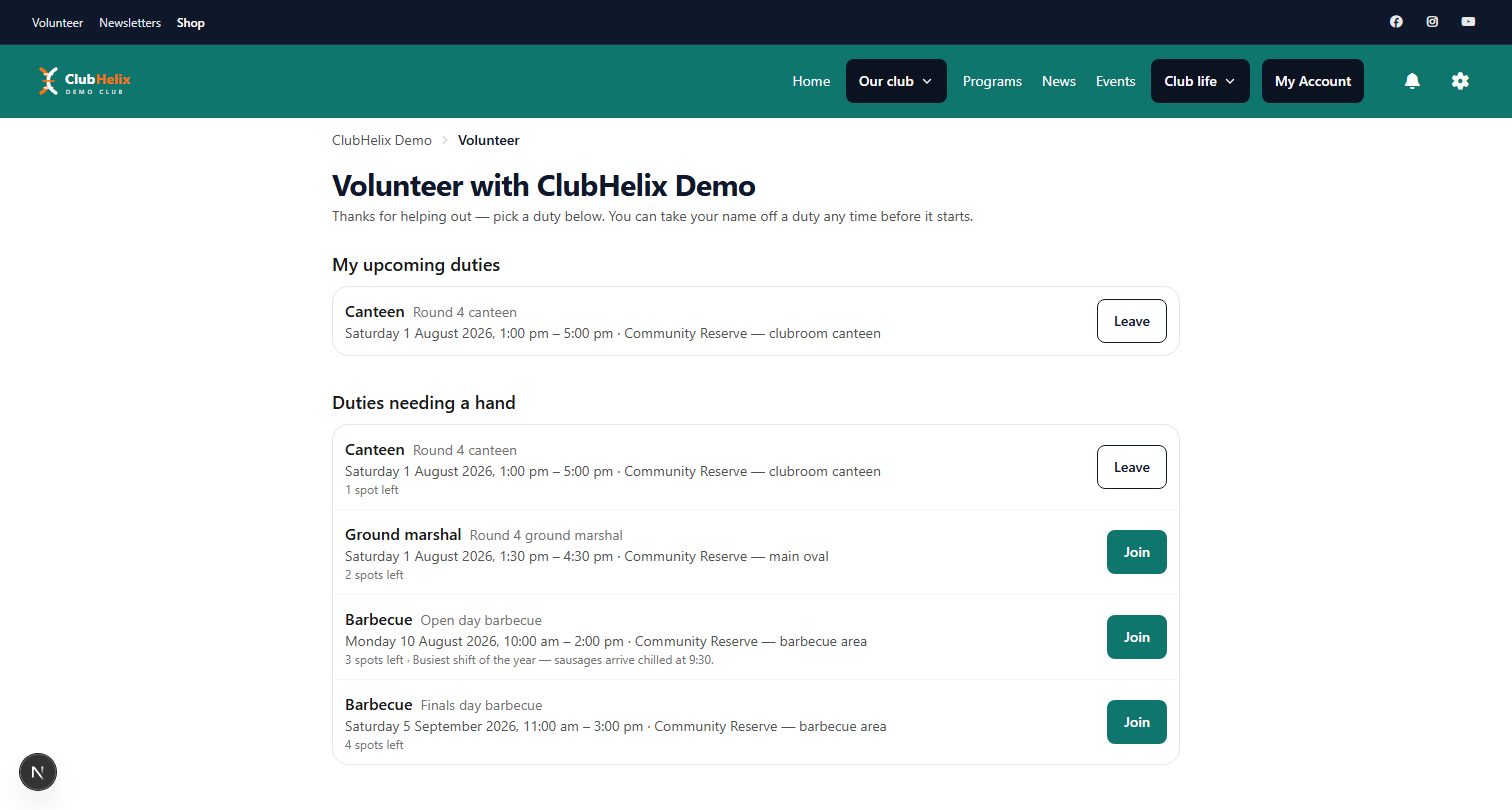
Most of what burns out a garden committee is not gardening. It is the waiting list in a spreadsheet, the plot fees chased by bank transfer, the working-bee roster in a text thread, and the plant sale takings in a biscuit tin. ClubHelix puts that in one place: online joining and plot fees with renewals that chase themselves, a working-bee and duty roster members can sign up to from their phone, forms for plot applications and the waiting list, and an events calendar that sells open-garden and plant-sale tickets on your own website.
Start with one job rather than all of them. Put the waiting list on a proper form this month, and by the next intake you will have dated applications, a one-click annual confirmation, and no argument about who was ahead of whom. The free tier is enough to do exactly that, pricing is published on the site rather than quoted after a call, and you can create your garden's site without installing anything. Community gardens and other volunteer-run community organisations can see how the pieces fit on our community and service organisations page.
Frequently asked questions
How do you allocate plots fairly in a community garden?
Use a single dated waiting list, written priority rules agreed before anyone applies, and a published offer process — the top of the list is offered the next vacancy, gets a set number of days to accept, and returns to the bottom after two declines. Publish positions rather than names, confirm the list once a year so it stays real, and apply the same process to every vacancy including committee members' friends.
What should a plot agreement include?
The plot number, term and renewal date, the fee and what it covers, a plainly worded cultivation standard, rules on structures and trees, the water and chemicals policies, an absence-notification courtesy, a ban on private subletting or transfers, a three-step dispute process, and what happens to crops and structures at handover. Keep it to two pages and have every member sign it each year.
How do gardening clubs make money?
Plot or membership fees usually cover only the running costs — water, insurance, mulch and consumables. The projects get funded by plant sales, open garden weekends, produce and preserve stalls, workshops, and grants for infrastructure like sheds, tanks, shade structures and accessible beds. Propagating for a sale twelve weeks ahead is the highest-return fundraising a garden club can do.
How often should a community garden hold working bees?
Monthly is the rhythm most gardens settle on, with two or three bigger sessions a year for infrastructure. Keep them to two hours, publish the task list before people arrive, give each task a named leader, and finish with morning tea. Predictability matters more than frequency — a fixed date people can plan around beats a well-intentioned schedule that keeps moving.
What do you do about an abandoned plot?
Follow one written process every time: a friendly personal check-in first, then a formal notice with a deadline and a dated photo, then simple non-renewal at the end of the term. Keep the correspondence on file. Because the agreement has a fixed term, ending it is an administrative step rather than an eviction, which is exactly why the fixed term matters.
Keep reading — how to organise a working bee for the run sheet, and how to recruit club volunteers for the jobs beyond the plot.


