
What this guide answers
- What is the best club website platform?
There is no single answer, because four different product categories share the label.
- Is a free club website platform good enough?
Sometimes, yes — particularly a governing-body-funded one for a small affiliated club, or a general builder for a group that takes no money online.
- How much should a club website platform cost?
Published prices as at July 2026 range from nothing at all on governing-body-funded and ad-supported products to roughly the price of a monthly subscription with a payment percentage attached, with several suppliers…
- Can we move our club website to a different platform later?
Usually, if you prepared for it. Keep the domain registered in the club's name in a club-controlled account, keep an export of your member and payment data, and map your old page addresses to new ones so search results…
- Do we still need our own website if our governing body gives us one?
It depends what theirs does. Competition pages, fixtures and ladders are genuinely useful and worth linking to.
The committee has three quotes in front of it and none of them can be compared. One is free because the governing body pays for it. One is a monthly subscription with a payment percentage attached. One is a design tool at a low sticker price that will need four add-ons before registration day. Someone says "they all do websites, let's just take the cheapest", and that is how a club ends up on its fourth platform in eight years.
The problem is not that the market is confusing. It is that four genuinely different products all answer to the phrase "club website platform", and each is offering a different bargain. Governing-body platforms trade control for cost. Sport club platforms trade some design freedom for machinery. General website builders trade machinery for design freedom. App-first tools trade the website itself for reach into members' pockets. Every one of those bargains is right for somebody.
This guide sorts the four models, then works through the three questions that actually separate them (the sibling question — what club management software does beyond the website — has its own page): who holds your domain and your content when the relationship ends, what the bill looks like across three years rather than one, and what the platform does on the six days a week nobody is looking at the website. We build one of these products — ClubHelix is a club platform — so read our conclusions with that in mind. Everything we say about another company comes from public sources and is current as at July 2026; where a price is not published, we say so instead of guessing, and you should verify anything you are about to sign.
The four bargains on offer
Governing-body and white-label platforms. Your national or state body buys a platform and distributes it to affiliated clubs, usually free or close to it. ClubSpark, from London-based Sportlabs, is the clearest example: it is free to LTA-registered venues and accredited coaches in the UK, adds 0.8% per Stripe transaction, and hosts thousands of club sites on clubspark.lta.org.uk subdomains. PlayHQ in Australia sits at the far end of the same idea — funded by national body contracts, brilliant at fixtures, ladders and registrations for AFL, cricket, basketball and netball, and not a club website product at all. GameDay, the Melbourne-based Stack Sports platform, has served clubs, leagues and national bodies across Australia, New Zealand and the UK for years and includes a websites product; its subscription pricing is not published, so it is quote-based by nature.
Sport club platforms. Products sold directly to clubs that combine a website with the administration behind it. Pitchero, out of Leeds, is the closest product-shape match to what we build: club websites, a branded app, membership and payments, team stats and league feeds, priced Free / £38 a month / £99 a month with payment fees from 2.42% + 17p on Standard down to 1.67% + 15p on Pro, and no payments at all on the free plan. In Australia, revolutioniseSPORT sells annual plans by club size — A$112 a year for up to 100 members, A$396 for up to 500, A$989 for up to 1,500 — with online payments through Pin Payments at 2% + A$1.60 a transaction. Jersey Watch takes the same shape into the American volunteer-club market from US$29 a month by athlete volume. ClubHelix is in this category too.
General website builders. Wix, Squarespace, WordPress and their peers. They win on design, and their template galleries dominate searches for club website templates. They know nothing about members, seasons or fees, and everything the club needs beyond publishing arrives as a separate add-on. We wrote a whole comparison of that trade-off in club website builder vs a general website builder.
App-first tools with a site attached. Stack Team App, also Melbourne-based, is free to clubs and ad-supported, with end-users able to pay around A$4.49 a year to remove ads according to its app-store listing; it generates a basic website alongside the app. Spond, from Oslo, is free with no subscription and makes its money on payment processing and its Superdraw fundraising product, where the club keeps 65% of ticket sales according to its own site — and it has no public club websites at all. Both are excellent at getting a message to a parent on a Thursday night. Neither is trying to be your shopfront.
Who holds the address, the words and the list
This is the question committees ask last and should ask first, because it is the only one that gets more expensive with time. Three assets are in play, and they detach from each other in a way that surprises people.
| Asset | Why it matters | The question to ask a supplier |
|---|---|---|
| The domain name | Your printed address, your email, ten years of links pointing at you | Can we connect a domain the club already owns, and who is listed as owner? |
| The content | Photos, history, honour boards, policies, every page someone wrote | Can we export pages and images ourselves, without asking anyone? |
| The member and fee data | Who has joined, who has paid, who consented to what | Can an admin export the full member list and payment history today? |
The four models answer those differently. A white-label platform distributed by a governing body typically parks you on its subdomain — that is the point of the model, since the network of club pages is part of what the platform sells back to the sport. It costs you nothing and it is not yours. If your club has spent a decade earning links to platform.governingbody.org/yourclub, moving means starting the address from scratch. That is a real cost, and it is invisible until the day you want to leave.
App-first tools have the same shape for a different reason: the site is generated as a by-product of the app, so there is little to take with you because there was little to begin with. General builders are the cleanest on this one — you point your own domain at them and the pages are yours to copy — but the member and fee data usually lives in whichever form and payment add-ons you bolted on, in three places, in three formats. Sport club platforms vary; the honest test is not what the salesperson says but whether an admin can produce a CSV of members and payments in the demo, unassisted.
Our position, which we apply to ourselves: register the domain in the club's name, in an account the club controls, before you choose a platform at all. How to buy a domain for a club covers the mechanics. Then require that whatever you pick connects that domain rather than renting you one — ClubHelix does this with custom domains on every paid tier, and we would tell you to walk away from anyone who cannot.

Three years, not one
Sticker price is a one-year number, and clubs live in three-to-five-year cycles. Rather than build a cross-currency table that would need conversion rates we cannot stand behind, here are the published figures in the currency each supplier publishes them in, as at July 2026, with the structural point underneath each.
Published in Australian dollars. revolutioniseSPORT charges annually by member band: A$112 a year at 100 members or fewer, A$396 up to 500, A$989 up to 1,500. Over three years, a stable 400-member club pays A$1,188 in subscription. Cross into the next band in year two — a good junior recruitment season will do it — and the three-year figure changes shape entirely. Payments run at 2% + A$1.60 a transaction through Pin Payments. Stack Team App charges clubs nothing at all, with advertising carried in front of your members instead.
Published in pounds. Pitchero's Standard plan is £38 a month, which is £1,368 over three years, with payment fees of 2.42% + 17p; Pro is £99 a month, or £3,564 over three years, with fees falling to 1.67% + 15p. Its free plan cannot take payments, which is the honest boundary of most free tiers. membermojo, at the small end, is free to 50 members and around £75 a year for 500 — roughly £225 across three years — with no platform transaction fee of its own, so you pay Stripe's 1.5% + 20p and nothing else.
Published in US dollars. Jersey Watch starts at US$29 a month by athlete volume with a US$19 first month and no contract, so the entry band lands a little over US$1,000 across three years. TidyHQ, the Adelaide-born community-group platform, has a free plan and a Pro plan at US$69 a month, published as A$89, £49 and NZ$99 — about US$2,484 over three years — though its strength is committee and finance admin rather than websites.
Three structural points matter more than any of those totals.
The fixed component of a transaction fee is the one that bites small clubs. Take an illustrative club collecting 300 payments of A$60 at 2% + A$1.60: that is A$360 in percentage and A$480 in fixed fees, so A$840 on A$18,000 — an effective 4.7%. The same rate on 300 payments of A$300 is A$2,280 on A$90,000, or 2.5%. If your club sells lots of small things — social nights, a canteen top-up, a junior clinic — read the fixed cents before the percentage.
Member bands are a growth tax. Any plan priced by member count re-prices exactly when your club has a good year. Ask where the band edges sit and model your three-year membership forecast against them, not last season's number.
Setup fees and quote-only pricing belong in the model too. Squadspot in Australia charges a one-time setup fee plus a monthly per-active-member rate and does not publish the amounts. ClubZap in Ireland is quote-based across two plans, with transactions from 3.75% + 10c. Clubforce, also Irish, is quote-based with no public price list and multi-year discounts, and has been known to waive a €200 setup fee as a promotion. None of that is sinister — it is how the enterprise end of this market sells — but a quote you cannot compare is a cost you cannot budget. Our what a club website costs guide breaks the whole line down.
The admin behind the website, which is the real differentiator
Here is the uncomfortable truth about club websites: the pages are the easy part. Any of these products can put a photo of the seniors under lights on a home page. What separates them is the six days a week when nobody is admiring the design and somebody is trying to find out whether the under-13s' registration cleared.
| The weekly job | Governing-body platform | Sport club platform | General builder | App-first tool |
|---|---|---|---|---|
| Take a sign-up and mark it paid | Yes, in the sport's shape | Yes, in the club's shape | Form add-on plus a spreadsheet | Sometimes, via payments |
| Publish a draw that changed on Wednesday | Yes, this is its core strength | Yes | Someone edits a table | Posts a message |
| Message one team, not the whole club | Limited | Yes | Export addresses by hand | Yes, this is its strength |
| Sell merchandise or event tickets | Rarely | Varies by product | Shop plan plus a cart add-on | Rarely |
| Roster volunteers for a canteen shift | Rarely | Varies by product | Another add-on | Sometimes |
| Keep waivers, screening checks and consents | Sport-mandated fields only | Varies by product | An inbox somewhere | Rarely |
| Hand the whole thing over in October | Add a club admin | Add an admin, remove the old | "Who has the login?" | Add an admin |
Read down the columns and the four bargains become obvious. Governing-body platforms are superb at exactly the jobs the sport mandates and largely silent on everything else, because everything else is not their contract. General builders are strong on the first column of any design conversation and weak on every row above. App-first tools own the message and ignore the shopfront. Sport club platforms cover the most rows and are the most variable in how well they cover them — this is where you need to make a supplier demonstrate, not describe.
The demo questions we would ask any of them, in this order:
- "Show me a brand-new volunteer publishing a news post." Count the steps. Count what can break.
- "Show me the screen where I see who has paid." If the answer starts with an export, you have found your treasurer's lost evenings.
- "Show me sending an email to one team." If it involves copying addresses, the member list and the mailing list are two different things and always will be.
- "What happens to our site, our domain and our data if we stop paying?" Get the answer while you are still a prospect.
Where each model is genuinely the right answer
We would rather you chose well than chose us, so here is the fair version.
Take the governing-body platform when your sport mandates registration and competitions through it anyway, your club is small, and a page with fixtures and a contact form is genuinely all you need. You are getting real infrastructure for nothing, and duplicating it would be silly. Just be clear-eyed that your public presence lives on somebody else's address.
Take the general website builder when no money moves through the site, when design matters more than admin — a gallery-led club, an arts organisation, a heavily art-directed identity — or when your governing body already runs registrations and the site exists to look good and point at their links. Setting up a club website for free is a better starting point than a subscription in that case.
Take the app-first tool when your problem is communication, not publication: a single-team club, a training group, a social competition where everyone already has the app and nobody has ever visited the website. Just budget for the ad experience your members will get on a free ad-supported product, and remember there is no shopfront for the family who has not joined yet.
Take a sport club platform when membership, fees, teams, fixtures, events or commerce are in the picture, and when the person maintaining it will change every year or two. That is the case where the machinery earns its subscription, and it is most clubs of any size. Our gallery of club website examples is a useful way to calibrate what "good" looks like before you shortlist.
Building the site and running the club in the same place
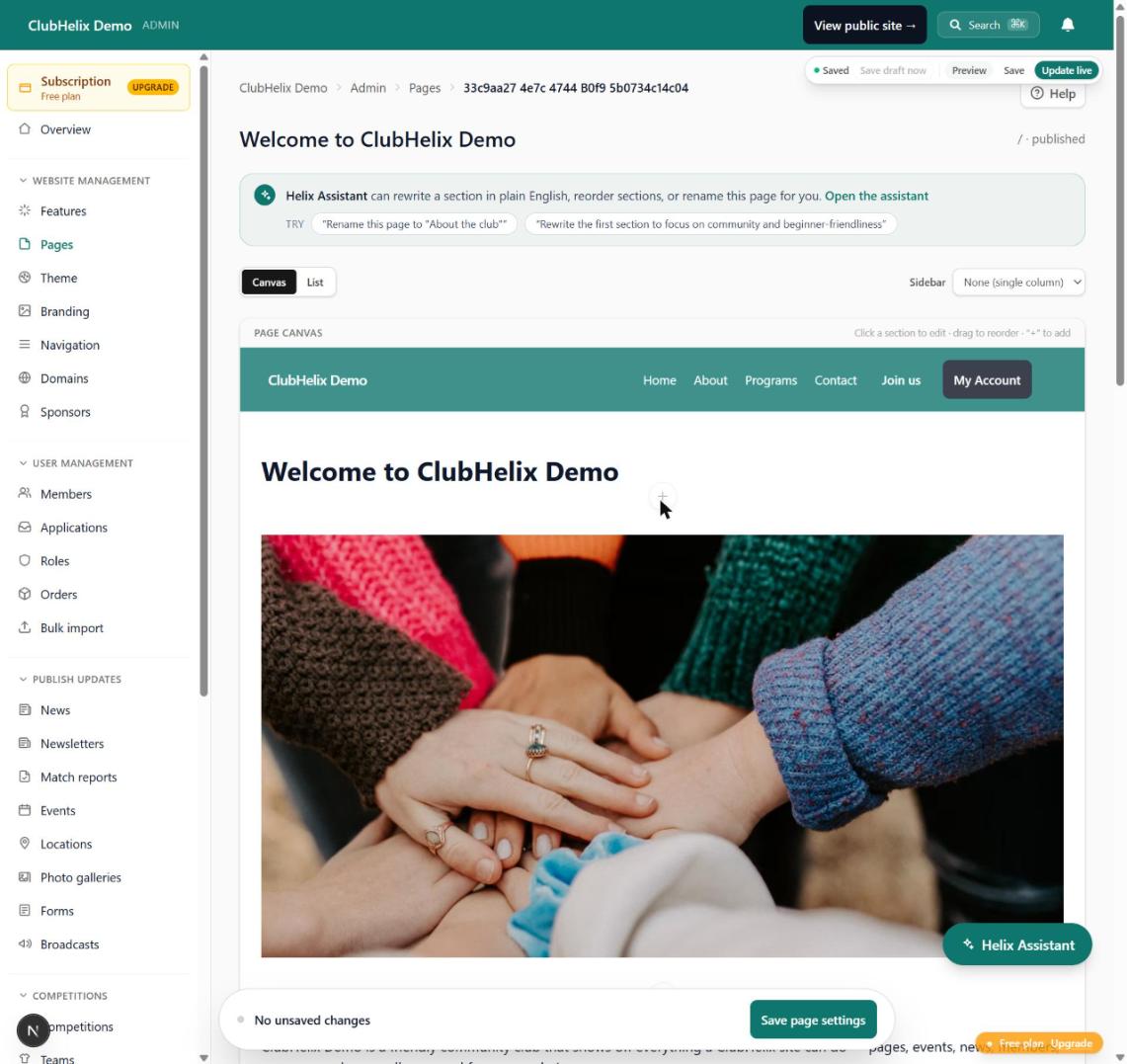
If your shortlist has landed on a club platform, what you are really buying is one system where the page and the machinery are the same product. In the ClubHelix club website builder, the canvas page editor gives a committee a genuine design surface with sections, photos and your own theme and branding, while self-registration takes the sign-ups and payments behind it — so the join button on the page you just edited creates a member record and marks them paid, on your own domain rather than a subdomain we lend you.
There is a free club website plan to build on, published prices when your club outgrows it, and an independent team behind the whole platform rather than a stack of unrelated suppliers. Most committees have a working site by the end of one evening — start building yours, or hand the first build to us with done-for-you setup.
If you want our head-to-head write-ups rather than this survey, they live at /compare — against Pitchero, GameDay, revolutioniseSPORT, general website builders, and the "club website alongside PlayHQ" case.
The fair statement of our limits, since we have asked everyone else to be honest. ClubHelix has no governing-body distribution deals, so we will never be the platform your sport hands you — where your national body mandates rails for registrations and competitions, you keep those and we cover the club-facing layer around them. We ship an installable web app rather than native app-store apps, so a club whose whole strategy is an icon on the App Store should choose accordingly. We do not do video streaming or match analysis, we do not integrate with access-control hardware, and beyond our own website the product is English-only today: our marketing site, help wiki and guides are available in Spanish and Brazilian Portuguese as a preview, but the admin, member accounts, your club's public website and the emails it sends are in English. If a competitor on this page fits your club better on those points, take them. Every head-to-head we publish, including the website builder comparison for sports clubs, is listed on the club software comparisons page.
Frequently asked questions
What is the best club website platform?
There is no single answer, because four different product categories share the label. If your sport mandates a platform, that decides your registrations and competitions and the question becomes what to use for the rest. If money, membership or teams flow through your site, a club platform will beat a general website builder. If the site is genuinely a brochure, a general builder gives you better design for less.
Is a free club website platform good enough?
Sometimes, yes — particularly a governing-body-funded one for a small affiliated club, or a general builder for a group that takes no money online. The two things to check are whether payments are available on the free plan at all (on several products they are not) and whose address your site lives at, because a free site on someone else's subdomain is the hardest thing to move later.
How much should a club website platform cost?
Published prices as at July 2026 range from nothing at all on governing-body-funded and ad-supported products to roughly the price of a monthly subscription with a payment percentage attached, with several suppliers quote-only. Model three years rather than one, include the transaction fee on your real payment volume, and check where the member-count band edges sit before you commit.
Can we move our club website to a different platform later?
Usually, if you prepared for it. Keep the domain registered in the club's name in a club-controlled account, keep an export of your member and payment data, and map your old page addresses to new ones so search results still land. Moving off a platform-owned subdomain is the hardest version of this, because the address itself does not travel.
Do we still need our own website if our governing body gives us one?
It depends what theirs does. Competition pages, fixtures and ladders are genuinely useful and worth linking to. What they do not carry is your news, your sponsors, your events, your shop, your history and your join page — the things that persuade a family who has never met you. Many clubs run both quite happily, with the mandated rails for the sport and their own site for the club.
Keep reading — how to build a sports club website walks the whole build from domain to launch, and how much a club website costs breaks down the money. Spotted something outdated or unfair above? Corrections are welcome via contact — this page only works if it stays honest.


