
What this guide answers
- Is a free club website really free, or is there a catch?
Reputable free tiers are genuinely free — the "catch" is openly structural: platform branding on the site, a platform web address, and caps on members or pages, with advanced features reserved for paid plans.
- Can we take membership payments on a free club website?
Often yes — many club platforms include online registration with card payment on lower tiers, with standard card-processing fees applying per transaction (that part is never free, on any platform, at any tier).
- What's the best free website builder for a club?
The honest answer: for a club, a club platform's free tier beats a generic website builder's free tier, because the hard part of a club website was never the pages — it's the member list, registrations and payments…
- How long does it take to set up a free club website?
An afternoon, with most of that spent gathering content rather than building — logo, fees, times, photos, contacts.
Every club committee has had this conversation: "we need a website" followed immediately by "we have no money". Good news — for a community club, that's a solvable problem. Free club websites in 2026 are genuinely useful, not crippled demos, and a volunteer can have one live in an afternoon.
But "free" deserves an honest treatment, because free tiers differ wildly in what they include, what they quietly leave out, and what they cost you in volunteer hours down the track. This guide walks through setting one up properly, the trade-offs nobody puts on their pricing page, and how to make choices today that don't need undoing when the club grows.
What a free club website can honestly do
Start with the encouraging part. On a decent free tier, a community club can run:
- A real multi-page site — home, join, fixtures or calendar, contact — not a single scrolling placeholder.
- Online membership sign-up feeding an actual member list, instead of a paper form and a spreadsheet.
- An events calendar members can check from their phones.
- News posts for announcements and match reports.
- Club colours and logo applied across the site.
That covers the overwhelming majority of what visitors come to a club website for. A club testing whether it needs a website at all can build the whole thing on a free plan and lose very little — just check the member cap before you plan a season around it, because active members are what free tiers are usually sized by.
The honest trade-offs of "free"
Nobody runs servers out of charity, so every free tier pays for itself somehow. The usual trade-offs — check each against your club's reality:
- Platform branding on your site. Free plans typically show the platform's name in your header or footer. Cosmetic, but it's the first thing paid tiers remove.
- A platform web address. You'll get an address like platform.com/yourclub rather than yourclub.org.au. Fine for sharing links; weaker on sponsor proposals and flyers.
- Caps on scale. Member limits, page limits, storage limits — and the member limit is the one that bites first, because free tiers are typically sized for a handful of active members. Read that number before you plan around it: a committee trialling the site won't notice, a 40-member club will hit it in the first month.
- The advanced admin sits behind paid tiers. Email broadcasts at volume, online shops, competition management, finer permissions — the things that matter more as the club grows.
- Generic builders' hidden cost: the patchwork. With a general-purpose free website builder the site itself is free, but registration means bolting on a separate forms tool, payments mean payment links pasted by hand, and the member list means a spreadsheet — three logins, no single source of truth, all maintained by whoever set it up. Free-as-in-website often isn't free-as-in-running-the-club.
One trade-off you should refuse: ads on your club site. A junior club's website carrying random third-party ads looks terrible to parents and sponsors alike. Free tiers without ads exist; hold that line.
Step by step: free club website in an afternoon
The build itself is the quick part — the checklist below is deliberately the same shape as our full guide to building a sports club website, which covers each step in depth.
- Gather the raw materials first (this is genuinely most of the work): your logo as a transparent PNG, club colours, fee table, training times, venue addresses, three or four decent photos, and role-based contact details.
- Sign up on the free tier with a club email address, not a personal one — the account should survive committee handover. ClubHelix's free plan is on the pricing page, alongside exactly what it includes and what the paid tiers add — no surprises later.
- Set your theme once: logo and colours, applied site-wide, so every page you add matches automatically.
- Build four pages, finished, before any others: Home (what/where/who plus a join button), Join (fees and a real sign-up form), Fixtures or Calendar, Contact. Four finished pages beat nine "coming soon" stubs — placeholder pages read as a dead club.
- Publish and test on a phone — most of your visitors are on one. Can a parent find training times in ten seconds? Can they tap the venue and get directions?
- Point people at it: community social media groups, your governing body's club listing, the council directory, a QR code on the registration-day flyer.
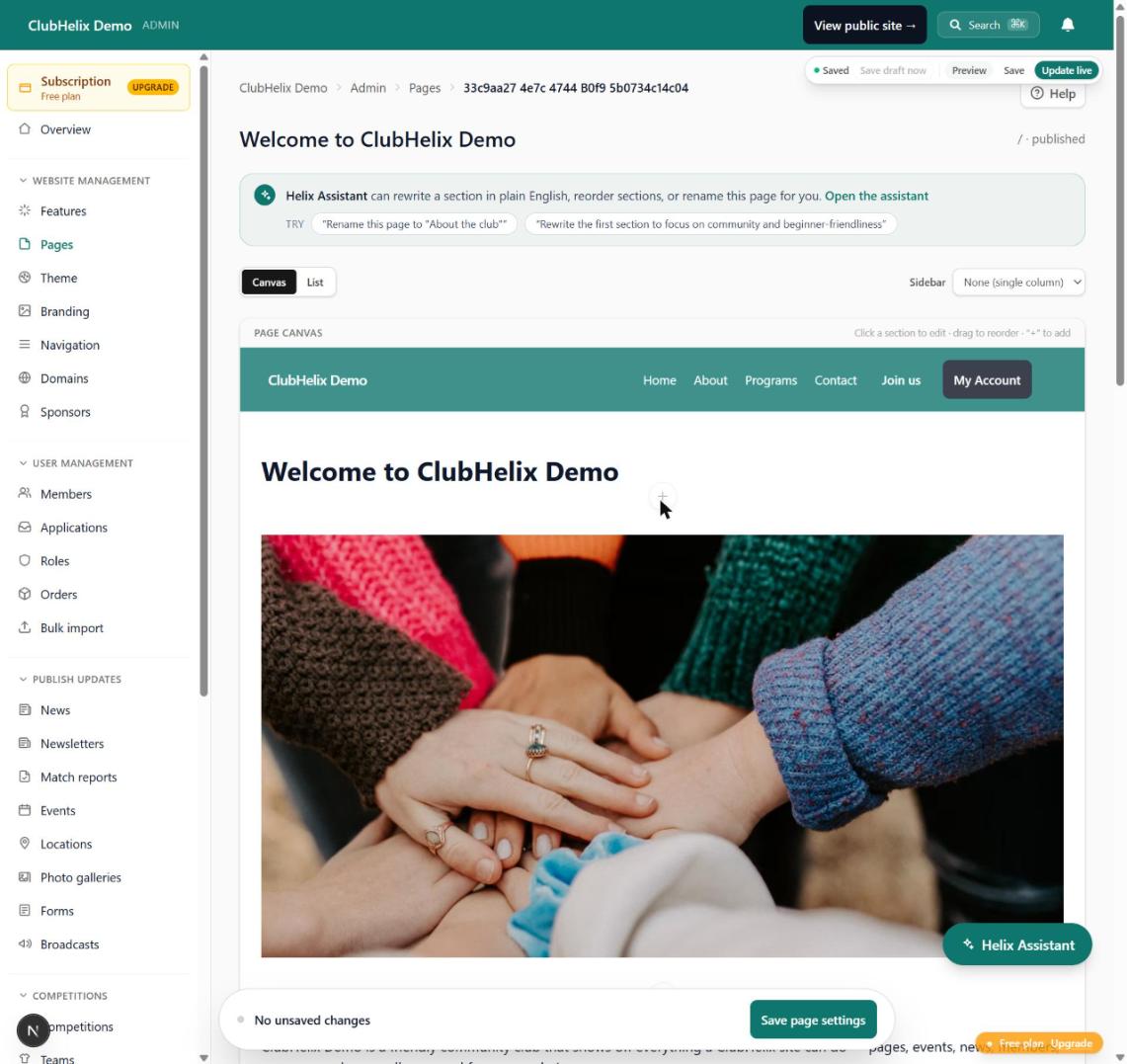
With a drag-and-drop editor this is honestly an afternoon — sections drag into place, and there's nothing to install or host.
The one thing worth paying for on day one
If your club spends money on exactly one digital thing this year, make it the domain name. It's the cheapest credibility upgrade that exists, it's easy to read out at the bar, and it's insurance: the address on your flyers, QR codes and sponsor decks stays yours forever, wherever the site behind it lives. Register it in the club's name, from the club's account.
Aim for yourclub.org.au or .com.au, roughly $15–$40 a year. Note that .org.au and .com.au have eligibility rules — you generally need an ABN or an incorporated entity to hold one — so sort the club's legal structure first. See starting a club for that sequencing.
Some platforms let you connect your own domain on free or low tiers; others reserve it for paid plans — check before you commit if this matters to you on day one. Even if you can't connect it yet, register it now so it's waiting.
Free vs paid: when the maths flips
The right way to think about upgrading isn't features — it's volunteer hours and money handled. Signals the free tier's job is done:
- You're collecting real money. Season fees for a couple of hundred members deserve proper online payment with automatic receipts and records — chasing bank transfers against a spreadsheet burns treasurer evenings that cost more than any subscription.
- You've hit the caps — members, pages, storage — and you're working around them rather than within them.
- The patchwork is creaking. If registration, payments, email and the website are four separate free tools glued together by one heroic volunteer, you're paying full price in the only currency clubs are actually short of.
- Sponsors are on the site. A sponsor strip on a platform-branded free address undersells clubs that are otherwise well run.
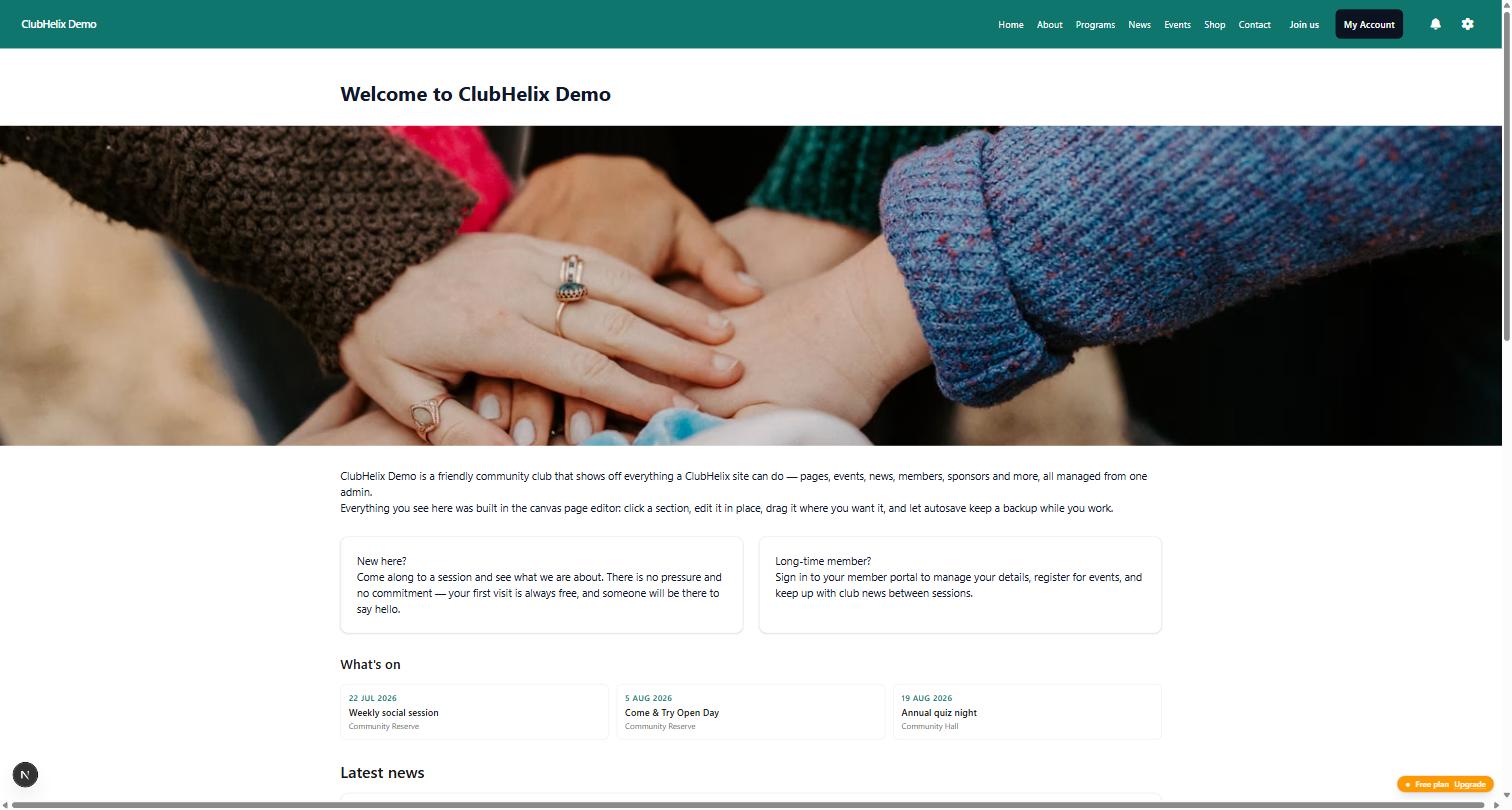
A club that starts on a well-chosen free tier upgrades by flipping a plan switch — same site, same member data, same address. A club that starts on a patchwork rebuilds. That, more than anything on a feature table, is the argument for choosing your free platform carefully. (For what a finished, grown-up club site looks like, browse our club website examples.)
Mistakes free-tier clubs make (all avoidable)
- Personal accounts everywhere. The site, the domain, the email list — all under one volunteer's personal logins. Institutionalise from day one: club email address, shared password manager entry, two admins minimum.
- Launching half-built. Publish four finished pages; add the rest as they're actually ready.
- Letting it go stale. A website with last season's fees does more harm than no website. Put "check the website's four pages" on the pre-season committee checklist — it's a twenty-minute job.
- Ignoring search basics. Suburb + sport in your homepage title and first paragraph ("Bayside Netball Club — junior and senior netball in Melbourne's bayside"). Free tier or not, local search is your top recruitment channel.
- Treating free as forever without a plan. Free tiers are a superb start, and a fine permanent home for the very smallest clubs — but decide in advance which signal (money, caps, patchwork) will trigger the upgrade conversation, so it happens calmly at budget time rather than mid-crisis in July. For most clubs the member cap gets there first.
Frequently asked questions
Is a free club website really free, or is there a catch?
Reputable free tiers are genuinely free — the "catch" is openly structural: platform branding on the site, a platform web address, and caps on members or pages, with advanced features reserved for paid plans. That's a fair trade for a small club. The catches to actually avoid are third-party ads on your site and platforms that make leaving hard by holding your member data.
Can we take membership payments on a free club website?
Often yes — many club platforms include online registration with card payment on lower tiers, with standard card-processing fees applying per transaction (that part is never free, on any platform, at any tier). Check exactly what each tier includes on the platform's pricing page — ClubHelix's is here. If a free tier only offers a contact form, budget the volunteer hours of chasing bank transfers into your definition of "free".
What's the best free website builder for a club?
The honest answer: for a club, a club platform's free tier beats a generic website builder's free tier, because the hard part of a club website was never the pages — it's the member list, registrations and payments behind them. A generic builder does free pages beautifully and leaves you stitching the club part together from separate tools. Pick whichever club platform's free tier fits your size; the full build guide has the evaluation checklist.
How long does it take to set up a free club website?
An afternoon, with most of that spent gathering content rather than building — logo, fees, times, photos, contacts. The build itself, on a drag-and-drop editor, is an hour or two for the essential four pages. Launch fast with less, then improve; a live imperfect site recruits better than a perfect one scheduled for next month.
Start where every club should: free. ClubHelix gives your club a real website with drag-and-drop editing and your club's colours — see what each plan includes on pricing, and create your club site this afternoon.


