
What this guide answers
- Is our club eligible for a .org.au domain?
au is designed for exactly that, and eligibility is checked automatically at checkout using your ABN or incorporation number.
- What is the best domain ending for a sports club?
au — it's cheap, it reads as the non-profit you are, and eligibility is straightforward for incorporated associations.
- Who should the club domain be registered to?
The club itself — the incorporated association with its ABN — never an individual volunteer, however trusted.
- Can we move our existing website to a new domain?
Yes, and it's routine: connect the new domain to your platform, and keep the old address redirecting to the new one for as long as practical so printed materials, QR codes and old links keep working.
A domain name is the smallest purchase your club will ever make that outlives every committee: $15–$40 a year for an address — yourclub.org.au — that goes on the banner, the jumper sponsor's invoice, the QR code at rego day, and the front of every email the club sends. Get it right once and it works for decades. Get it wrong — registered in a volunteer's personal name, on a forgettable ending, tied to a defunct email — and it becomes one of the classic club-admin disasters.
This guide walks a committee through the whole decision: which ending to choose (with the actual eligibility rules for .org.au), what to name it, where to buy it, the ownership rules that protect the club, and how it connects to your website and email once you have it.
Which ending should a club choose?
For Australian clubs, four endings are worth considering. The short version: .org.au is the natural home for an incorporated community club, with .com.au a fine alternative and .au worth adding defensively once you're established.
| Ending | Who it's for | Eligibility | Typical cost/yr | Reads as |
|---|---|---|---|---|
.org.au | Charities and non-profit organisations | Non-profit entity with an Australian presence — an incorporated association qualifies | $10–$25 | Community organisation — exactly what you are |
.com.au | Commercial entities | ABN/ACN required; broadly available to registered organisations | $10–$25 | Business-flavoured but completely normal for clubs |
.au (direct) | Anyone with a verified Australian presence | ABN/ACN or other Australian connection | $10–$25 | Modern, short; newer so both variants often free |
.com | Anyone, worldwide | None | $15–$40 | Generic; fine, but doesn't signal local or non-profit |
Notes a committee should actually weigh:
.org.aueligibility is simpler than clubs fear. The.org.auspace is for non-profits and charities with an Australian presence. An incorporated association (the structure most clubs already have) qualifies straightforwardly — you'll typically supply your incorporation number or ABN at checkout, and the registrar checks it automatically. If your club is unincorporated, sort incorporation first; it matters for far more than the domain.- Australian endings require Australian credentials. All
.aufamily names (.org.au,.com.au, direct.au) require a verified Australian presence — usually your ABN. Registering is easiest once the club has an ABN, which is free and useful everywhere else too (banking, grants, invoicing sponsors). - Direct
.auand defensive registrations. Since direct.auregistration opened, many organisations hold bothyourclub.org.auandyourclub.au, pointing one at the other. It's cheap insurance against confusion, but it's optional — do it once the club is established, not on day one. - Avoid free subdomains as your public identity.
yourclub.freewebsitebuilder.siteaddresses are fine as a temporary scaffold, but they change if you switch platforms, look less credible on sponsorship proposals, and can't carry club email. The whole point of buying a domain is an address the club controls permanently, whatever software sits behind it.
Choosing the name itself
Rules of thumb, learned the hard way by a thousand clubs:
- Match how people say it. If everyone calls you "Northside Tigers",
northsidetigers.org.aubeatsnthsdetigersfc.org.au. You will read this address out loud over the phone and print it on banners — it must survive both. - Shorter wins, but clarity beats brevity. Drop words like "incorporated"; keep the words that identify you locally (suburb or sport) if the short name is ambiguous or taken.
- No hyphens, no numbers unless they're genuinely part of the club name. Both are misheard verbally and mistyped constantly.
- Check the name across everything at once. Before committing, check the domain and the matching social handles. Perfect alignment isn't essential, but you want to know now, not after the banner is printed.
- If your dream name is taken, check who by. Another club with the same name in another state is normal — add your suburb. A dormant registration might lapse; set a calendar reminder. Don't pay squatters speculative prices for a community club domain; a small variation costs nothing.
Where to buy it (and the traps at checkout)
Buy from any established, accredited Australian registrar — the product is identical, so compare on renewal price (the first-year teaser is irrelevant; you'll pay the renewal price for decades), support quality, and whether the dashboard is simple enough for a non-technical secretary.
Checkout traps to decline politely:
- Website builder and hosting bundles. Your club platform provides the website; you only need the domain.
- Multiple mailbox upsells. Decide your email setup separately and deliberately — our guide to getting a club email address covers the options from free forwarding up.
- "Privacy protection" for
.aunames is largely moot — registrant details for organisations are limited in the public record anyway. - Multi-year lock-ins at inflated renewal rates. Multi-year is fine (it's a hedge against lapse-by-forgetfulness) but only at a sensible per-year price.
Do say yes to: auto-renewal, paid from the club's card, with renewal notices going to a role-based club address.
The ownership rules that protect the club
This section matters more than everything above it. Domains are lost not to technology but to administration: registered under a personal email, paid from a personal card, forgotten at handover, expired silently, gone.
- Registrant = the club. The legal registrant must be the incorporated association (with its ABN/incorporation number) — never a volunteer personally, never the web person's business, never a sponsor "helping out". Whoever is the registrant owns the domain, whatever anyone intended.
- Account contact = a role address. The registrar account and renewal notices point at
secretary@oradmin@at the club — an address that transfers with the role. (Circular on day one, since that address needs the domain? Use a shared club-controlled inbox first, then update it once club email is live.) - Two people can always get in. Registrar login credentials sit in the committee handover pack; at least two current committee members can access the account. Review at every AGM, alongside the bank signatories — same category of risk.
- Auto-renew from the club account. Expired club domains are snapped up by parking services within days, and buying one back is somewhere between expensive and impossible.
- Record it in the asset register. Registrar, renewal date, cost, login location. The domain is club property; treat it like the mower.
If your domain is currently registered to a past volunteer: fix it now, while relations are good. Registrars all have a change-of-registrant process, it's free or nearly so, and it takes ten minutes of cooperation — a commodity that has a way of evaporating after a contested AGM.

Connecting the domain to your website and email
A fresh domain does nothing by itself — it's an entry in the DNS system that you point at services. The two connections every club makes:
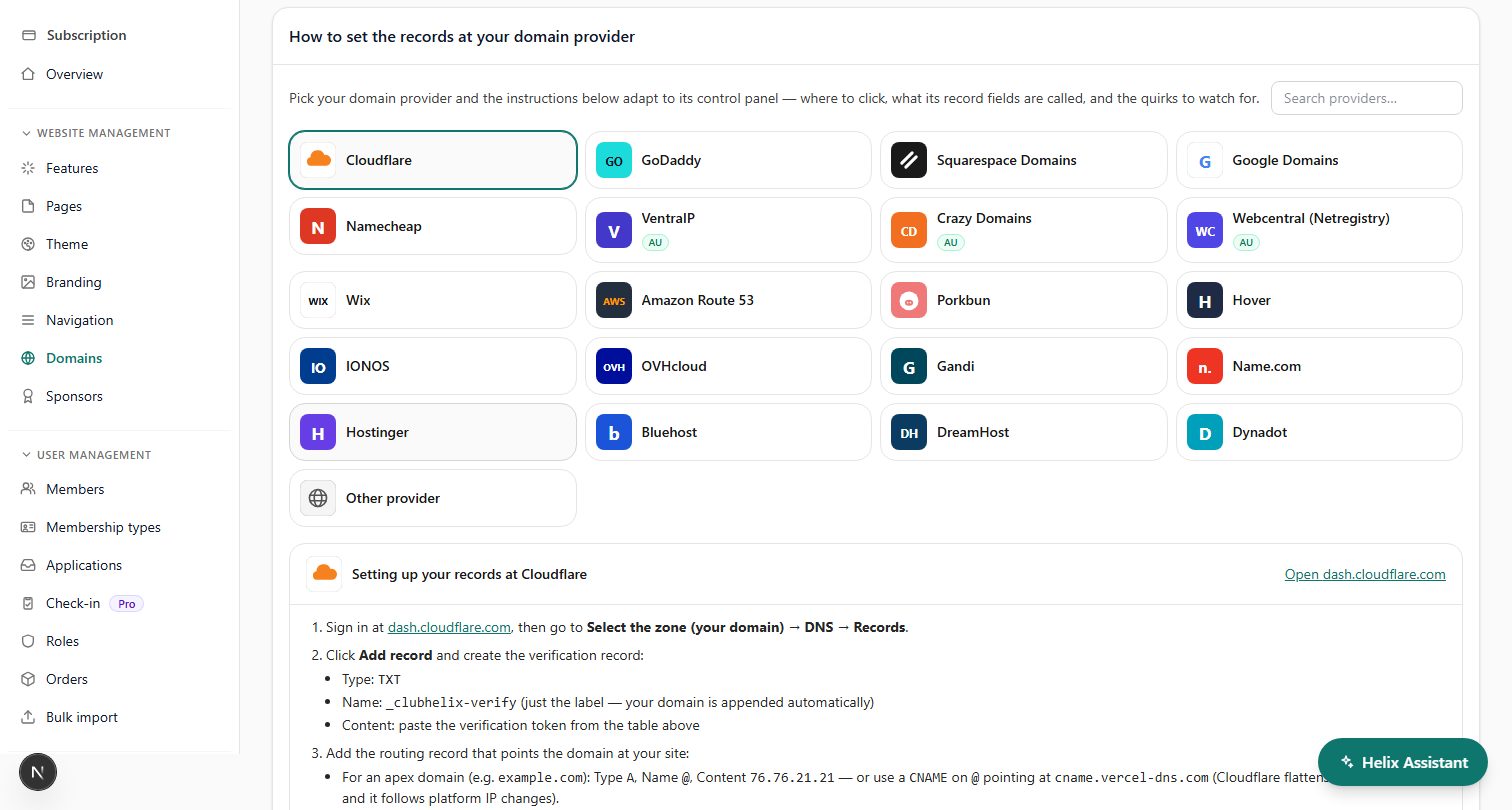
Website. Your club platform gives you a couple of DNS records (typically a CNAME for www and an A/ALIAS record for the bare domain). You paste them into the registrar's DNS panel, the platform verifies, and your site answers at yourclub.org.au with an HTTPS certificate issued automatically. On ClubHelix, custom domains are set up from the admin with the exact records shown, verification tracked, and certificates handled — no separate hosting to buy. (Building the site itself? Start with how to build a sports club website.)
Email. The same domain carries your club's email addresses (secretary@yourclub.org.au) and — critically — the authentication records (SPF, DKIM) that keep bulk club email out of spam folders. Each email service you use gives you a few more DNS records to paste in. Plain-language detail in why club emails go to spam, and ClubHelix's custom sending domain generates and verifies its records for you.
A tidy pattern for the DNS panel: add records, never delete ones you don't understand, and keep a one-line note in the handover doc for what each record is for ("CNAME www → website", "TXT → email authentication"). Future volunteers will not have to reverse-engineer it.
What it costs, all in
- Domain registration: $10–$40/year depending on ending and registrar. Budget $25.
- Defensive second registration (e.g. matching
.au): optional, same again. - Connecting to website/email: free — it's configuration, not a product.
- The real cost is governance: ten minutes at each AGM confirming the renewal is set, the contacts are current, and two people hold access.
Against that: an address that survives every platform change, committee handover and rebrand the club will ever have. Few line items in the club budget buy more permanence per dollar. When you're ready to put a website behind it, ClubHelix plans include custom domain connection — see pricing.
Frequently asked questions
Is our club eligible for a .org.au domain?
If your club is an incorporated association (or otherwise a non-profit with an Australian presence), yes — .org.au is designed for exactly that, and eligibility is checked automatically at checkout using your ABN or incorporation number. Unincorporated clubs should incorporate first, which matters well beyond the domain. If you'd rather not wait, .com.au is available to any organisation with an ABN and is completely normal for sporting clubs.
What is the best domain ending for a sports club?
For Australian community clubs, .org.au — it's cheap, it reads as the non-profit you are, and eligibility is straightforward for incorporated associations. .com.au is an equally practical choice, and a matching direct .au is worth adding defensively once the club is established. Plain .com is fine but signals neither local nor community. Whichever you choose, the name should match what locals actually call the club.
Who should the club domain be registered to?
The club itself — the incorporated association with its ABN — never an individual volunteer, however trusted. The registrar account should use a role-based club email for renewals, at least two committee members should hold access, auto-renew should be paid from the club account, and the whole arrangement should be reviewed at every AGM. Most "we lost our domain" stories are really "it was registered to someone who left".
Can we move our existing website to a new domain?
Yes, and it's routine: connect the new domain to your platform, and keep the old address redirecting to the new one for as long as practical so printed materials, QR codes and old links keep working. If you're switching from a free subdomain to your own domain, do it early — every season you wait puts the temporary address on more jumpers, flyers and fridge magnets.
Got the domain? ClubHelix connects your own domain to a full club website — with your club's colours and authenticated club email on the same address.


