
What this guide answers
- What adult-to-child ratio does a youth group need?
Minimum ratios are set by your state's guidance and, if you're affiliated, your parent organisation — they vary by age group and activity type, with younger children and higher-risk activities needing more adults.
- Do parent helpers need a working-with-children check?
Rules vary by state: some exempt parents volunteering in an activity their own child participates in, others don't, and exemptions often disappear for overnight activities.
- How big should a youth group be?
Most groups work best with 15–30 young people per section or age band — enough energy for great games, small enough that every child is known well by leaders.
- How is a scout-style group different from a general youth club?
Scout-style groups belong to a national organisation that provides the program framework, awards scheme, training, insurance and child-safety policies — you deliver a defined program locally.
Canada edition. This guide is written for volunteer-run clubs in Canada. Where rules differ — grants, tax, incorporation, safeguarding — follow the Canada-specific pointers below or check with your national body.
Youth groups come in many uniforms — scout and guide-style groups, church youth groups, council drop-in programs, cadet units, junior service clubs — but the job of running one is remarkably consistent: keep young people safe, give them a program worth turning up for, keep parents informed, and keep a small team of volunteer leaders from burning out.
This guide covers youth group management for leaders and committees, whether you're taking over an established scout-style group or starting a community youth club from scratch. Child safety comes first, because in this kind of group it genuinely is the foundation everything else stands on.
Child safety is the foundation, not a checkbox
For a youth group, safeguarding isn't abstract compliance — it shapes how you recruit leaders, run activities, communicate and handle concerns.
Requirements are set provincially and by whatever national organisation you're chartered under. Expect a criminal record check with a vulnerable sector screening for every adult leader, repeated on a cycle — note that this screening is run through local police and can take considerable time, so start it well before you need the leader. Every province imposes a legal duty to report suspected child abuse, and in most it applies to every adult, volunteers included. Adopt a written two-adult rule and train leaders on it.
The load-bearing pieces:
- Screening every adult. Leaders, helpers and regular parent volunteers need the working-with-children clearance required in your state (names and rules differ — see schemes such as the Victorian WWCC or the NSW Office of the Children's Guardian). Verify cards, record numbers and expiry dates, and actually check them before someone starts — not after. Our guide to working-with-children check requirements for clubs covers the state-by-state landscape.
- A written child-safe policy and code of conduct that every leader signs — covering supervision, physical contact, one-on-one situations (avoid them; use the two-adult rule), transport, photography and online communication. Our child-safe standards guide walks through building one.
- Safe communication channels. Adults never message a young person privately. Group communication goes through parents for younger members, or through monitored group channels — never a leader's personal chat account — for older ones.
- A clear way to raise concerns, a named child-safety contact, and knowledge of your state's reporting obligations. Every incident and near miss gets written down — an incident report form makes that routine rather than exceptional.
If your group is affiliated with a national youth organisation, adopt their current policies and training wholesale — they're maintained by specialists and your affiliation will require it anyway.
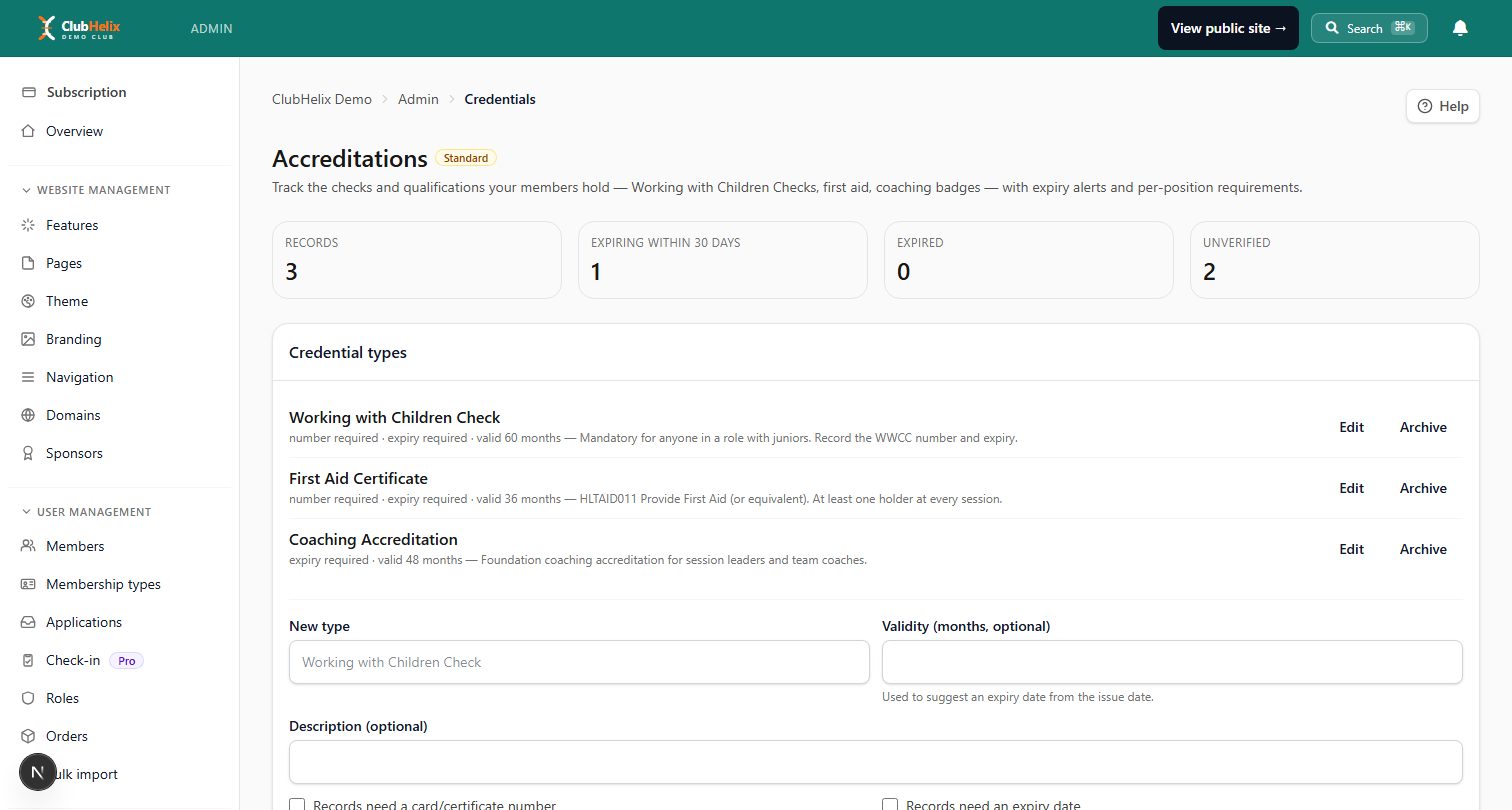
Tracking all of this is genuinely hard with a spreadsheet: cards expire quietly, and an expired clearance means an adult legally can't help that week. This is exactly the problem an accreditation and WWCC expiry tracker solves — every leader's clearances in one place, with expiry warnings before they bite.
Child-safety law and WWCC schemes differ between states and change over time — treat this as general information and confirm current requirements with your state regulator and, if affiliated, your parent organisation.
Leaders and helpers: recruiting, ratios and rosters
A youth group lives and dies on its adult volunteers. Three practical rules:
- Recruit in pairs and teams, never lone heroes. One leader per section is a resignation waiting to happen. Aim for at least two screened leaders at every session, plus a bench of parent helpers — the two-adult rule is both a safety measure and a burnout preventer.
- Set supervision ratios deliberately. Your affiliation or state guidance will set minimum adult-to-child ratios by age; younger sections and adventurous activities need more adults. Publish your ratios so parents know them, and cancel rather than run under-supervised.
- Make helping easy and specific. "We need a parent to run the supply cupboard for term 2" recruits far better than "we need help". Our guide on recruiting club volunteers has scripts that work.
Invest in your leaders: pay for their first-aid training, run a proper handover when leaders change, and thank them publicly and often.
Plan a program young people actually want to attend
The difference between a thriving group and a dwindling one is nearly always the program. Principles that hold across scout-style groups, church groups and drop-in clubs alike:
- Plan by term, publish in advance. A term sheet — one line per week — lets families plan and builds anticipation. Mix your regular formula with anchor events: a camp or sleepover, a community-service project, an excursion, a games tournament.
- Balance the mix. A reliable weekly rhythm (games, activity, food, wind-down) with variety inside it. Scout-style groups have badge and award frameworks that do this structuring for you; independent groups should steal the idea — progression keeps older kids engaged.
- Let young people lead. From choosing next term's activities to older members running games for younger ones, shared ownership is the single best retention tool for teenagers.
- Have a wet-weather and low-numbers plan in your back pocket every week.
A simple term-planning table keeps everyone aligned:
| Week | Activity | Lead adult | Needs |
|---|---|---|---|
| 1 | Welcome night + games | Sam | Name tags, BBQ |
| 2 | First-aid skills night | Priya | Guest instructor, bandages |
| 3 | Night hike | Sam + Alex | Extra helpers, torches, forms |
| 4 | Community garden project | Alex | Tools, gloves, sunscreen |
For activities beyond the hall — hikes, water activities, camps — use your parent organisation's approval process, or if independent, write a simple risk assessment and collect a signed permission and medical form for each event. Digital waivers and permission forms beat crumpled paper notes: parents sign from their phone and you can see at a glance who hasn't.
Communicating with parents (without drowning)
Parents judge a youth group as much on communication as on program. The formula:
- One channel of record. A term email covering dates, costs and forms, with everything also on the group's website. Chat threads are for reminders, never for the only copy of important information.
- RSVPs for everything with a headcount. Knowing 14 of 22 are coming to the hike changes your transport, food and supervision maths. Online RSVPs and attendance tracking also gives you the session-by-session roll — which doubles as your evacuation list on the night.
- Emergency contacts and medical info, current and accessible. Collected at registration, updated yearly, and available to leaders at every activity (printed or on a phone) — never locked in a filing cabinet at the hall.
- Close the loop after events. A short photo recap (only of children with photo consent) is the best recruitment material you'll ever produce.

Money, fees and fundraising
Youth groups run on modest budgets, but the money still needs proper handling — it's other people's money held in trust for children's activities:
- Set fees deliberately. A term or annual fee covering hall hire, insurance, materials and affiliation, with activity costs (camps, excursions) charged per event. Publish a hardship policy — no young person should miss out quietly because of cost, and most groups would rather know.
- Collect online. Chasing cash and matching mystery bank transfers is the treasurer's least favourite job; online registration with payment fixes both, and gives you a clean record for the AGM.
- Fundraise on the classics. Sausage sizzles, quiz nights, and community grants — youth programs are a favoured category for council and state grants. See our fundraising ideas and grant application guide.
- Two signatories, simple reports. Standard committee hygiene applies, however small the amounts.
Your group's online front door
Families find youth groups the same way they find everything else — by searching. A scout group website (or any youth group's site) needs to answer a parent's questions in one visit: who the group is for, ages and sections, when and where you meet, what it costs, how adults are screened, and how to register interest. A visible child-safety statement isn't just compliance — it's the first thing careful parents look for.
Keep it current: term dates, upcoming events, and a photo feed with consent-checked images. A stale website quietly tells parents the group might be too.
ClubHelix gives youth groups exactly this front door — a proper website with online registration, event RSVPs and permission forms, leader WWCC expiry tracking, safeguarded group chat and parent email in one place, with a free tier to start. See how scout-style and youth organisations use it on our scouts and youth groups page.
Frequently asked questions
What adult-to-child ratio does a youth group need?
Minimum ratios are set by your state's guidance and, if you're affiliated, your parent organisation — they vary by age group and activity type, with younger children and higher-risk activities needing more adults. Whatever the minimum, never run a session with fewer than two screened adults.
Do parent helpers need a working-with-children check?
Rules vary by state: some exempt parents volunteering in an activity their own child participates in, others don't, and exemptions often disappear for overnight activities. Check your state scheme's current rules, and when in doubt, get the check — it's free for volunteers in most states.
How big should a youth group be?
Most groups work best with 15–30 young people per section or age band — enough energy for great games, small enough that every child is known well by leaders. Beyond that, split into sections by age rather than growing one giant group.
How is a scout-style group different from a general youth club?
Scout-style groups belong to a national organisation that provides the program framework, awards scheme, training, insurance and child-safety policies — you deliver a defined program locally. An independent youth club designs its own program and carries its own compliance, which is more freedom and more work.