
What this guide answers
- What records does a dive club need to keep on its members?
At minimum: training agency and certification level, certification date, any specialty tickets, the date of the last logged dive, fitness-to-dive declaration date, first-aid and oxygen currency for anyone filling that…
- How should a dive club handle currency for lapsed divers?
Write a tiered currency policy and publish it. A common approach is no action for divers who have been in the water recently, a paired shallow dive for those with a gap of several months, and a supervised refresher for…
- How do clubs pair buddies fairly on a trip?
Use a stated method rather than letting pairs form on arrival — sort by certification, then currency, then site familiarity, plan every pair to the lower certification and shorter gas of the two, and assign new members…
- Should a dive club take deposits for boat charters?
Yes, because a charter is a fixed cost regardless of how many divers turn up.
- Does a small dive club need its own website?
It helps more than most clubs expect. The trip calendar, the joining process, the currency rules and the site information are exactly what prospective members look for before they contact anyone, and a self-service…
It is quarter to six on a Saturday morning, the charter leaves at seven, and your trip leader is standing at the ramp trying to work out whether the person who just arrived has been in the water since the year before last. Nobody wants that conversation in the dark, half into a wetsuit, in front of eleven other people who are ready to load. And nobody should have to have it — the answer should have been settled on Wednesday, from a record the club already holds.
Dive clubs are unusual among community clubs because the admin is load-bearing. A tennis club with a messy membership list has a messy membership list. A dive club with a messy certification list quietly plans an under-qualified diver onto a site they cannot handle, or sends a pair down with mismatched training and no shared plan. That is the whole argument of this guide — the records, the pairing and the trip rules are not bureaucracy bolted onto the club, they are the club, and the social side is far better when they are handled early and consistently instead of on the ramp.
This guide is for the volunteers who actually run a recreational dive club — the committee, the dive officer, the trip coordinator and whoever ended up holding the bank card. It covers certification and currency records, planning a dive day and pairing buddies, the money mechanics of boat charters, deposits and cancellations, gear and cylinder test dates, and how to run all of it from a club website instead of a group chat, an inbox and three spreadsheets that disagree with each other.
Decide which kind of dive club you are
Before you fix any process, be honest about the shape of the club, because the shape decides who carries what.
| Club shape | The club provides | The diver provides | Where the obligation sits |
|---|---|---|---|
| Social trip club | Calendar, bookings, buddies, shared costs | Own certification, gear, fitness, currency | Mostly with the individual diver — but the club still chooses who it puts on a boat |
| Club attached to a dive centre | Social calendar, member rates, a trip pipeline | Training and fills bought from the centre | Shared — get the arrangement in writing, including who supervises club trips |
| Training club | Instructors, dive leaders, courses, often compressors and cylinders | Membership and willingness to be supervised | Heaviest — you are running training and equipment programs, not just a calendar |
Most clubs drift from the first shape towards the third without ever deciding to. Someone buys a compressor, an instructor joins and starts teaching, and suddenly the club has obligations its constitution never anticipated. Name your shape in the welcome pack so a new member knows exactly what the club does and does not provide, and revisit it whenever the club acquires equipment or an instructor.
Recreational clubs here commonly affiliate with the national underwater federation, and most incorporate as an incorporated association under their state or territory legislation — which is what lets the club hold a bank account, sign a charter contract and take out insurance in its own name rather than in the treasurer's. Read the affiliation insurance wording closely and confirm what it covers for club-organised dives, shore dives and training. Our guide on how to incorporate a club covers the setup.
Certification, currency and the records that matter
What to hold on every diver
A dive club's member record is a genuine operational document, not a mailing list. Hold these fields, keep them member-editable, and require committee approval on the ones that matter.
| Field | Why it matters | How often it changes |
|---|---|---|
| Training agency and certification level | Decides which sites and depths a diver can be planned onto | Rarely |
| Certification date and card or reference number | Lets you verify rather than take someone's word | Rarely |
| Specialty tickets (nitrox, deep, wreck, night, drysuit) | Some trips simply cannot take a diver without one | Occasionally |
| Date of last logged dive | The single best currency signal you have | Every trip |
| Refresher or checkout completed | Whether a lapsed diver has actually been back in the water | Per lapse |
| Fitness-to-dive declaration date | Charters and sites routinely ask for it | Annually |
| First-aid and oxygen provider currency | Determines who can be the trip's first-aid officer | Every one to three years |
| Emergency contact and relevant medical notes | Needed on the day, on the boat, by the person running the roll | Annually |
| Diver insurance or cover reference | Some operators and sites require evidence before boarding | Annually |
| Signed club rules and acknowledgement | Establishes that the diver has accepted how the club operates | Annually |
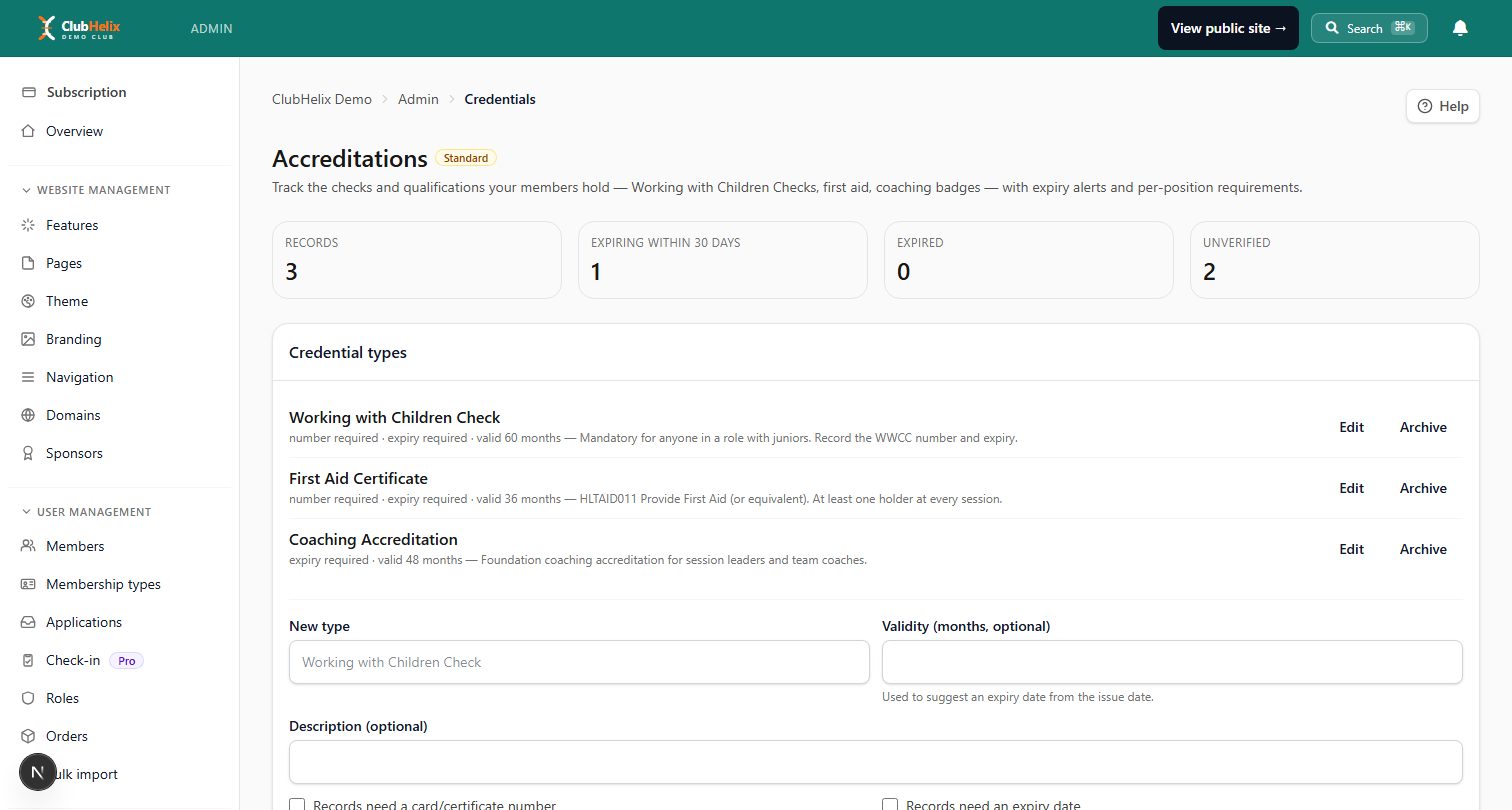
Two rules make the difference between a list and a system. First, store the expiry or renewal date, not just the fact that a document once existed — an oxygen provider certificate with no date on file is the same as no certificate. Second, make it self-service: members update their own profile after a course, the committee approves the change, and nobody has to email a photo of a card to a volunteer who checks their inbox weekly. Accreditation tracking exists for exactly this pattern, with expiry reminders that go out before the trip rather than after.
Currency is the rule most clubs skip
Certifications do not expire. Competence does. A diver certified eight years ago who has not been wet since is a genuine planning problem, and the club that has no written rule will resolve it socially — which means badly, in public, at the ramp.
Write a currency policy, publish it, and apply it to everyone including committee members. As an example only, a workable set of tiers looks like this:
- Dived in the last three months — no action, normal pairing.
- Three to twelve months — pair with an experienced member, shallow and sheltered first dive of the trip.
- Twelve to twenty-four months — pool or sheltered-water refresher with a dive leader before joining a boat trip.
- Over twenty-four months, or moving up a site grade — refresher plus a supervised checkout dive before the club plans them onto anything demanding.
The policy is only worth writing if it is visible. Your trip coordinator should be able to open the trip list and see a flag beside any name that needs attention, four days out, without cross-referencing a spreadsheet. That single change removes the most uncomfortable conversation in club diving from the ramp and moves it to a Wednesday evening message.

Pool time is the underrated club asset here. A monthly hour of lane or dive-well hire gives you somewhere to run refreshers, mask-clear and regulator drills, gear trials and new-member checkouts without burning a charter seat — and it is the cheapest fix available for the currency problem above.
Planning a dive day
Roles on the day
The failure mode on club trips is not that nobody is in charge — it is that one enthusiastic person is quietly doing five jobs and has stopped counting heads.
| Role | Owns | Should hold |
|---|---|---|
| Trip coordinator (before the day) | Bookings, payments, headcount, briefing note, currency flags cleared | Access to the member records |
| Dive leader or in-water supervisor | The plan, depth and time limits, the call to change or abort it | The club's recognised leadership grade |
| Surface marshal | Roll call in and out of the water, in-water times, the tally board | Nothing technical — but must not dive |
| First-aid and oxygen officer | Kit check before departure, response on the day | Current first-aid and oxygen provider |
| Boat liaison or shore captain | Skipper communication, loading order, ramp and parking logistics | Local knowledge of the site |
| Every buddy pair | Each other, all day | A shared plan agreed before entry |
The rule worth writing into your trip policy: on a full charter, no single person holds two of the first four roles. If the club is small enough that this is impossible, cap the trip size until it is possible.
Pairing buddies without a committee meeting
Pairing is where clubs are either generous or cliquey, and new members can tell within one trip. Use a stated method rather than letting pairs form in the car park by default:
- Sort the trip list by certification level, then by currency, then by familiarity with the site.
- Pair down, not across — the plan follows the lower certification and the shorter gas of the pair, and everyone should know that before the boat leaves.
- Give any new or returning member a designated experienced buddy, chosen by the dive leader, not by whoever is left over.
- Keep one flexible experienced diver unpaired to absorb an odd number or a last-minute drop-out.
- Publish the buddy board the night before, with the pairing plus the planned maximum depth and time for each pair.
Publishing it early is the point. It converts a car-park negotiation into a message people read on the couch, and it lets someone say "I would rather not do that site" before they have driven two hours to say it.
A trip run sheet you can reuse
| When | What happens | Who |
|---|---|---|
| Four days out | Trip list closes, currency flags cleared, final numbers to the operator | Trip coordinator |
| Two days out | Payments reconciled, buddy board published, gear and cylinder needs confirmed | Trip coordinator |
| Day before | Conditions check, go or no-go message sent either way by the stated time | Trip coordinator |
| One hour before | Arrival, roll call, fitness declarations confirmed, kit assembled | Surface marshal |
| Thirty minutes | Briefing — site, plan, limits, signals, lost-buddy procedure, emergency plan | Dive leader |
| Departure | Load in agreed order, tally on board | Boat liaison |
| Each dive | In and out times recorded against every name | Surface marshal |
| Surface interval | Tally, gas check, plan the second dive with any changes | Dive leader |
| Back on shore | Debrief, logs updated, any incident or near miss captured while it is fresh | Dive leader |
Charters, deposits and cancellations
The break-even nobody explains to new committees
Boat charter is a fixed cost pretending to be a variable one. You are buying the boat, not the seats, and the operator does not care how many of your members woke up at five. The per-head price is simply the charter cost divided by whoever actually turned up and paid.
That maths is brutal at the edges. If a boat takes twelve and you price seats assuming twelve:
| Divers who pay | Each pays, relative to a full boat | What that feels like |
|---|---|---|
| 12 | 1.00× | The advertised price |
| 11 | 1.09× | Absorbed without noticing |
| 10 | 1.20× | Grumbling |
| 8 | 1.50× | People start dropping out |
| 6 | 2.00× | The trip collapses or the club eats the loss |
There are only three honest responses, and every club uses some mix of them: price seats at the number you realistically expect rather than the maximum, take deposits that make dropping out cost something, or accept that the club underwrites a shortfall from a trip fund built up from better-attended trips. What does not work is discovering the gap the night before and asking eight people to pay more.
Get quotes as a whole-boat day rate as well as per head, because the whole-boat rate is where a club with a solid trip list makes its margin. As an illustrative example only — if a whole-boat day rate is quoted at $1,400 for a twelve-diver boat, your break-even at ten divers is $140 a seat, so pricing at $150 gives you a small buffer for the trip fund. Confirm whether the quoted rate includes GST, and whether fills, weights and tanks are extra.
A deposit and cancellation policy you can copy
Adapt this, publish it on the trip page, and repeat it in the confirmation message so nobody can claim surprise.
Trip deposits and cancellations. A place on a club trip is confirmed when the deposit is paid. Deposits are refundable up to the trip cut-off date shown on the trip page, after which the place is only refundable if someone from the waitlist takes it. If the club or the operator cancels the trip for weather, sea state or safety, all payments are refunded in full or carried to the next trip at your choice. Members who do not show up without notice forfeit the deposit — that money covers the seat the club has already paid for.
Three details make it work in practice. Set the cut-off to the date the operator's own cancellation terms bite, not an arbitrary week. Run a real waitlist so a late drop-out has somewhere to go. And apply the policy to committee members first and most visibly, because the moment it bends for an office-holder it is no longer a policy.
Making the weather call
Weather calls burn goodwill when they are late or silent. Publish a decision time — say, 6pm the evening before — and send a message at that time whether the answer is yes or no. A trip that is going still deserves a message, because it stops fourteen people texting the coordinator to ask. Urgent notices belong on a channel people actually see at dawn, which usually means SMS or a push notification rather than an email, and the decision itself should sit with the dive leader and skipper rather than being crowd-sourced in a chat thread.
Gear, fills and cylinder test dates
Equipment administration is the other half of the paperwork that matters, and it is much easier to keep if it lives beside the member records rather than in a shed notebook.
| Item | Check | Frequency | Owner |
|---|---|---|---|
| Cylinders | In-test date legible before fill or trip | Per the standard that applies where you dive | Member or gear officer |
| Regulators | Service and function check | Per manufacturer, typically annually | Owner |
| BCD inflator and dumps | Function check | Every dive | Diver |
| Club loan kit | Wash, dry, condition note, back on the register | After every use | Gear officer |
| Oxygen kit | Contents, cylinder pressure, seals, mask sizes | Before every trip | First-aid officer |
| Compressor (if owned) | Filter changes and air-quality testing | Per the maintenance schedule | Compressor officer |
Cylinder testing intervals and the rules about who may fill what are set locally and change from place to place, so confirm the current requirement with your fill station or the relevant authority rather than relying on what the club has always done. If the club owns a compressor, treat air quality testing as non-negotiable and diarise it — it is the single item where "we have never had a problem" is the most dangerous sentence in the clubroom.
A club loan-kit pool is the cheapest membership growth lever a dive club has. A few sets of well-maintained mask, fins, BCD and regulator in common sizes lets a newly certified diver come on three trips before spending on their own gear, which is exactly the window where clubs lose people. Register every item, record who has it, and charge a small hire fee that funds servicing.
Safety, incidents and the near-miss log
Every club will have incidents — a free-flow at depth, a diver who surfaces alone, a boat that leaves the ramp with the drain plug still on the dash. What separates well-run clubs is whether those events are captured while the details are fresh and reviewed later, or retold as a funny story at the Christmas function and never fixed.
Log both incidents and near misses, in the same place, with the same short form: what happened, where, who was involved, conditions, what was done, and what the club will change. Assign every entry to a named person to close out, and put the open items on the committee agenda. A club that reviews near misses six times a year is running a safety system; a club that only fills in a form after an ambulance is called is running a filing cabinet.
Digital forms beat paper for the obvious reason that paper on a boat becomes pulp. Incident reporting built into the club site gives you a timestamped record, a review workflow and an audit trail without anyone typing up a wet page — and our incident report form template covers what to capture. Pair it with digital waivers so trip acknowledgements are signed once, stored against the member, and not photographed on someone's phone. For the wider picture, read sports club risk management.
If the club takes junior divers or runs any youth activity, working-with-children screening is required and the scheme, the name of the check and the exemptions differ in every state and territory. Confirm the current requirement with your state or territory regulator and your national body, and note that the training agency's own minimum ages and supervision ratios apply on top. Our guide on working with children check requirements for clubs is a starting point, not a substitute for the regulator.
Membership, fees and what the club is actually selling
Dive club membership is rarely bought for the diving alone — it is bought for access to buddies, to organised trips and to knowledge about local sites. Price accordingly: a modest annual membership that funds the club's fixed costs, with trips priced at cost plus a small contribution to the gear and oxygen fund.
| Category | Who it suits | Typically includes |
|---|---|---|
| Full diving member | Regular club divers | Trip priority, loan kit access, pool sessions, voting rights |
| Family or household | Diving couples and families | Bundled rate, one renewal date, shared trip booking |
| Student or young adult | Newly certified divers on tight budgets | Discounted rate, loan kit included for the first season |
| Social or non-diving | Retired divers, partners, boat handlers, shore crew | Social calendar, newsletter, no in-water entitlements |
| Trip guest | Visiting or prospective divers | Single-trip participation at a guest rate, with records checked |
Keep the fee structure simple enough to explain in one sentence, and take the money online. Chasing bank transfers is where a treasurer's evenings disappear — online registration and payment with automatic renewals turns the registrar's job into checking a dashboard. For the pricing logic itself, read how much should club membership cost, and build the year out with the club budget template.
The volunteer roles that keep a dive club alive are narrower than most sports: a dive officer, a trip coordinator, a gear officer, a treasurer and someone who handles new members well. Slice them small and hand them over deliberately — how to recruit club volunteers has the approach that works when the pool of willing people is thirty, not three hundred.
Getting the ramp admin off a clipboard
The pattern behind nearly every problem above is the same: a record that exists somewhere, but not where the person making the decision is standing. ClubHelix puts them in one place — accreditation and currency tracking with expiry reminders, events and trip bookings with deposits, waitlists and a headcount that updates itself, digital waivers signed once and stored against the member, and incident reporting that survives a wet boat deck.
There is a free tier to start on, so you can move one thing across — usually the trip list — and see whether the club actually uses it before committing anything. The pricing is published rather than quoted, and most committees have their site, member records and first trip page live in a single evening. Create your club site and start with the next charter.
Frequently asked questions
What records does a dive club need to keep on its members?
At minimum: training agency and certification level, certification date, any specialty tickets, the date of the last logged dive, fitness-to-dive declaration date, first-aid and oxygen currency for anyone filling that role, emergency contacts and any insurance reference. Store expiry dates rather than just documents, and let members update their own records so the list stays current between committee meetings.
How should a dive club handle currency for lapsed divers?
Write a tiered currency policy and publish it. A common approach is no action for divers who have been in the water recently, a paired shallow dive for those with a gap of several months, and a supervised refresher for anyone who has not dived in a year or more. The key is applying it visibly and equally, including to committee members, so it is a club rule rather than a judgement about one person.
How do clubs pair buddies fairly on a trip?
Use a stated method rather than letting pairs form on arrival — sort by certification, then currency, then site familiarity, plan every pair to the lower certification and shorter gas of the two, and assign new members a designated experienced buddy. Publish the buddy board the night before so anyone uncomfortable with the pairing or the site can say so early.
Should a dive club take deposits for boat charters?
Yes, because a charter is a fixed cost regardless of how many divers turn up. A deposit that is refundable until a stated cut-off, then only refundable if someone from the waitlist takes the place, protects the club from underwriting empty seats without punishing people who genuinely cannot come. Publish the policy on the trip page and repeat it in the confirmation.
Does a small dive club need its own website?
It helps more than most clubs expect. The trip calendar, the joining process, the currency rules and the site information are exactly what prospective members look for before they contact anyone, and a self-service trip page removes the coordinator's biggest time sink. A group chat is good for chatter but terrible as a record, and it is invisible to anyone who has not joined yet.
Keep reading — how to run a sailing club covers the same weather-dependent calendar problem from the surface, and how to run a climbing club tackles skills grading and trip supervision in another risk-managed sport.


