
What this guide answers
- How much does it cost to incorporate a club?
The government application fee is modest — roughly $40 to $250 depending on your state or territory, with small annual lodgement fees thereafter.
- Does our club need an ABN as well as incorporation?
Almost certainly yes. Incorporation creates the legal entity; the ABN is how banks, grant bodies, sponsors and the tax system identify it.
- Can we run the club without incorporating?
Yes, informally — many small social groups do. But an unincorporated group can't hold assets or contracts in its own name, members and organisers can carry personal liability, and most grants, councils and sporting…
- Is a club automatically a charity or tax exempt once incorporated?
No — incorporation, charity registration and tax status are three separate things.
Sooner or later, every growing club hits the same wall: the council wants a legal entity on the ground-hire agreement, the bank wants a certificate before it opens an account, the grant application has a mandatory "incorporated?" checkbox. Incorporation is the step that turns "a group of people" into "an organisation" in the eyes of the law — and for community clubs in Australia, the standard vehicle is the incorporated association.
This guide explains what incorporation does, how the process works, where an ABN fits in, and what obligations you take on. It's written for club volunteers, not lawyers, so one thing before we start:
General information only, not legal advice. Incorporation is regulated separately by each Australian state and territory, and the rules, fees and forms change. Always confirm the current requirements with your state regulator (linked below) and consider getting professional advice for anything unusual about your club's situation.
What incorporation actually does
An incorporated association is a legal entity separate from its members. That single fact does almost all the work:
- The club can own things in its own name — a bank account, equipment, contracts, a lease on the clubrooms. No more assets parked in a volunteer's name.
- Committee members get personal protection. In the normal course of events, the club's debts and legal liabilities belong to the club, not to the individuals running it. (This protection isn't absolute — committee members still have duties to act honestly and responsibly — but it's the difference between a club problem and a personal catastrophe.)
- The club survives its people. Members and committee change; the entity continues. Contracts, accounts and registrations don't need redoing every AGM.
- Doors open. Most grants, government programs, sporting-body affiliations, council leases and insurers require or strongly prefer incorporation.
The trade-off is a set of ongoing obligations — a constitution, a committee, an AGM, financial records and an annual lodgement — which we'll cover below. For nearly every club handling real money, the trade is clearly worth it.
Are you eligible, and is an incorporated association the right structure?
Incorporated associations are designed for not-for-profit community organisations. Broadly, you'll need to be not-for-profit (any surplus goes back into the club's purposes, never distributed to members), have a minimum number of members (commonly five or more, varying by state), and operate primarily within your home state.
For a typical sports or social club, an incorporated association is almost always the right fit. The main alternative — a company limited by guarantee, registered federally with ASIC — suits organisations operating across multiple states or at significant scale, and comes with heavier compliance. If your club is charitable in nature, registration with the ACNC may also be relevant. When in doubt about structure, this is precisely the moment brief professional advice pays for itself.
The process, step by step
The details vary by state, but the shape of the process is the same everywhere:
1. Adopt a constitution (your rules)
Every incorporated association needs a written set of rules covering purposes, membership, the committee, meetings, finances and winding up. Every state publishes model rules you can adopt as-is or adapt — the fastest, safest route for a new club. We've broken down what goes in them in how to write a club constitution.
2. Hold a formation meeting
Gather your founding members and pass the required resolutions: to incorporate, to adopt the rules, to elect the first committee, and to authorise someone (usually the secretary or a designated public officer) to lodge the application. Keep minutes — the application typically asks about this meeting, and those minutes are the first entry in your club's official records.
3. Check the name
Your proposed name must be distinguishable from existing registered names and will generally end in "Incorporated" or "Inc.". Most state regulators provide a name-search tool. (Choosing the name itself is a bigger question — our club name guide covers it.)
4. Lodge the application and pay the fee
Applications go to your state or territory regulator, mostly online, with a modest fee (roughly $40–$250 depending on jurisdiction). The regulators are:
- NSW — NSW Fair Trading
- Victoria — Consumer Affairs Victoria
- Queensland — Office of Fair Trading Queensland
- South Australia — Consumer and Business Services SA
- Western Australia — Consumer Protection WA
- Tasmania — Consumer, Building and Occupational Services
- ACT — Access Canberra
- NT — Licensing NT
Processing commonly takes days to a few weeks. When it's done you receive a certificate of incorporation — scan it, store it somewhere the whole committee can find it, and take it with you to the bank.
5. Get an ABN (and decide about GST)
An Australian Business Number isn't part of incorporation, but almost every club needs one: banks ask for it, invoices and grants require it, and it's how the tax system identifies the club. Registration is free through the Australian Business Register — be wary of third-party sites that charge for it.
While you're there, two related decisions to read up on at the ATO's not-for-profit section: whether your club can self-assess as income tax exempt (many community sporting clubs can — check the current criteria, and note that self-assessing clubs now lodge an annual self-review return), and GST, which is optional until your club's turnover crosses the not-for-profit registration threshold.

What you sign up for: ongoing obligations
Incorporation is a standing commitment, not a one-off form. The core obligations in every jurisdiction:
- Hold an AGM each year, where members receive the financial statements and elect the committee.
- Keep proper financial records and, in most states, lodge an annual statement or return with the regulator (requirements scale with club revenue — small clubs usually face the lightest tier).
- Maintain a register of members and keep your rules, committee details and registered address up to date with the regulator.
- Run the club according to its own rules — the constitution isn't decoration; meetings, elections and spending decisions need to follow it.
- Committee duties. Committee members must act in good faith, avoid conflicts of interest, and not let the club trade while insolvent.
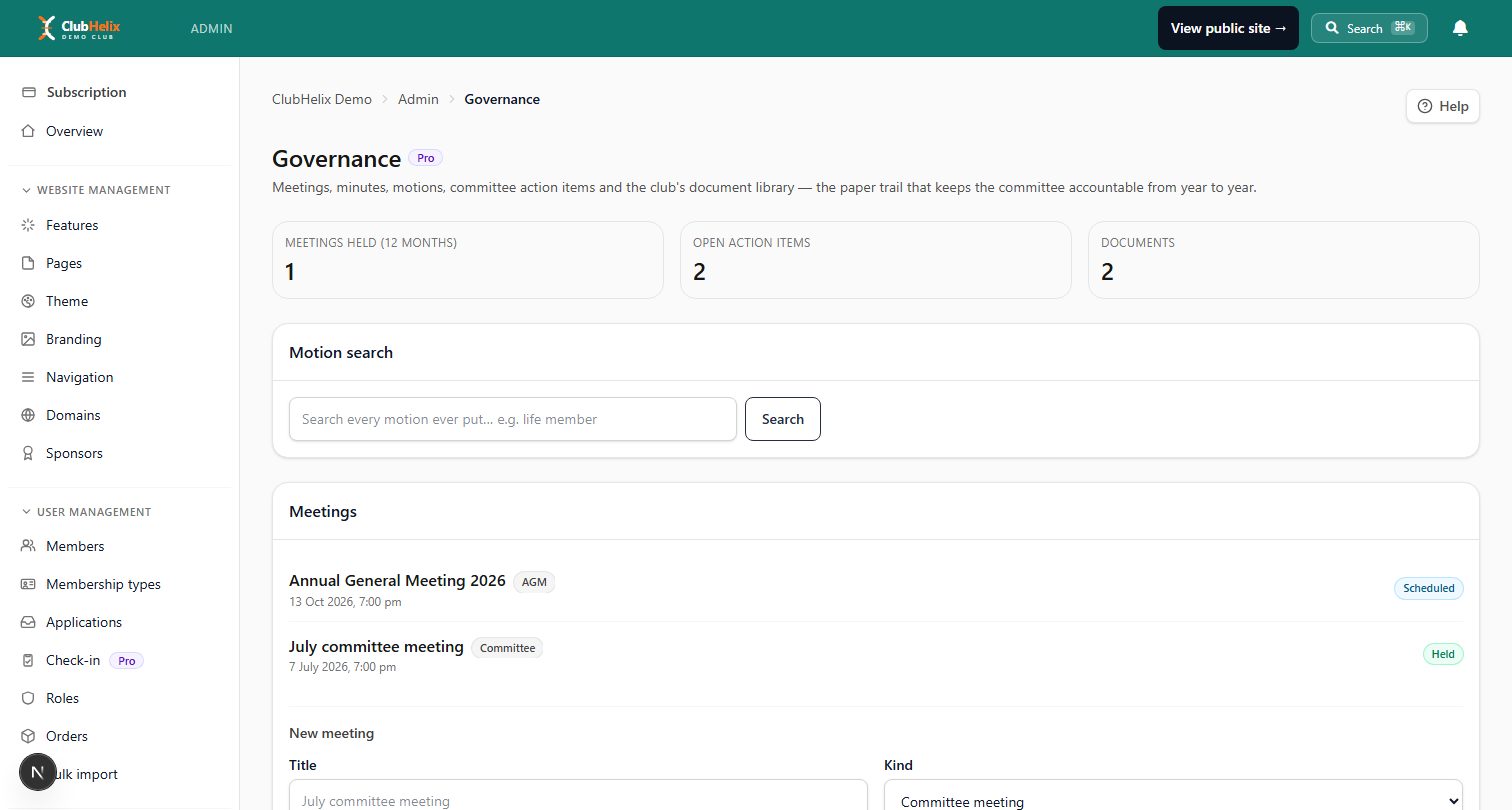
None of this is onerous if you build the habit early: agendas, minutes, motions and an actions register from the very first meeting. This is exactly the discipline a governance and meetings tool is built to make routine — minutes and resolutions recorded as you go, so the AGM and the annual return are an export, not an archaeology dig.
Worth repeating: this is general information only, not legal advice. Requirements differ between states and change over time — always verify against your own regulator's current guidance.
Common questions clubs trip over
A few recurring traps worth flagging before the FAQ proper. Don't collect significant money before incorporating — pre-incorporation contracts and funds held personally create exactly the mess incorporation exists to prevent. Don't let the "public officer" role lapse in states that require one; it's the regulator's contact point and must be kept current. And don't treat the constitution as write-once — clubs evolve, and amending your rules (by special resolution, lodged with the regulator) is normal maintenance, not failure.
Frequently asked questions
How much does it cost to incorporate a club?
The government application fee is modest — roughly $40 to $250 depending on your state or territory, with small annual lodgement fees thereafter. An ABN is free from the Australian Business Register. The real cost is volunteer time: a formation meeting, the application, and the ongoing rhythm of minutes, AGMs and annual statements.
Does our club need an ABN as well as incorporation?
Almost certainly yes. Incorporation creates the legal entity; the ABN is how banks, grant bodies, sponsors and the tax system identify it. Banks will generally want both the certificate of incorporation and the ABN to open a club account. Register the ABN free at the official Australian Business Register — never pay a third-party site for it.
Can we run the club without incorporating?
Yes, informally — many small social groups do. But an unincorporated group can't hold assets or contracts in its own name, members and organisers can carry personal liability, and most grants, councils and sporting bodies will require incorporation before dealing with you. The usual trigger points are collecting season fees, signing a venue agreement, or applying for a first grant.
Is a club automatically a charity or tax exempt once incorporated?
No — incorporation, charity registration and tax status are three separate things. Many community sporting clubs can self-assess as income tax exempt under the ATO's rules (with an annual self-review return now required), while charitable clubs may need ACNC registration to access charity tax concessions. Check the current criteria at the ATO and ACNC rather than assuming.
Once the paperwork's done, run the club like it's incorporated — ClubHelix's governance tools keep minutes, motions and AGM records in one place, alongside your member register and club website. See pricing.


