
What this guide answers
- How do I stop a retro gaming club becoming one person's private collection?
Write the ownership down before it becomes awkward. Every item in the register carries an owner and a status — club-owned, permanent loan, or event loan — and every lender signs a one-page agreement covering repairs…
- Does a retro gaming club need insurance?
Most clubs need at least public liability cover to be allowed into any venue, and separate consideration of the collection itself.
- How many setups do we need for a games night?
Work backwards from your RSVP count rather than guessing. As a rough planning rule, one station per four to six attendees keeps queues short on a social night, and a bracket needs more because matches run in parallel.
- Can we charge entry to a public retro event?
Usually yes, though it depends on your venue agreement and your club's legal structure, and a partner institution may want the session free to the public as a condition of hosting.
- What is the safest way to run a repair night?
With written rules on the wall and a named supervisor. Nobody opens mains-powered equipment unless qualified, everything on the bench carries a tested or not-tested tag, nothing goes to a public venue until it has been…
UK edition. This guide is written for volunteer-run clubs in the UK. Where rules differ — grants, tax, incorporation, safeguarding — follow the UK-specific pointers below or check with your national body.
Row 61 of the club spreadsheet reads: SNES, PAL, yellowed, works, Dave, at the storage unit since 2019. Nobody has spoken to Dave in two years. He may or may not still consider that console his. If the roof leaks tonight, nobody can say who is out of pocket, and if the club wound up next month nobody could say with confidence which crates go home with whom.
That single row is the central problem of running a retro gaming club, and it is why this guide starts with the collection rather than the games. Most community clubs own gear that wears out and gets replaced — balls, nets, a barbecue, a trestle table. A retro club owns hardware that stopped being manufactured decades ago, quietly climbs in value, is frequently irreplaceable, and is often not the club's property at all. Every genuinely hard decision you will make — insurance, storage, who gets a key, whether the machine goes to the school holiday event — traces back to that.
This guide is for the handful of people who have ended up running a retro gaming, arcade or console-collecting club: cataloguing and insuring a shared collection, moving it without wrecking it, running a repair bench that does not injure anybody, putting on public retro events and partnering with libraries and museums, and the membership and money model that keeps the whole thing standing when the founder moves interstate.
Decide which of the three clubs you actually are
Retro clubs come in three shapes, and almost all the friction inside them comes from members assuming they joined a different one from the one the committee is running.
| Shape | What it owns | Who turns up | Where money comes from | How it fails |
|---|---|---|---|---|
| The play club | Almost nothing — members bring their own | Social players, families, lapsed gamers | Subs and a hall-hire kitty | The two people who cart everything in burn out and it stops |
| The workshop club | A bench, tools, donor units, part-fixed cabinets | Fixers, electronics people, collectors | Repair days, donations, occasional grants | It quietly becomes a private workshop that new members can't join |
| The exhibition club | A travelling exhibit, road cases, signage | The public, at six events a year | Event fees, venue partnerships, sponsors | All effort goes into public days and members get nothing |
Most clubs are a blend, and that is fine — but name the dominant shape for the coming year out loud at a committee meeting, because it decides your insurance, your storage bill, your roster and what you ask new members for. A workshop club that keeps accepting exhibition bookings will run out of volunteers by spring. A play club that starts accepting donated cabinets has silently become a workshop club with nowhere to put anything.
Write the answer into your club's aims for the year and publish it. New members should be able to read your website and know whether they are joining a Thursday night of couch multiplayer or a Saturday spent recapping a power supply.
The collection is the club
Catalogue before you collect
The register is the single highest-value document a retro club owns, and it takes an afternoon to start. Nine columns is enough.
| Field | Why it earns its place |
|---|---|
| Asset ID | A physical label on the item that matches the row — no ID, no register |
| Item, model and variant | Region, revision and board type change the parts, the price and the tournament fairness |
| Ownership status | Club-owned, permanent loan, or on loan for one event only |
| Owner and contact | The whole point of the exercise |
| Condition and known faults | So the next volunteer doesn't rediscover a dead capacitor at load-in |
| Replacement value + basis | What you would pay to replace it today, and how you arrived at that |
| Photos | Serial number, badges, and every existing scratch, taken on the day it arrived |
| Location | Crate number, shelf, or whose garage |
| Last tested / serviced | Feeds directly into the pre-event checklist below |
Our club equipment register template is a reasonable starting point; add the ownership and variant columns and you have a retro register. Photograph everything on intake, not later — after five years in a storage unit, nobody can prove which scratches were there first, and that argument has ended more than one club friendship.
Record the video standard, because it is not cosmetic. Most hardware in local collections is 50Hz PAL — machines that run a few per cent slower than their 60Hz siblings, with different power supplies and, on some consoles, cartridge lockout. A 50Hz machine and its 60Hz twin are not interchangeable on the bench or in a bracket: the timing differs and so do the parts. When members import 60Hz machines, log the power supply as its own asset and store the two families of brick physically apart.
Three ownership states, one short agreement
Ownership ambiguity is what kills retro clubs, and it is solved by a one-page loan agreement that every lender signs once. Keep the clauses plain:
- What the item is, with its asset ID and intake photos attached.
- Which state it is in — gifted to the club, on permanent loan, or lent for a named event.
- Whether the club may repair, modify or re-cap it, and who decides.
- Whether it may leave the clubroom for public events, and whether it may be played by the public.
- How much notice the lender gives to take it back, and who pays transport.
- What happens if it is damaged or stolen while in the club's care, in plain language.
- What happens to it if the club winds up — the clause everyone skips and every treasurer eventually wishes they had.
Two practical rules on top. First, gifts should be in writing too, or the donor's family will one day ask for the cabinet back. Second, review the register at the annual general meeting and contact every lender you have not heard from in a year; if you cannot reach someone after three attempts across two channels, note the attempts in the register and put the item into a clearly labelled "unclaimed" state rather than pretending the question does not exist.
Insurance, in general terms
This is general information rather than advice, and a broker who has insured a collection before will earn their fee here. The things retro clubs typically get wrong are worth knowing about before you ring anyone.
Standard contents cover is written for gear that has a shelf price. Out-of-production hardware does not, so ask about agreed-value cover and be ready to justify your numbers with completed sale prices rather than optimistic listings. Cover for items at a fixed address is not the same as cover in transit or cover while on display somewhere else, and public events involve all three in one weekend. Members' items on loan are frequently excluded unless they are specifically noted. Venues often require the club to hold public liability cover and to name them on the certificate. Re-value the collection every couple of years, because the market for this hardware moves. Our guide on whether your club needs insurance covers the broader question, and your risk register — see sports club risk management — should list the collection as an asset, not just an activity.
Moving it without breaking it
- Buy or build proper road cases for anything that travels regularly. Foam-lined crates with numbered lids beat cardboard within two events.
- One crate, one station. Console, controllers, cables, power supply, games and the display go together and stay together.
- Label every cable at both ends with the station number. Half of all event teardown chaos is a bucket of unlabelled cables.
- Displays are the heavy, fragile, awkward item. Two-person lifts, always, and never stacked.
- Photograph the loaded vehicle. It settles the "did we bring the second controller" argument on the spot.
- Reconcile against the register at pack-down, item by item, before anyone leaves. What came in must go out.

The repair bench, and the rules that make it survivable
Repair nights are the best recruitment tool a retro club has and the one activity with real physical risk attached. Old hardware runs on mains power, holds charge after it is unplugged, contains leaking batteries and capacitors, and was built before most modern safety expectations. None of that means you should not have a bench. It means the bench needs written rules that a new member can read on the wall.
Adopt a short policy — this one is a starting point, not a legal document:
- Nobody opens a mains-powered chassis unless they are qualified to work on that class of equipment. Old display hardware in particular can hold a dangerous charge long after it is unplugged; that is work for someone with the training, not an enthusiastic member with a screwdriver.
- Nothing that plugs into a wall goes to a public event until it has been checked by a suitably qualified person and labelled with the date.
- Every item on the bench wears one of three tags — not tested, do not power on, tested, safe to run, or awaiting parts. No tag means the first tag.
- One named bench supervisor per repair night. The bench closes when they go home, not when the last person leaves.
- Soldering happens at the ventilated end of the room, with eye protection, and never alone in the building.
- Log every repair against the asset register — what failed, what was replaced, what is still marginal. The next volunteer inherits your notes instead of your mystery.
- Donor units are labelled as donors and stored separately, so nobody spends an evening lovingly restoring the parts machine.
In the United Kingdom, the equivalent conversation is portable appliance testing, and while the law is framed around maintaining equipment in a safe condition rather than mandating a specific test interval, venues and insurers frequently ask for evidence anyway. Check the current guidance from the health and safety regulator and ask each venue what they require in writing. Practically, test the whole collection in one session before the season of events starts, keep the certificates with the register, and remember that fused plugs mean fuse ratings are part of the check.
Parts, consumables and the skills problem
Keep a modest standing stock rather than ordering per repair: belts, controller membranes, common connectors, coin cells, thermal paste, contact cleaner, mains leads, video cables and adapters, and a jar of the screws that every machine of your era uses. Fund it with a consumables kitty rather than out of one member's pocket, and let members buy parts through the club at cost — several clubs run this as a small line in their club shop so the money is traceable.
The bigger risk is skills concentration. Most clubs have exactly one person who can actually fix things, and when that person moves house the workshop stops. Pair a learner with the fixer on every job, make the register notes detailed enough to teach from, and run one "how this machine works" session a term. Volunteer succession in a retro club is a technical problem as much as a rostering one — recruiting club volunteers covers the rostering half.
Public retro events and institutional partners
A public retro day is the fastest way to convert nostalgia into membership, because your product demonstrates itself. Somebody walks past, sees a machine they had when they were nine, plays it for ten minutes, and is emotionally available for a conversation about joining in a way that no flyer achieves. The trick is capturing that moment rather than letting it walk out the door.
The pitch that gets you a venue
Institutions want programming that draws families and does not create work for their staff. Give them a single page they can forward internally:
- What you bring — number of stations, the era range, and one or two headline machines with a story attached.
- Footprint and floor plan, including how you queue people and where the noisy machines sit.
- Power needs — how many outlets, roughly what load, and whether you bring your own leads.
- Staffing — how many volunteers, their hours, and who supervises which stations.
- Pack-in and pack-out windows, and vehicle access.
- What you need from them — tables, chairs, bins, parking, and a lockable room overnight for multi-day events.
- What they get — an attendance draw, photos they can use, and a named contact who answers messages.
Expect to be asked for a certificate of currency, a risk assessment, evidence that your electrical gear has been checked, and a named on-the-day contact. Have all four in a folder ready to send; the clubs that get invited back are the ones whose paperwork arrives the same day it is requested.
Public libraries and heritage venues are the easiest first partner, and their half-term and summer programming is planned months ahead — approach them a term in advance, not a fortnight. Local museums with a social-history remit are a natural fit, since your collection is social history, and community centres will often trade room hire for one free public session.
The exhibit, not the arcade
The difference between a club that gets re-booked and one that does not is curation. Put a card beside every machine with the year, what it originally cost relative to a week's wages, and one sentence about why it matters. Mix three station types: freeplay machines anyone can walk up to, a supervised station for the rare or delicate hardware, and one short bracket on a game that reads well to spectators. Put a visible timer on the popular stations and run "winner stays" on two-player machines so queues move. Keep the loudest cabinet away from the quiet part of the building — that one decision determines whether a library invites you back.
Capture the moment while people are still standing there. A tablet or a phone open on your join page beats a clipboard, and a printed card with a QR code to the same page beats both for people who want to think about it. Use a simple form for "tell me when the next event is" rather than a mailing-list sign-up sheet nobody can read afterwards.
| When | What happens |
|---|---|
| 8 weeks out | Venue confirmed in writing, date published, insurance and paperwork sent |
| 6 weeks out | Machine list locked, gaps identified, lenders asked |
| 4 weeks out | Volunteer roster published with named shifts; electrical checks booked |
| 2 weeks out | Floor plan and power plan sent to the venue; social and local media push begins |
| Week of | Crates packed and reconciled against the register; signage printed; a spares box packed |
| Load-in | Two-person lifts, station-by-station setup, every machine tested before doors open |
| Doors | One volunteer on the join table at all times, not just when it's quiet |
| Pack-down | Register reconciled item by item before anyone leaves |
| The week after | Thank the venue, send the photos, follow up every enquiry within days |
Volunteers who supervise children at your public events are usually screened through the relevant national vetting scheme, and the host venue will often want to see evidence before your first family session. Requirements differ depending on the role and the setting, so check with the relevant authority and ask the venue what it requires, since institutions frequently set a higher bar than the minimum.
Membership, money and the storage question
Retro clubs have an unusual cost structure: almost no recurring operating cost except the one big one — somewhere to keep the collection. A storage unit is dead money that buys no member experience. A cheap hall with a lockable cupboard and permission to leave a bench set up is worth paying substantially more for, because it turns storage into a venue. If you end up with a room of your own, hiring it out to other groups on your quiet nights is the most reliable second income a club of this size can build.
Build the income mix from four sources rather than leaning on subs alone: annual memberships, public event income, a small merch and parts line, and one grant or partnership a year. Spend in this order — insurance first, then storage, then tools and testing, and only then hardware. It is the opposite of what everyone wants, and it is why the clubs that last are boring about money in year one.
As an illustration rather than a benchmark, community clubs of this size commonly land somewhere around £25–£50 a year for an adult membership, with a concession rate and a higher "bench member" tier for people who want a key and workshop access. On the funding side, National Lottery community funding and local authority community or heritage grants are the realistic targets, and a collection with a genuine social-history angle interviews well for heritage money in a way that a plain hobby club does not.
The weekly night that keeps the club alive
Public events recruit; the regular night retains. Fix the slot — the same night, the same fortnight, published a season ahead — because irregular events are the ones people forget. Then make three small operational decisions that do most of the work.
Take RSVPs, even for a free night. Not to gatekeep, but because the setup roster depends on the count: six people means two stations and one car, twenty means four stations, a second vehicle and someone on the door. Publishing an event with RSVPs and watching the number move through the week is the difference between a smooth setup and three people carrying displays in the rain.
Rotate the format so the same twelve people do not run everything. A workable pattern over a month: one freeplay social night, one themed night built around a single console or year, one bracket night on a game everyone can pick up, and one bench night. Publish the theme in advance and members bring the right hardware without being asked.
Close properly. A short closing checklist — machines off and cooled, crates reconciled, bins out, keys accounted for, doors and windows — pinned to the wall and signed by whoever closes. It sounds bureaucratic until the night somebody leaves a display powered on in a locked hall.
Running the club from one place
The admin behind a retro club is not complicated, it is just scattered — a spreadsheet of members, another of hardware, a chat thread for the roster, a form for the school holiday event, and a treasurer chasing renewals by message. ClubHelix pulls that into one club website: events with RSVPs and ticketing for public days and game nights, attendance tracking so you know who actually came, volunteer rostering with named shifts for load-in and the join table, and a club shop for merch and parts at cost. Memberships renew online instead of by reminder message, and the register of who is financial stops living in one person's laptop.
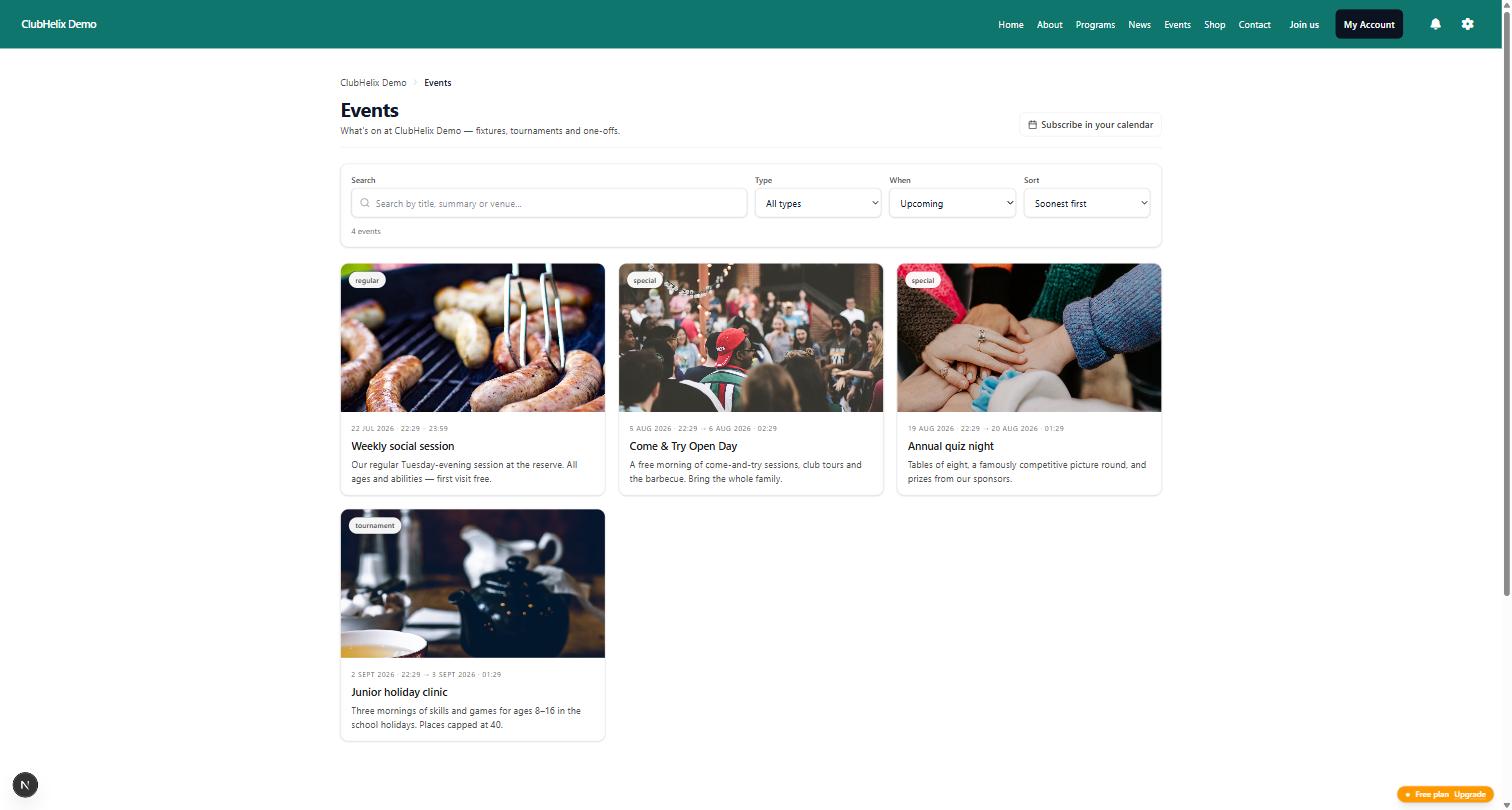
There is a free tier to start on, and the pricing is published rather than quoted. If your club is currently a spreadsheet, a chat group and a lot of goodwill, you can create your club site between one game night and the next — and the hobby and interest club pages show what a finished one looks like.
Frequently asked questions
How do I stop a retro gaming club becoming one person's private collection?
Write the ownership down before it becomes awkward. Every item in the register carries an owner and a status — club-owned, permanent loan, or event loan — and every lender signs a one-page agreement covering repairs, public play, notice to withdraw and what happens if the club winds up. Clubs get into trouble when the founder's collection and the club collection are the same pile of crates and nobody has ever said so out loud.
Does a retro gaming club need insurance?
Most clubs need at least public liability cover to be allowed into any venue, and separate consideration of the collection itself. This is general information, not advice — talk to a broker who has insured a collection, and ask specifically about agreed-value cover for out-of-production hardware, cover in transit, cover while on display somewhere else, and whether members' loaned items are included or excluded.
How many setups do we need for a games night?
Work backwards from your RSVP count rather than guessing. As a rough planning rule, one station per four to six attendees keeps queues short on a social night, and a bracket needs more because matches run in parallel. Take RSVPs even for free nights so the setup roster and the number of vehicles match the number of people actually coming.
Can we charge entry to a public retro event?
Usually yes, though it depends on your venue agreement and your club's legal structure, and a partner institution may want the session free to the public as a condition of hosting. Many clubs run free entry with a donation tin and sell merch instead, which converts far better into memberships than a ticket price does. Check the terms of any grant funding too, since some community funding requires free access.
What is the safest way to run a repair night?
With written rules on the wall and a named supervisor. Nobody opens mains-powered equipment unless qualified, everything on the bench carries a tested or not-tested tag, nothing goes to a public venue until it has been checked by a suitably qualified person, and every repair is logged against the asset register. Check the specific electrical testing requirements for your area with the relevant authority and with each venue.
Keep reading: how to run a model railway club covers clubroom tenure and the annual exhibition in more depth, and how to run a fighting game community picks up where your bracket night starts getting serious.


