
What this guide answers
- How many setups do you need for a weekly bracket?
Roughly one setup per five or six entrants keeps a double-elimination bracket moving.
- Should a weekly charge an entry fee?
Most do, and the clearest structure separates a venue fee that covers the room from a pot that belongs entirely to the players.
- How do you make a local welcoming to new players?
With logistics, not good intentions. Name a greeter each week, run a newcomer bracket for players who have never made top eight, protect one station for casual play so early losers still get games, label the stations…
- What should be in a fighting game community code of conduct?
Short, readable clauses covering harassment and slurs, respect for other people's equipment and for venue staff, and the fact that behaviour in the chat and on stream is judged the same as behaviour in the room.
- How does a weekly turn into a proper scene?
By keeping records. Run a points season across three or four months, publish the standings after every week, finish it with a finals night, and archive the results so the scene accumulates a history.
You have the room from seven until eleven. Registration closes at half past seven, which means the bracket starts at quarter to eight if you are efficient and eight fifteen if you are not. Thirty-two people have signed up, you have six setups, and one of them belongs to a member who has just messaged to say he is stuck at work. The venue manager has already mentioned, twice, that the cleaners come at eleven.
Everything else about running a fighting game community — the culture, the rivalries, the newcomer who becomes a regular, the scene that produces a national-level player — sits on top of that piece of arithmetic. Get the numbers wrong and grand finals happen in the car park at midnight, the venue stops returning your messages, and the twelve people who came for their first bracket never come back because they went out in twenty minutes and then stood around for three hours.
This guide is for whoever ended up organising the locals. It covers the maths of a weekly, the kit the community owns and the kit it borrows, negotiating a venue deal that survives a change of manager, entry fees and pot splits, the conduct and moderation work that decides whether the room is welcoming, and how a weekly grows into a scene with a season and a record of its own.
The arithmetic of a weekly
A double-elimination bracket runs roughly two matches per entrant, minus a couple — so thirty-two entrants means about sixty-two sets. That number is fixed by the format, not by how well you organise. What you control is how many run in parallel and how much dead time sits between them.
Assume ten minutes per set including turnaround — which is generous for a two-out-of-three and tight for a three-out-of-five — and assume your last three or four sets run on a single stream setup with a bit of ceremony. That gives you a planning table you can actually hold a venue conversation with.
| Entrants | Sets (double elim) | Setups | Bracket play | Top-8 tail | Realistic finish from a 7.45pm start |
|---|---|---|---|---|---|
| 16 | ~30 | 4 | ~75 min | ~30 min | 9.30pm |
| 24 | ~46 | 5 | ~90 min | ~35 min | 9.50pm |
| 32 | ~62 | 6 | ~105 min | ~40 min | 10.10pm |
| 48 | ~94 | 8 | ~120 min | ~45 min | 10.30pm |
| 64 | ~126 | 8 | ~160 min | ~50 min | 11.15pm |
Read it as a constraint rather than a prediction. If your room closes at eleven and you regularly draw forty-plus entrants, you have three levers and only three: more setups, fewer games in one night, or pools that seed straight into a top eight. Adding a second game to a weekly is the decision that quietly breaks the most locals — it halves your setups per bracket and roughly doubles your finish time. Alternate weeks by game instead, and publish which game is on which week a month ahead.
The other half of the arithmetic is registration. Close it, in writing, at a stated time. Late entries cause more bracket delay than anything else, because every one of them means a rebuild and a re-seed. Take sign-ups online during the week so you walk in knowing whether tonight is a twenty or a fifty — an event page with RSVPs on the club's own site does that job and gives you a headcount to send the venue on the Monday.
Three small habits recover an entire hour across a night: call the next set while the current one is still playing, put the bracket on a screen everybody can see instead of on your phone, and appoint one person whose only job is chasing players to stations. That last role is not glamorous and it is the highest-leverage volunteer job in the room.
The setups, and who owns them
A "setup" is not a console. It is a display, a console or PC, a legal copy of the game with the current patch, power, a table, two chairs and enough space that a player's elbow is not in a stranger's drink. Count setups by that definition and you will stop being surprised on the night.
Almost every local starts by borrowing everything, and almost every local eventually learns why that hurts. The community's kit should grow deliberately, in this order: displays first, because they are the thing nobody wants to carry and the thing that most affects fairness; then a couple of consoles; then the boring infrastructure — power boards, extension leads, cable ties, adapters, a spare controller or two, and a labelled crate to put it all in.

Fairness is the argument for standardising displays. Different panels introduce different amounts of lag, and a bracket where one station feels different from the others produces exactly the kind of low-grade grievance that erodes a scene. If you cannot standardise, at least test and label: put the same settings on every display, mark the ones known to be slower, and keep them off the stream setup and out of top eight.
Write down a short kit policy before you own anything worth arguing about:
- Ownership. Every item is either community-owned or lent by a named person, and both states are written in one shared list with a photo. Nothing is "the club's" by drift.
- Transport and setup. Whoever owns a lent item sets it up and packs it down, unless they have agreed otherwise in advance. Lending a screen should not mean losing your evening.
- Damage. Say plainly what happens if borrowed kit breaks. Most communities land on "we take reasonable care and we are not an insurer", and the important part is that it is said out loud before a controller goes flying, not after.
- Controllers and adapters. Publish the controller policy with the ruleset — what is allowed, what needs an adapter, and who brings the adapters. Have a loan controller available for newcomers.
- Storage. One crate, one key holder, one backup key holder. If the kit lives in one person's boot, the weekly is cancelled the week they are away.
Keeping that list somewhere shared beats keeping it in a chat thread. Our club equipment register template is more structure than a small local needs on day one, but it is the shape you will grow into by year two.
The venue deal
Venues are the reason locals die, and almost always because the deal was never really a deal — it was a friendly manager who has now moved on. Get to a written arrangement, however informal, with a named contact and a stated end date to review it.
| Venue type | What they want from you | What you should push for | The catch |
|---|---|---|---|
| Bar or pub function room | Bar spend on a quiet night | Free room, guaranteed weeknight, storage cupboard | Age restrictions cut out your junior players |
| Board-game or hobby café | Table spend, a regular booking, foot traffic | A fixed table block and power access | Space is tight; noise and other bookings clash |
| Community hall | Room hire, tidy exit | A recurring booking and a storage cupboard | Everything is BYO, including tables and internet |
| University or college room | Affiliation with a student club | Free or near-free rooms and reliable power | Term-time only, and access dies over the break |
| Games or hobby shop | Sales, a reason for people to be in the store | After-hours access, a tournament partnership | Small footprint caps entrant numbers |
| Arcade or esports bar | Door split, drinks, a marquee night | Setups supplied, promotion, a longer end time | Their equipment, their rules, their priorities |
Whatever the type, the conversation covers the same seven things: the recurring night and time, the end time and how firm it is, what it costs and in what form (room hire, minimum spend, door split, or nothing), power — how many circuits and outlets, which is a genuine constraint with eight setups running, tables and chairs, storage between weeks, and internet if you stream.
Bring a one-page proposal rather than a chat. Numbers help: expected attendance, the spend a typical attendee makes, the hours you occupy the room, and photos from a previous night. Venues are being asked to give up a room; give them a reason that shows up in their takings.
Two protections worth building in early. First, name a second contact on both sides, so a change of manager does not reset the relationship to zero. Second, keep a written record of what was agreed — even a summary email after a conversation — because "we've always been allowed to" is not an argument that survives new management.
Licensed venues are the most common home for a weekly and the biggest structural problem for a scene with junior players, since a licensed room usually restricts who can be present and until when. Ask the licensee directly what applies to their venue rather than guessing, and if under-18s are effectively locked out, consider a monthly all-ages event in a community hall or library space so your junior players have somewhere to play at all.
Entry fees, venue fees and the pot
Keep two amounts separate in everybody's mind, and in your announcements: the venue fee, which covers the room and the running of the event and never goes to a player, and the pot, which is the prize money and belongs entirely to the entrants. Blurring them is the fastest way to lose the room's trust.
Standard pot splits are conventions rather than rules, and any of these are defensible as long as it is published before entries open:
| Field size | Common split | Why |
|---|---|---|
| Under 12 | 60 / 40 or 50 / 30 / 20 | Too few entrants to spread thin; third place must still mean something |
| 12–24 | 60 / 30 / 10 | The standard for a healthy weekly |
| 25–48 | 50 / 30 / 20 or 60 / 25 / 15 | Deeper fields justify paying deeper |
| 48+ | Top 4 or top 6 paid | At this size, a top-eight run deserves a return |
A pot bonus — the club adding to the pot from its own funds or a sponsor — is the most effective single tool for growing a weekly, because it makes turning up feel like value rather than a gamble. Announce it in advance and cap it, so a quiet week does not cost the club more than it can afford.
Go cashless as early as you can. Cash in a room means someone carries a float, someone reconciles at midnight, and someone eventually loses an envelope. Taking entry online means the bracket and the payments are the same list, the pot is calculable before the doors open, and your treasurer has a record rather than a story. It also solves the awkward part of running a free weekly with a paid side bracket — the two lists stay separate automatically.
Publish the money rules with the ruleset: what the venue fee covers, how the pot splits, whether the pot bonus applies, what happens to the pot if the bracket cannot be finished, and the refund position for someone who signs up and cannot make it. Deciding a refund question in the moment, in public, is how organisers become villains.
Where entry fees fund a cash prize pool, gaming and prize-competition rules may apply, and they are set at state, territory or regional level rather than nationally. Treat this as background rather than legal advice — check with the relevant gaming or racing regulator for your area before running anything with a substantial pot, and consider funding prizes from sponsorship rather than entries if the answer is unclear.
Conduct, moderation and a room people come back to
Fighting games are played eighteen inches from your opponent's shoulder, in public, with an audience. That intimacy is why the scene is special and why moderation is not optional. A local with no stated standards does not become neutral; it becomes whatever its loudest regulars are like.
Write a code of conduct short enough that people read it. Ours is a decent starting point — see the player code of conduct template — and adapt it to a room rather than a pitch. The essential clauses: no harassment of any kind, no slurs, hands off other people's equipment, respect the venue and its staff, and behaviour on the stream and in the club's chat is covered by the same rules as behaviour in the room.
Then make it operational, because a code nobody can act on is decoration:
- Two named contacts for reports, not one, and at least one of them not part of the same friendship group as the regulars. Put both names and how to reach them on the wall and on your website.
- A written response process. Listen, take notes the same night, talk to the other party, decide, and tell the person who reported it what happened. Vague outcomes are why people stop reporting.
- Proportionate outcomes. A quiet word, a formal warning, a suspension for a number of weeks, a ban. Write the ladder down before you need it.
- Appeals to someone else. Whoever made the decision does not hear the appeal.
- A record. Warnings and bans logged privately with dates and reasons, so a pattern across two years is visible even when the organisers change.
The welcome side matters just as much, and it is mostly logistics rather than sentiment. A named greeter each week who intercepts anyone standing alone in a doorway. A newcomer or amateur bracket that anyone who has never made top eight can enter. One casual station explicitly protected from bracket use, because the person who lost their first two sets needs somewhere to keep playing. Labelled stations so people know what is running where. A spare controller anyone can borrow. And the deliberate habit of asking a strong player to run a few casual sets with a beginner and explain what they are doing — it is the most persuasive thing that can happen to someone on their first night.
Keep the between-weeks conversation somewhere your moderators actually control. A members' chat attached to the club is easier to moderate consistently than a sprawling public server, and it keeps the club's own announcements from scrolling away under memes.
Geography shapes what a scene can be. Major cities are far enough apart that travelling for a monthly is a flight rather than a drive for most people, so a healthy local matters far more than it does in dense scenes — you cannot rely on a nearby city to absorb your players. That argues for investing in a strong weekly and one or two well-run majors a year that people plan travel around, rather than a crowded calendar nobody can afford to attend.
From a weekly to a scene
The step from "a bracket happens on Wednesdays" to "there is a scene here" is mostly record-keeping. Run a points season: every weekly awards points by placement, the table runs for three or four months, and the top eight qualify for a finals night with the season's pot bonus on it. Nothing raises weekly attendance in the quiet months like a standings table that somebody is two places off.
Add a monthly with a slightly bigger pot, a longer bracket and a stream. Build one annual event — the same weekend each year, a venue that can hold it, and enough notice that people from other cities can plan travel. Keep a results archive, because a scene with five years of published results has a history, and a history is what makes people feel like they belong to something.
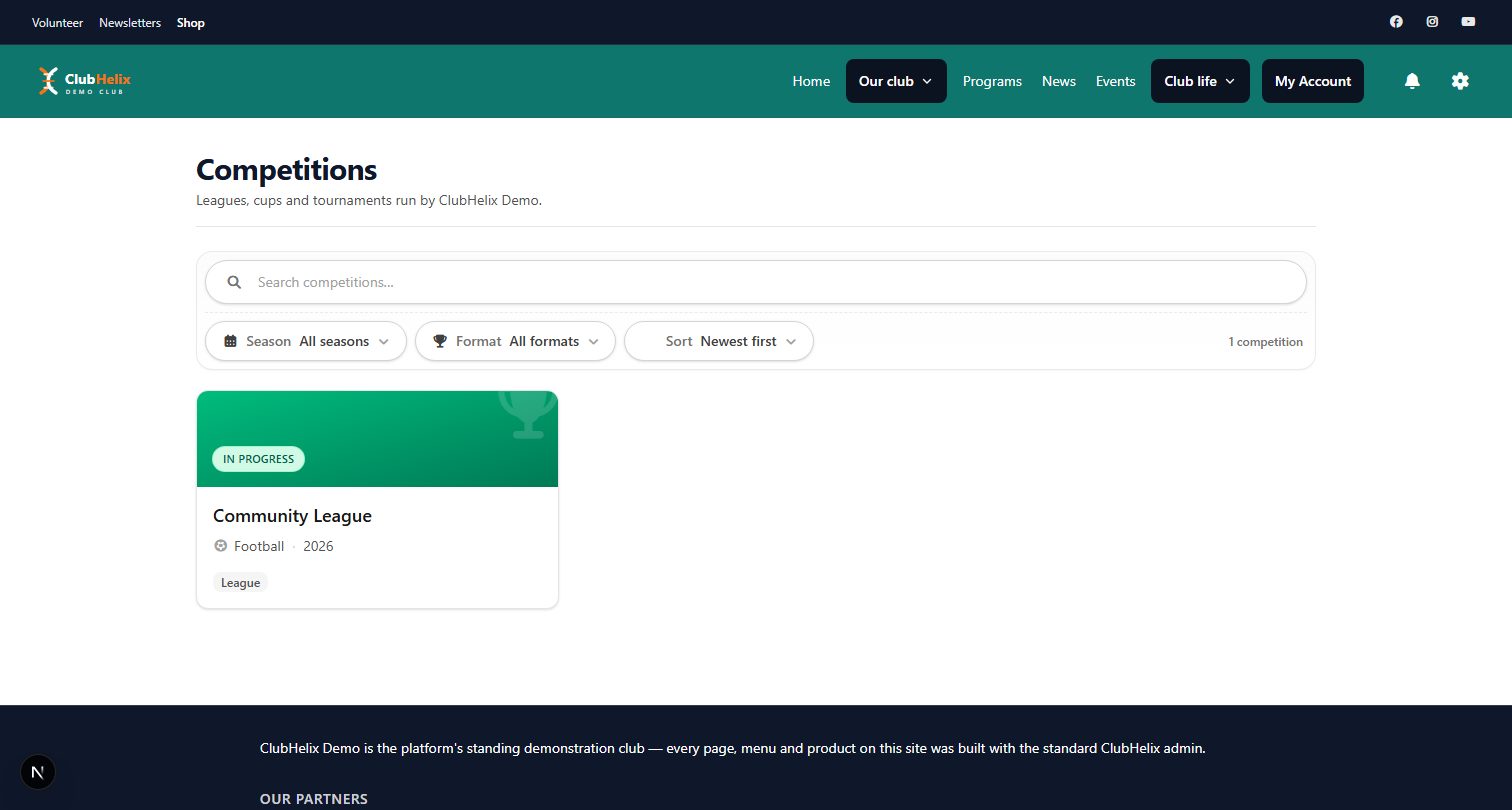
All of that wants a home that is not a chat thread. A competitions section with brackets, results and a season ladder, plus a finals series page for the playoff night, turns your weekly into a public record that new players, venues and sponsors can all look at. Our guide on how to run a university esports club covers the same problem from the student-society end, and there is a lot of overlap worth stealing.
Giving the community a home online
Right now the local probably lives in four places: a chat server for the conversation, a bracket tool for the night, a spreadsheet for the season points and one person's phone for the money. It works until that person is away, and none of it is findable by someone searching for a scene in your city. ClubHelix gives the community a proper site: events with RSVPs and paid entry, competitions with brackets, results and season ladders, a moderated member chat, and a members list so your regulars and your mailing list are the same thing.
There is a free tier that will comfortably carry a weekly, the pricing is published up front, and it is designed for people organising things after work rather than for businesses. If you have been meaning to give the scene something more permanent than a pinned message, you can set it up before next week's bracket.
Frequently asked questions
How many setups do you need for a weekly bracket?
Roughly one setup per five or six entrants keeps a double-elimination bracket moving. A double-elimination bracket runs about two sets per entrant, so thirty-two players means around sixty-two sets — at ten minutes a set across six setups, that is nearly two hours of play before the top eight even starts. Count your setups before you accept entries, not after.
Should a weekly charge an entry fee?
Most do, and the clearest structure separates a venue fee that covers the room from a pot that belongs entirely to the players. Publish both amounts and the pot split before entries open. Free weeklies work well for building a new scene, and a club-funded pot bonus is the most reliable way to grow attendance once one exists.
How do you make a local welcoming to new players?
With logistics, not good intentions. Name a greeter each week, run a newcomer bracket for players who have never made top eight, protect one station for casual play so early losers still get games, label the stations, keep a loan controller for people without one, and ask your strongest players to run sets with beginners and explain what they are doing.
What should be in a fighting game community code of conduct?
Short, readable clauses covering harassment and slurs, respect for other people's equipment and for venue staff, and the fact that behaviour in the chat and on stream is judged the same as behaviour in the room. Then the operational half — two named people to report to, a written response process, a ladder of outcomes, appeals heard by someone else, and a private log of warnings and bans.
How does a weekly turn into a proper scene?
By keeping records. Run a points season across three or four months, publish the standings after every week, finish it with a finals night, and archive the results so the scene accumulates a history. Add one monthly with a bigger pot and one annual event on a fixed weekend, and give all of it a permanent website rather than a chat thread nobody can search.
Keep reading: how to run a sim racing club covers stewarding and season structure in more depth, and player code of conduct template gives you the document to adapt.


