
What this guide answers
- How many rounds should a sim racing season have?
Eight to ten rounds suits most club leagues — long enough for a championship to mean something, short enough that people finish it.
- How do you handle penalties in a sim racing league fairly?
Separate the roles. The race director runs the night and logs incidents without judging them; a panel of three stewards reviews the evidence afterwards, at least one of whom is not racing in that class.
- What should a sim racing club publish after each round?
Provisional results within an hour of the flag with the incident list attached, then final results and updated standings once the protest window closes.
- Do sim racing clubs need sponsors?
Not to survive — a modest annual membership generally covers server hosting.
- Can a sim racing club run its own website and standings?
Yes, and it is the best investment a league can make. Fixtures, results, ladders, entry forms and a stewards' decisions archive on one searchable site replace a pinned message and a spreadsheet, and give sponsors and…
Lap 34 of 40, third and fourth into the first corner, one of them a fraction late on the brakes. Both cars end up in the gravel, the championship lead swaps hands, and by eleven o'clock that night the club's chat server has four hundred messages, two members threatening to quit, and a screenshot war between people who were not even in the race. Nobody has yet asked the only question that matters, which is: what process decides this, and did we agree to it in February?
That is the whole job of running a sim racing club. The racing is the easy part — the sim provides the track, the physics, the timing and the replay. What it does not provide is legitimacy. A league only works if drivers believe the result is real, and belief comes from process: a calendar published before anyone knows who is quick, sporting regulations written when nothing is at stake, stewards who are visibly not racing for the title, and a standings table with a timestamp on it.
This guide is for the person who started a league in a group chat and now finds themselves running an organisation. It covers the roles you need, designing a season that actually finishes, the run sheet for race night, a penalty and protest process that holds up under pressure, publishing results, and the broadcast and sponsorship layer that turns a private league into a club people want to join.
The club behind the league
Most leagues fail at exactly one point: the founder is the league director, the race director, the head steward, the results publisher and the driver leading the championship. Nothing bad has to happen for that to become untenable — it is untenable by design, and everyone can see it.
Split the jobs, even if the same three people cover them across different rounds. The critical separation is between running the race and judging the race.
| Role | Owns | Time per round | Must not also be |
|---|---|---|---|
| League director | Regulations, calendar, entry list, the final word on the season | 2–3 hours | A steward on protests involving the title |
| Race director | The night itself — server, starts, restarts, live calls | 3 hours on race night | A competitor in that race |
| Stewards panel (3) | Incident reviews, penalties, published reasoning | 1–2 hours after | Racing in the class they judge |
| Results and timing | Provisional and final results, standings, corrections | 1 hour after | — |
| Broadcast lead | Stream, commentary roster, overlays, highlights | 4 hours on race night | Race director |
| Membership and comms | Sign-ups, reserves, the calendar page, the weekly notice | 1 hour a week | — |
| Sponsorship | Partner deals, invoicing, delivering what was promised | Seasonal | — |
Three stewards is the smallest panel that works, because it can reach a majority without the head steward personally owning every unpopular decision. Recruit at least one from outside the competing field — a retired driver, a commentator, someone from a partner club — and publish the panel's names in the regulations. Anonymous stewarding feels safer to the stewards and is corrosive to everyone else.
Write the sporting regulations once, before entries open, and version them. A short document beats a long one: entry and eligibility, car and setup rules, qualifying and race format, conduct standards, the incident process, penalties, points, reserves and the appeals route. Fifteen readable pages that everyone has actually opened is worth more than fifty nobody has.
Designing a season that finishes
The most common failure in club sim racing is not conflict, it is attrition. A season that started with twenty-eight cars ends with eleven, half the field has stopped caring by round six, and the title is mathematically settled with three rounds to run. That is a design problem, and you fix it on a spreadsheet in the off-season.
| Season shape | Rounds | Race length | Suits | Watch out for |
|---|---|---|---|---|
| Short sprint series | 6 | 25–35 min | New leagues, testing whether a night works | Ends before habits form |
| Standard club season | 8–10 | 40–60 min | Most clubs | Needs a mid-season break or people burn out |
| Twin-race rounds | 8 | 2 × 25 min | Mixed-ability fields, reversed-grid interest | Doubles the incident count per night |
| Endurance series | 4–5 | 90 min–3 hours | Committed fields with driver pairings | Driver-swap rules and stint logging get complicated |
| Multi-class in one race | 8–10 | 60 min | Small clubs wanting two titles on one night | Traffic rules must be explicit or it is chaos |
Three design decisions do most of the work. First, splits. Once you have more entries than grid slots, run divisions by pace rather than by sign-up order, promote and relegate two or three drivers between rounds, and publish the rule that governs it. A driver who is last every week in the top split leaves; the same driver fighting for a podium in the second split renews.
Second, drop scores. Allowing each driver to discard their worst one or two rounds is the cheapest retention mechanism available, because a disconnect in round three no longer ends someone's season. It costs you a slightly muddier championship table and buys you a full grid in round nine.
Third, reserves. Maintain a published reserve list with a clear call-up order and a deadline — reserves confirmed by the evening before, not twenty minutes before the green light. Reserve drivers score in their own standings or not at all; decide which and write it down, because deciding it after a reserve wins is how leagues acquire enemies.
Build the calendar around the nights people can actually make, and publish it in one place that never moves. A fixture and season calendar on your own club site beats a pinned message that scrolls away, and our guide on how to make a fixture draw covers the mechanics of building a draw that spreads the load.
Set the calendar against the summer, not the winter. A season that runs across the long holiday period will lose half its grid to travel, family and heat for the exact weeks people are least likely to sit in a rig in a hot room. Two workable shapes: a main championship from late summer through to the middle of the year, or two short series either side of the holidays with a one-off enduro in between to keep the club alive over the break.

Race night, from T-60 to T+30
Race night runs on a script, and the script is what stops a chaotic evening from becoming a disputed result. Publish it so drivers know exactly what happens and when.
| Time | What happens |
|---|---|
| T-60 | Server up with final settings, password posted to entrants only, race director on voice |
| T-45 | Practice open; entry list checked against the confirmed grid; reserves called in |
| T-20 | Driver briefing — track limits, pit-lane rules, restart procedure, anything specific to the round |
| T-10 | Qualifying |
| T-0 | Formation and start |
| Live | Race director calls only safety and procedural matters; incidents are noted, not judged |
| Flag | Provisional results posted with the incident list attached |
| T+30 | Protest window opens and the deadline is published |
Four live policies decide how the night feels.
Track limits. Pick the enforcement model before the season, not the round — sim-enforced penalties, a warning system, or steward review of flagged laps. Whatever you choose, apply it identically to the front and back of the field.
Restarts and safety cars. Say in advance what triggers a restart, how many are possible, and at what point the race stands regardless. The moment to decide "we restart if the leaders are wiped out at turn one" is not while the leaders are sitting in the gravel at turn one.
Disconnects. State the rule plainly. Common approaches are no rejoin after a disconnect, rejoin permitted at the back within a set number of laps, or a classified result if a driver has completed a defined proportion of the distance. Any of them work; not having one does not.
Voice comms. Race control talks, drivers listen. A separate channel for spotters and a rule that in-race complaints go to the protest form rather than the microphone will save your race director's evening.
Keep race control's brief narrow: the race director manages the running of the event and does not hand out penalties in the moment. Every incident gets logged with a lap number and the cars involved, and then it goes to the stewards. That single discipline removes most of the heat, because nobody is being judged by someone who is simultaneously trying to run a server.
Stewarding — a process that survives a title fight
The test of an incident process is not whether it produces the right answer on a quiet Tuesday. It is whether, in the final round, with the championship on the line and both drivers well liked, it produces an answer that the losing party can live with. Design for that night.
What a valid protest looks like
Require a form, not a message. A protest that arrives as an angry paragraph at midnight cannot be assessed fairly, and a form gives the stewards the same fields every time: round and race, lap number and corner, cars involved, the specific regulation alleged to have been breached, a link to replay evidence with a timestamp, and a short description of what the protester says happened. Run it as an online form attached to your club site so submissions are timestamped, stored and reviewable, rather than scattered across private messages.
Set the window tightly — protests within 24 hours of provisional results, responses from the other driver within 24 hours of being notified, stewards' decisions published within 72 hours. Late protests are not heard. Deadlines feel harsh once and then save you every week after.
Judging consistently
- Evidence standard. Replay from at least two angles where available, and the stewards watch it before reading the argument. Onboard-only evidence flatters whoever recorded it.
- The test. Most leagues use a version of "was the overtaking car sufficiently alongside at the point of turn-in, and did both drivers leave racing room?" Write your version into the regulations with a diagram if you can.
- Reasoning, published. Every decision gets two or three sentences of reasoning posted publicly. This is the most valuable habit in league administration — it turns "the stewards hate me" into a body of precedent people can read.
- Conflict of interest. Any steward involved in the incident, in the same team, or in direct championship contention with either party recuses themselves and it is noted in the decision.
- No re-litigation. Once a decision is published, the chat thread is closed. The appeal route is the appeal route.
A penalty scale people understand
| Severity | Typical outcome |
|---|---|
| Minor contact, no lasting advantage or damage | Warning, logged against the driver's record |
| Avoidable contact causing a position loss | Time penalty applied to the finishing time |
| Avoidable contact causing a retirement | Larger time penalty plus grid drop at the next round |
| Repeat offending across rounds | Escalating grid penalties, then a race suspension |
| Deliberate contact or abuse of officials | Suspension or removal from the championship |
Carry a rolling record of licence points or warnings per driver, published alongside the standings, and let them expire after a set number of rounds so a clean driver is not haunted by round one forever. Appeals go to a person or panel who did not make the original decision — often the league director, who therefore should not be a steward. If your club has multiple leagues, the neatest arrangement is that each league's director hears the other's appeals.
Results nobody can argue with
Results are your club's product. Treat them like a publication rather than a message.
Publish provisional results within an hour of the flag, clearly labelled, with the incident list attached. Publish final results after the protest window closes, with any penalties applied and a link to the stewards' decisions. Never edit a published table silently — post a correction note with the date and what changed. Two versions with a visible history beats one table that quietly changed overnight and destroyed a season's worth of trust.
Standings need three things in the regulations before round one: the points scale, whether there are bonus points for pole or fastest lap, and the tie-break order — most wins, then most seconds, then most poles is a common chain. Decide drop scores here too, and show both raw and adjusted totals in the table so nobody has to do arithmetic to know where they stand.
Put all of it on the club's own site rather than in a spreadsheet link. A live match centre page that shows the round's results and the updated ladder within minutes of the flag, a competitions section holding the full calendar and standings, and a finals or shootout series page for the title-deciding rounds gives you a permanent, linkable, searchable record. That record is also what sponsors and new drivers look at before they commit.
Broadcast, sponsorship and money
The stream and the scoreboard are different things
A broadcast is worth doing badly before it is worth doing well — one commentator on a plain overlay beats no coverage at all. Build the roster like any other volunteer roster: a lead commentator, a co-commentator who knows the field, a producer switching cameras, and a spotter watching for incidents in the pack. Rotate people through so it is not one person's unpaid second job.
Be clear about the split, though. The stream lives on a streaming platform; the results, standings, penalties and calendar live on your club site. That separation matters practically — video disappears into an archive nobody scrolls, while a standings page is what people search for on a Wednesday morning. ClubHelix does not host or stream video, and it is not trying to; what it does is give the club a permanent home for everything the stream is talking about.
What a sponsor is actually buying
Local sim racing sponsorship is real but modest, and it works best when you sell attention and association rather than raw numbers you cannot verify. Never quote viewership figures you have not measured.
| Tier | Typically includes |
|---|---|
| Round | Naming rights to one round, overlay logo, mentions on broadcast, a post on the club site |
| Season | Logo on all overlays and the season calendar page, a partner page, driver-briefing mention |
| Class | Naming rights to a division plus everything in the season tier |
| Prize | Funds or product for the championship prizes, credited wherever the prizes are announced |
| In-kind | Hardware, wheel or rig product supplied for prizes or club use, credited in the same way |
Deliver what you sold and prove it: a short end-of-season report with the round pages, the standings, screenshots of the overlays and the post links. Sponsors renew on evidence. Keeping partner records, renewal dates and invoices in a sponsorship register rather than one person's inbox is the difference between a renewal conversation and an awkward silence — how to keep club sponsors happy goes further into that.
One caution, and it is a pointer rather than advice: where entry fees fund a cash prize pool, you may be running something that falls under gaming, lottery or prize-competition rules depending on where your club and your entrants are. Check with the relevant regulator before you take a single entry fee, and if in doubt, fund prizes from sponsorship or club funds rather than from the entry pot.
Scheduling is the sharpest local constraint. A national league spans three time zones for part of the year and effectively five arrangements once daylight saving splits the eastern states from the rest — an 8.30pm start in the east is 6pm in the west, before dinner. Either accept the compromise and rotate the start time between rounds, or run east and west divisions with a combined finale. Membership is usually a modest annual sub, around $20–$50 as a rough ballpark, which typically covers server hosting and a little towards prizes.
Look sideways for partners and pathways. Karting tracks, motorsport clubs and driver-training businesses share your audience almost exactly, and a rig at a race meeting or a club open day recruits better than any online post. Several real-world clubs will host a sim night in their clubrooms in exchange for the crowd it brings.
Putting the league on its own site
Everything above is administration: an entry list, a calendar, a run sheet, a protest form, a decisions archive, a standings table, a sponsor register. Right now it is probably spread across a chat server, a spreadsheet, a form tool and one person's memory — which works until that person misses a week. ClubHelix gives the club a website that holds it properly: competitions with fixtures, results and ladders, a live match centre for the night itself, forms for entries and protests, and member records so your entry list and your membership list are finally the same list.
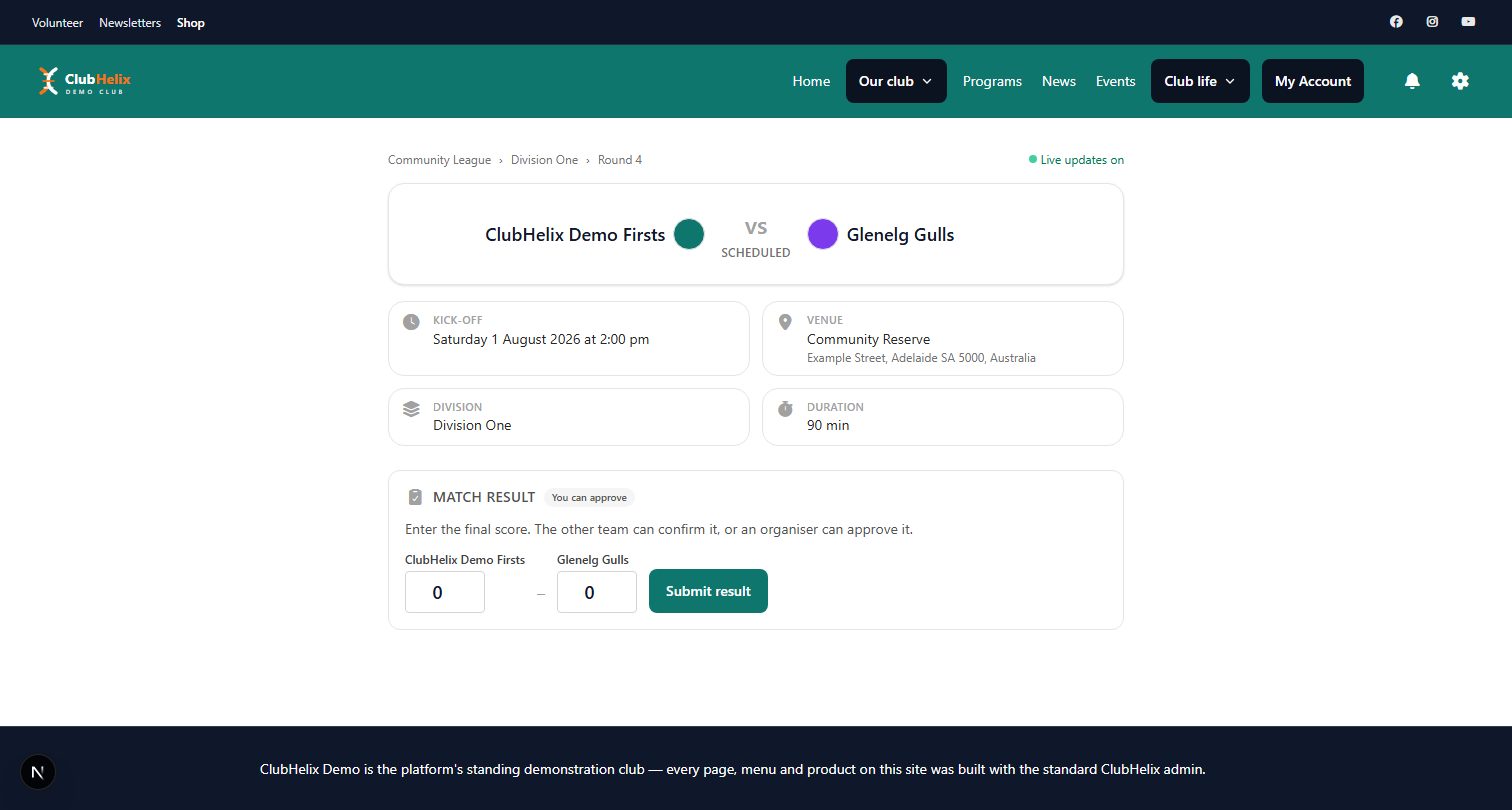
It starts free, the pricing sits on the page in plain numbers rather than behind a sales call, and the whole thing is put together for clubs that run on goodwill rather than budgets. If your league has outgrown its group chat, you can set the club up online between one round and the next — season calendar, entry form, standings page and all.
Frequently asked questions
How many rounds should a sim racing season have?
Eight to ten rounds suits most club leagues — long enough for a championship to mean something, short enough that people finish it. New leagues should start with six, because proving the night works matters more than crowning a champion. Whatever you pick, allow one or two drop scores so a single disconnect does not end someone's season in round three.
How do you handle penalties in a sim racing league fairly?
Separate the roles. The race director runs the night and logs incidents without judging them; a panel of three stewards reviews the evidence afterwards, at least one of whom is not racing in that class. Require protests on a timestamped form within a fixed window, publish short written reasoning for every decision, and send appeals to someone who was not part of the original ruling.
What should a sim racing club publish after each round?
Provisional results within an hour of the flag with the incident list attached, then final results and updated standings once the protest window closes. Never edit a published table silently — post a correction with the date and what changed. A permanent results page on the club's own site is worth far more than a message that has disappeared up the feed.
Do sim racing clubs need sponsors?
Not to survive — a modest annual membership generally covers server hosting. Sponsorship is worth pursuing when you can deliver something specific and prove you delivered it: overlay placement, round naming, a partner page, an end-of-season report with links. Never quote audience figures you have not actually measured, and fund cash prizes carefully, since prize pools can be regulated.
Can a sim racing club run its own website and standings?
Yes, and it is the best investment a league can make. Fixtures, results, ladders, entry forms and a stewards' decisions archive on one searchable site replace a pinned message and a spreadsheet, and give sponsors and prospective drivers something credible to look at. The video stream stays on a streaming platform; the record of what happened lives on the club site.
Next: how to make a fixture draw covers building a calendar that spreads the load, and how to run a karting club is the real-world sibling with many of the same officiating problems.


