
What this guide answers
- How often should we contact sponsors during the season?
Three or four meaningful touchpoints beyond the invoice: a start-of-season welcome, a mid-season update with photos, an in-person invitation, and the end-of-season report.
- What should be in an end-of-season sponsor report?
Proof of everything delivered (with photos), your honest reach numbers, the season's community story, and a specific thank-you naming what their money funded.
- When should we ask sponsors to renew?
Start the conversation a month or more before you need an answer, and always after they've received the season report.
- A sponsor says they're not getting value — what do we do?
Thank them for saying so, then fix the gap fast: check the delivery register for missed commitments, boost their visibility for the rest of the season, and offer a package better matched to their goals.
Most clubs pour their energy into winning sponsors and almost none into keeping them — then act surprised when the renewal email goes unanswered. Yet sponsor retention is where the real money is: a renewing sponsor costs you a coffee and a report, while a replacement costs months of door-knocking, and usually signs for less than the sponsor you lost.
The pattern behind almost every lost sponsor is the same. The club took the cheque in March, hung the banner, and went silent until the next invoice in February. The sponsor spent a year wondering what they got, then decided the answer was "a warm feeling", and warm feelings don't survive a tight budget year. Here's how to be the club sponsors don't cut.
Why sponsors actually leave
It's rarely about money, and almost never about your on-field results. Sponsors walk when:
- They can't see what they got. No photos, no numbers, no mentions — just a logo on a fence they've never visited.
- Nothing promised was delivered — or worse, they don't know whether it was delivered, which lands the same way.
- The only contact all year was the renewal invoice. Being treated as an ATM is the single most-cited reason local sponsors quietly lapse.
- The person who loved the club left the business, and their successor inherited a line item with no story attached.
- Renewal arrived as an ambush — a February invoice with no warning, no report, no conversation.
Every one of those is fixable with process, not charm. The rest of this guide is that process. (If you're still building your sponsor list in the first place, start with how to get sponsors for a sports club — retention starts with promising the right things.)
Deliver what you promised — and track it in writing
Sponsor retention starts the day the agreement is signed, with an unglamorous tool: a delivery register. List every commitment in the package, who owns it, and when it happens. If you promised it, schedule it.
| Commitment | Owner | When | Done? |
|---|---|---|---|
| Logo + link on club website | Website admin | Within 1 week of signing | ☐ |
| Ground signage installed | Facilities volunteer | Before round 1 | ☐ |
| Sponsor spotlight news post | Comms volunteer | Round 3 | ☐ |
| Social media mentions (×6) | Comms volunteer | Spread across season | ☐ |
| Logo in email newsletter footer | Comms volunteer | Every edition | ☐ |
| Sponsors' day invitation | President | Round 10 | ☐ |
| End-of-season report | Sponsorship coordinator | Within 3 weeks of finals | ☐ |
Two rules make the register work. First, one named owner per line — "the committee" delivers nothing. Second, photograph everything as it happens: the banner going up, the crowd in front of it, the jumper presentation, the spotlight post. Those photos cost nothing in the moment and become the backbone of your end-of-season report.
If your club has more than a handful of sponsors, spreadsheets start leaking. A dedicated sponsors CRM keeps each sponsor's package, commitments, contacts and renewal date in one place the whole committee can see — so delivery survives a change of sponsorship coordinator.
Make their visibility real, not theoretical
A logo on a fence is visibility once. A sponsor woven through your club's channels is visibility forty times a season — and it's the cheapest thing on this list because the channels already exist.
One practical note: if a sponsor is claiming the payment as a business expense rather than a donation, they'll want a tax invoice, and if your club is registered for GST the sponsorship is generally a taxable sale. Sort that with your treasurer at the start, not at renewal.
The channels themselves:
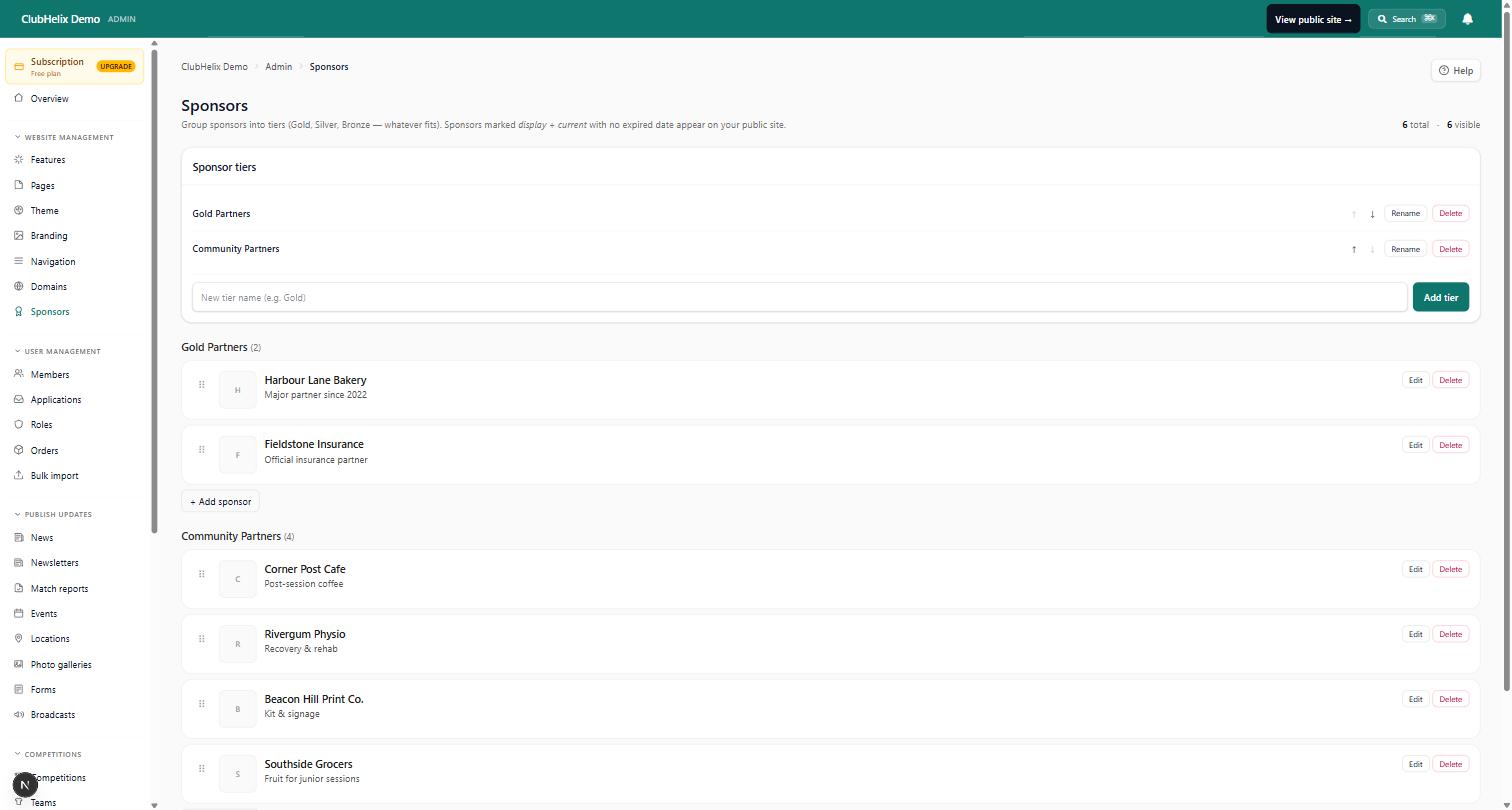
- Website. Logos with links on the homepage and a proper sponsors page — tiered so your major partner is unmistakably bigger than the bronze sponsors. Keep it current; a defunct sponsor still on the site tells every current one how much you care.
- Club news. A "sponsor spotlight" news post per sponsor per season — three paragraphs about their business, why they back the club, and a photo of a real human. Sponsors share these to their own customers, which is precisely the point.
- Email. Sponsor logos in the newsletter footer, and a genuine mention when there's news — "our major sponsor just opened their second store". With email broadcasts going to your full member list, that's reach a fence banner never gets.
- Match day and socials. PA thank-yous, scoreboard mentions, and tagged posts when the content is natural — the team in sponsored jumpers, the post-match meal at the sponsor's pub.
The test for every channel: could the sponsor screenshot this and show their business partner? If yes, it counts. If it only exists in your intentions, it doesn't.
Communicate like a partner, not a payee

Three or four non-invoice touchpoints a season transform the relationship:
- Start of season: a welcome note confirming what's in their package and when it lands — plus their signage photographed and sent the week it goes up.
- Mid-season: a two-line update with a photo. "Crowd shot from Saturday in front of your banner — memberships are up 12 on last year, thanks for being part of it."
- An invitation with no ask: a sponsors' day, a presentation-night table, a junior clinic visit. Sponsors who've stood on your ground and been thanked in person renew at a completely different rate.
- Bad news early: if something promised slips (the signage got vandalised, the spotlight post ran late), say so and fix it. Sponsors forgive hiccups; they don't forgive silence.
Assign this to one person — a sponsorship coordinator, even informally. Sponsors renew with people, and continuity of contact is half the battle when their staff change too.
The end-of-season sponsor report
This is the single highest-leverage document in club sponsorship, and it takes about an hour if you've been photographing delivery all season. One or two pages, per sponsor or as a shared report with a personalised cover note:
- What was delivered — the register, ticked, with photos: signage in situ, the spotlight post, the newsletter footer, the sponsors' day.
- The reach numbers you actually have — members and families in the club, newsletter subscribers, website visits, social followers, event attendances. Real, modest numbers beat inflated ones; never invent figures.
- The season's story — teams fielded, juniors introduced to the sport, community events run. Sponsors back the story, not the ladder position.
- A thank you that sounds human — one sentence about what their support actually funded: "your sponsorship covered every junior's match ball and umpire fees this season."
Send it within a few weeks of the season ending, while the goodwill is warm — not attached to the renewal invoice. Our end-of-season report template gives you a structure to start from.
Make renewal a conversation, not an invoice
With the report sent, sponsorship renewal becomes easy — but sequence matters:
- Report first (post-season, no ask attached).
- Conversation second (a month or so before you need an answer): a coffee or a call. Ask what worked for them, what they'd change, and what their year ahead looks like. Listen — this is where you learn a sponsor is quietly unhappy while there's still time to fix it.
- Offer third, tailored to what you heard — same package, a step up with first right of refusal on naming rights, or a graceful step down that keeps them in the family rather than losing them entirely.
- Invoice last, once they've said yes.
Track renewal dates like fixtures — every sponsor's renewal in the club calendar with a reminder well ahead, so no agreement ever just quietly expires. And when a sponsor does leave despite everything, exit well: thank them publicly, take the signage down promptly, and leave the door open. Businesses cycle; the club that handled the exit gracefully is the first call when their budget comes back.
If your club runs on ClubHelix, the retention machinery is built in: a sponsors CRM tracking packages, delivery and renewal dates, sponsor logos on your website, news spotlights and email broadcasts for the visibility that fills your report. It's one less spreadsheet standing between your club and a renewing sponsor — see pricing for what's included free.
Frequently asked questions
How often should we contact sponsors during the season?
Three or four meaningful touchpoints beyond the invoice: a start-of-season welcome, a mid-season update with photos, an in-person invitation, and the end-of-season report. Enough to feel like a partnership, not so much it becomes noise.
What should be in an end-of-season sponsor report?
Proof of everything delivered (with photos), your honest reach numbers, the season's community story, and a specific thank-you naming what their money funded. One or two pages, sent within a few weeks of the season ending — separate from the renewal invoice.
When should we ask sponsors to renew?
Start the conversation a month or more before you need an answer, and always after they've received the season report. Renewal should confirm a decision the report already made for them — never ambush a sponsor with a cold invoice.
A sponsor says they're not getting value — what do we do?
Thank them for saying so, then fix the gap fast: check the delivery register for missed commitments, boost their visibility for the rest of the season, and offer a package better matched to their goals. A complaint is a renewal conversation in disguise — silence is what kills sponsorships.


