
What this guide answers
- What does a motocross club need to run a practice day?
A valid approval for the day, a prepared and inspected track, sign-on checking membership and licences, signed risk acknowledgements, scrutineering, a compulsory rider briefing, flag marshals with a signalling system…
- How do you manage motocross noise complaints?
Test and log sound at scrutineering using the method your governing body specifies, hold your permitted hours without exception, ban idling and warm-ups outside them, keep a complaints register with your responses, and…
- How often does a motocross track need preparation?
Watering is a weekly job through the riding season and repeated on ride days.
- What is checked at motocross scrutineering?
Typically brakes, a self-closing throttle, secure grips and plugged bar ends, intact levers, chain and sprocket guards, a serviceable silencer with a sound test where required, a working cut-out, sound tyres and…
- What records should a motocross club keep?
Sign-on and licence checks, signed waivers, scrutineering and sound test logs, incident and near-miss reports with follow-up, rider briefing records, machinery maintenance logs, track inspection sign-offs, the…
Canada edition. This guide is written for volunteer-run clubs in Canada. Where rules differ — grants, tax, incorporation, safeguarding — follow the Canada-specific pointers below or check with your national body.
Most community clubs worry about membership numbers. A motocross club worries about a letter. One neighbour, one complaint about a Sunday morning that started twenty minutes early, one investigation into whether the club is operating within its approval — and forty years of volunteer work is suddenly negotiable. That threat sits behind every decision a motocross committee makes.
State it plainly. A motocross club is not a sports club with machinery attached. It is a small industrial site — earthmoving equipment, fuel storage, noise emissions, water management, a first aid response plan and a licensing regime — run by volunteers on weekends. The riding is the easy part. Everything that lets the riding happen is a compliance job, and the club best at that job gets to keep riding.
This guide covers the permit and its conditions, track preparation and the machinery roster, running a practice day from sign-on through scrutineering to the last session, noise and the neighbours, the officials you cannot operate without, and the records you must be able to produce when someone asks.
Your permit is the club
Whatever it is called where you are — a development approval, a planning consent, a conditional use permit, a licence — the document allowing motorsport on your land is the most important thing the club owns, and most committees have never read it end to end. Do that at the next meeting, out loud. Then build a conditions register — one row per condition, with a named owner.
| Condition type | What it typically specifies | Who owns it | Evidence you keep |
|---|---|---|---|
| Operating days and hours | Which days, start and finish times, number of days a year | Secretary | Published calendar, gate log |
| Noise | A limit and a measurement method, sometimes at a boundary | Compliance officer | Sound test records, any monitoring |
| Rider numbers | Maximum riders on track or on site at once | Clerk of the course | Sign-on records per session |
| Access and traffic | Entry point, parking layout, traffic management | Event coordinator | Traffic plan, marshal roster |
| Water and sediment | Dust suppression, runoff and sediment controls | Track director | Watering log, inspection notes |
| Fuel and waste | Bunded storage, spill kits, waste and wash-down management | Track director | Storage checks, spill kit inventory |
| Amenities | Toilets, waste, camping if permitted | Event coordinator | Servicing records |
| Vegetation and buffers | Screening plantings, bunding, retained vegetation | Track director | Photos, planting records |
Review it annually and after every change of committee. Two rules make it work. Never let a condition be owned by "the committee", because that means nobody. And never assume a long-standing informal practice is permitted just because nobody has objected — the day someone does, the only thing that matters is the document.
The approval usually sits with a county or municipal zoning authority, often as a conditional or special use permit with a renewal cycle, and environmental agencies handle noise and stormwater separately. Permits with renewal dates are the ones clubs forget — put the date in the club calendar with a six-month warning.
This is general information rather than advice. Approvals, noise regulation and licensing differ by jurisdiction and change over time — confirm your position with your regulator, your governing body and, where the stakes justify it, a planning professional.
Clubs affiliate through their provincial motorcycle association to the national body, which issues competition licences, sets the class and age structure, accredits officials and publishes the rules. Track inspection by the association is usually required before sanctioned events, separately from municipal permits.
Track prep, watering and the machinery roster
A motocross track degrades every time it is used. Ruts deepen, jump faces square off, braking bumps form, and the top layer dries out and blows away. Preparation is not a pre-event tidy-up — it is a machinery program with a schedule, a budget and a crew of trained operators.
The rhythm
- After every ride day — walk the track, fill the worst ruts, repair jump faces and take-offs, check every fence, bale, tyre wall and marker arrow, note what needs machine time.
- Weekly through the season — water. This is the whole game. A track watered the evening before and again in the morning holds its shape, throws no dust and rides safely. A dry track produces exactly the complaint that reaches your regulator.
- Before each ride day — rip the hard pan where required, grade, water, then let it set. Ripping and watering an hour before riding produces a slick, dangerous surface; finish the work the day before.
- Monthly — drainage, culverts, silt controls, bunding, safety fencing, run-off areas, signage, pit and parking surfaces.
- Off-season — the major program. Reshaping, importing material, rebuilding jump faces, drainage works, and a full service of every machine.
Machinery, and the rules around it
Most clubs run a tractor with a ripper and grading blade, a compact loader, a water cart, a roller and a fleet of hand tools. This is the highest-risk activity the club undertakes, and it happens when almost nobody is watching. Five non-negotiables:
- Only ticketed, authorised operators, on a written list held by the track director. Enthusiasm is not a qualification.
- Nobody operates alone. Two people minimum, with a check-in time.
- A pre-start check and maintenance log per machine — hours, fuel, fluids, faults, repairs. Your evidence, your maintenance planning and your insurance position.
- A machinery budget line, including fuel, servicing, tyres, hydraulics and a replacement sinking fund. Machinery fails on the Thursday before an open meeting, not gradually.
- Water access sorted before the season. Know your source, your licence or agreement to draw from it, your storage and your pump backup.
Working bees carry this program. Publish the jobs, the tools needed and the finish time — a task list gets people, a general call for help does not. How to organise a working bee covers the format, and volunteer rostering lets people claim the actual job.

Practice days — sign-on, scrutineering, marshals and first aid
Practice days are most clubs' bread and butter, and also where discipline slips, because they feel informal. Run them with the structure of a race meeting and you will not have a bad one.
| Time | What happens | Who |
|---|---|---|
| 06:30 | Final grade and water done, track walked and signed off | Track director, clerk |
| 07:00 | Gates, sign-on, scrutineering and canteen open | Two on each |
| 08:15 | Sign-on closes for the first session block | Sign-on team |
| 08:30 | Rider briefing — no briefing means no riding | Clerk of the course |
| 08:45 | Session one begins, groups rotate on a published timetable | Flag marshals, control |
| 12:00 | Track break — water, grade, repair take-offs | Track crew |
| 15:30 | Last session, track sweep, gates close | Clerk of the course |
| 16:00 | Paperwork reconciled, reports filed, takings banked | Secretary, treasurer |
Sign-on
Sign-on is a compliance checkpoint, not a cash desk. Every rider is checked for current membership, a valid licence for what they are about to do, and a signed risk acknowledgement for the day. Under-18 riders need a guardian present to sign, and the club needs to know which adult is responsible for each minor on site. Day or trial licences make first visits possible — know what your governing body allows and do not improvise.
Take as much of this online as you can. Pre-registration with card payment turns sign-on into a check rather than a queue, and digital waivers mean the acknowledgement is signed on a phone before anyone leaves home and findable in seconds. Paper forms in a shoebox are the most common weak point in a motocross club's records.
Scrutineering
Every bike, every day, before it goes on track. Two trained scrutineers move a lot of bikes if the queue is organised. A community club checklist typically covers:
- Brakes front and rear, with adequate pad and fluid.
- A throttle that snaps closed on its own, and secure grips with plugged bar ends.
- Levers intact with no sharp broken ends, controls secure.
- Chain tension, chain guard and sprocket guard fitted.
- Silencer secure and serviceable, plus a sound test where your governing body requires one.
- Working engine cut-out or lanyard, where required.
- Tyres and wheels sound, spokes tight, no sharp edges or fluid leaks.
- Legible numbers, correct for the rider's class.
- Rider gear — helmet meeting any standard your governing body applies, goggles, boots, gloves, chest protection.
Publish the checklist on your website so riders arrive prepared. A bike that fails is not a confrontation if the standard was public a week earlier.
Marshals, control and medical cover
Flag marshals are the safety system. They need line of sight to cover the whole track between them, a reliable signalling system, a briefing before the first session, and training on flag meanings and the red-flag procedure. Position them so no blind landing or corner is unwatched, and give control the authority to stop a session instantly.
The clerk of the course runs the day and has final authority on whether riding proceeds. Medical cover requirements — qualification levels, whether an ambulance or paramedic must be on site, and what happens when cover leaves with a patient — are set by your governing body and your permit, not by the committee on the morning. Know your requirement, and write down that riding stops when cover is not present.
Every incident goes in the register the same day, including near misses and mechanical failures. Incident reporting keeps them searchable with the follow-up trail attached, which is what you want when an insurer or regulator asks about a date three years ago. The incident report form template covers the fields to capture, and sports club risk management the assessment behind it.
Noise, neighbours and keeping your permit
Noise is the largest existential risk to a motocross club, and it is manageable — but only by treating neighbour relations as a permanent program rather than a response to complaints.
Test sound, and record it. Where your governing body specifies a limit and a measurement method, apply it at scrutineering, log every reading against the rider and the bike, and turn away bikes that fail until they are fixed. The log matters as much as the test — a club that can produce a year of sound records is in a completely different position to one that says it usually checks.
Hold your hours religiously. Not one engine started before the permitted time, not one after. Post the times at the gate, brief them, and have a marshal empowered to stop someone. Most complaints are not about noise level at all — they are about a Sunday that started early.
Manage the pits. No idling, no revving in the paddock, no warm-ups outside the permitted window, and a warm-up area away from the boundary. Bikes blipped in a car park at 7am generate more ill will than a full session at midday.
Keep a complaints register — date, time, complainant, what was reported, wind direction, what was happening on track, what the club did. Respond personally and quickly, even to complaints you believe are unreasonable. A register of prompt, courteous responses is powerful evidence if the matter reaches a regulator.
Communicate before you make noise. A letterbox drop to nearby residents a week before an open meeting, with dates, hours and a phone number, turns a surprised neighbour into an informed one.
Invest in the physical fixes. Bunding, screening plantings and orienting the noisiest parts of the track away from the boundary all help, and are exactly what a grant can fund — as are dust suppression, sediment controls on runoff, bunded fuel storage with spill kits, and a wash-down area that does not drain to a waterway. Those last ones are usually permit conditions too, and what a regulator inspects first.
Membership, licences and the money
People confuse three separate things — club membership, a governing body licence, and entry to a specific day. Explain all three on your website in plain language, because the confusion costs you riders.
| Category | Suits | Typically includes |
|---|---|---|
| Senior riding member | Adult riders | Practice day access at member rate, voting rights |
| Junior riding member | Riders under the senior age | Member rate, junior coaching, class eligibility |
| Family | Households with multiple riders | Bundled riding memberships |
| Social / volunteer member | Officials, parents, track crew | Voting rights, no riding entitlement |
| Day entry | Visitors on a trial or day licence | One day's riding, at a higher rate than members |
The economics of a practice day, illustratively — eighty riders on a member and visitor mix, plus a canteen. Against that sit machinery fuel and hire, water, medical cover, officials, portable toilets, waste, insurance loading and consumables. The margin on a well-attended day is real; on a wet day with a full cost base it is not, which is why the cancellation call must be made early and communicated properly.
Funding for berms, screening, drainage and amenities usually comes from municipal recreation grants, provincial sport and community infrastructure programs and community foundations. Environmental and neighbour-amenity framing is usually the stronger application.
Budget the whole year properly with something like the club budget template, and treat machinery, water and medical cover as fixed costs rather than variables you can trim.
Officials, accreditation and succession
A motocross club cannot run without accredited people — a clerk of the course, a steward, scrutineers, flag marshals and qualified first aiders. Accreditation takes time and money, and most clubs are one retirement away from not being able to run a meeting.
Treat it as a workforce plan. Know who holds what and when it expires. Fund two new accreditations a year as a standing budget line, recruit from parents in their first season rather than waiting for volunteers to appear, and pair every new official with an experienced one for a full season. Publish what each role actually involves — most people say no because they imagine a bigger commitment than the job carries. Volunteer position descriptions is a useful start, and how to recruit club volunteers covers the ask.
Records you must be able to produce
If someone asks tomorrow, can you produce these — quickly, and from something more durable than a committee member's laptop?
- Sign-on records for every ride day — who rode, under what licence, and who signed for each minor.
- Signed risk acknowledgements and waivers, current for the season.
- Scrutineering records, including sound test readings where required.
- Incident reports, including near misses, with follow-up actions closed out.
- Rider briefing records — that it happened, who ran it, who attended.
- Machinery pre-start checks and maintenance logs.
- Track inspection sign-offs before each ride day.
- The complaints register and your responses.
- Officials' accreditations and expiry dates, and first aid qualifications.
- Insurance certificates and the permit conditions register.
Agree a retention period with your governing body and your insurer, keep the records somewhere with a proper audit trail, and back them up. A record system is only useful if it survives a change of secretary, and the same discipline applies to your plant and equipment list — the club equipment register template is a workable starting point for the machinery side.
Paperwork that survives an audit
Motocross generates more records per member than almost any community sport — waivers, licence checks, day entries, scrutineering and sound logs, incident reports, machinery maintenance, a complaints register, and accredited officials with expiry dates. On paper and in spreadsheets, all of it is one flood, one hard drive or one resignation away from gone. ClubHelix keeps it in one place with an immutable audit log behind it — digital waivers signed before riders arrive, incident reporting with the follow-up trail attached, event entries for practice days and open meetings, and member records showing licence and membership status at sign-on.
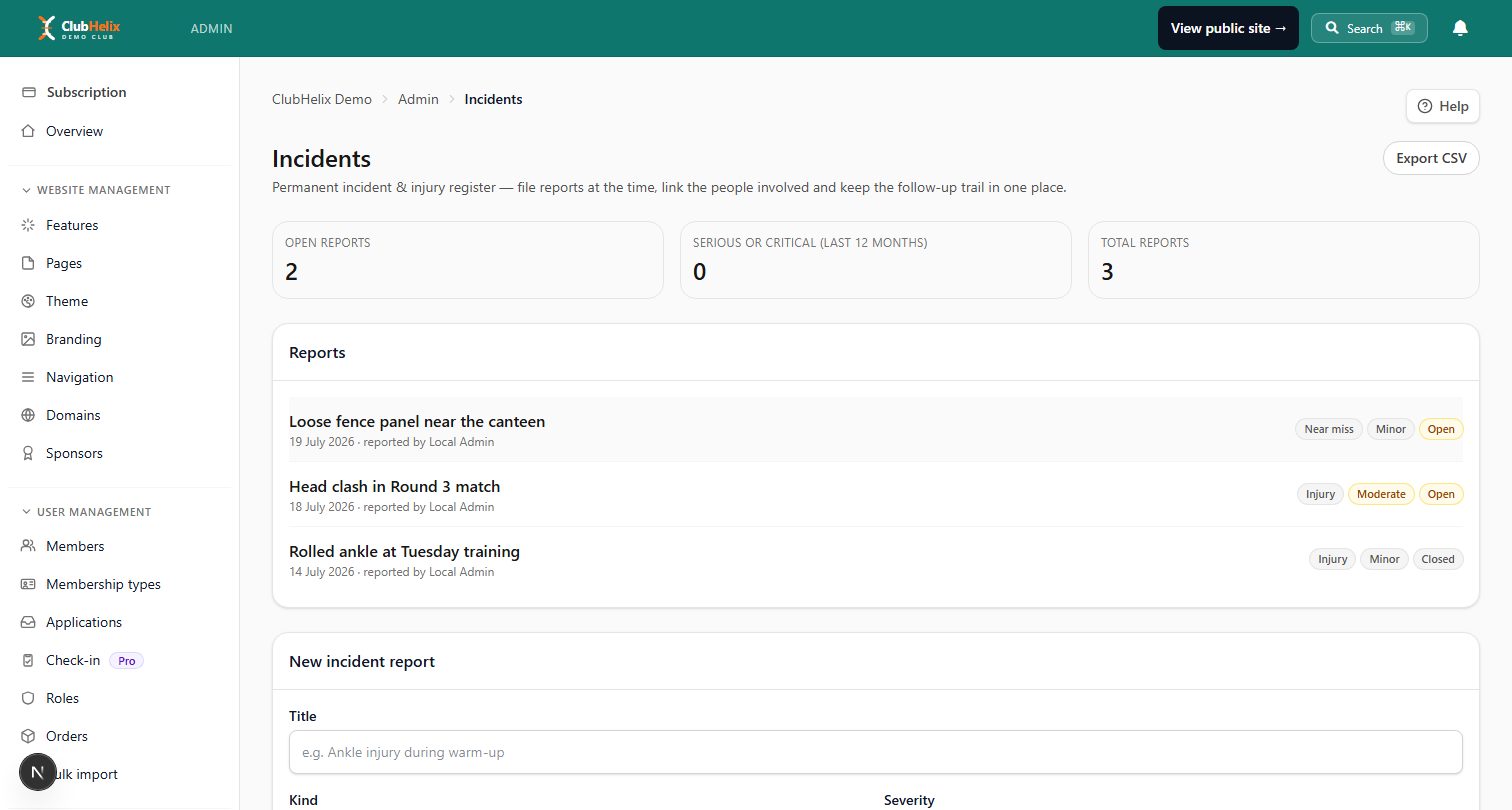
There is a free tier to start on and published pricing rather than a quote process. A committee can get the calendar, the join page, the waiver flow and the incident register running well before the next working bee. Set your club up and stop storing your compliance in a shoebox.
Frequently asked questions
What does a motocross club need to run a practice day?
A valid approval for the day, a prepared and inspected track, sign-on checking membership and licences, signed risk acknowledgements, scrutineering, a compulsory rider briefing, flag marshals with a signalling system, a clerk of the course with authority to stop riding, and the medical cover your governing body and permit require — with records of all of it, filed the same day.
How do you manage motocross noise complaints?
Test and log sound at scrutineering using the method your governing body specifies, hold your permitted hours without exception, ban idling and warm-ups outside them, keep a complaints register with your responses, and talk to nearby residents before big days rather than after. Bunding and screening plantings help, and are often grant-fundable.
How often does a motocross track need preparation?
Watering is a weekly job through the riding season and repeated on ride days. Ripping, grading and watering are finished the day before riding, not an hour before. Ruts, jump faces and safety fencing get attention after every ride day, drainage and sediment controls monthly, and the major reshaping happens in the off-season.
What is checked at motocross scrutineering?
Typically brakes, a self-closing throttle, secure grips and plugged bar ends, intact levers, chain and sprocket guards, a serviceable silencer with a sound test where required, a working cut-out, sound tyres and wheels, no leaks or sharp edges, correct numbers, and the rider's helmet, goggles, boots, gloves and body protection. Publish your checklist so riders arrive ready.
What records should a motocross club keep?
Sign-on and licence checks, signed waivers, scrutineering and sound test logs, incident and near-miss reports with follow-up, rider briefing records, machinery maintenance logs, track inspection sign-offs, the complaints register, officials' accreditations and expiry dates, and insurance and permit documents. Agree a retention period with your governing body and insurer.
Keep reading — sports club risk management for the assessment framework behind all of this, and how to run a BMX club if you share a precinct or a volunteer pool.


