
What this guide answers
- How should a kickboxing club structure its class timetable?
Work out what each session costs and what it returns, then build around the sessions that pay.
- What paperwork does a club need before someone spars or competes?
At minimum, a signed waiver and health screening on joining, a rule requiring members to report new injuries or diagnoses, and — for anyone competing — the registration, medical clearance and matching requirements set…
- How often do Thai pads and gloves need replacing?
There is no fixed schedule, because it depends entirely on how much they are used.
- How do you run a fight team without it costing the club money?
Charge the squad a reduced membership rather than nothing, budget corner and travel costs explicitly instead of absorbing them, look for a local sponsor to fund fight kit in exchange for branding, and be honest in your…
- Does a kickboxing club need a website if it has a busy social media page?
Yes, because the timetable, the price, the beginner pathway and the waiver all need a permanent home.
Ireland edition. This guide is written for volunteer-run clubs in Ireland. Where rules differ — grants, tax, incorporation, safeguarding — follow the Ireland-specific pointers below or check with your national body.
Walk into a kickboxing club at 6pm and you will see thirty people in a bag class, most of whom will never have a fight and have no intention of doing so. Come back at 8pm and there will be seven, three of them on the pads with the head coach, working towards a bout in six weeks that will cost the club money and earn it nothing. Both sessions are the club. Only one of them pays for the room.
That cross-subsidy is the honest structure of almost every kickboxing and Muay Thai club, and pretending otherwise is how coaches end up broke and exhausted. The fitness timetable is the business. The fight team is the reason the coach got into this, the thing that gives the club its standard and its identity, and — measured on its own — a cost centre. Run well, the two support each other: the fighters make the club look serious, the fitness classes make the fighters possible. Run badly, the coach spends every spare hour on three people and wonders why the rent is hard.
This guide is about running both at once. It covers reading your timetable as a profit and loss rather than as a wish list, the waiver and medical paperwork that keeps a full-contact club on the right side of its obligations, and the unglamorous truth about pads, gloves and equipment budgets. If you are looking for the general club-administration questions instead, our guides on running a boxing club and running a martial arts club cover the ground this one deliberately skips.
Two populations, one floor
Before the timetable, get clear about who you actually serve. These groups want different things, tolerate different levels of risk, and respond to completely different messages.
| Group | Why they come | What they need from you | What they cost you |
|---|---|---|---|
| Fitness and bag classes | Conditioning, stress relief, learning something real | Predictable class times, no obligation to spar, a coach who remembers their name | Low — high heads per coach hour |
| Technique and beginners | Skill, curiosity, maybe one day a bout | A structured course, clear progression, controlled contact | Low to moderate |
| Sparring group | Testing themselves without competing | Strict supervision, matched partners, enforced gear rules | Moderate — needs a senior coach in the room |
| Fight team | Competition | Pads with the head coach, a corner, medicals, travel, weight management | High — coach time, entry fees, corner costs, travel |
| Juniors | Confidence, fitness, discipline | Separate classes, no head contact, screened coaches, parent communication | Moderate — ratios and compliance |
The mistake is treating this as a hierarchy, with fitness members as failed fighters at the bottom. They are not the base of a pyramid; they are the customer. A member who comes twice a week for four years, never spars and pays every month is worth more than a fighter who trains free for eighteen months and then retires. Design your timetable, communication and pricing around that without making the fitness members feel second-class.
A timetable that pays for the fight team
Print your weekly timetable and write two numbers beside every session: how many people were on the floor last time it ran, and what it costs you to run — coach payment, plus a share of rent and utilities for that hour.
Most clubs discover three things immediately. A couple of sessions are quietly carrying everything. A couple are running with four people out of habit. And the fighters' session is the most expensive hour in the week by a distance, because it takes the highest-paid coach and produces the least income.
A worked example
These figures are illustrative only — use your own — but the shape is typical. Say your venue and fixed costs come to the equivalent of a hundred units a week and you run fourteen sessions. That is roughly seven units of fixed cost per session before you pay a coach anything.
- The 6pm bag class runs 24 heads. It carries itself several times over.
- The 9:30am class runs 11, mostly parents after school drop-off, and pays its way comfortably.
- The 7pm technique class runs 14 and is your main recruiting ground into everything else.
- The Tuesday 8:30pm fighters' session runs 6, with your head coach on pads for ninety minutes. It loses money every week.
- The Thursday 12pm class has run with three people since February. It is costing you the coach's time and a venue hour for nothing.
That last line is the decision most clubs avoid. Cancelling a session feels like shrinking. It is not — it is moving an hour of coach time from a session with three people to a beginners' course with twelve, which is the thing that eventually feeds the fighters' session anyway.
Protect the sessions that fund everything
- Run beginners' courses on fixed intakes, not open enrolment. A six-week course with a start date, a finish date and a cap converts far better than "come along any time", and it gives you a natural moment to sell a membership. Programs and term enrolment handles the roll, the cap and the payment.
- Never cancel a money session for a fight camp. If the head coach is away cornering, someone else takes the 6pm class. Members who turn up to a locked door twice do not come a third time.
- Put the timetable somewhere it is always correct. Not a photo of a whiteboard posted in a story that expires. A page on your own site that you update once and that everyone can check at 5:45pm.
- Charge the fight team something. Not full price, necessarily, but something. A squad that pays a reduced membership values the coaching, and the club is not subsidising people who can afford to contribute.

Plan the timetable around the season too. Evening attendance dips through the long summer break when people travel, then rebounds sharply in the new school year and again in the first weeks of January — the two windows where the decision to start something actually gets made. Open a beginners' course in each of them, and run a reduced timetable through the quiet weeks rather than closing entirely, because a club that goes dark for a month loses the habit as well as the revenue.
Sparring is where the timetable meets the risk register
Sparring is the point at which a fitness class becomes a contact sport, and it deserves written rules rather than custom.
- Invitation only. Nobody spars because they turned up in the right session. A coach decides, based on technical control rather than fitness or enthusiasm.
- Gear is not negotiable. Mouthguard, headgear where your rules require it, shin guards, groin protection, and gloves of the weight your club sets for sparring rather than bag work. Turn people away who arrive without it; doing that once fixes it permanently.
- Match by control, not by size. Weight matters, but experience and temperament matter more. A heavy beginner is a hazard to a light experienced member and vice versa.
- A senior coach is in the room, watching, not training. This is the rule most often broken and the one that most often matters.
- Set the intensity out loud, every session. Percentages are vague; "technical, you are working the jab, nobody is trying to hurt anybody" is not.
- Head knocks end the session. Anyone showing signs of concussion stops immediately and does not return that day. Follow the return-to-sport protocol your governing or sanctioning body publishes, and never let a member, a coach or a parent talk you out of it.
Write every incident down the same evening — what happened, who was involved, what was done, whether medical attention was sought. Two minutes at the time; enormous value later. Our incident report form template gives you the fields, and incident reporting keeps the log somewhere the committee can actually review rather than in a coach's phone.
Waivers, health screening and pre-fight clearance
Combat sport paperwork comes in three layers, and clubs routinely collect the first and forget the other two.
Layer one — the joining waiver and health screening
Every member signs before their first session, including trial members and visitors. Alongside the assumption-of-risk wording, collect a short health screening: existing injuries, heart and blood pressure conditions, epilepsy, diabetes, asthma, pregnancy, current medication, previous concussions, and an emergency contact. You are not making a medical judgement — you are deciding when to say "please get a doctor's clearance before you start", and you are giving your coaches the information they need in an emergency.
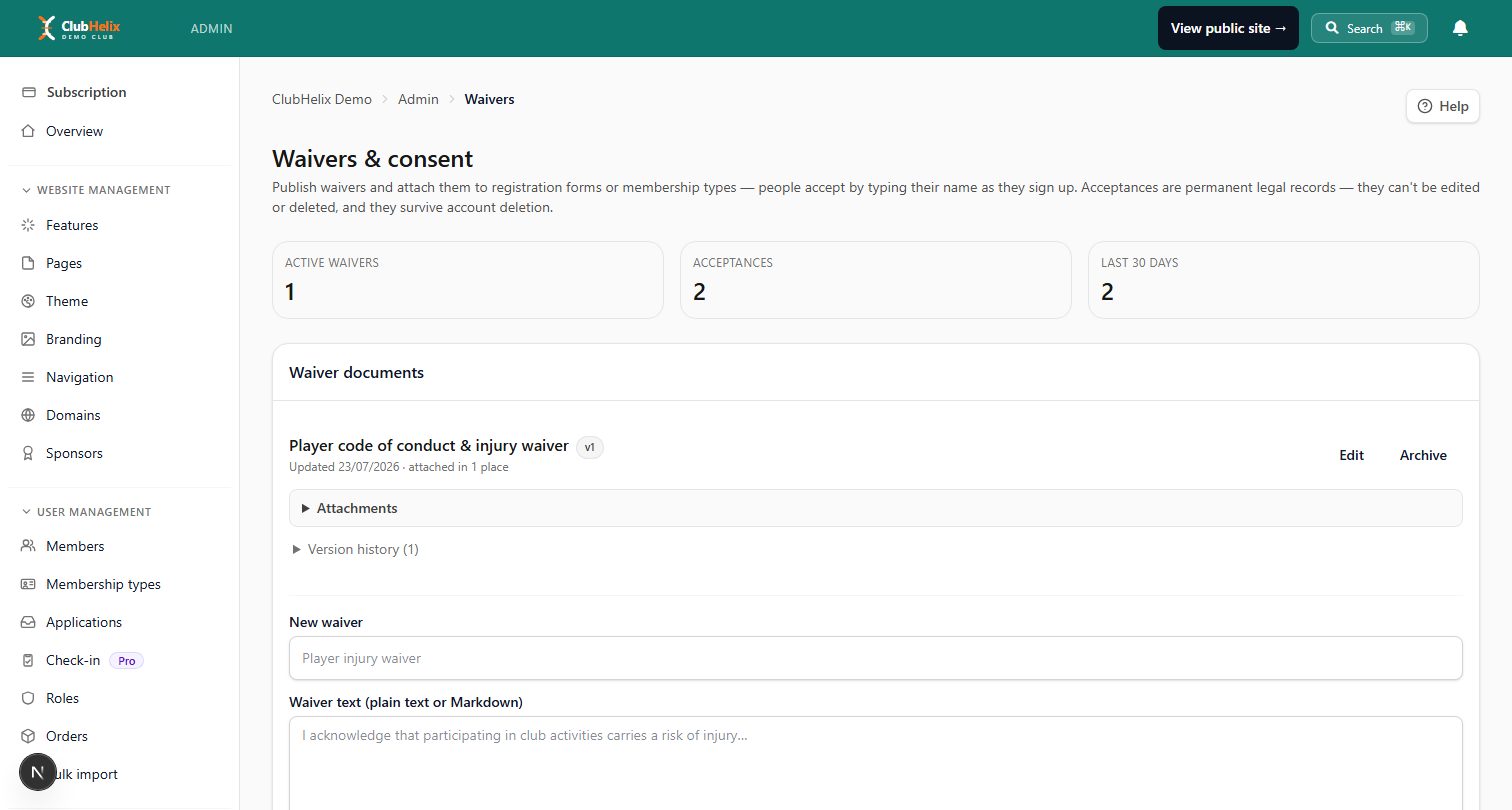
Collect it digitally rather than on paper. Paper waivers live in a folder that is never in the room when you need it, and a signature from three years ago on a form nobody can find is worth very little. Digital waivers attach the signed document and its timestamp to the member record, so the coach on the door can see at a glance who has one and who does not.
Layer two — keeping it current
A waiver signed once and never revisited slowly stops describing reality. Build in a refresh:
- An annual re-declaration at renewal, updating injuries, medications and emergency contacts.
- A rule that any member reports a new injury, surgery or diagnosis before returning to training.
- A separate, shorter waiver for visitors, trial classes and open sessions — collected in advance where you can, so the door is not a bottleneck.
- Parental consent plus medical information for every junior, refreshed each year.
Layer three — pre-fight clearance
This is the layer that is genuinely regulated, and the layer where general advice is worthless because the rules belong to whoever sanctions the bout. What is broadly true everywhere is that an amateur bout requires the athlete to be registered or licensed with the sanctioning body, medically cleared within a defined window before the event, matched within a weight and experience band, and free of any medical suspension imposed after a previous stoppage.
Your job as the club is administrative, not medical. Keep a per-fighter record with: registration or licence number and expiry, date of last medical clearance and when it lapses, bout record with results, any stand-down period and the date it ends, weight division, and who is approved to corner them. Check it before you enter anyone into anything.
Amateur combat sport in Ireland is governed by the recognised national body for each code, which sets registration, medical clearance and matching requirements. Venue licensing and event conditions may also involve the local authority. Ask your sanctioning body directly, and get event requirements in writing before you sell a ticket. This is general information, not advice.
Pads, gloves and an equipment budget that survives contact
Kickboxing equipment does not wear out gracefully. It works, and then one day the foam has compressed to nothing and a coach's forearms are taking the impact. Budget for replacement as a running cost rather than an occasional shock.
| Item | What kills it | Who should own it | Budget note |
|---|---|---|---|
| Thai pads | Foam compression from daily use; stitching at the strap | Club | The most-replaced item in the building; buy two pairs at a time and rotate |
| Focus mitts | Palm padding flattens; velcro fails | Club | Cheaper and longer-lived than Thai pads, but check the palm regularly |
| Belly pad and kick shield | Core foam collapses in the middle | Club | Rotate the striking face rather than always presenting the same side |
| Heavy bags | Filling settles hard at the bottom; chains and swivels wear | Club | Re-pack or rotate bags annually; inspect swivels and mounts every term |
| Sparring gloves (loan) | Lining tears; padding hardens; odour | Club initially, member eventually | Number every pair and log the set they belong to |
| Headgear and shin guards (loan) | Straps, foam, hygiene | Club initially, member eventually | Set a rule — after the beginners' course, members buy their own |
| Handwraps | Cannot be shared, ever | Member | Sell them at the door; it removes an excuse |
| Mats and flooring | Seams, edges, hidden moisture | Club | The biggest single capital item after the bags |
Loan gloves without the smell
Every club that lends gloves has the same problem, and it is solvable with a routine rather than a product.
- Number every pair and keep them in numbered slots so you can see what is missing and what is being over-used.
- Wipe the inside after every class with an appropriate disinfectant, and let them dry open rather than zipped into a bag.
- Rotate stock so the same three pairs are not doing all the work.
- Retire on lining damage, not on appearance — a torn lining shreds a member's hands.
- Set an ownership deadline. Loan gear gets a beginner through their first six weeks. After that, they buy their own. Make it easy by stocking the basics yourself; a small club shop selling wraps, mouthguards and gloves in your own colours turns a nagging conversation into a transaction and adds a modest margin.
Keep an equipment register with purchase dates, so you are replacing on evidence rather than on complaint. The club equipment register template is a straightforward starting point, and it doubles as your insurance inventory if the worst happens.
For budgeting, price your replacement cycle at current retail and add a buffer for delivery, which is a real cost for clubs in Ireland ordering from overseas suppliers. Ask about club or trade pricing before your first big order, and consider approaching a local business to part-sponsor the fight team's kit in exchange for branding and a mention on your site.
Coaches, corners and running your own fight night
Your coaching bench is a compliance surface. Every coach needs current accreditation for the code they teach, first aid and resuscitation, and — if they corner — whatever second's licence your sanctioning body issues. Anyone working with juniors needs the background screening required where you train. All of it expires, usually at inconvenient times.
Keep one register with an expiry date on every line and a reminder ninety days out. Accreditation tracking does this properly, which matters because an insurer's first question after an incident is whether the person supervising was qualified. While you are at it, confirm your policy actually names full-contact training and sparring; general sports cover very often excludes it. Our guide on whether your club needs insurance walks through the questions to ask a broker.
Hosting your own event is the other big undertaking, and it is a promoter's job rather than a coach's. You will need the sanctioning body's approval, licensed officials, medical staff on site, a venue that meets the conditions, and a plan for ticketing, seating and door management. Sell tickets through your own site rather than an external ticketing page — you keep the customer data, you can email attendees directly next time, and the fees stay in the club. Events and ticketing covers it, and our comparison of an external ticketing site versus built-in ticketing explains why that matters more than it sounds.
Getting the admin out of the coach's phone
Everything above lands on one person's phone by default — waivers, timetable questions, who has paid, who is cleared, who needs new gloves, who is fighting in six weeks. That is the actual reason coaches burn out, and it is entirely fixable. ClubHelix gives your club a proper website with digital waivers collected at sign-up, programs and course enrolment for beginners' intakes with caps and payment, accreditation tracking so no coach's certification expires unnoticed, and events and ticketing for your own fight nights. Kickboxing sits under our martial arts club management software page, which shows how a class-based club is set up.
There is a free tier, so you can build the site and see whether it earns its place before spending anything. The pricing is published on the page instead of hidden behind a quote form, and a coach with an hour spare can have a timetable, a beginners' course and a working waiver live tonight — start here.
Frequently asked questions
How should a kickboxing club structure its class timetable?
Work out what each session costs and what it returns, then build around the sessions that pay. Fitness and bag classes carry the club; beginners' courses on fixed intakes feed everything else; the fighters' session is the most expensive hour in the week and should be scheduled where it does not displace a money class.
What paperwork does a club need before someone spars or competes?
At minimum, a signed waiver and health screening on joining, a rule requiring members to report new injuries or diagnoses, and — for anyone competing — the registration, medical clearance and matching requirements set by whoever sanctions the bout. Keep a per-fighter record of licence expiry, last medical, bout history and any stand-down period. The specific requirements are set by your sanctioning body and vary by jurisdiction, so confirm them directly rather than copying another club.
How often do Thai pads and gloves need replacing?
There is no fixed schedule, because it depends entirely on how much they are used. Replace pads when the foam has compressed enough that a coach can feel the impact through them, and retire gloves when the internal lining tears or the padding hardens. Keep an equipment register with purchase dates so you replace on evidence rather than on complaints.
How do you run a fight team without it costing the club money?
Charge the squad a reduced membership rather than nothing, budget corner and travel costs explicitly instead of absorbing them, look for a local sponsor to fund fight kit in exchange for branding, and be honest in your accounts about what the team costs. The point is not to make the fight team profitable — it is to know the number, so the decision to fund it is deliberate rather than accidental.
Does a kickboxing club need a website if it has a busy social media page?
Yes, because the timetable, the price, the beginner pathway and the waiver all need a permanent home. Social posts vanish, and the person deciding at 9pm whether to try a class on Thursday will not scroll back three weeks to find your schedule. A simple club site with an accurate timetable, an open beginners' course and a join button converts far more of that traffic than a feed does.
Keep reading — how to run a boxing club covers the amateur competition side in more depth, and does our club need insurance gets into what full-contact cover should include.
