
What this guide answers
- Do we really need written terms for an hourly court or arena booking?
Yes, even a short set, because the terms are what let a volunteer act calmly on the day — turning away the unbooked fourth horse, refusing an unpaid booking, closing a waterlogged surface — without it becoming a…
- Can we say "no refunds" for cancellations?
A blanket "no refunds under any circumstances" is unenforceable in many places and unfair everywhere, so write a window instead — a full refund before a stated cut-off, payable in full after it, and a full refund…
- How do we make sure people actually see the terms?
Link them beside the "book" button, put a one-line summary in the resource description, and link them again in the confirmation email; the confirmation is the document both sides will produce if there is a dispute.
- What should we ask people to tell us at booking?
Anything that affects safety or the next booking — a young or difficult horse, a medical condition relevant to the activity, an attendee with additional needs, equipment they plan to bring.
- Is this template legal advice?
No — it is general information and a starting point, not a substitute for a lawyer reading your terms against your lease, your insurance and the rules where your club is.
South Africa edition. This guide is written for volunteer-run clubs in South Africa. Where rules differ — grants, tax, incorporation, safeguarding — follow the South Africa-specific pointers below or check with your national body.
Most facility hire runs on goodwill, and goodwill is fine until a rider brings a fifth horse, a hirer leaves the clubrooms with the kitchen wrecked, or a family who booked the court on Saturday turns up on Sunday and insists that was the deal. Then everyone reaches for the terms, and there aren't any.
A short set of hire terms fixes that. Not a contract nobody reads — a page of numbered clauses that says who may book, what they get, what they owe, what happens when plans change and what the club expects while they are there. This guide is a template you can copy and adapt, with a plain-language note under each clause explaining what it is for and where to change it. It closes with where to publish the terms, how the details people give at booking tie into them, and a worked example of the terms in action on a booking page.
This is general information, not legal advice. Facility hire touches insurance, consumer law, liquor rules and, for equestrian clubs, animal welfare rules, and all of those vary by jurisdiction. Have someone qualified read your final terms, and check any conditions in your lease or your governing body's rules.
How to use this template
Copy the quoted text under each heading into one document, in order, replace everything in square brackets, delete the clauses that do not apply, and read the whole thing aloud once. If a sentence would embarrass you if a member read it back to you at the AGM, rewrite it. Aim for a single page; a hire agreement that runs to six is one nobody signs, and one nobody signs is one you cannot enforce.
The template
1. Who may book
Bookings may be made by [financial members of the Club / any person aged 18 or over / holders of the following membership types: …]. The person making the booking (the Hirer) is responsible for everyone who attends under it. A booking is personal to the Hirer and may not be transferred or on-sold.
The first clause decides who you are dealing with. A club that opens bookings to everyone takes on strangers and should say the Hirer is responsible for their party; a club that limits bookings to financial members can keep the clause short. Set the age here too, because a booking is an agreement and a fourteen-year-old should not be the one making it.
2. What a booking includes
A booking gives the Hirer use of the facility named in the booking confirmation, for the time stated, and nothing else. Use of [lights / equipment / the kitchen / changing rooms] is [included / available on request / not included]. Other areas of the Club's premises are not part of the booking.
Say what the money buys. "The arena" does not include the jumps in the shed unless you say it does; "the clubrooms" does not include the bar. Naming the confirmation as the record of what was booked also stops the Sunday-not-Saturday argument, because the confirmation says which.
3. Arrival, departure and set-up
The booked time includes all set-up, warm-up, pack-down and clean-up. The Hirer must arrive no earlier than [10 minutes] before the booked time and vacate the facility by its end, so that the next booking can begin on time. [Horseboxes / vehicles] must park only in [the designated area].
The clause that saves the most friction on the day. If tacking up, warming up or hosing down happen inside the hour, the rider knows to book two; if a party needs an hour to decorate, the hirer knows to pay for it. Say where vehicles go and where muck or rubbish goes, because those are the two things neighbours ring about.
4. Numbers and capacity
The number of [horses / players / people] stated at booking is the number permitted in the facility. The Club may refuse entry to any person or animal not covered by the booking, or charge for them at the casual rate. The maximum number in the facility at any one time is [4 horses / 12 people], whether under one booking or several.
Numbers are a safety rule before they are a pricing rule. Tie the permitted number to the number stated at booking — that is the sentence that lets the gate volunteer turn away the fourth horse without an argument — and state the absolute capacity separately, so that a shared facility has a ceiling whoever booked the places.
5. Payment
The hire fee is the rate shown on the booking page at the time of booking, [including / excluding] any applicable tax. Where the facility is paid by card at the time of booking, the booking is not confirmed until payment succeeds. Where the facility is paid at the venue, the booking is confirmed on request and the Hirer must pay the amount stated in the confirmation, by [the method stated in the booking confirmation], before using the facility. A booking that has not been paid for may be refused.
The clause has to cover both ways money moves. For card at booking, say the booking is not confirmed until the card clears, so nobody argues that a failed payment held the slot. For payment at the venue, say the booking is confirmed but the fee is due before use, and name the method — "by the QR code in the tack room" — so the volunteer at the gate can point at the sign. Keep "may be refused" as the backstop; you will rarely use it, but it is what makes the clause mean something.
6. Cancellations and refunds
The Hirer may cancel a booking at any time before it starts [through their account on the booking page / by contacting the Club]. A booking cancelled [more than 24 hours] before it starts is refunded in full; one cancelled later, or not cancelled, is payable in full. A fee paid at the venue is refunded the way it was paid. A fee paid by card is refunded to the same card. A booking that was to be paid at the venue and is cancelled owes nothing.
Write the refund window to suit your club and your risk; a members' court can be generous, a stranger's clubroom hire less so. The mechanics matter as much as the window: say that a venue payment goes back the way it came (cash for cash, a reversal on the terminal, a transfer) and that a card payment goes back to the card, because those are two different jobs for two different people. If your booking system lets members cancel their own upcoming bookings, name it here — it is the single biggest reducer of no-shows, and it only works if people know it exists.
7. Conduct and safety
The Hirer and everyone attending under the booking must comply with the Club's rules displayed at the facility and with any reasonable direction from a Club official. [Approved helmets and suitable footwear must be worn while mounted. / Non-marking shoes must be worn on the court.] Children under [16] must be supervised by an adult at all times. The Hirer must tell the Club at booking of anything the Club should know, including [a young, green or difficult horse / a medical condition relevant to the activity / an attendee with additional needs].
Two halves. The first points at the rules on the wall, so the terms do not have to repeat them and you can change a rule without reissuing the terms. The second creates a duty to tell the club — which is what makes the comments box at booking more than a courtesy. A hirer who was asked "Anything we should know?" and wrote nothing has less to say afterwards than one who was never asked.

8. Damage, cleaning and bond
The Hirer is responsible for any damage to the facility or the Club's property during the booking, beyond fair wear, and for leaving the facility as it was found. [A bond of [amount] is payable before a casual hire and refunded within [7 days] of the booking, less the reasonable cost of any cleaning, repair or replacement, which the Club will itemise.]
For an hourly court or arena booking, the first sentence is usually enough. For clubrooms, functions and any hire by a stranger, take a bond and say exactly how and when it comes back — promptness is what earns the word of mouth. Itemising deductions with photos is the difference between a deduction and a dispute.
9. Weather and closures
The Club may close the facility without notice where [the surface is unfit / the court is unsafe / the building is unusable], including for weather, and will tell the Hirer as soon as practicable. A booking cancelled by the Club under this clause is refunded in full or, at the Hirer's choice, moved to another time. The Club is not otherwise liable for any loss arising from a closure.
Say who decides and what the Hirer gets. A waterlogged arena is closed, not "use at your own risk"; a refund or a rebooking is the fair remedy; and the last sentence keeps a closed court from becoming a claim for the coach's lost lesson fees. Match this to your insurance position — see our guide on club insurance.
10. The Club's right to cancel or refuse
The Club may cancel a booking or refuse further bookings from a Hirer who breaches these terms, fails to pay, or behaves in a way that puts people, animals or property at risk. Where the Club cancels a booking for a reason other than a breach, any fee paid is refunded in full.
Short, and rarely used, but the clause that lets a committee act on the second no-show or the hirer who left the kitchen wrecked. Keep the two cases apart: a cancellation for breach is not refunded; a cancellation for the club's own reasons is.
11. Privacy
The details given at booking — including the Hirer's name and contact details, the number of [horses / people] and anything the Hirer tells the Club about the booking — are collected to administer the booking and the facility, are seen only by the Club's authorised officials, and are handled in accordance with the Club's privacy policy at [link].
The comments box collects real personal information: "my daughter has epilepsy", "my horse is in season". Say what you collect, who sees it and where the policy lives. Our club privacy policy template covers the policy itself; this clause just points at it.
12. Contact and disputes
Questions about a booking should be sent to [role, email, phone]. Any dispute about a booking will be raised first with [the Club secretary / facilities officer] and, if unresolved, dealt with under the Club's [complaints process / constitution].
Name a role, not a person, so the terms survive a committee change. Pointing at the complaints process keeps a booking argument from going straight to social media.
Where to publish the terms
Terms that live in a drawer do not exist. Put them in three places:
- On the booking page, as a link beside the "book" button and a one-line summary in the resource description — "Per horse, per hour, up to four. Pay at the gate before you ride. Cancel any time before your slot." The summary is what most people read; the full terms are what settles a dispute.
- In the confirmation email, as a link. The confirmation is the document both sides will produce later.
- On your venue-hire page for clubrooms and function hire, alongside the prices and the photos — many enquiries answer themselves, and the ones that come in have read the rules. Our guide to hiring out your clubrooms covers the hire agreement for functions in more depth, including bonds, alcohol and insurance evidence.
Keep the terms versioned — a date at the bottom, and the old version filed — so you know which terms a booking was made under.
Jurisdiction notes
Keep the shared clauses country-neutral and put the local specifics in your own appendix. In particular:
- Consumer law. Cancellation and refund terms must be fair and clearly disclosed under the Consumer Protection Act; avoid blanket "no refunds" wording.
- Alcohol. Whether a hirer may serve or sell alcohol depends on provincial liquor licensing and any licence the club holds; write the answer into clause 7.
- Animals. Equestrian clubs should follow their national body's helmet and safety standards in clause 7.
The terms in action on a booking page
Terms are only as good as the moment they are applied, and most of the clauses above are applied at the moment of booking. Here is how they land on a booking page, using ClubHelix facility booking on the ClubHelix Demo club's arena as the worked example.
Clause 1 (who may book) is the resource's eligibility setting — everyone, financial members only, or specific membership types — so a non-member sees the arena but cannot book it if the terms say members only. Guests, where allowed, book with a name and an email and receive a confirmation.
Clause 4 (numbers) is the unit count. The resource counts "horses" with a maximum per booking, and on a shared arena a capacity of four places; the booking page shows "2 of 4 left", refuses the fifth horse, and the confirmation records the number booked — the number the terms say is allowed in. On the Bookings page each booking carries a "3 of 4" badge and a Horses column, so the gate volunteer can check the terms against the list.
Clause 5 (payment) is the resource's payment setting. "Card at the time of booking" holds the slot until the card clears; "At the venue" confirms straight away and shows "Pay [amount] at the venue" with the club's own instructions — the method the terms name — on the booking screen, in the confirmation email and in the booker's bookings list. The Bookings page lists what is owed, and Mark paid records cash, card at the venue, bank transfer or other, with a reference and a receipt.
Clause 6 (cancellations) — members can cancel their own upcoming bookings from the booking page at any time before the slot starts, which is the mechanism the clause names; the refund window itself is the club's policy, not something the software imposes. A cancelled booking that was to be paid at the venue owes nothing, and the cancellation email says so; a venue payment already taken is refunded the way it was taken; a card payment is refunded through the payment provider and reconciles back on its own.
Clause 7 (tell us) is the comments box. A label such as "Anything we should know?" — optional or required — appears for members and guests alike, and what they write is private to the club: it shows under the booker's email on the Bookings page and in the CSV export, never on the public grid. That is the "what you told us at booking" record the clause relies on.
Clause 9 (closures) is a closure with a visitor-visible reason — "Surface waterlogged", "Resurfacing" — for one resource or the whole venue, which takes the slots off the grid and lists the affected bookings so the club can contact and cancel them.
Clause 11 (privacy) is helped by two things: the audit log records who marked a booking paid, cancelled it or changed the resource, and the comments are only visible to club staff, never on the public grid. For hires that need more than a tick — clubroom functions, a bond, insurance evidence — a form collects the hirer's details in one place, and the club's digital waivers keep a versioned document with each typed-name acceptance recorded permanently, which is the right home for terms a hirer must formally accept.
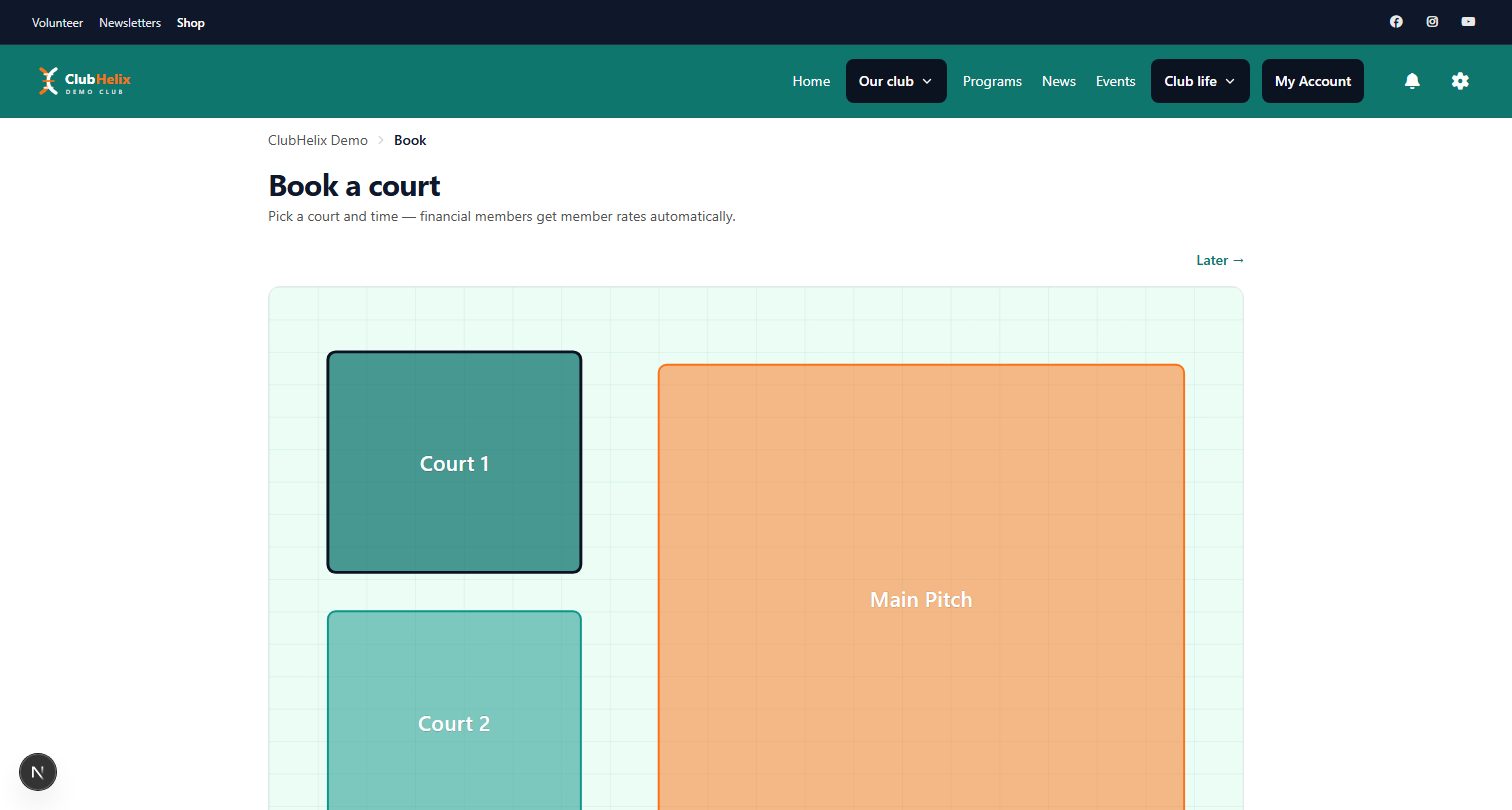
The equestrian version of all this — surfaces, capacity, clinics, paying at the gate — is in our guide to hiring out a riding arena; the same template works for a court, a lane or a room with the bracketed words changed. If your club runs on ClubHelix, the terms link sits in the resource description and the rest is configuration; see pricing or sign up to try it on your own facilities.
Frequently asked questions
Do we really need written terms for an hourly court or arena booking?
Yes, even a short set, because the terms are what let a volunteer act calmly on the day — turning away the unbooked fourth horse, refusing an unpaid booking, closing a waterlogged surface — without it becoming a personal argument. One page is enough; the clauses in this template can be trimmed to eight for a simple hourly facility.
Can we say "no refunds" for cancellations?
A blanket "no refunds under any circumstances" is unenforceable in many places and unfair everywhere, so write a window instead — a full refund before a stated cut-off, payable in full after it, and a full refund whenever the club itself cancels. Check the consumer-law position where you are, and remember that a booking to be paid at the venue and cancelled simply owes nothing.
How do we make sure people actually see the terms?
Link them beside the "book" button, put a one-line summary in the resource description, and link them again in the confirmation email; the confirmation is the document both sides will produce if there is a dispute. Date the terms and keep old versions so you know which terms a booking was made under.
What should we ask people to tell us at booking?
Anything that affects safety or the next booking — a young or difficult horse, a medical condition relevant to the activity, an attendee with additional needs, equipment they plan to bring. A comments box labelled "Anything we should know?" collects it, and clause 7 turns answering it into a duty rather than a courtesy.
Is this template legal advice?
No — it is general information and a starting point, not a substitute for a lawyer reading your terms against your lease, your insurance and the rules where your club is. Insurance, consumer law, alcohol and animal-welfare rules all vary by jurisdiction, so have someone qualified check the final version.
